





惯性聚合 高效追踪和阅读你感兴趣的博客、新闻、科技资讯
阅读原文 在惯性聚合中打开

推荐订阅源

美团技术团队
P
Privacy International News Feed
P
Proofpoint News Feed
Security Archives - TechRepublic
C
CXSECURITY Database RSS Feed - CXSecurity.com
Know Your Adversary
Know Your Adversary
Security Latest
Security Latest
Threat Intelligence Blog | Flashpoint
Attack and Defense Labs
NISL@THU
NISL@THU
cs.AI updates on arXiv.org
W
WeLiveSecurity
GbyAI
GbyAI
N
News and Events Feed by Topic
N
News | PayPal Newsroom
Y
Y Combinator Blog
C
CERT Recently Published Vulnerability Notes
N
Netflix TechBlog - Medium
S
Security Affairs
Spread Privacy
Spread Privacy
罗磊的独立博客
腾讯CDC
MyScale Blog
MyScale Blog
www.infosecurity-magazine.com
L
LINUX DO - 热门话题
The Cloudflare Blog
L
LangChain Blog
博客园_首页
H
Hacker News: Front Page
宝玉的分享
宝玉的分享
Martin Fowler
Martin Fowler
博客园 - 聂微东
SecWiki News
SecWiki News
A
Arctic Wolf
爱范儿
爱范儿
Google Online Security Blog
T
Threat Research - Cisco Blogs
Hacker News - Newest:
Hacker News - Newest: "LLM"
有赞技术团队
有赞技术团队
The GitHub Blog
The GitHub Blog
Cyberwarzone
Cyberwarzone
博客园 - 叶小钗
V
Visual Studio Blog
V
V2EX
T
Tailwind CSS Blog
Project Zero
Project Zero
T
The Blog of Author Tim Ferriss
F
Fortinet All Blogs
MongoDB | Blog
MongoDB | Blog
D
Docker

Hugging Face - Blog

Waypoint-1.5: Higher-Fidelity Interactive Worlds for Everyday GPUs ALTK‑Evolve: On‑the‑Job Learning for AI Agents Safetensors is Joining the PyTorch Foundation Holo3: Breaking the Computer Use Frontier Any Custom Frontend with Gradio's Backend A New Framework for Evaluating Voice Agents (EVA) Bringing Robotics AI to Embedded Platforms: Dataset Recording, VLA Fine‑Tuning, and On‑Device Optimizations One-Shot Any Web App with Gradio's gr.HTML CUGA on Hugging Face: Democratizing Configurable AI Agents New in llama.cpp: Model Management Building Deep Research: How we Achieved State of the Art OVHcloud on Hugging Face Inference Providers 🔥 20x Faster TRL Fine-tuning with RapidFire AI Building for an Open Future - our new partnership with Google Cloud Aligning to What? Rethinking Agent Generalization in MiniMax M2 Building a Healthcare Robot from Simulation to Deployment with NVIDIA Isaac Sentence Transformers is joining Hugging Face! Unlock the power of images with AI Sheets Supercharge your OCR Pipelines with Open Models Google Cloud C4 Brings a 70% TCO improvement on GPT OSS with Intel and Hugging Face Get your VLM running in 3 simple steps on Intel CPUs Nemotron-Personas-India: Synthesized Data for Sovereign AI Introducing RTEB: A New Standard for Retrieval Evaluation Accelerating Qwen3-8B Agent on Intel® Core™ Ultra with Depth-Pruned Draft Models VibeGame: Exploring Vibe Coding Games Nemotron-Personas-Japan: ソブリン AI のための合成データセット Swift Transformers Reaches 1.0 – and Looks to the Future Smol2Operator: Post-Training GUI Agents for Computer Use SyGra: The One-Stop Framework for Building Data for LLMs and SLMs Gaia2 and ARE: Empowering the community to study agents Scaleway on Hugging Face Inference Providers 🔥 Democratizing AI Safety with RiskRubric.ai Public AI on Hugging Face Inference Providers 🔥 `LeRobotDataset:v3.0`: Bringing large-scale datasets to `lerobot` Visible Watermarking with Gradio Introducing the Palmyra-mini family: Powerful, lightweight, and ready to reason! Tricks from OpenAI gpt-oss YOU 🫵 can use with transformers Fine-tune Any LLM from the Hugging Face Hub with Together AI Jupyter Agents: training LLMs to reason with notebooks mmBERT: ModernBERT goes Multilingual Welcome EmbeddingGemma, Google's new efficient embedding model SAIR: Accelerating Pharma R&D with AI-Powered Structural Intelligence Make your ZeroGPU Spaces go brrr with ahead-of-time compilation NVIDIA Releases 6 Million Multi-Lingual Reasoning Dataset Generate Images with Claude and Hugging Face From Zero to GPU: A Guide to Building and Scaling Production-Ready CUDA Kernels MCP for Research: How to Connect AI to Research Tools Kimina-Prover-RL Arm & ExecuTorch 0.7: Bringing Generative AI to the masses Neural Super Sampling is here! TextQuests: How Good are LLMs at Text-Based Video Games? 🇵🇭 FilBench - Can LLMs Understand and Generate Filipino? Introducing AI Sheets: a tool to work with datasets using open AI models! Accelerate ND-Parallel: A guide to Efficient Multi-GPU Training Vision Language Model Alignment in TRL ⚡️ Welcome GPT OSS, the new open-source model family from OpenAI! Measuring Open-Source Llama Nemotron Models on DeepResearch Bench 📚 3LM: A Benchmark for Arabic LLMs in STEM and Code Implementing MCP Servers in Python: An AI Shopping Assistant with Gradio Introducing Trackio: A Lightweight Experiment Tracking Library from Hugging Face Say hello to `hf`: a faster, friendlier Hugging Face CLI ✨ Parquet Content-Defined Chunking TimeScope: How Long Can Your Video Large Multimodal Model Go? Fast LoRA inference for Flux with Diffusers and PEFT Accelerate a World of LLMs on Hugging Face with NVIDIA NIM Arc Virtual Cell Challenge: A Primer Consilium: When Multiple LLMs Collaborate Back to The Future: Evaluating AI Agents on Predicting Future Events Five Big Improvements to Gradio MCP Servers Ettin Suite: SoTA Paired Encoders and Decoders Migrating the Hub from Git LFS to Xet Kimina-Prover: Applying Test-time RL Search on Large Formal Reasoning Models Asynchronous Robot Inference: Decoupling Action Prediction and Execution ScreenEnv: Deploy your full stack Desktop Agent Building the Hugging Face MCP Server Reachy Mini - The Open-Source Robot for Today's and Tomorrow's AI Builders Creating custom kernels for the AMD MI300 Upskill your LLMs With Gradio MCP Servers SmolLM3: smol, multilingual, long-context reasoner Three Mighty Alerts Supporting Hugging Face’s Production Infrastructure Efficient MultiModal Data Pipeline Announcing NeurIPS 2025 E2LM Competition: Early Training Evaluation of Language Models Training and Finetuning Sparse Embedding Models with Sentence Transformers Welcome the NVIDIA Llama Nemotron Nano VLM to Hugging Face Hub Gemma 3n fully available in the open-source ecosystem! Transformers backend integration in SGLang (LoRA) Fine-Tuning FLUX.1-dev on Consumer Hardware Groq on Hugging Face Inference Providers 🔥 How Long Prompts Block Other Requests - Optimizing LLM Performance Learn the Hugging Face Kernel Hub in 5 Minutes Convert Transformers to ONNX with Hugging Face Optimum Intel and Hugging Face Partner to Democratize Machine Learning Hardware Acceleration Director of Machine Learning Insights [Part 3: Finance Edition] The Annotated Diffusion Model Deep Q-Learning with Space Invaders Graphcore and Hugging Face Launch New Lineup of IPU-Ready Transformers Introducing Pull Requests and Discussions 🥳 Efficient Table Pre-training without Real Data: An Introduction to TAPEX An Introduction to Q-Learning Part 2/2 How Sempre Health is leveraging the Expert Acceleration Program to accelerate their ML roadmap
Introducing Optimum: The Optimization Toolkit for Transformers at Scale
2021-09-14 · via Hugging Face - Blog

Back to Articles

Morgan Funtowicz's avatar

Ella Charlaix's avatar

Michael Benayoun's avatar

Jeff Boudier's avatar

This post is the first step of a journey for Hugging Face to democratize state-of-the-art Machine Learning production performance. To get there, we will work hand in hand with our Hardware Partners, as we have with Intel below. Join us in this journey, and follow Optimum, our new open source library!

Why 🤗 Optimum?

🤯 Scaling Transformers is hard

What do Tesla, Google, Microsoft and Facebook all have in common? Well many things, but one of them is they all run billions of Transformer model predictions every day. Transformers for AutoPilot to drive your Tesla (lucky you!), for Gmail to complete your sentences, for Facebook to translate your posts on the fly, for Bing to answer your natural language queries.

Transformers have brought a step change improvement in the accuracy of Machine Learning models, have conquered NLP and are now expanding to other modalities starting with Speech and Vision. But taking these massive models into production, and making them run fast at scale is a huge challenge for any Machine Learning Engineering team.

What if you don’t have hundreds of highly skilled Machine Learning Engineers on payroll like the above companies? Through Optimum, our new open source library, we aim to build the definitive toolkit for Transformers production performance, and enable maximum efficiency to train and run models on specific hardware.

🏭 Optimum puts Transformers to work

To get optimal performance training and serving models, the model acceleration techniques need to be specifically compatible with the targeted hardware. Each hardware platform offers specific software tooling, features and knobs that can have a huge impact on performance. Similarly, to take advantage of advanced model acceleration techniques like sparsity and quantization, optimized kernels need to be compatible with the operators on silicon, and specific to the neural network graph derived from the model architecture. Diving into this 3-dimensional compatibility matrix and how to use model acceleration libraries is daunting work, which few Machine Learning Engineers have experience on.

Optimum aims to make this work easy, providing performance optimization tools targeting efficient AI hardware, built in collaboration with our Hardware Partners, and turn Machine Learning Engineers into ML Optimization wizards.

With the Transformers library, we made it easy for researchers and engineers to use state-of-the-art models, abstracting away the complexity of frameworks, architectures and pipelines.

With the Optimum library, we are making it easy for engineers to leverage all the available hardware features at their disposal, abstracting away the complexity of model acceleration on hardware platforms.

🤗 Optimum in practice: how to quantize a model for Intel Xeon CPU

🤔 Why quantization is important but tricky to get right

Pre-trained language models such as BERT have achieved state-of-the-art results on a wide range of natural language processing tasks, other Transformer based models such as ViT and Speech2Text have achieved state-of-the-art results on computer vision and speech tasks respectively: transformers are everywhere in the Machine Learning world and are here to stay.

However, putting transformer-based models into production can be tricky and expensive as they need a lot of compute power to work. To solve this many techniques exist, the most popular being quantization. Unfortunately, in most cases quantizing a model requires a lot of work, for many reasons:

  1. The model needs to be edited: some ops need to be replaced by their quantized counterparts, new ops need to be inserted (quantization and dequantization nodes), and others need to be adapted to the fact that weights and activations will be quantized.

This part can be very time-consuming because frameworks such as PyTorch work in eager mode, meaning that the changes mentioned above need to be added to the model implementation itself. PyTorch now provides a tool called torch.fx that allows you to trace and transform your model without having to actually change the model implementation, but it is tricky to use when tracing is not supported for your model out of the box.

On top of the actual editing, it is also necessary to find which parts of the model need to be edited, which ops have an available quantized kernel counterpart and which ops don't, and so on.

  1. Once the model has been edited, there are many parameters to play with to find the best quantization settings:

    • Which kind of observers should I use for range calibration?
    • Which quantization scheme should I use?
    • Which quantization related data types (int8, uint8, int16) are supported on my target device?
  2. Balance the trade-off between quantization and an acceptable accuracy loss.

  3. Export the quantized model for the target device.

Although PyTorch and TensorFlow made great progress in making things easy for quantization, the complexities of transformer based models makes it hard to use the provided tools out of the box and get something working without putting up a ton of effort.

💡 How Intel is solving quantization and more with Neural Compressor

Intel® Neural Compressor (formerly referred to as Low Precision Optimization Tool or LPOT) is an open-source python library designed to help users deploy low-precision inference solutions. The latter applies low-precision recipes for deep-learning models to achieve optimal product objectives, such as inference performance and memory usage, with expected performance criteria. Neural Compressor supports post-training quantization, quantization-aware training and dynamic quantization. In order to specify the quantization approach, objective and performance criteria, the user must provide a configuration yaml file specifying the tuning parameters. The configuration file can either be hosted on the Hugging Face's Model Hub or can be given through a local directory path.
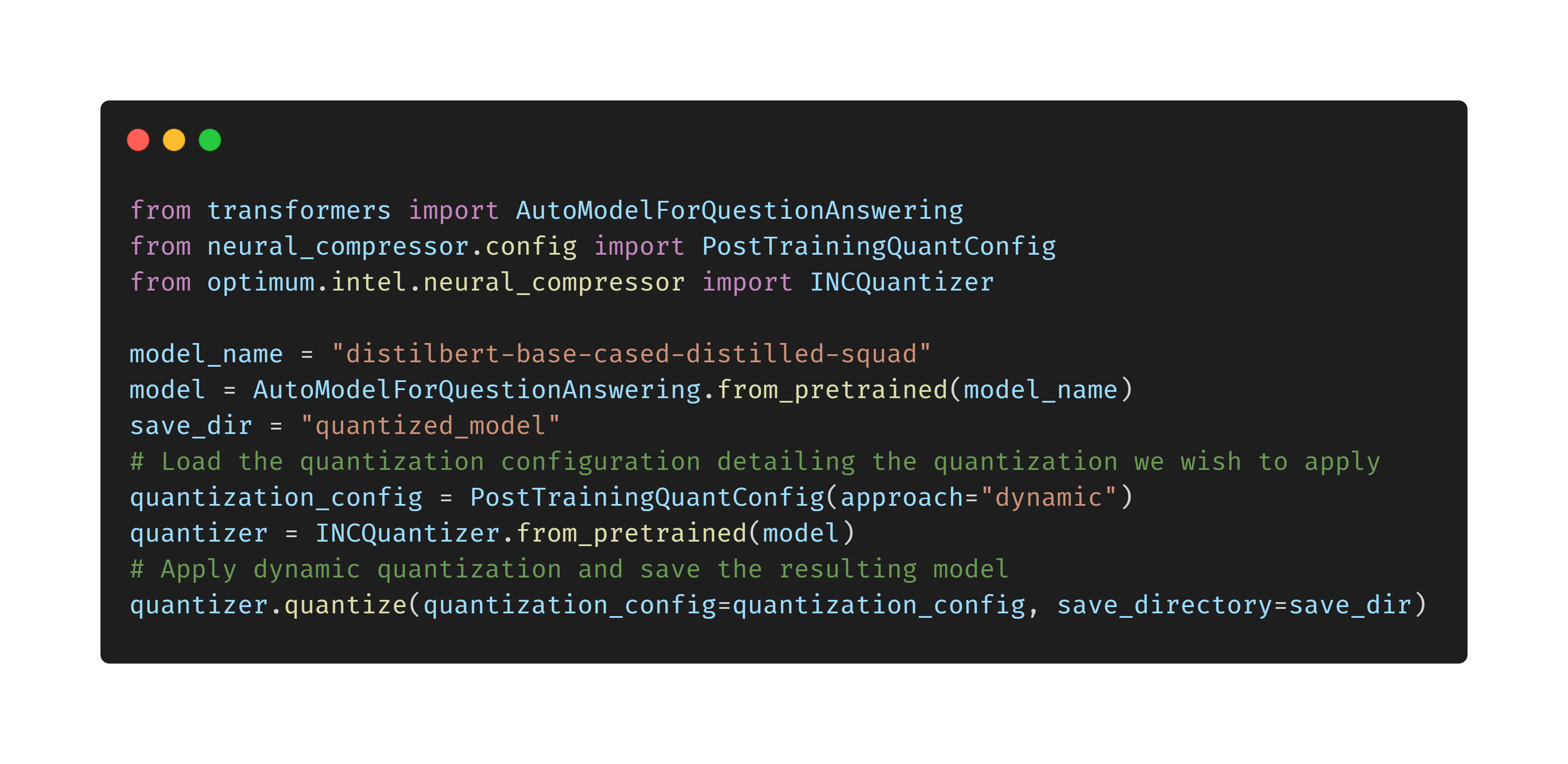
🔥 How to easily quantize Transformers for Intel Xeon CPUs with Optimum

Automatic quantization code snippet

Follow 🤗 Optimum: a journey to democratize ML production performance

⚡️State of the Art Hardware

Optimum will focus on achieving optimal production performance on dedicated hardware, where software and hardware acceleration techniques can be applied for maximum efficiency. We will work hand in hand with our Hardware Partners to enable, test and maintain acceleration, and deliver it in an easy and accessible way through Optimum, as we did with Intel and Neural Compressor. We will soon announce new Hardware Partners who have joined us on our journey toward Machine Learning efficiency.

🔮 State-of-the-Art Models

The collaboration with our Hardware Partners will yield hardware-specific optimized model configurations and artifacts, which we will make available to the AI community via the Hugging Face Model Hub. We hope that Optimum and hardware-optimized models will accelerate the adoption of efficiency in production workloads, which represent most of the aggregate energy spent on Machine Learning. And most of all, we hope that Optimum will accelerate the adoption of Transformers at scale, not just for the biggest tech companies, but for all of us.

🌟 A journey of collaboration: join us, follow our progress

Every journey starts with a first step, and ours was the public release of Optimum. Join us and make your first step by giving the library a Star, so you can follow along as we introduce new supported hardware, acceleration techniques and optimized models.

If you would like to see new hardware and features be supported in Optimum, or you are interested in joining us to work at the intersection of software and hardware, please reach out to us at hardware@huggingface.co