



惯性聚合 高效追踪和阅读你感兴趣的博客、新闻、科技资讯
阅读原文 在惯性聚合中打开

推荐订阅源

Scott Helme
Scott Helme
宝玉的分享
宝玉的分享
B
Blog RSS Feed
博客园 - 司徒正美
Stack Overflow Blog
Stack Overflow Blog
博客园_首页
H
Help Net Security
T
The Blog of Author Tim Ferriss
让小产品的独立变现更简单 - ezindie.com
月光博客
月光博客
F
Full Disclosure
爱范儿
爱范儿
罗磊的独立博客
G
Google Developers Blog
Last Week in AI
Last Week in AI
Jina AI
Jina AI
量子位
Hacker News: Ask HN
Hacker News: Ask HN
aimingoo的专栏
aimingoo的专栏
PCI Perspectives
PCI Perspectives
酷 壳 – CoolShell
酷 壳 – CoolShell
Application and Cybersecurity Blog
S
Secure Thoughts
L
LINUX DO - 最新话题
Exploit-DB.com RSS Feed
Project Zero
Project Zero
云风的 BLOG
云风的 BLOG
V
V2EX
H
Heimdal Security Blog
Engineering at Meta
Engineering at Meta
I
InfoQ
D
Darknet – Hacking Tools, Hacker News & Cyber Security
Hugging Face - Blog
Hugging Face - Blog
博客园 - 聂微东
S
Security Affairs
Security Archives - TechRepublic
Cyberwarzone
Cyberwarzone
G
GRAHAM CLULEY
Apple Machine Learning Research
The GitHub Blog
The GitHub Blog
T
Tor Project blog
Recent Commits to openclaw:main
Attack and Defense Labs
Know Your Adversary
Know Your Adversary
CTFtime.org: upcoming CTF events
D
Docker
Vercel News
Vercel News
Cyber Security Advisories - MS-ISAC
有赞技术团队
有赞技术团队
J
Java Code Geeks

Hugging Face - Blog

Waypoint-1.5: Higher-Fidelity Interactive Worlds for Everyday GPUs ALTK‑Evolve: On‑the‑Job Learning for AI Agents Safetensors is Joining the PyTorch Foundation Holo3: Breaking the Computer Use Frontier Any Custom Frontend with Gradio's Backend A New Framework for Evaluating Voice Agents (EVA) Bringing Robotics AI to Embedded Platforms: Dataset Recording, VLA Fine‑Tuning, and On‑Device Optimizations One-Shot Any Web App with Gradio's gr.HTML CUGA on Hugging Face: Democratizing Configurable AI Agents New in llama.cpp: Model Management Building Deep Research: How we Achieved State of the Art OVHcloud on Hugging Face Inference Providers 🔥 20x Faster TRL Fine-tuning with RapidFire AI Building for an Open Future - our new partnership with Google Cloud Aligning to What? Rethinking Agent Generalization in MiniMax M2 Building a Healthcare Robot from Simulation to Deployment with NVIDIA Isaac Sentence Transformers is joining Hugging Face! Unlock the power of images with AI Sheets Supercharge your OCR Pipelines with Open Models Google Cloud C4 Brings a 70% TCO improvement on GPT OSS with Intel and Hugging Face Get your VLM running in 3 simple steps on Intel CPUs Nemotron-Personas-India: Synthesized Data for Sovereign AI Introducing RTEB: A New Standard for Retrieval Evaluation Accelerating Qwen3-8B Agent on Intel® Core™ Ultra with Depth-Pruned Draft Models VibeGame: Exploring Vibe Coding Games Nemotron-Personas-Japan: ソブリン AI のための合成データセット Swift Transformers Reaches 1.0 – and Looks to the Future Smol2Operator: Post-Training GUI Agents for Computer Use SyGra: The One-Stop Framework for Building Data for LLMs and SLMs Gaia2 and ARE: Empowering the community to study agents Scaleway on Hugging Face Inference Providers 🔥 Democratizing AI Safety with RiskRubric.ai Public AI on Hugging Face Inference Providers 🔥 `LeRobotDataset:v3.0`: Bringing large-scale datasets to `lerobot` Visible Watermarking with Gradio Introducing the Palmyra-mini family: Powerful, lightweight, and ready to reason! Tricks from OpenAI gpt-oss YOU 🫵 can use with transformers Fine-tune Any LLM from the Hugging Face Hub with Together AI Jupyter Agents: training LLMs to reason with notebooks mmBERT: ModernBERT goes Multilingual Welcome EmbeddingGemma, Google's new efficient embedding model SAIR: Accelerating Pharma R&D with AI-Powered Structural Intelligence Make your ZeroGPU Spaces go brrr with ahead-of-time compilation NVIDIA Releases 6 Million Multi-Lingual Reasoning Dataset Generate Images with Claude and Hugging Face From Zero to GPU: A Guide to Building and Scaling Production-Ready CUDA Kernels MCP for Research: How to Connect AI to Research Tools Kimina-Prover-RL Arm & ExecuTorch 0.7: Bringing Generative AI to the masses Neural Super Sampling is here! TextQuests: How Good are LLMs at Text-Based Video Games? 🇵🇭 FilBench - Can LLMs Understand and Generate Filipino? Introducing AI Sheets: a tool to work with datasets using open AI models! Accelerate ND-Parallel: A guide to Efficient Multi-GPU Training Vision Language Model Alignment in TRL ⚡️ Welcome GPT OSS, the new open-source model family from OpenAI! Measuring Open-Source Llama Nemotron Models on DeepResearch Bench 📚 3LM: A Benchmark for Arabic LLMs in STEM and Code Implementing MCP Servers in Python: An AI Shopping Assistant with Gradio Introducing Trackio: A Lightweight Experiment Tracking Library from Hugging Face Say hello to `hf`: a faster, friendlier Hugging Face CLI ✨ Parquet Content-Defined Chunking TimeScope: How Long Can Your Video Large Multimodal Model Go? Fast LoRA inference for Flux with Diffusers and PEFT Accelerate a World of LLMs on Hugging Face with NVIDIA NIM Arc Virtual Cell Challenge: A Primer Consilium: When Multiple LLMs Collaborate Back to The Future: Evaluating AI Agents on Predicting Future Events Five Big Improvements to Gradio MCP Servers Ettin Suite: SoTA Paired Encoders and Decoders Migrating the Hub from Git LFS to Xet Kimina-Prover: Applying Test-time RL Search on Large Formal Reasoning Models Asynchronous Robot Inference: Decoupling Action Prediction and Execution ScreenEnv: Deploy your full stack Desktop Agent Building the Hugging Face MCP Server Reachy Mini - The Open-Source Robot for Today's and Tomorrow's AI Builders Creating custom kernels for the AMD MI300 Upskill your LLMs With Gradio MCP Servers SmolLM3: smol, multilingual, long-context reasoner Three Mighty Alerts Supporting Hugging Face’s Production Infrastructure Efficient MultiModal Data Pipeline Announcing NeurIPS 2025 E2LM Competition: Early Training Evaluation of Language Models Training and Finetuning Sparse Embedding Models with Sentence Transformers Welcome the NVIDIA Llama Nemotron Nano VLM to Hugging Face Hub Gemma 3n fully available in the open-source ecosystem! Transformers backend integration in SGLang (LoRA) Fine-Tuning FLUX.1-dev on Consumer Hardware Groq on Hugging Face Inference Providers 🔥 How Long Prompts Block Other Requests - Optimizing LLM Performance Learn the Hugging Face Kernel Hub in 5 Minutes Convert Transformers to ONNX with Hugging Face Optimum Intel and Hugging Face Partner to Democratize Machine Learning Hardware Acceleration Director of Machine Learning Insights [Part 3: Finance Edition] The Annotated Diffusion Model Deep Q-Learning with Space Invaders Graphcore and Hugging Face Launch New Lineup of IPU-Ready Transformers Introducing Pull Requests and Discussions 🥳 Efficient Table Pre-training without Real Data: An Introduction to TAPEX An Introduction to Q-Learning Part 2/2 How Sempre Health is leveraging the Expert Acceleration Program to accelerate their ML roadmap
Retrieval Augmented Generation with Huggingface Transformers and Ray
system · 2021-02-10 · via Hugging Face - Blog

Back to Articles

system's avatar

A guest blog post by Amog Kamsetty from the Anyscale team

Huggingface Transformers recently added the Retrieval Augmented Generation (RAG) model, a new NLP architecture that leverages external documents (like Wikipedia) to augment its knowledge and achieve state of the art results on knowledge-intensive tasks. In this blog post, we introduce the integration of Ray, a library for building scalable applications, into the RAG contextual document retrieval mechanism. This speeds up retrieval calls by 2x and improves the scalability of RAG distributed fine-tuning.
What is Retrieval Augmented Generation (RAG)?

alt_text

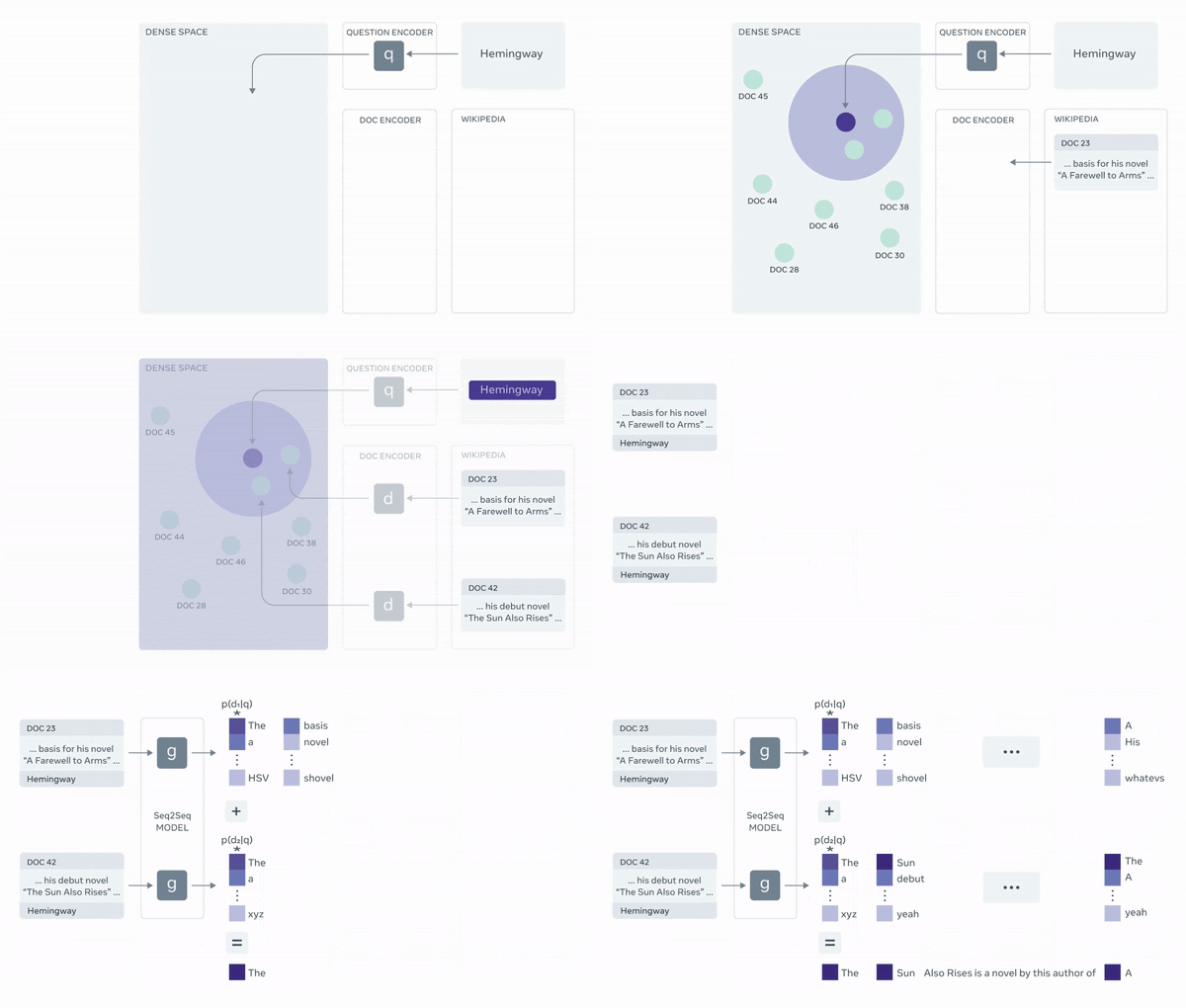
An overview of RAG. The model retrieves contextual documents from an external dataset as part of its execution. These contextual documents are used in conjunction with the original input to produce an output. The GIF is taken from Facebook's original blog post.

Recently, Huggingface partnered with Facebook AI to introduce the RAG model as part of its Transformers library.

RAG acts just like any other seq2seq model. However, RAG has an intermediate component that retrieves contextual documents from an external knowledge base (like a Wikipedia text corpus). These documents are then used in conjunction with the input sequence and passed into the underlying seq2seq generator.

This information retrieval step allows RAG to make use of multiple sources of knowledge -- those that are baked into the model parameters and the information that is contained in the contextual passages, allowing it to outperform other state-of-the-art models in tasks like question answering. You can try it for yourself using this demo provided by Huggingface!

Scaling up fine-tuning

This retrieval of contextual documents is crucial for RAG's state-of-the-art results but introduces an extra layer of complexity. When scaling up the training process via a data-parallel training routine, a naive implementation of the document lookup can become a bottleneck for training. Further, the document index used in the retrieval component is often quite large, making it infeasible for each training worker to load its own replicated copy of the index.

The previous implementation of RAG fine-tuning leveraged the torch.distributed communication package for the document retrieval portion. However, this implementation sometimes proved to be inflexible and limited in scalability.

Instead, a framework-agnostic and a more flexible implementation for ad-hoc concurrent programming is required. Ray fits the bill perfectly. Ray is a simple, yet powerful Python library for general-purpose distributed and parallel programming. Using Ray for distributed document retrieval, we achieved a 2x speedup per retrieval call compared to torch.distributed, and overall better fine-tuning scalability.
Ray for Document Retrieval

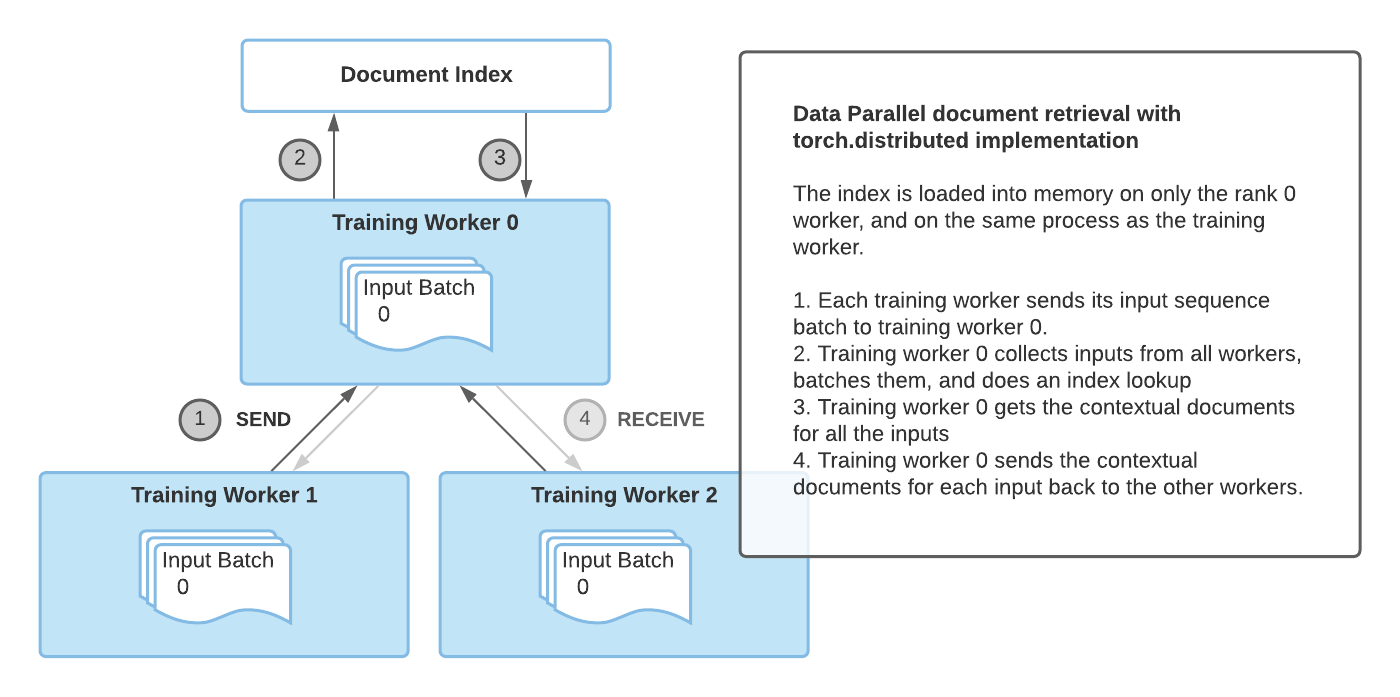
alt_text Document retrieval with the torch.distributed implementation

The main drawback of the torch.distributed implementation for document retrieval was that it latched onto the same process group used for training and only the rank 0 training worker loaded the index into memory.

As a result, this implementation had some limitations:
  1. Synchronization bottleneck: The rank 0 worker had to receive the inputs from all workers, perform the index query, and then send the results back to the other workers. This limited performance with multiple training workers.
  2. PyTorch specific: The document retrieval process group had to latch onto the existing process group used for training, meaning that PyTorch had to be used for training as well.

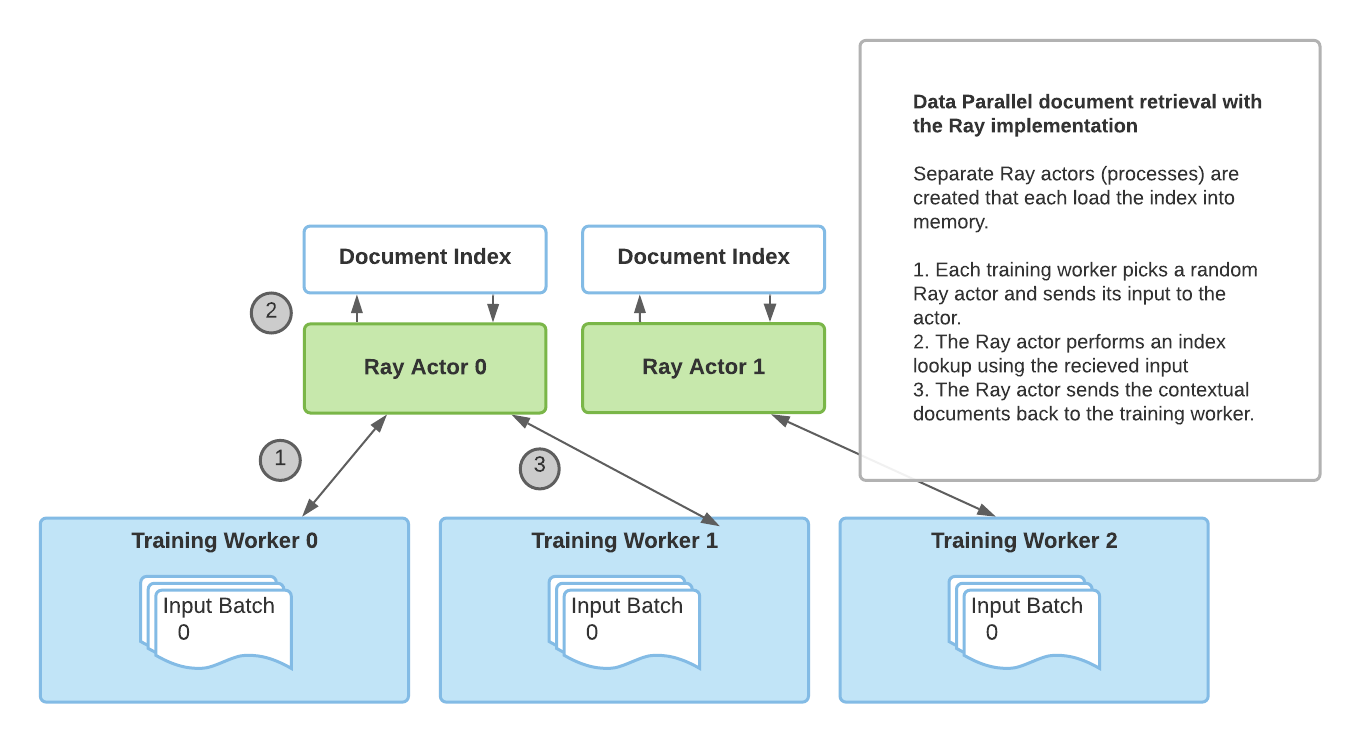
alt_text Document retrieval with the Ray implementation

To overcome these limitations, we introduced a novel implementation of distributed retrieval based on Ray. With Ray’s stateful actor abstractions, multiple processes that are separate from the training processes are used to load the index and handle the retrieval queries. With multiple Ray actors, retrieval is no longer a bottleneck and PyTorch is no longer a requirement for RAG.

And as you can see below, using the Ray based implementation leads to better retrieval performance for multi-GPU fine-tuning. The following results show the seconds per retrieval call and we can see that as we increase the number of GPUs that we train on, using Ray has comparatively better performance than torch.distributed. Also, if we increase the number of Ray processes that perform retrieval, we also get better performance with more training workers since a single retrieval process is no longer a bottleneck.

2 GPU 3 GPU 4 GPU
torch.distributed 2.12 sec/retrieval 2.62 sec/retrieve 3.438 sec/retrieve
Ray 2 retrieval processes 1.49 sec/retrieve 1.539 sec/retrieve 2.029 sec/retrieve
Ray 4 retrieval processes 1.145 sec/retrieve 1.484 sec/retrieve 1.66 sec/retrieve

A performance comparison of different retrieval implementations. For each document retrieval implementation, we run 500 training steps with a per-GPU batch size of 8, and measure the time it takes to retrieve the contextual documents for each batch on the rank 0 training worker. As the results show, using multiple retrieval processes improves performance, especially as we scale training to multiple GPUs.

How do I use it?

Huggingface provides a PyTorch Lightning based fine tuning script, and we extended it to add the Ray retrieval implementation as an option.

To try it out, first install the necessary requirements

pip install ray
pip install transformers
pip install -r transformers/examples/research_projects/rag/requirements.txt

Then, you can specify your data paths and other configurations and run finetune-rag-ray.sh!

# Sample script to finetune RAG using Ray for distributed retrieval.

# Add parent directory to python path to access lightning_base.py
export PYTHONPATH="../":"${PYTHONPATH}"

# Start a single-node Ray cluster.
ray start --head

# A sample finetuning run, you need to specify data_dir, output_dir and model_name_or_path
# run ./examples/rag/finetune_rag_ray.sh --help to see all the possible options

python examples/rag/finetune_rag.py \
    --data_dir $DATA_DIR \
    --output_dir $OUTPUT_DIR \
    --model_name_or_path $MODEL_NAME_OR_PATH \
    --model_type rag_sequence \
    --fp16 \
    --gpus 8 \
    --profile \
    --do_train \
    --do_predict \
    --n_val -1 \
    --train_batch_size 8 \
    --eval_batch_size 1 \
    --max_source_length 128 \
    --max_target_length 25 \
    --val_max_target_length 25 \
    --test_max_target_length 25 \
    --label_smoothing 0.1 \
    --dropout 0.1 \
    --attention_dropout 0.1 \
    --weight_decay 0.001 \
    --adam_epsilon 1e-08 \
    --max_grad_norm 0.1 \
    --lr_scheduler polynomial \
    --learning_rate 3e-05 \
    --num_train_epochs 100 \
    --warmup_steps 500 \
    --gradient_accumulation_steps 1 \
    --distributed_retriever ray \
    --num_retrieval_workers 4

# Stop the Ray cluster.
ray stop

What’s next?

Using RAG with Huggingface transformers and the Ray retrieval implementation for faster distributed fine-tuning, you can leverage RAG for retrieval-based generation on your own knowledge-intensive tasks.

Also, hyperparameter tuning is another aspect of transformer fine tuning and can have huge impacts on accuracy. For scalable and easy hyperparameter tuning, check out the Ray Tune library. By using Ray Tune’s integration with PyTorch Lightning, or the built-in integration with Huggingface transformers, you can run experiments to find the perfect hyperparameters for your RAG model.

And lastly, stay tuned for a potential Tensorflow implementation of RAG on Huggingface!

If you plan to try RAG+Ray integration out, please feel free to share your experiences on the Ray Discourse or join the Ray community Slack for further discussion -- we’d love to hear from you!

Also published at https://medium.com/distributed-computing-with-ray/retrieval-augmented-generation-with-huggingface-transformers-and-ray-b09b56161b1e