





惯性聚合 高效追踪和阅读你感兴趣的博客、新闻、科技资讯
阅读原文 在惯性聚合中打开

推荐订阅源

小众软件
小众软件
IT之家
IT之家
钛媒体:引领未来商业与生活新知
钛媒体:引领未来商业与生活新知
Security Archives - TechRepublic
P
Proofpoint News Feed
C
CERT Recently Published Vulnerability Notes
阮一峰的网络日志
阮一峰的网络日志
OSCHINA 社区最新新闻
OSCHINA 社区最新新闻
The Cloudflare Blog
P
Palo Alto Networks Blog
Know Your Adversary
Know Your Adversary
D
Darknet – Hacking Tools, Hacker News & Cyber Security
Cisco Talos Blog
Cisco Talos Blog
L
Lohrmann on Cybersecurity
AWS News Blog
AWS News Blog
J
Java Code Geeks
博客园_首页
Scott Helme
Scott Helme
WordPress大学
WordPress大学
有赞技术团队
有赞技术团队
T
The Exploit Database - CXSecurity.com
Security Latest
Security Latest
V
Visual Studio Blog
Cloudbric
Cloudbric
Jina AI
Jina AI
K
KPMG report finds enterprise disconnect between AI and its ROI | CIO
博客园 - 叶小钗
Apple Machine Learning Research
博客园 - 聂微东
人人都是产品经理
人人都是产品经理
A
Arctic Wolf
C
Cybersecurity and Infrastructure Security Agency CISA
S
SegmentFault 最新的问题
The Last Watchdog
The Last Watchdog
SecWiki News
SecWiki News
cs.CV updates on arXiv.org
W
WeLiveSecurity
K
Kaspersky official blog
让小产品的独立变现更简单 - ezindie.com
Hacker News: Ask HN
Hacker News: Ask HN
cs.CL updates on arXiv.org
freeCodeCamp Programming Tutorials: Python, JavaScript, Git & More
宝玉的分享
宝玉的分享
Hugging Face - Blog
Hugging Face - Blog
量子位
Google Online Security Blog
博客园 - Franky
Simon Willison's Weblog
博客园 - 三生石上(FineUI控件)
Recent Commits to openclaw:main

Hugging Face - Blog

Waypoint-1.5: Higher-Fidelity Interactive Worlds for Everyday GPUs ALTK‑Evolve: On‑the‑Job Learning for AI Agents Safetensors is Joining the PyTorch Foundation Holo3: Breaking the Computer Use Frontier Any Custom Frontend with Gradio's Backend A New Framework for Evaluating Voice Agents (EVA) Bringing Robotics AI to Embedded Platforms: Dataset Recording, VLA Fine‑Tuning, and On‑Device Optimizations One-Shot Any Web App with Gradio's gr.HTML CUGA on Hugging Face: Democratizing Configurable AI Agents New in llama.cpp: Model Management Building Deep Research: How we Achieved State of the Art OVHcloud on Hugging Face Inference Providers 🔥 20x Faster TRL Fine-tuning with RapidFire AI Building for an Open Future - our new partnership with Google Cloud Aligning to What? Rethinking Agent Generalization in MiniMax M2 Building a Healthcare Robot from Simulation to Deployment with NVIDIA Isaac Sentence Transformers is joining Hugging Face! Unlock the power of images with AI Sheets Supercharge your OCR Pipelines with Open Models Google Cloud C4 Brings a 70% TCO improvement on GPT OSS with Intel and Hugging Face Get your VLM running in 3 simple steps on Intel CPUs Nemotron-Personas-India: Synthesized Data for Sovereign AI Introducing RTEB: A New Standard for Retrieval Evaluation Accelerating Qwen3-8B Agent on Intel® Core™ Ultra with Depth-Pruned Draft Models VibeGame: Exploring Vibe Coding Games Nemotron-Personas-Japan: ソブリン AI のための合成データセット Swift Transformers Reaches 1.0 – and Looks to the Future Smol2Operator: Post-Training GUI Agents for Computer Use SyGra: The One-Stop Framework for Building Data for LLMs and SLMs Gaia2 and ARE: Empowering the community to study agents Scaleway on Hugging Face Inference Providers 🔥 Democratizing AI Safety with RiskRubric.ai Public AI on Hugging Face Inference Providers 🔥 `LeRobotDataset:v3.0`: Bringing large-scale datasets to `lerobot` Visible Watermarking with Gradio Introducing the Palmyra-mini family: Powerful, lightweight, and ready to reason! Tricks from OpenAI gpt-oss YOU 🫵 can use with transformers Fine-tune Any LLM from the Hugging Face Hub with Together AI Jupyter Agents: training LLMs to reason with notebooks mmBERT: ModernBERT goes Multilingual Welcome EmbeddingGemma, Google's new efficient embedding model SAIR: Accelerating Pharma R&D with AI-Powered Structural Intelligence Make your ZeroGPU Spaces go brrr with ahead-of-time compilation NVIDIA Releases 6 Million Multi-Lingual Reasoning Dataset Generate Images with Claude and Hugging Face From Zero to GPU: A Guide to Building and Scaling Production-Ready CUDA Kernels MCP for Research: How to Connect AI to Research Tools Kimina-Prover-RL Arm & ExecuTorch 0.7: Bringing Generative AI to the masses Neural Super Sampling is here! TextQuests: How Good are LLMs at Text-Based Video Games? 🇵🇭 FilBench - Can LLMs Understand and Generate Filipino? Introducing AI Sheets: a tool to work with datasets using open AI models! Accelerate ND-Parallel: A guide to Efficient Multi-GPU Training Vision Language Model Alignment in TRL ⚡️ Welcome GPT OSS, the new open-source model family from OpenAI! Measuring Open-Source Llama Nemotron Models on DeepResearch Bench 📚 3LM: A Benchmark for Arabic LLMs in STEM and Code Implementing MCP Servers in Python: An AI Shopping Assistant with Gradio Introducing Trackio: A Lightweight Experiment Tracking Library from Hugging Face Say hello to `hf`: a faster, friendlier Hugging Face CLI ✨ Parquet Content-Defined Chunking TimeScope: How Long Can Your Video Large Multimodal Model Go? Fast LoRA inference for Flux with Diffusers and PEFT Accelerate a World of LLMs on Hugging Face with NVIDIA NIM Arc Virtual Cell Challenge: A Primer Consilium: When Multiple LLMs Collaborate Back to The Future: Evaluating AI Agents on Predicting Future Events Five Big Improvements to Gradio MCP Servers Ettin Suite: SoTA Paired Encoders and Decoders Migrating the Hub from Git LFS to Xet Kimina-Prover: Applying Test-time RL Search on Large Formal Reasoning Models Asynchronous Robot Inference: Decoupling Action Prediction and Execution ScreenEnv: Deploy your full stack Desktop Agent Building the Hugging Face MCP Server Reachy Mini - The Open-Source Robot for Today's and Tomorrow's AI Builders Creating custom kernels for the AMD MI300 Upskill your LLMs With Gradio MCP Servers SmolLM3: smol, multilingual, long-context reasoner Three Mighty Alerts Supporting Hugging Face’s Production Infrastructure Efficient MultiModal Data Pipeline Announcing NeurIPS 2025 E2LM Competition: Early Training Evaluation of Language Models Training and Finetuning Sparse Embedding Models with Sentence Transformers Welcome the NVIDIA Llama Nemotron Nano VLM to Hugging Face Hub Gemma 3n fully available in the open-source ecosystem! Transformers backend integration in SGLang (LoRA) Fine-Tuning FLUX.1-dev on Consumer Hardware Groq on Hugging Face Inference Providers 🔥 How Long Prompts Block Other Requests - Optimizing LLM Performance Learn the Hugging Face Kernel Hub in 5 Minutes Convert Transformers to ONNX with Hugging Face Optimum Intel and Hugging Face Partner to Democratize Machine Learning Hardware Acceleration Director of Machine Learning Insights [Part 3: Finance Edition] The Annotated Diffusion Model Deep Q-Learning with Space Invaders Graphcore and Hugging Face Launch New Lineup of IPU-Ready Transformers Introducing Pull Requests and Discussions 🥳 Efficient Table Pre-training without Real Data: An Introduction to TAPEX An Introduction to Q-Learning Part 2/2 How Sempre Health is leveraging the Expert Acceleration Program to accelerate their ML roadmap
Universal Image Segmentation with Mask2Former and OneFormer
Niels Rogge, Shivalika Singh, Alara Dirik · 2023-01-19 · via Hugging Face - Blog

Back to Articles

Niels Rogge's avatar

Shivalika Singh's avatar

Alara Dirik's avatar

This article is also available in Chinese 简体中文.

This guide introduces Mask2Former and OneFormer, 2 state-of-the-art neural networks for image segmentation. The models are now available in 🤗 transformers, an open-source library that offers easy-to-use implementations of state-of-the-art models. Along the way, you'll learn about the difference between the various forms of image segmentation.

Image segmentation

Image segmentation is the task of identifying different "segments" in an image, like people or cars. More technically, image segmentation is the task of grouping pixels with different semantics. Refer to the Hugging Face task page for a brief introduction.

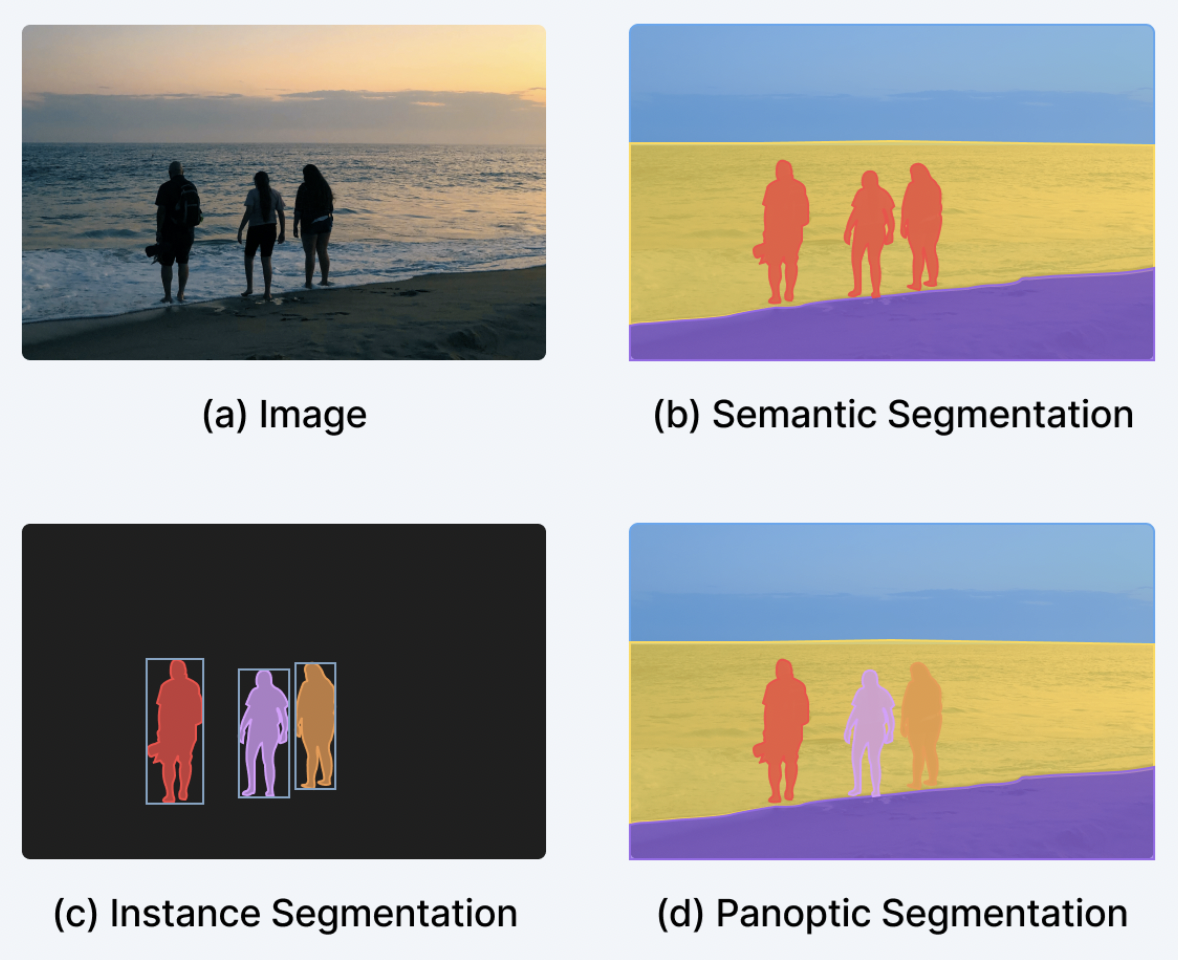
Image segmentation can largely be split into 3 subtasks - instance, semantic and panoptic segmentation - with numerous methods and model architectures to perform each subtask.

  • instance segmentation is the task of identifying different "instances", like individual people, in an image. Instance segmentation is very similar to object detection, except that we'd like to output a set of binary segmentation masks, rather than bounding boxes, with corresponding class labels. Instances are oftentimes also called "objects" or "things". Note that individual instances may overlap.
  • semantic segmentation is the task of identifying different "semantic categories", like "person" or "sky" of each pixel in an image. Contrary to instance segmentation, no distinction is made between individual instances of a given semantic category; one just likes to come up with a mask for the "person" category, rather than for the individual people for example. Semantic categories which don't have individual instances, like "sky" or "grass", are oftentimes referred to as "stuff", to make the distinction with "things" (great names, huh?). Note that no overlap between semantic categories is possible, as each pixel belongs to one category.
  • panoptic segmentation, introduced in 2018 by Kirillov et al., aims to unify instance and semantic segmentation, by making models simply identify a set of "segments", each with a corresponding binary mask and class label. Segments can be both "things" or "stuff". Unlike in instance segmentation, no overlap between different segments is possible.

The figure below illustrates the difference between the 3 subtasks (taken from this blog post).
drawing

Over the last years, researchers have come up with several architectures that were typically very tailored to either instance, semantic or panoptic segmentation. Instance and panoptic segmentation were typically solved by outputting a set of binary masks + corresponding labels per object instance (very similar to object detection, except that one outputs a binary mask instead of a bounding box per instance). This is oftentimes called "binary mask classification". Semantic segmentation on the other hand was typically solved by making models output a single "segmentation map" with one label per pixel. Hence, semantic segmentation was treated as a "per-pixel classification" problem. Popular semantic segmentation models which adopt this paradigm are SegFormer, on which we wrote an extensive blog post, and UPerNet.

Universal image segmentation

Luckily, since around 2020, people started to come up with models that can solve all 3 tasks (instance, semantic and panoptic segmentation) with a unified architecture, using the same paradigm. This started with DETR, which was the first model that solved panoptic segmentation using a "binary mask classification" paradigm, by treating "things" and "stuff" classes in a unified way. The key innovation was to have a Transformer decoder come up with a set of binary masks + classes in a parallel way. This was then improved in the MaskFormer paper, which showed that the "binary mask classification" paradigm also works really well for semantic segmentation.

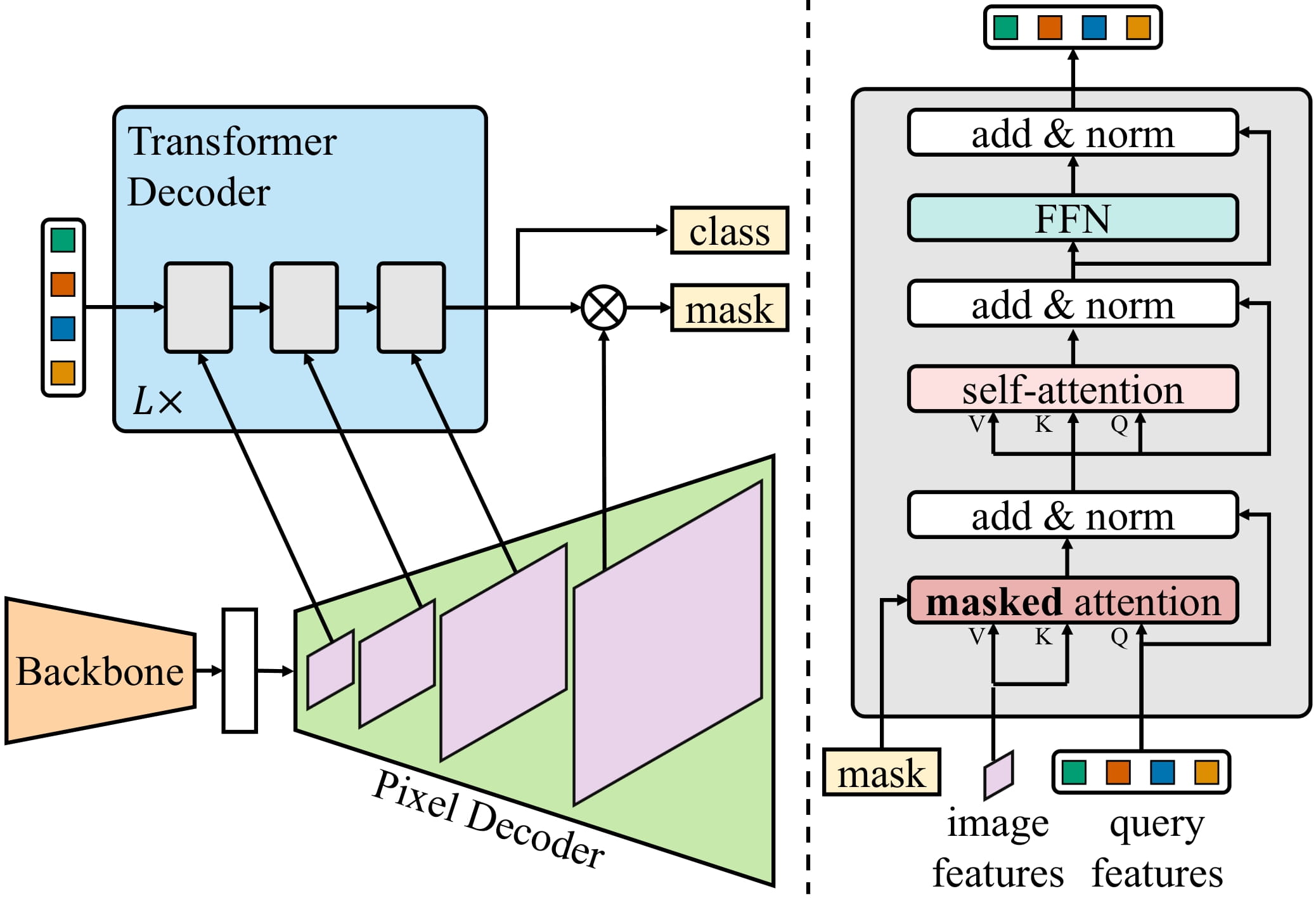
Mask2Former extends this to instance segmentation by further improving the neural network architecture. Hence, we've evolved from separate architectures to what researchers now refer to as "universal image segmentation" architectures, capable of solving any image segmentation task. Interestingly, these universal models all adopt the "mask classification" paradigm, discarding the "per-pixel classification" paradigm entirely. A figure illustrating Mask2Former's architecture is depicted below (taken from the original paper).
drawing

In short, an image is first sent through a backbone (which, in the paper could be either ResNet or Swin Transformer) to get a list of low-resolution feature maps. Next, these feature maps are enhanced using a pixel decoder module to get high-resolution features. Finally, a Transformer decoder takes in a set of queries and transforms them into a set of binary mask and class predictions, conditioned on the pixel decoder's features.

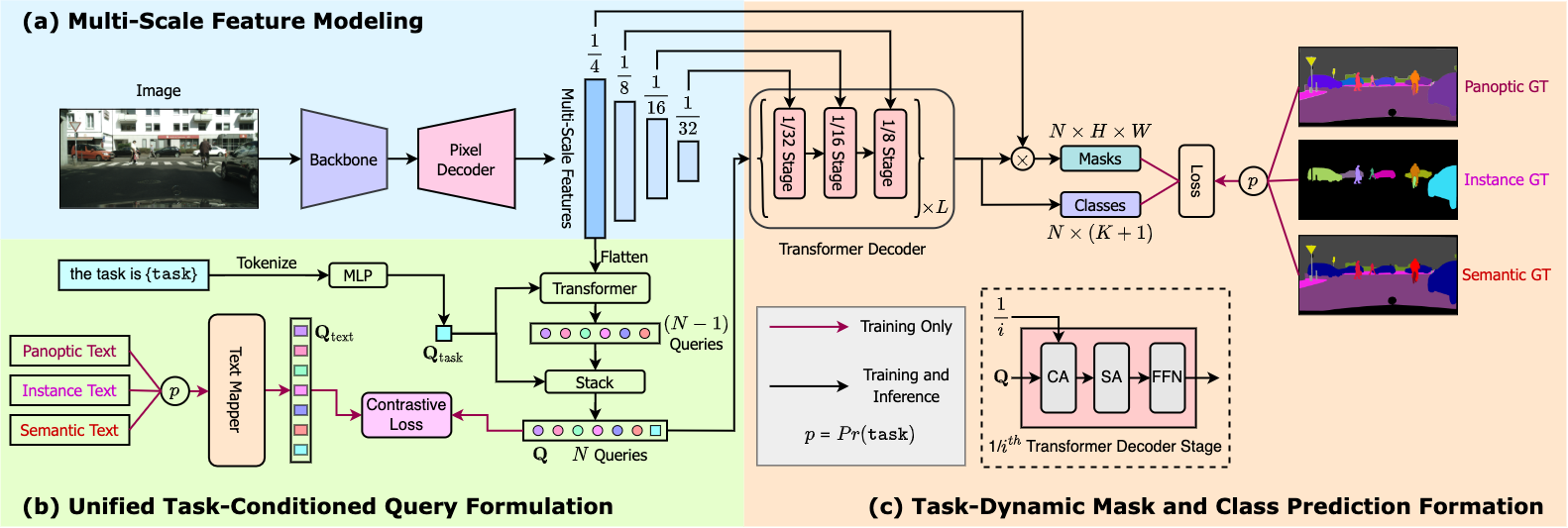
Note that Mask2Former still needs to be trained on each task separately to obtain state-of-the-art results. This has been improved by the OneFormer model, which obtains state-of-the-art performance on all 3 tasks by only training on a panoptic version of the dataset (!), by adding a text encoder to condition the model on either "instance", "semantic" or "panoptic" inputs. This model is also as of today available in 🤗 transformers. It's even more accurate than Mask2Former, but comes with greater latency due to the additional text encoder. See the figure below for an overview of OneFormer. It leverages either Swin Transformer or the new DiNAT model as backbone.
drawing

Inference with Mask2Former and OneFormer in Transformers

Usage of Mask2Former and OneFormer is pretty straightforward, and very similar to their predecessor MaskFormer. Let's instantiate a Mask2Former model from the hub trained on the COCO panoptic dataset, along with its processor. Note that the authors released no less than 30 checkpoints trained on various datasets.

from transformers import AutoImageProcessor, Mask2FormerForUniversalSegmentation

processor = AutoImageProcessor.from_pretrained("facebook/mask2former-swin-base-coco-panoptic")
model = Mask2FormerForUniversalSegmentation.from_pretrained("facebook/mask2former-swin-base-coco-panoptic")

Next, let's load the familiar cats image from the COCO dataset, on which we'll perform inference.

from PIL import Image

url = "http://images.cocodataset.org/val2017/000000039769.jpg"
image = Image.open(requests.get(url, stream=True).raw)
image

We prepare the image for the model using the image processor, and forward it through the model.

inputs = processor(image, return_tensors="pt")

with torch.no_grad():
    outputs = model(**inputs)

The model outputs a set of binary masks and corresponding class logits. The raw outputs of Mask2Former can be easily postprocessed using the image processor to get the final instance, semantic or panoptic segmentation predictions:

prediction = processor.post_process_panoptic_segmentation(outputs, target_sizes=[image.size[::-1]])[0]
print(prediction.keys())
Output:
----------------------------------------------------------------------------------------------------
dict_keys(['segmentation', 'segments_info'])

In panoptic segmentation, the final prediction contains 2 things: a segmentation map of shape (height, width) where each value encodes the instance ID of a given pixel, as well as a corresponding segments_info. The segments_info contains more information about the individual segments of the map (such as their class / category ID). Note that Mask2Former outputs binary mask proposals of shape (96, 96) for efficiency and the target_sizes argument is used to resize the final mask to the original image size.

Let's visualize the results:

from collections import defaultdict
import matplotlib.pyplot as plt
import matplotlib.patches as mpatches
from matplotlib import cm

def draw_panoptic_segmentation(segmentation, segments_info):
    # get the used color map
    viridis = cm.get_cmap('viridis', torch.max(segmentation))
    fig, ax = plt.subplots()
    ax.imshow(segmentation)
    instances_counter = defaultdict(int)
    handles = []
    # for each segment, draw its legend
    for segment in segments_info:
        segment_id = segment['id']
        segment_label_id = segment['label_id']
        segment_label = model.config.id2label[segment_label_id]
        label = f"{segment_label}-{instances_counter[segment_label_id]}"
        instances_counter[segment_label_id] += 1
        color = viridis(segment_id)
        handles.append(mpatches.Patch(color=color, label=label))
        
    ax.legend(handles=handles)

draw_panoptic_segmentation(**panoptic_segmentation)
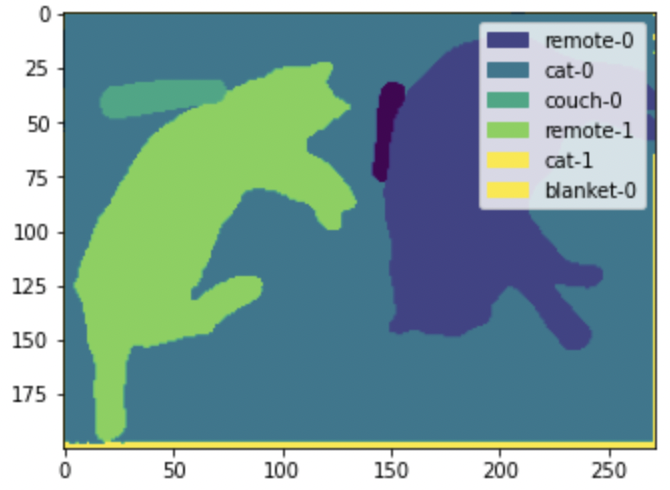
Here, we can see that the model is capable of detecting the individual cats and remotes in the image. Semantic segmentation on the other hand would just create a single mask for the "cat" category.

To perform inference with OneFormer, which has an identical API except that it also takes an additional text prompt as input, we refer to the demo notebook.

Fine-tuning Mask2Former and OneFormer in Transformers

For fine-tuning Mask2Former/OneFormer on a custom dataset for either instance, semantic and panoptic segmentation, check out our demo notebooks. MaskFormer, Mask2Former and OneFormer share a similar API so upgrading from MaskFormer is easy and requires minimal changes.

The demo notebooks make use of MaskFormerForInstanceSegmentation to load the model whereas you'll have to switch to using either Mask2FormerForUniversalSegmentation or OneFormerForUniversalSegmentation. In case of image processing for Mask2Former, you'll also have to switch to using Mask2FormerImageProcessor. You can also load the image processor using the AutoImageProcessor class which automatically takes care of loading the correct processor corresponding to your model. OneFormer on the other hand requires a OneFormerProcessor, which prepares the images, along with a text input, for the model.

Conclusion

That's it! You now know about the difference between instance, semantic and panoptic segmentation, as well as how to use "universal architectures" such as Mask2Former and OneFormer using the 🤗 transformers library.

We hope you enjoyed this post and learned something. Feel free to let us know whether you are satisfied with the results when fine-tuning Mask2Former or OneFormer.

If you liked this topic and want to learn more, we recommend the following resources:

  • Our demo notebooks for MaskFormer, Mask2Former and OneFormer, which give a broader overview on inference (including visualization) as well as fine-tuning on custom data.
  • The [live demo spaces] for Mask2Former and OneFormer available on the Hugging Face Hub which you can use to quickly try out the models on sample inputs of your choice.