



惯性聚合 高效追踪和阅读你感兴趣的博客、新闻、科技资讯
阅读原文 在惯性聚合中打开

推荐订阅源

Security Archives - TechRepublic
罗磊的独立博客
T
The Blog of Author Tim Ferriss
The GitHub Blog
The GitHub Blog
Apple Machine Learning Research
The Register - Security
J
Java Code Geeks
V2EX - 技术
V2EX - 技术
Vercel News
Vercel News
N
News and Events Feed by Topic
腾讯CDC
P
Proofpoint News Feed
N
News | PayPal Newsroom
www.infosecurity-magazine.com
爱范儿
爱范儿
O
OpenAI News
酷 壳 – CoolShell
酷 壳 – CoolShell
月光博客
月光博客
Martin Fowler
Martin Fowler
Engineering at Meta
Engineering at Meta
D
Docker
Y
Y Combinator Blog
博客园 - 聂微东
G
Google Developers Blog
S
Security @ Cisco Blogs
Simon Willison's Weblog
S
Schneier on Security
H
Hackread – Cybersecurity News, Data Breaches, AI and More
S
SegmentFault 最新的问题
云风的 BLOG
云风的 BLOG
阮一峰的网络日志
阮一峰的网络日志
C
CXSECURITY Database RSS Feed - CXSecurity.com
CTFtime.org: upcoming CTF events
C
CERT Recently Published Vulnerability Notes
I
Intezer
G
GRAHAM CLULEY
有赞技术团队
有赞技术团队
Attack and Defense Labs
V
Visual Studio Blog
博客园 - Franky
博客园 - 三生石上(FineUI控件)
W
WeLiveSecurity
钛媒体:引领未来商业与生活新知
钛媒体:引领未来商业与生活新知
让小产品的独立变现更简单 - ezindie.com
Hugging Face - Blog
Hugging Face - Blog
Scott Helme
Scott Helme
T
Troy Hunt's Blog
Hacker News - Newest:
Hacker News - Newest: "LLM"
L
LINUX DO - 最新话题
C
Cybersecurity and Infrastructure Security Agency CISA

Hugging Face - Blog

Waypoint-1.5: Higher-Fidelity Interactive Worlds for Everyday GPUs ALTK‑Evolve: On‑the‑Job Learning for AI Agents Safetensors is Joining the PyTorch Foundation Holo3: Breaking the Computer Use Frontier Any Custom Frontend with Gradio's Backend A New Framework for Evaluating Voice Agents (EVA) Bringing Robotics AI to Embedded Platforms: Dataset Recording, VLA Fine‑Tuning, and On‑Device Optimizations One-Shot Any Web App with Gradio's gr.HTML CUGA on Hugging Face: Democratizing Configurable AI Agents New in llama.cpp: Model Management Building Deep Research: How we Achieved State of the Art OVHcloud on Hugging Face Inference Providers 🔥 20x Faster TRL Fine-tuning with RapidFire AI Building for an Open Future - our new partnership with Google Cloud Aligning to What? Rethinking Agent Generalization in MiniMax M2 Building a Healthcare Robot from Simulation to Deployment with NVIDIA Isaac Sentence Transformers is joining Hugging Face! Unlock the power of images with AI Sheets Supercharge your OCR Pipelines with Open Models Google Cloud C4 Brings a 70% TCO improvement on GPT OSS with Intel and Hugging Face Get your VLM running in 3 simple steps on Intel CPUs Nemotron-Personas-India: Synthesized Data for Sovereign AI Introducing RTEB: A New Standard for Retrieval Evaluation Accelerating Qwen3-8B Agent on Intel® Core™ Ultra with Depth-Pruned Draft Models VibeGame: Exploring Vibe Coding Games Nemotron-Personas-Japan: ソブリン AI のための合成データセット Swift Transformers Reaches 1.0 – and Looks to the Future Smol2Operator: Post-Training GUI Agents for Computer Use SyGra: The One-Stop Framework for Building Data for LLMs and SLMs Gaia2 and ARE: Empowering the community to study agents Scaleway on Hugging Face Inference Providers 🔥 Democratizing AI Safety with RiskRubric.ai Public AI on Hugging Face Inference Providers 🔥 `LeRobotDataset:v3.0`: Bringing large-scale datasets to `lerobot` Visible Watermarking with Gradio Introducing the Palmyra-mini family: Powerful, lightweight, and ready to reason! Tricks from OpenAI gpt-oss YOU 🫵 can use with transformers Fine-tune Any LLM from the Hugging Face Hub with Together AI Jupyter Agents: training LLMs to reason with notebooks mmBERT: ModernBERT goes Multilingual Welcome EmbeddingGemma, Google's new efficient embedding model SAIR: Accelerating Pharma R&D with AI-Powered Structural Intelligence Make your ZeroGPU Spaces go brrr with ahead-of-time compilation NVIDIA Releases 6 Million Multi-Lingual Reasoning Dataset Generate Images with Claude and Hugging Face From Zero to GPU: A Guide to Building and Scaling Production-Ready CUDA Kernels MCP for Research: How to Connect AI to Research Tools Kimina-Prover-RL Arm & ExecuTorch 0.7: Bringing Generative AI to the masses Neural Super Sampling is here! TextQuests: How Good are LLMs at Text-Based Video Games? 🇵🇭 FilBench - Can LLMs Understand and Generate Filipino? Introducing AI Sheets: a tool to work with datasets using open AI models! Accelerate ND-Parallel: A guide to Efficient Multi-GPU Training Vision Language Model Alignment in TRL ⚡️ Welcome GPT OSS, the new open-source model family from OpenAI! Measuring Open-Source Llama Nemotron Models on DeepResearch Bench 📚 3LM: A Benchmark for Arabic LLMs in STEM and Code Implementing MCP Servers in Python: An AI Shopping Assistant with Gradio Introducing Trackio: A Lightweight Experiment Tracking Library from Hugging Face Say hello to `hf`: a faster, friendlier Hugging Face CLI ✨ Parquet Content-Defined Chunking TimeScope: How Long Can Your Video Large Multimodal Model Go? Fast LoRA inference for Flux with Diffusers and PEFT Accelerate a World of LLMs on Hugging Face with NVIDIA NIM Arc Virtual Cell Challenge: A Primer Consilium: When Multiple LLMs Collaborate Back to The Future: Evaluating AI Agents on Predicting Future Events Five Big Improvements to Gradio MCP Servers Ettin Suite: SoTA Paired Encoders and Decoders Migrating the Hub from Git LFS to Xet Kimina-Prover: Applying Test-time RL Search on Large Formal Reasoning Models Asynchronous Robot Inference: Decoupling Action Prediction and Execution ScreenEnv: Deploy your full stack Desktop Agent Building the Hugging Face MCP Server Reachy Mini - The Open-Source Robot for Today's and Tomorrow's AI Builders Creating custom kernels for the AMD MI300 Upskill your LLMs With Gradio MCP Servers SmolLM3: smol, multilingual, long-context reasoner Three Mighty Alerts Supporting Hugging Face’s Production Infrastructure Efficient MultiModal Data Pipeline Announcing NeurIPS 2025 E2LM Competition: Early Training Evaluation of Language Models Training and Finetuning Sparse Embedding Models with Sentence Transformers Welcome the NVIDIA Llama Nemotron Nano VLM to Hugging Face Hub Gemma 3n fully available in the open-source ecosystem! Transformers backend integration in SGLang (LoRA) Fine-Tuning FLUX.1-dev on Consumer Hardware Groq on Hugging Face Inference Providers 🔥 How Long Prompts Block Other Requests - Optimizing LLM Performance Learn the Hugging Face Kernel Hub in 5 Minutes Convert Transformers to ONNX with Hugging Face Optimum Intel and Hugging Face Partner to Democratize Machine Learning Hardware Acceleration Director of Machine Learning Insights [Part 3: Finance Edition] The Annotated Diffusion Model Deep Q-Learning with Space Invaders Graphcore and Hugging Face Launch New Lineup of IPU-Ready Transformers Introducing Pull Requests and Discussions 🥳 Efficient Table Pre-training without Real Data: An Introduction to TAPEX An Introduction to Q-Learning Part 2/2 How Sempre Health is leveraging the Expert Acceleration Program to accelerate their ML roadmap
The Age of Machine Learning As Code Has Arrived
Julien Simon · 2021-10-20 · via Hugging Face - Blog

Back to Articles

Julien Simon's avatar

This article is also available in Chinese 简体中文.

The 2021 edition of the State of AI Report came out last week. So did the Kaggle State of Machine Learning and Data Science Survey. There's much to be learned and discussed in these reports, and a couple of takeaways caught my attention.

"AI is increasingly being applied to mission critical infrastructure like national electric grids and automated supermarket warehousing calculations during pandemics. However, there are questions about whether the maturity of the industry has caught up with the enormity of its growing deployment."

There's no denying that Machine Learning-powered applications are reaching into every corner of IT. But what does that mean for companies and organizations? How do we build rock-solid Machine Learning workflows? Should we all hire 100 Data Scientists ? Or 100 DevOps engineers?

"Transformers have emerged as a general purpose architecture for ML. Not just for Natural Language Processing, but also Speech, Computer Vision or even protein structure prediction."

Old timers have learned the hard way that there is no silver bullet in IT. Yet, the Transformer architecture is indeed very efficient on a wide variety of Machine Learning tasks. But how can we all keep up with the frantic pace of innovation in Machine Learning? Do we really need expert skills to leverage these state of the art models? Or is there a shorter path to creating business value in less time?

Well, here's what I think.

Machine Learning For The Masses!

Machine Learning is everywhere, or at least it's trying to be. A few years ago, Forbes wrote that "Software ate the world, now AI is eating Software", but what does this really mean? If it means that Machine Learning models should replace thousands of lines of fossilized legacy code, then I'm all for it. Die, evil business rules, die!

Now, does it mean that Machine Learning will actually replace Software Engineering? There's certainly a lot of fantasizing right now about AI-generated code, and some techniques are certainly interesting, such as finding bugs and performance issues. However, not only shouldn't we even consider getting rid of developers, we should work on empowering as many as we can so that Machine Learning becomes just another boring IT workload (and boring technology is great). In other words, what we really need is for Software to eat Machine Learning!

Things are not different this time

For years, I've argued and swashbuckled that decade-old best practices for Software Engineering also apply to Data Science and Machine Learning: versioning, reusability, testability, automation, deployment, monitoring, performance, optimization, etc. I felt alone for a while, and then the Google cavalry unexpectedly showed up:

"Do machine learning like the great engineer you are, not like the great machine learning expert you aren't." - Rules of Machine Learning, Google

There's no need to reinvent the wheel either. The DevOps movement solved these problems over 10 years ago. Now, the Data Science and Machine Learning community should adopt and adapt these proven tools and processes without delay. This is the only way we'll ever manage to build robust, scalable and repeatable Machine Learning systems in production. If calling it MLOps helps, fine: I won't argue about another buzzword.

It's really high time we stopped considering proof of concepts and sandbox A/B tests as notable achievements. They're merely a small stepping stone toward production, which is the only place where assumptions and business impact can be validated. Every Data Scientist and Machine Learning Engineer should obsess about getting their models in production, as quickly and as often as possible. An okay production model beats a great sandbox model every time.

Infrastructure? So what?

It's 2021. IT infrastructure should no longer stand in the way. Software has devoured it a while ago, abstracting it away with cloud APIs, infrastructure as code, Kubeflow and so on. Yes, even on premises.

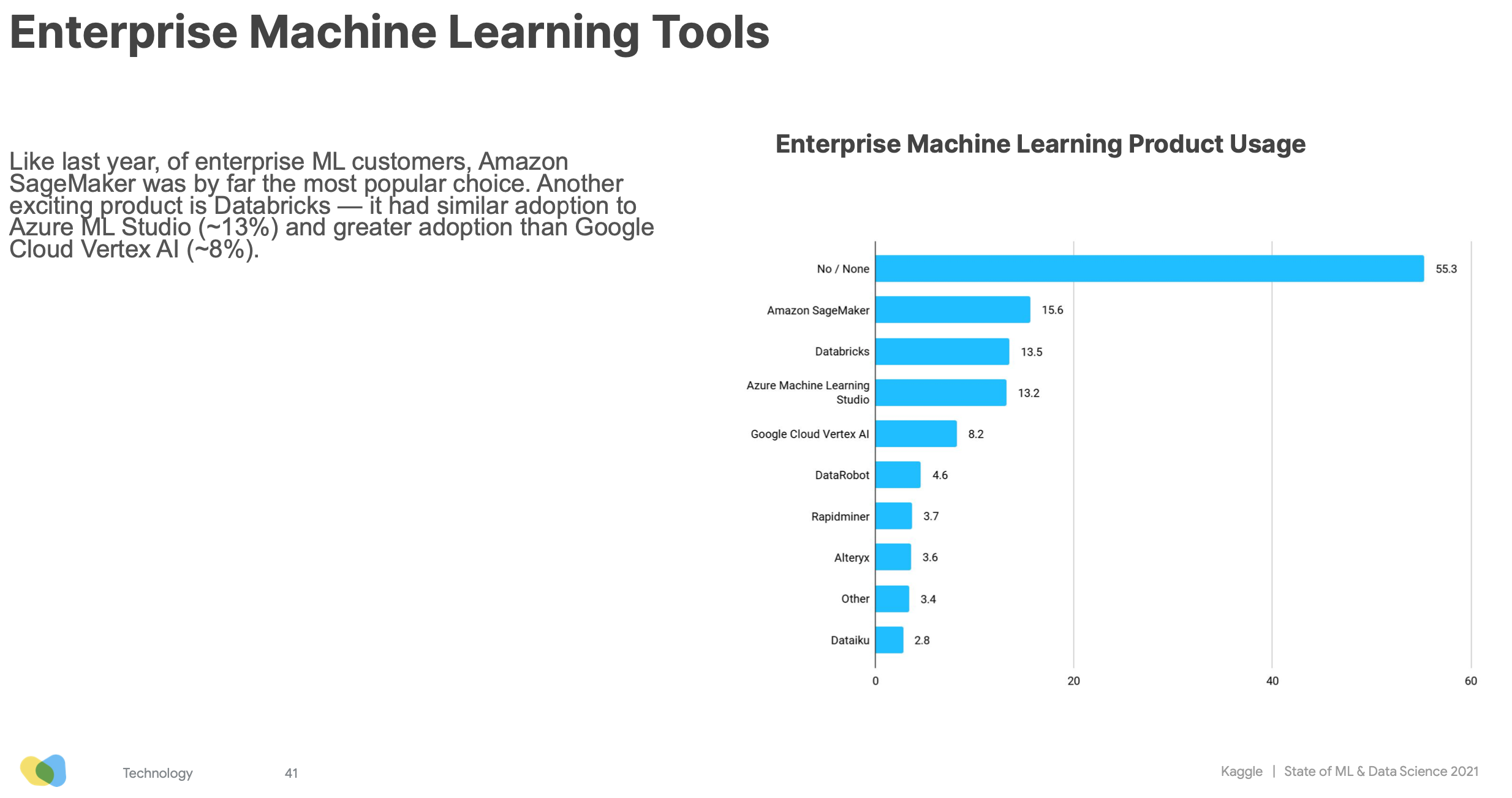
The same is quickly happening for Machine Learning infrastructure. According to the Kaggle survey, 75% of respondents use cloud services, and over 45% use an Enterprise ML platform, with Amazon SageMaker, Databricks and Azure ML Studio taking the top 3 spots.
With MLOps, software-defined infrastructure and platforms, it's never been easier to drag all these great ideas out of the sandbox, and to move them to production. To answer my original question, I'm pretty sure you need to hire more ML-savvy Software and DevOps engineers, not more Data Scientists. But deep down inside, you kind of knew that, right?

Now, let's talk about Transformers.


Transformers! Transformers! Transformers! (Ballmer style)

Says the State of AI report: "The Transformer architecture has expanded far beyond NLP and is emerging as a general purpose architecture for ML". For example, recent models like Google's Vision Transformer, a convolution-free transformer architecture, and CoAtNet, which mixes transformers and convolution, have set new benchmarks for image classification on ImageNet, while requiring fewer compute resources for training.
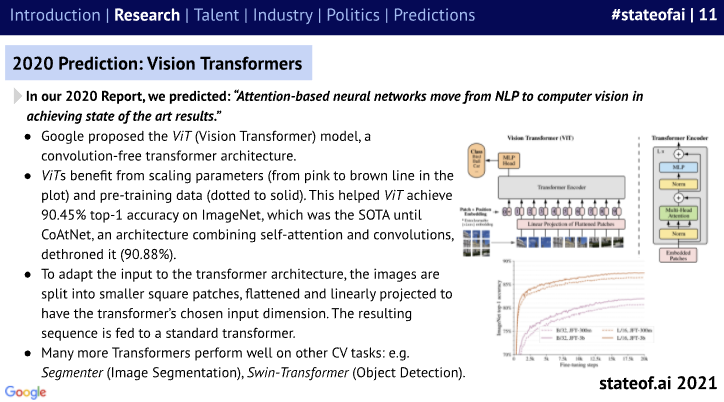
Transformers also do very well on audio (say, speech recognition), as well as on point clouds, a technique used to model 3D environments like autonomous driving scenes.

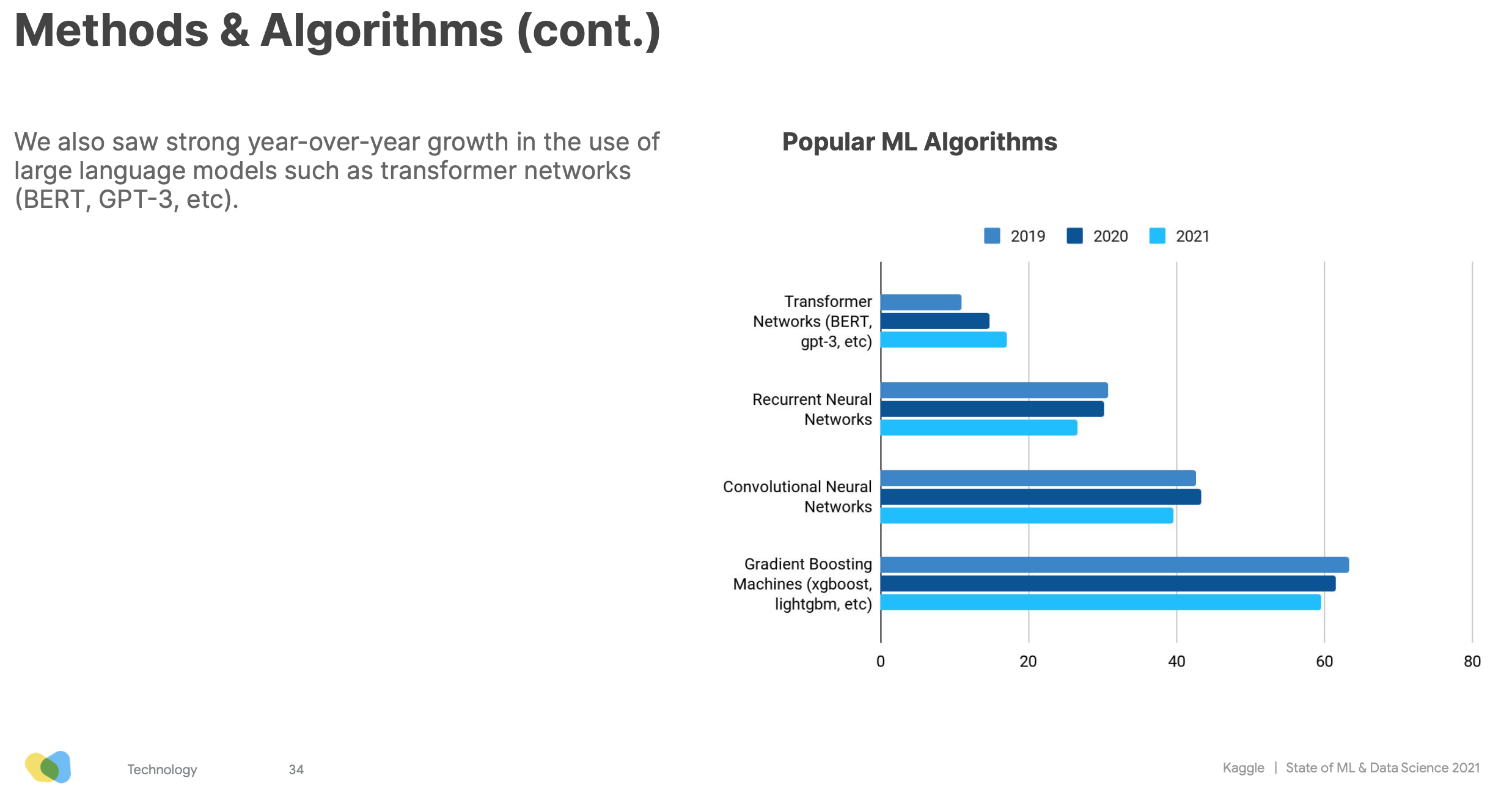
The Kaggle survey echoes this rise of Transformers. Their usage keeps growing year over year, while RNNs, CNNs and Gradient Boosting algorithms are receding.
On top of increased accuracy, Transformers also keep fulfilling the transfer learning promise, allowing teams to save on training time and compute costs, and to deliver business value quicker.
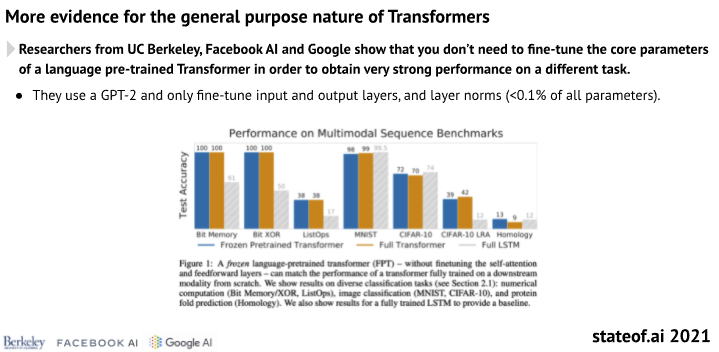
With Transformers, the Machine Learning world is gradually moving from "Yeehaa!! Let's build and train our own Deep Learning model from scratch" to "Let's pick a proven off the shelf model, fine-tune it on our own data, and be home early for dinner."

It's a Good Thing in so many ways. State of the art is constantly advancing, and hardly anyone can keep up with its relentless pace. Remember that Google Vision Transformer model I mentioned earlier? Would you like to test it here and now? With Hugging Face, it's the simplest thing.
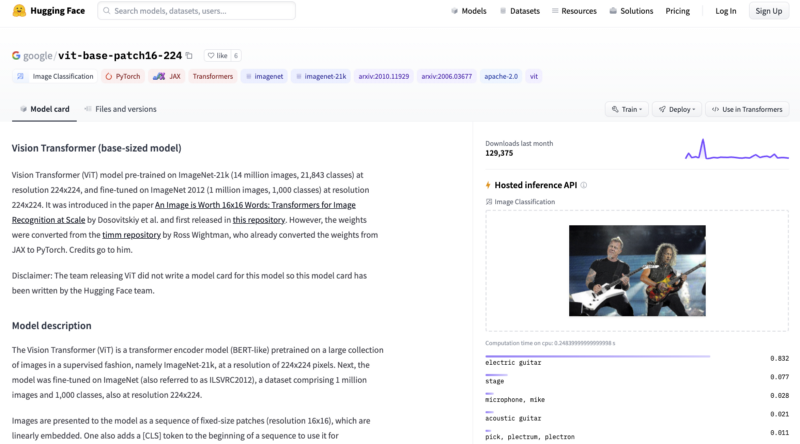
How about the latest zero-shot text generation models from the Big Science project?
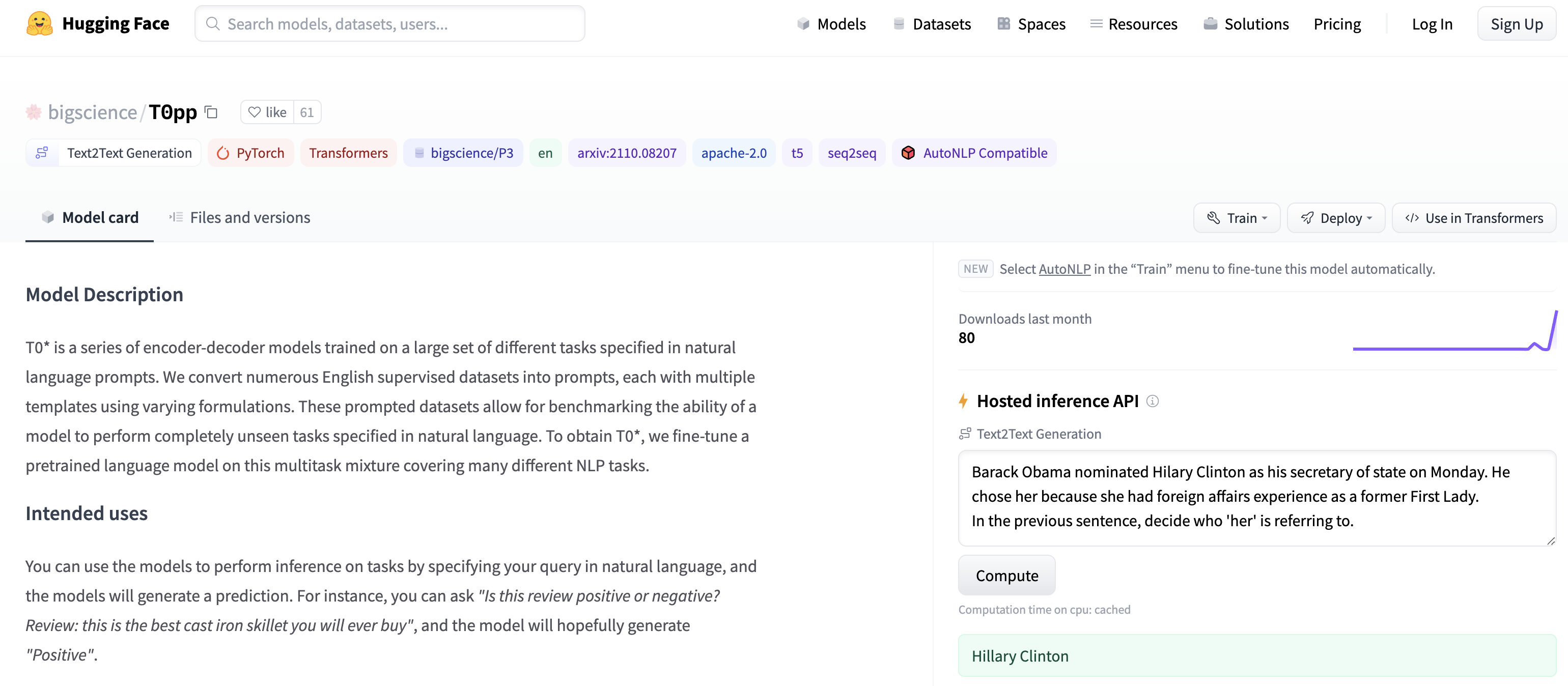
You can do the same with another 16,000+ models and 1,600+ datasets, with additional tools for inference, AutoNLP, latency optimization, and hardware acceleration. We can also help you get your project off the ground, from modeling to production.

Our mission at Hugging Face is to make Machine Learning as friendly and as productive as possible, for beginners and experts alike.

We believe in writing as little code as possible to train, optimize, and deploy models.

We believe in built-in best practices.

We believe in making infrastructure as transparent as possible.

We believe that nothing beats high quality models in production, fast.

Machine Learning as Code, right here, right now!

A lot of you seem to agree. We have over 52,000 stars on Github. For the first year, Hugging Face is also featured in the Kaggle survey, with usage already over 10%.
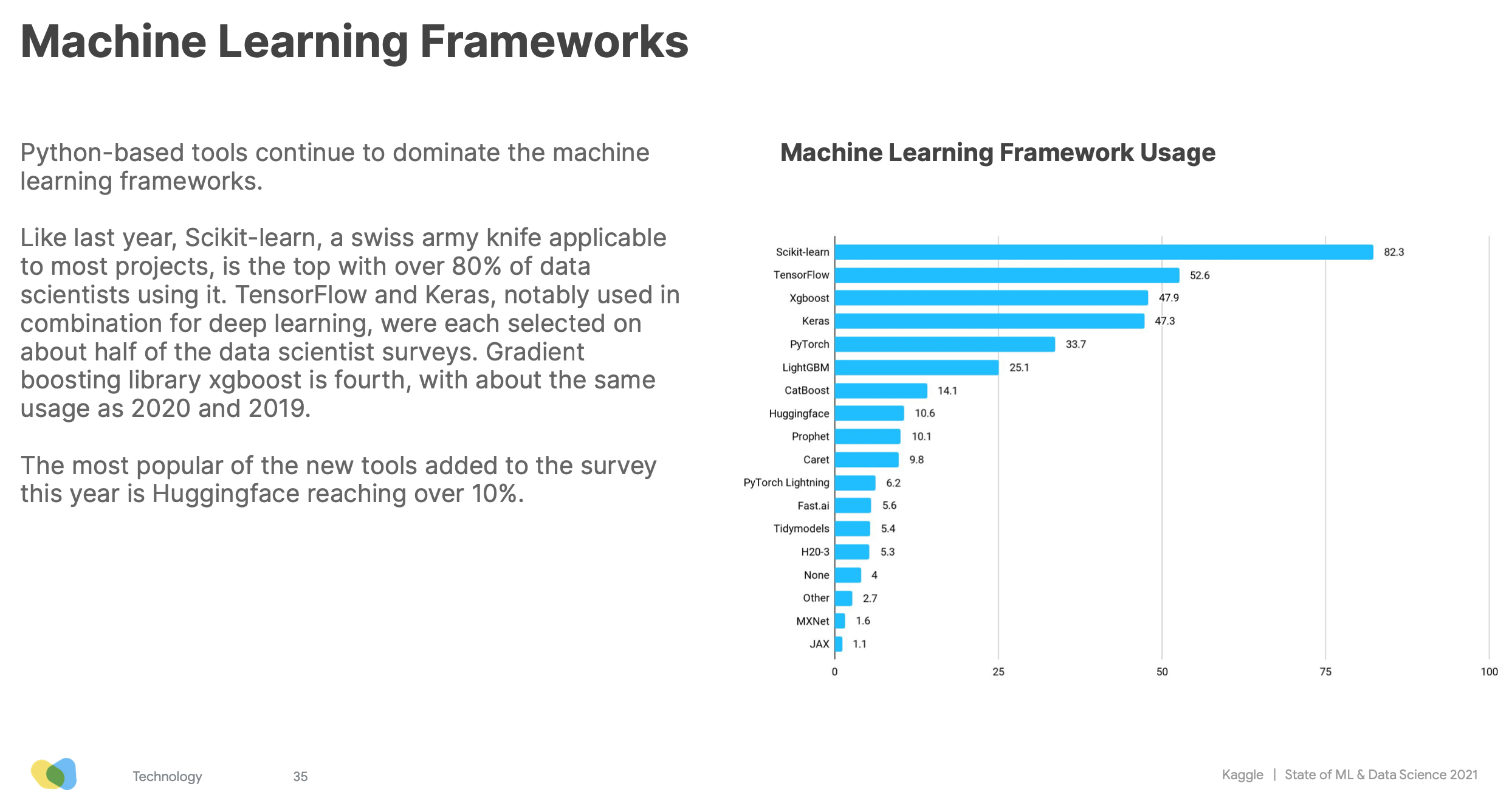
Thank you all. And yeah, we're just getting started.


Interested in how Hugging Face can help your organization build and deploy production-grade Machine Learning solutions? Get in touch at julsimon@huggingface.co (no recruiters, no sales pitches, please).