


惯性聚合 高效追踪和阅读你感兴趣的博客、新闻、科技资讯
阅读原文 在惯性聚合中打开

推荐订阅源

爱范儿
爱范儿
P
Palo Alto Networks Blog
月光博客
月光博客
H
Hackread – Cybersecurity News, Data Breaches, AI and More
I
InfoQ
aimingoo的专栏
aimingoo的专栏
腾讯CDC
T
Threatpost
D
DataBreaches.Net
Vercel News
Vercel News
F
Fortinet All Blogs
Engineering at Meta
Engineering at Meta
C
Cybersecurity and Infrastructure Security Agency CISA
Forbes - Security
Forbes - Security
U
Unit 42
C
Check Point Blog
Blog — PlanetScale
Blog — PlanetScale
O
OpenAI News
量子位
TaoSecurity Blog
TaoSecurity Blog
Microsoft Azure Blog
cs.AI updates on arXiv.org
V
Visual Studio Blog
Recorded Future
Recorded Future
云风的 BLOG
云风的 BLOG
Security Archives - TechRepublic
The Last Watchdog
The Last Watchdog
S
Security Affairs
Attack and Defense Labs
罗磊的独立博客
Stack Overflow Blog
Stack Overflow Blog
Microsoft Security Blog
让小产品的独立变现更简单 - ezindie.com
V
V2EX
小众软件
小众软件
S
SegmentFault 最新的问题
www.infosecurity-magazine.com
W
WeLiveSecurity
AI
AI
Threat Intelligence Blog | Flashpoint
博客园 - 聂微东
I
Intezer
Know Your Adversary
Know Your Adversary
Exploit-DB.com RSS Feed
P
Proofpoint News Feed
freeCodeCamp Programming Tutorials: Python, JavaScript, Git & More
The Cloudflare Blog
博客园_首页
NISL@THU
NISL@THU
K
KPMG report finds enterprise disconnect between AI and its ROI | CIO

Hugging Face - Blog

Waypoint-1.5: Higher-Fidelity Interactive Worlds for Everyday GPUs ALTK‑Evolve: On‑the‑Job Learning for AI Agents Safetensors is Joining the PyTorch Foundation Holo3: Breaking the Computer Use Frontier Any Custom Frontend with Gradio's Backend A New Framework for Evaluating Voice Agents (EVA) Bringing Robotics AI to Embedded Platforms: Dataset Recording, VLA Fine‑Tuning, and On‑Device Optimizations One-Shot Any Web App with Gradio's gr.HTML CUGA on Hugging Face: Democratizing Configurable AI Agents New in llama.cpp: Model Management Building Deep Research: How we Achieved State of the Art OVHcloud on Hugging Face Inference Providers 🔥 20x Faster TRL Fine-tuning with RapidFire AI Building for an Open Future - our new partnership with Google Cloud Aligning to What? Rethinking Agent Generalization in MiniMax M2 Building a Healthcare Robot from Simulation to Deployment with NVIDIA Isaac Sentence Transformers is joining Hugging Face! Unlock the power of images with AI Sheets Supercharge your OCR Pipelines with Open Models Google Cloud C4 Brings a 70% TCO improvement on GPT OSS with Intel and Hugging Face Get your VLM running in 3 simple steps on Intel CPUs Nemotron-Personas-India: Synthesized Data for Sovereign AI Introducing RTEB: A New Standard for Retrieval Evaluation Accelerating Qwen3-8B Agent on Intel® Core™ Ultra with Depth-Pruned Draft Models VibeGame: Exploring Vibe Coding Games Nemotron-Personas-Japan: ソブリン AI のための合成データセット Swift Transformers Reaches 1.0 – and Looks to the Future Smol2Operator: Post-Training GUI Agents for Computer Use SyGra: The One-Stop Framework for Building Data for LLMs and SLMs Gaia2 and ARE: Empowering the community to study agents Scaleway on Hugging Face Inference Providers 🔥 Democratizing AI Safety with RiskRubric.ai Public AI on Hugging Face Inference Providers 🔥 `LeRobotDataset:v3.0`: Bringing large-scale datasets to `lerobot` Visible Watermarking with Gradio Introducing the Palmyra-mini family: Powerful, lightweight, and ready to reason! Tricks from OpenAI gpt-oss YOU 🫵 can use with transformers Fine-tune Any LLM from the Hugging Face Hub with Together AI Jupyter Agents: training LLMs to reason with notebooks mmBERT: ModernBERT goes Multilingual Welcome EmbeddingGemma, Google's new efficient embedding model SAIR: Accelerating Pharma R&D with AI-Powered Structural Intelligence Make your ZeroGPU Spaces go brrr with ahead-of-time compilation NVIDIA Releases 6 Million Multi-Lingual Reasoning Dataset Generate Images with Claude and Hugging Face From Zero to GPU: A Guide to Building and Scaling Production-Ready CUDA Kernels MCP for Research: How to Connect AI to Research Tools Kimina-Prover-RL Arm & ExecuTorch 0.7: Bringing Generative AI to the masses Neural Super Sampling is here! TextQuests: How Good are LLMs at Text-Based Video Games? 🇵🇭 FilBench - Can LLMs Understand and Generate Filipino? Introducing AI Sheets: a tool to work with datasets using open AI models! Accelerate ND-Parallel: A guide to Efficient Multi-GPU Training Vision Language Model Alignment in TRL ⚡️ Welcome GPT OSS, the new open-source model family from OpenAI! Measuring Open-Source Llama Nemotron Models on DeepResearch Bench 📚 3LM: A Benchmark for Arabic LLMs in STEM and Code Implementing MCP Servers in Python: An AI Shopping Assistant with Gradio Introducing Trackio: A Lightweight Experiment Tracking Library from Hugging Face Say hello to `hf`: a faster, friendlier Hugging Face CLI ✨ Parquet Content-Defined Chunking TimeScope: How Long Can Your Video Large Multimodal Model Go? Fast LoRA inference for Flux with Diffusers and PEFT Accelerate a World of LLMs on Hugging Face with NVIDIA NIM Arc Virtual Cell Challenge: A Primer Consilium: When Multiple LLMs Collaborate Back to The Future: Evaluating AI Agents on Predicting Future Events Five Big Improvements to Gradio MCP Servers Ettin Suite: SoTA Paired Encoders and Decoders Migrating the Hub from Git LFS to Xet Kimina-Prover: Applying Test-time RL Search on Large Formal Reasoning Models Asynchronous Robot Inference: Decoupling Action Prediction and Execution ScreenEnv: Deploy your full stack Desktop Agent Building the Hugging Face MCP Server Reachy Mini - The Open-Source Robot for Today's and Tomorrow's AI Builders Creating custom kernels for the AMD MI300 Upskill your LLMs With Gradio MCP Servers SmolLM3: smol, multilingual, long-context reasoner Three Mighty Alerts Supporting Hugging Face’s Production Infrastructure Efficient MultiModal Data Pipeline Announcing NeurIPS 2025 E2LM Competition: Early Training Evaluation of Language Models Training and Finetuning Sparse Embedding Models with Sentence Transformers Welcome the NVIDIA Llama Nemotron Nano VLM to Hugging Face Hub Gemma 3n fully available in the open-source ecosystem! Transformers backend integration in SGLang (LoRA) Fine-Tuning FLUX.1-dev on Consumer Hardware Groq on Hugging Face Inference Providers 🔥 How Long Prompts Block Other Requests - Optimizing LLM Performance Learn the Hugging Face Kernel Hub in 5 Minutes Convert Transformers to ONNX with Hugging Face Optimum Intel and Hugging Face Partner to Democratize Machine Learning Hardware Acceleration Director of Machine Learning Insights [Part 3: Finance Edition] The Annotated Diffusion Model Deep Q-Learning with Space Invaders Graphcore and Hugging Face Launch New Lineup of IPU-Ready Transformers Introducing Pull Requests and Discussions 🥳 Efficient Table Pre-training without Real Data: An Introduction to TAPEX An Introduction to Q-Learning Part 2/2 How Sempre Health is leveraging the Expert Acceleration Program to accelerate their ML roadmap
Easily Train Models with H100 GPUs on NVIDIA DGX Cloud
Philipp Schmid, Jeff Boudier, Rafael Pierre, Abhishek Thakur · 2024-03-18 · via Hugging Face - Blog

Back to Articles

This article is also available in Chinese 简体中文.

Update: This service is deprecated and no longer available as of April 10th, 2025.

Today, we are thrilled to announce the launch of Train on DGX Cloud, a new service on the Hugging Face Hub, available to Enterprise Hub organizations. Train on DGX Cloud makes it easy to use open models with the accelerated compute infrastructure of NVIDIA DGX Cloud. Together, we built Train on DGX Cloud so that Enterprise Hub users can easily access the latest NVIDIA H100 Tensor Core GPUs, to fine-tune popular Generative AI models like Llama, Mistral, and Stable Diffusion, in just a few clicks within the Hugging Face Hub.
Thumbnail

GPU Poor No More

This new experience expands upon the strategic partnership we announced last year to simplify the training and deployment of open Generative AI models on NVIDIA accelerated computing. One of the main problems developers and organizations face is the scarcity of GPU availability, and the time-consuming work of writing, testing, and debugging training scripts for AI models. Train with DGX Cloud offers an easy solution to these challenges, providing instant access to NVIDIA GPUs, starting with H100 on NVIDIA DGX Cloud. In addition, Train with DGX Cloud offers a simple no-code training job creation experience powered by Hugging Face AutoTrain and Hugging Face Spaces.

Enterprise Hub organizations can give their teams instant access to powerful NVIDIA GPUs, only incurring charges per minute of compute instances used for their training jobs.

“Train on DGX Cloud is the easiest, fastest, most accessible way to train Generative AI models, combining instant access to powerful GPUs, pay-as-you-go, and no-code training,” says Abhishek Thakur, creator of Hugging Face AutoTrain. “It will be a game changer for data scientists everywhere!”

"Today’s launch of Hugging Face Autotrain powered by DGX Cloud represents a noteworthy step toward simplifying AI model training,” said Alexis Bjorlin, vice president of DGX Cloud, NVIDIA. “By integrating NVIDIA’s AI supercomputer in the cloud with Hugging Face’s user-friendly interface, we’re empowering organizations to accelerate their AI innovation."

How it works

Training Hugging Face models on NVIDIA DGX Cloud has never been easier. Below you will find a step-by-step tutorial to fine-tune Mistral 7B.

Note: You need access to an Organization with a Hugging Face Enterprise subscription to use Train on DGX Cloud

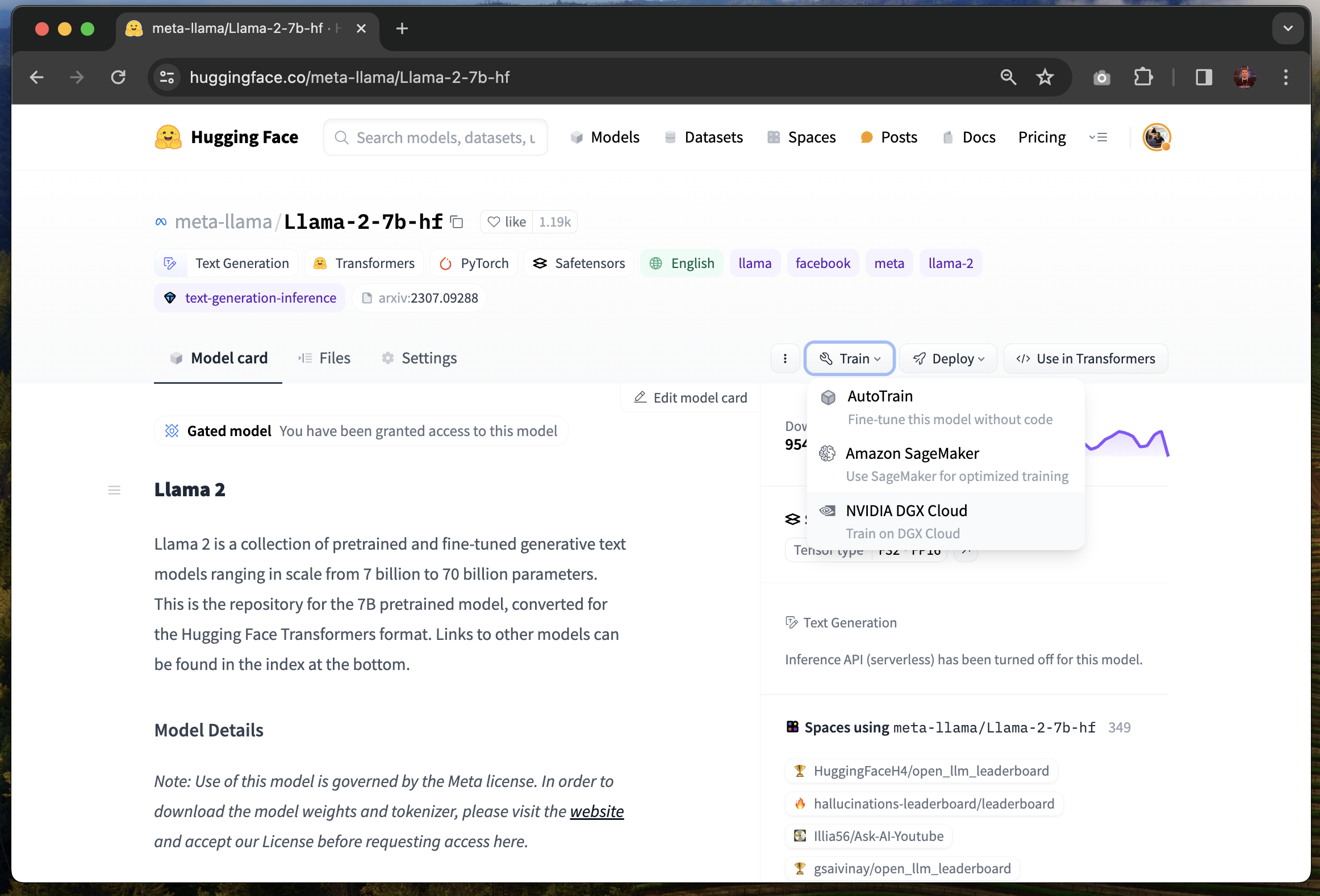
You can find Train on DGX Cloud on the model page of supported Generative AI models. It currently supports the following model architectures: Llama, Falcon, Mistral, Mixtral, T5, Gemma, Stable Diffusion, and Stable Diffusion XL.
Model Card

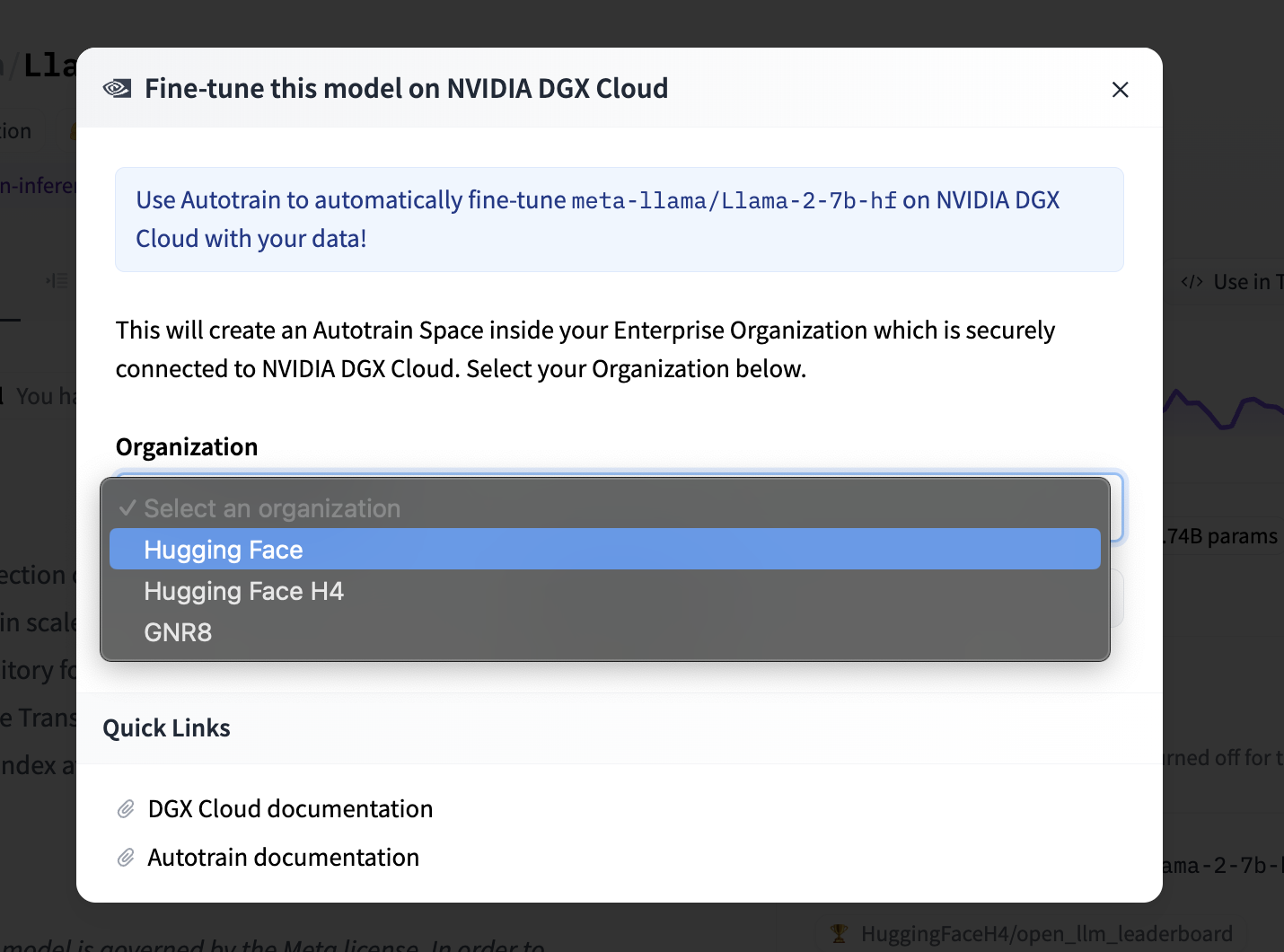
Open the “Train” menu, and select “NVIDIA DGX Cloud” - this will open an interface where you can select your Enterprise Organization.
Organization Selection

Then, click on “Create new Space”. When using Train on DGX Cloud for the first time, the service will create a new Hugging Face Space within your Organization, so you can use AutoTrain to create training jobs that will be executed on NVIDIA DGX Cloud. When you want to create another training job later, you will automatically be redirected back to the existing AutoTrain Space.

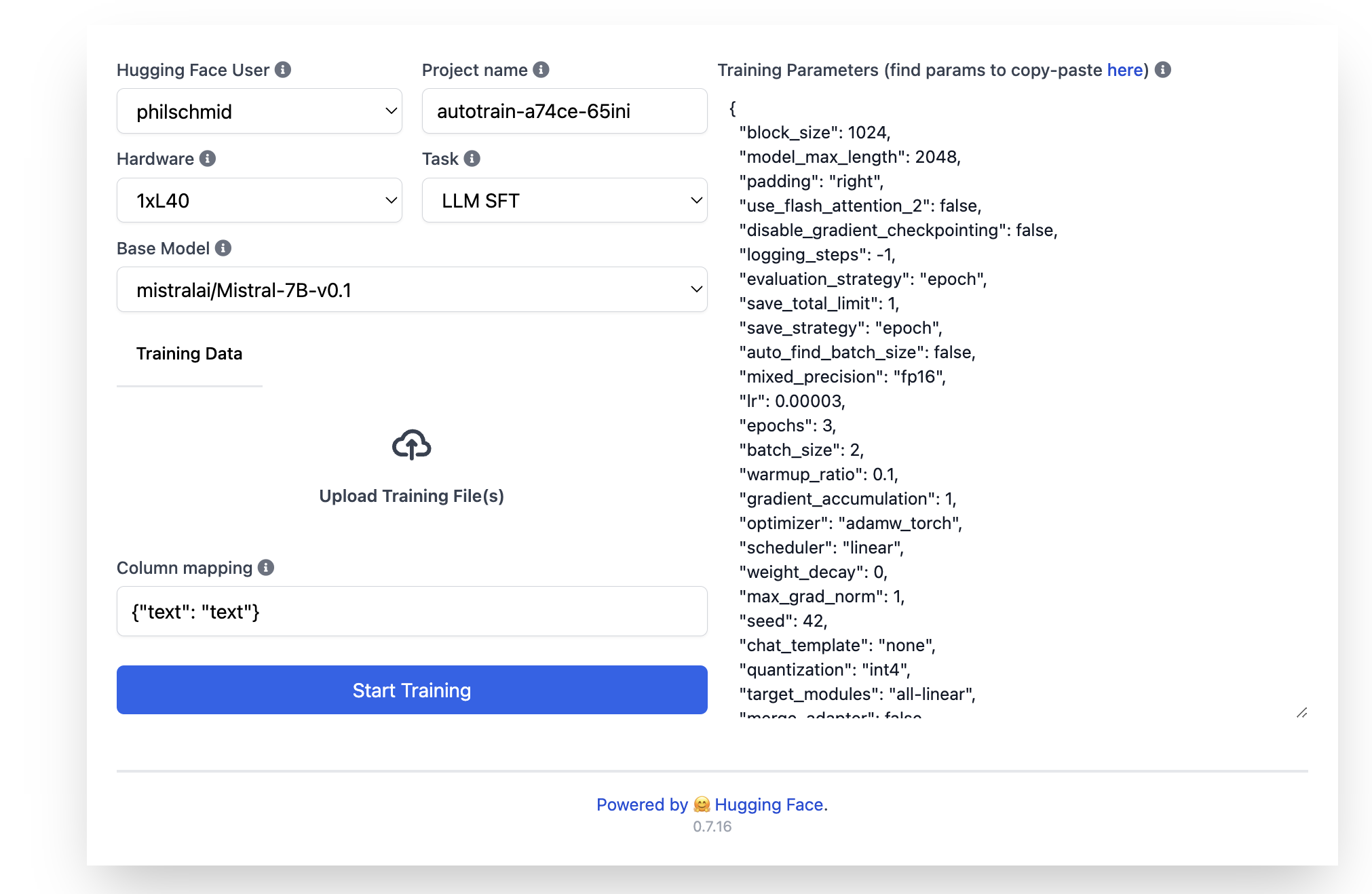
Once in the AutoTrain Space, you can create your training job by configuring the Hardware, Base Model, Task, and Training Parameters.
Create AutoTrain Job

For Hardware, you can select NVIDIA H100 GPUs, available in 1x, 2x, 4x and 8x instances, or L40S GPUs (coming soon). The training dataset must be directly uploaded in the “Upload Training File(s)” area. CSV and JSON files are currently supported. Make sure that the column mapping is correct following the example below. For Training Parameters, you can directly edit the JSON configuration on the right side, e.g., changing the number of epochs from 3 to 2.

When everything is set up, you can start your training by clicking “Start Training”. AutoTrain will now validate your dataset, and ask you to confirm the training.
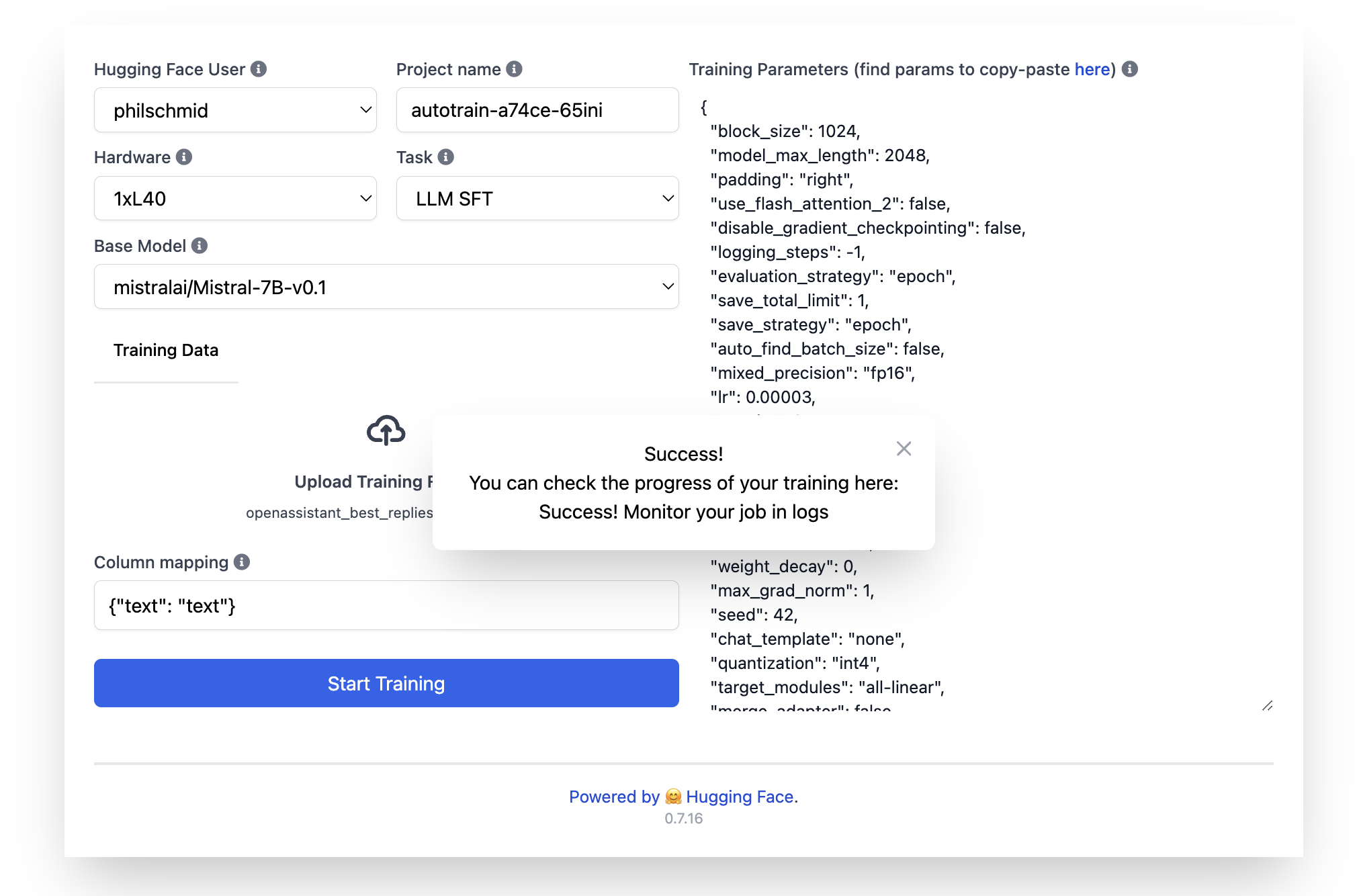
Launched Training Job

You can monitor your training by opening the “logs” of the Space.
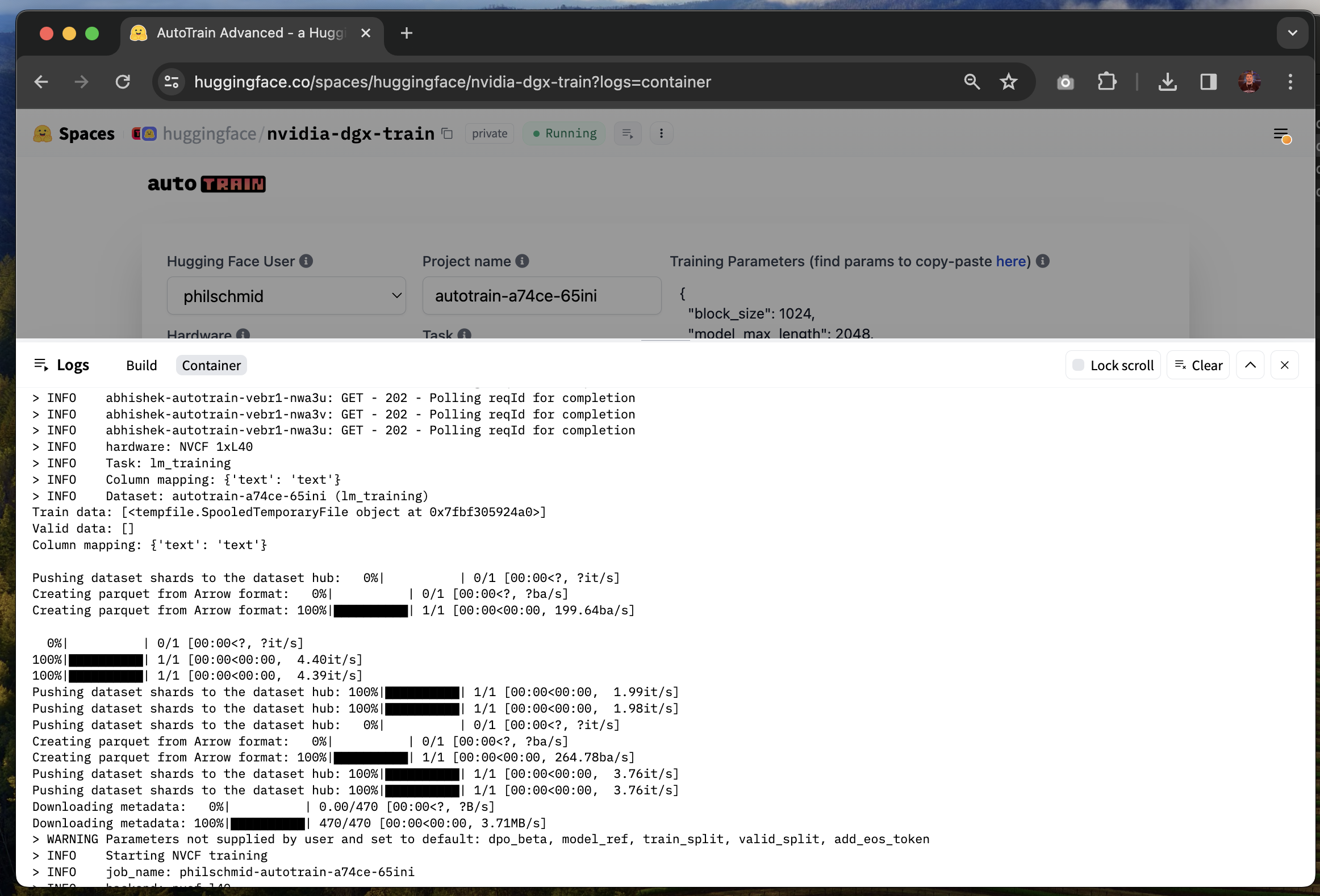
Training Logs

After your training is complete, your fine-tuned model will be uploaded to a new private repository within your selected namespace on the Hugging Face Hub.

Train on DGX Cloud is available today for all Enterprise Hub Organizations! Give the service a try, and let us know your feedback!

Pricing for Train on DGX Cloud

Usage of Train on DGX Cloud is billed by the minute of the GPU instances used during your training jobs. Current prices for training jobs are $8.25 per GPU hour for H100 instances, and $2.75 per GPU hour for L40S instances. Usage fees accrue to your Enterprise Hub Organizations’ current monthly billing cycle, once a job is completed. You can check your current and past usage at any time within the billing settings of your Enterprise Hub Organization.

For example, fine-tuning Mistral 7B on 1500 samples on a single NVIDIA L40S takes ~10 minutes and costs ~$0.45.

We’re just getting started

We are excited to collaborate with NVIDIA to democratize accelerated machine learning across open science, open source, and cloud services.

Our collaboration on open science through BigCode enabled the training of StarCoder 2 15B, a fully open, state-of-the-art code LLM trained on more than 600 languages.

Our collaboration on open source is fueling the new optimum-nvidia library, accelerating the inference of LLMs on the latest NVIDIA GPUs and already achieving 1,200 tokens per second with Llama 2.

Our collaboration on cloud services created Train on DGX Cloud today. We are also working with NVIDIA to optimize inference and make accelerated computing more accessible to the Hugging Face community, leveraging our collaboration on NVIDIA TensorRT-LLM and optimum-nvidia. In addition, some of the most popular open models on Hugging Face will be on NVIDIA NIM microservices, which was announced today at GTC.

For those attending GTC this week, make sure to watch session S63149 on Wednesday 3/20, at 3pm PT where Jeff will guide you through Train on DGX Cloud and more. Also don't miss the next Hugging Cast where we will give a live demo of Train on DGX Cloud and you can ask questions directly to Abhishek and Rafael on Thursday, 3/21, at 9am PT / 12pm ET / 17h CET - Watch record here.