





惯性聚合 高效追踪和阅读你感兴趣的博客、新闻、科技资讯
阅读原文 在惯性聚合中打开

推荐订阅源

大猫的无限游戏
大猫的无限游戏
N
News | PayPal Newsroom
cs.AI updates on arXiv.org
P
Palo Alto Networks Blog
P
Privacy & Cybersecurity Law Blog
H
Hacker News: Front Page
Vercel News
Vercel News
阮一峰的网络日志
阮一峰的网络日志
博客园 - 叶小钗
IT之家
IT之家
B
Blog
Google DeepMind News
U
Unit 42
cs.CV updates on arXiv.org
Attack and Defense Labs
美团技术团队
Y
Y Combinator Blog
爱范儿
爱范儿
L
Lohrmann on Cybersecurity
O
OpenAI News
酷 壳 – CoolShell
酷 壳 – CoolShell
W
WeLiveSecurity
Microsoft Azure Blog
H
Help Net Security
T
Threatpost
Application and Cybersecurity Blog
TaoSecurity Blog
TaoSecurity Blog
Simon Willison's Weblog
Security Archives - TechRepublic
M
MIT News - Artificial intelligence
Last Week in AI
Last Week in AI
Apple Machine Learning Research
AWS News Blog
AWS News Blog
D
Darknet – Hacking Tools, Hacker News & Cyber Security
T
Tenable Blog
The GitHub Blog
The GitHub Blog
Google DeepMind News
Help Net Security
Help Net Security
小众软件
小众软件
罗磊的独立博客
B
Blog RSS Feed
S
SegmentFault 最新的问题
L
LINUX DO - 热门话题
Scott Helme
Scott Helme
G
GRAHAM CLULEY
Martin Fowler
Martin Fowler
Exploit-DB.com RSS Feed
The Last Watchdog
The Last Watchdog
P
Proofpoint News Feed
Security Latest
Security Latest

Hugging Face - Blog

Waypoint-1.5: Higher-Fidelity Interactive Worlds for Everyday GPUs ALTK‑Evolve: On‑the‑Job Learning for AI Agents Safetensors is Joining the PyTorch Foundation Holo3: Breaking the Computer Use Frontier Any Custom Frontend with Gradio's Backend A New Framework for Evaluating Voice Agents (EVA) Bringing Robotics AI to Embedded Platforms: Dataset Recording, VLA Fine‑Tuning, and On‑Device Optimizations One-Shot Any Web App with Gradio's gr.HTML CUGA on Hugging Face: Democratizing Configurable AI Agents New in llama.cpp: Model Management Building Deep Research: How we Achieved State of the Art OVHcloud on Hugging Face Inference Providers 🔥 20x Faster TRL Fine-tuning with RapidFire AI Building for an Open Future - our new partnership with Google Cloud Aligning to What? Rethinking Agent Generalization in MiniMax M2 Building a Healthcare Robot from Simulation to Deployment with NVIDIA Isaac Sentence Transformers is joining Hugging Face! Unlock the power of images with AI Sheets Supercharge your OCR Pipelines with Open Models Google Cloud C4 Brings a 70% TCO improvement on GPT OSS with Intel and Hugging Face Get your VLM running in 3 simple steps on Intel CPUs Nemotron-Personas-India: Synthesized Data for Sovereign AI Introducing RTEB: A New Standard for Retrieval Evaluation Accelerating Qwen3-8B Agent on Intel® Core™ Ultra with Depth-Pruned Draft Models VibeGame: Exploring Vibe Coding Games Nemotron-Personas-Japan: ソブリン AI のための合成データセット Swift Transformers Reaches 1.0 – and Looks to the Future Smol2Operator: Post-Training GUI Agents for Computer Use SyGra: The One-Stop Framework for Building Data for LLMs and SLMs Gaia2 and ARE: Empowering the community to study agents Scaleway on Hugging Face Inference Providers 🔥 Democratizing AI Safety with RiskRubric.ai Public AI on Hugging Face Inference Providers 🔥 `LeRobotDataset:v3.0`: Bringing large-scale datasets to `lerobot` Visible Watermarking with Gradio Introducing the Palmyra-mini family: Powerful, lightweight, and ready to reason! Tricks from OpenAI gpt-oss YOU 🫵 can use with transformers Fine-tune Any LLM from the Hugging Face Hub with Together AI Jupyter Agents: training LLMs to reason with notebooks mmBERT: ModernBERT goes Multilingual Welcome EmbeddingGemma, Google's new efficient embedding model SAIR: Accelerating Pharma R&D with AI-Powered Structural Intelligence Make your ZeroGPU Spaces go brrr with ahead-of-time compilation NVIDIA Releases 6 Million Multi-Lingual Reasoning Dataset Generate Images with Claude and Hugging Face From Zero to GPU: A Guide to Building and Scaling Production-Ready CUDA Kernels MCP for Research: How to Connect AI to Research Tools Kimina-Prover-RL Arm & ExecuTorch 0.7: Bringing Generative AI to the masses Neural Super Sampling is here! TextQuests: How Good are LLMs at Text-Based Video Games? 🇵🇭 FilBench - Can LLMs Understand and Generate Filipino? Introducing AI Sheets: a tool to work with datasets using open AI models! Accelerate ND-Parallel: A guide to Efficient Multi-GPU Training Vision Language Model Alignment in TRL ⚡️ Welcome GPT OSS, the new open-source model family from OpenAI! Measuring Open-Source Llama Nemotron Models on DeepResearch Bench 📚 3LM: A Benchmark for Arabic LLMs in STEM and Code Implementing MCP Servers in Python: An AI Shopping Assistant with Gradio Introducing Trackio: A Lightweight Experiment Tracking Library from Hugging Face Say hello to `hf`: a faster, friendlier Hugging Face CLI ✨ Parquet Content-Defined Chunking TimeScope: How Long Can Your Video Large Multimodal Model Go? Fast LoRA inference for Flux with Diffusers and PEFT Accelerate a World of LLMs on Hugging Face with NVIDIA NIM Arc Virtual Cell Challenge: A Primer Consilium: When Multiple LLMs Collaborate Back to The Future: Evaluating AI Agents on Predicting Future Events Five Big Improvements to Gradio MCP Servers Ettin Suite: SoTA Paired Encoders and Decoders Migrating the Hub from Git LFS to Xet Kimina-Prover: Applying Test-time RL Search on Large Formal Reasoning Models Asynchronous Robot Inference: Decoupling Action Prediction and Execution ScreenEnv: Deploy your full stack Desktop Agent Building the Hugging Face MCP Server Reachy Mini - The Open-Source Robot for Today's and Tomorrow's AI Builders Creating custom kernels for the AMD MI300 Upskill your LLMs With Gradio MCP Servers SmolLM3: smol, multilingual, long-context reasoner Three Mighty Alerts Supporting Hugging Face’s Production Infrastructure Efficient MultiModal Data Pipeline Announcing NeurIPS 2025 E2LM Competition: Early Training Evaluation of Language Models Training and Finetuning Sparse Embedding Models with Sentence Transformers Welcome the NVIDIA Llama Nemotron Nano VLM to Hugging Face Hub Gemma 3n fully available in the open-source ecosystem! Transformers backend integration in SGLang (LoRA) Fine-Tuning FLUX.1-dev on Consumer Hardware Groq on Hugging Face Inference Providers 🔥 How Long Prompts Block Other Requests - Optimizing LLM Performance Learn the Hugging Face Kernel Hub in 5 Minutes Convert Transformers to ONNX with Hugging Face Optimum Intel and Hugging Face Partner to Democratize Machine Learning Hardware Acceleration Director of Machine Learning Insights [Part 3: Finance Edition] The Annotated Diffusion Model Deep Q-Learning with Space Invaders Graphcore and Hugging Face Launch New Lineup of IPU-Ready Transformers Introducing Pull Requests and Discussions 🥳 Efficient Table Pre-training without Real Data: An Introduction to TAPEX An Introduction to Q-Learning Part 2/2 How Sempre Health is leveraging the Expert Acceleration Program to accelerate their ML roadmap
Introducing the Data Measurements Tool: an Interactive Tool for Looking at Datasets
Sasha Luccioni, Yacine Jernite, Margaret Mitchell · 2021-11-29 · via Hugging Face - Blog

Back to Articles

Sasha Luccioni's avatar

Yacine Jernite's avatar

Margaret Mitchell's avatar

tl;dr: We made a tool you can use online to build, measure, and compare datasets.

Click to access the 🤗 Data Measurements Tool here.


As developers of a fast-growing unified repository for Machine Learning datasets (Lhoest et al. 2021), the 🤗 Hugging Face team has been working on supporting good practices for dataset documentation (McMillan-Major et al., 2021). While static (if evolving) documentation represents a necessary first step in this direction, getting a good sense of what is actually in a dataset requires well-motivated measurements and the ability to interact with it, dynamically visualizing different aspects of interest.

To this end, we introduce an open-source Python library and no-code interface called the 🤗 Data Measurements Tool, using our Dataset and Spaces Hubs paired with the great Streamlit tool. This can be used to help understand, build, curate, and compare datasets.

What is the 🤗 Data Measurements Tool?

The Data Measurements Tool (DMT) is an interactive interface and open-source library that lets dataset creators and users automatically calculate metrics that are meaningful and useful for responsible data development.

Why have we created this tool?

Thoughtful curation and analysis of Machine Learning datasets is often overlooked in AI development. Current norms for “big data” in AI (Luccioni et al., 2021, Dodge et al., 2021) include using data scraped from various websites, with little or no attention paid to concrete measurements of what the different data sources represent, nor the nitty-gritty details of how they may influence what a model learns. Although dataset annotation approaches can help to curate datasets that are more in line with a developer’s goals, the methods for “measuring” different aspects of these datasets are fairly limited (Sambasivan et al., 2021).

A new wave of research in AI has called for a fundamental paradigm shift in how the field approaches ML datasets (Paullada et al., 2020, Denton et al., 2021). This includes defining fine-grained requirements for dataset creation from the start (Hutchinson et al., 2021), curating datasets in light of problematic content and bias concerns (Yang et al., 2020, Prabhu and Birhane, 2020), and making explicit the values inherent in dataset construction and maintenance (Scheuerman et al., 2021, Birhane et al., 2021). Although there is general agreement that dataset development is a task that people from many different disciplines should be able to inform, in practice there is often a bottleneck in interfacing with the raw data itself, which tends to require complex coding skills in order to analyze and query the dataset.

Despite this, there are few tools openly available to the public to enable people from different disciplines to measure, interrogate, and compare datasets. We aim to help fill this gap. We learn and build from recent tools such as Know Your Data and Data Quality for AI, as well as research proposals for dataset documentation such as Vision and Language Datasets (Ferraro et al., 2015), Datasheets for Datasets (Gebru et al, 2018), and Data Statements (Bender & Friedman 2019). The result is an open-source library for dataset measurements, and an accompanying no-code interface for detailed dataset analysis.

When can I use the 🤗 Data Measurements Tool?

The 🤗 Data Measurements Tool can be used iteratively for exploring one or more existing NLP datasets, and will soon support iterative development of datasets from scratch. It provides actionable insights informed by research on datasets and responsible dataset development, allowing users to hone in on both high-level information and specific items.

What can I learn using the 🤗 Data Measurements Tool?

Dataset Basics

For a high-level overview of the dataset

This begins to answer questions like “What is this dataset? Does it have missing items?”. You can use this as “sanity checks” that the dataset you’re working with is as you expect it to be.

  • A description of the dataset (from the Hugging Face Hub)

  • Number of missing values or NaNs

Descriptive Statistics

To look at the surface characteristics of the dataset

This begins to answer questions like “What kind of language is in this dataset? How diverse is it?”

  • The dataset vocabulary size and word distribution, for both open- and closed-class words.

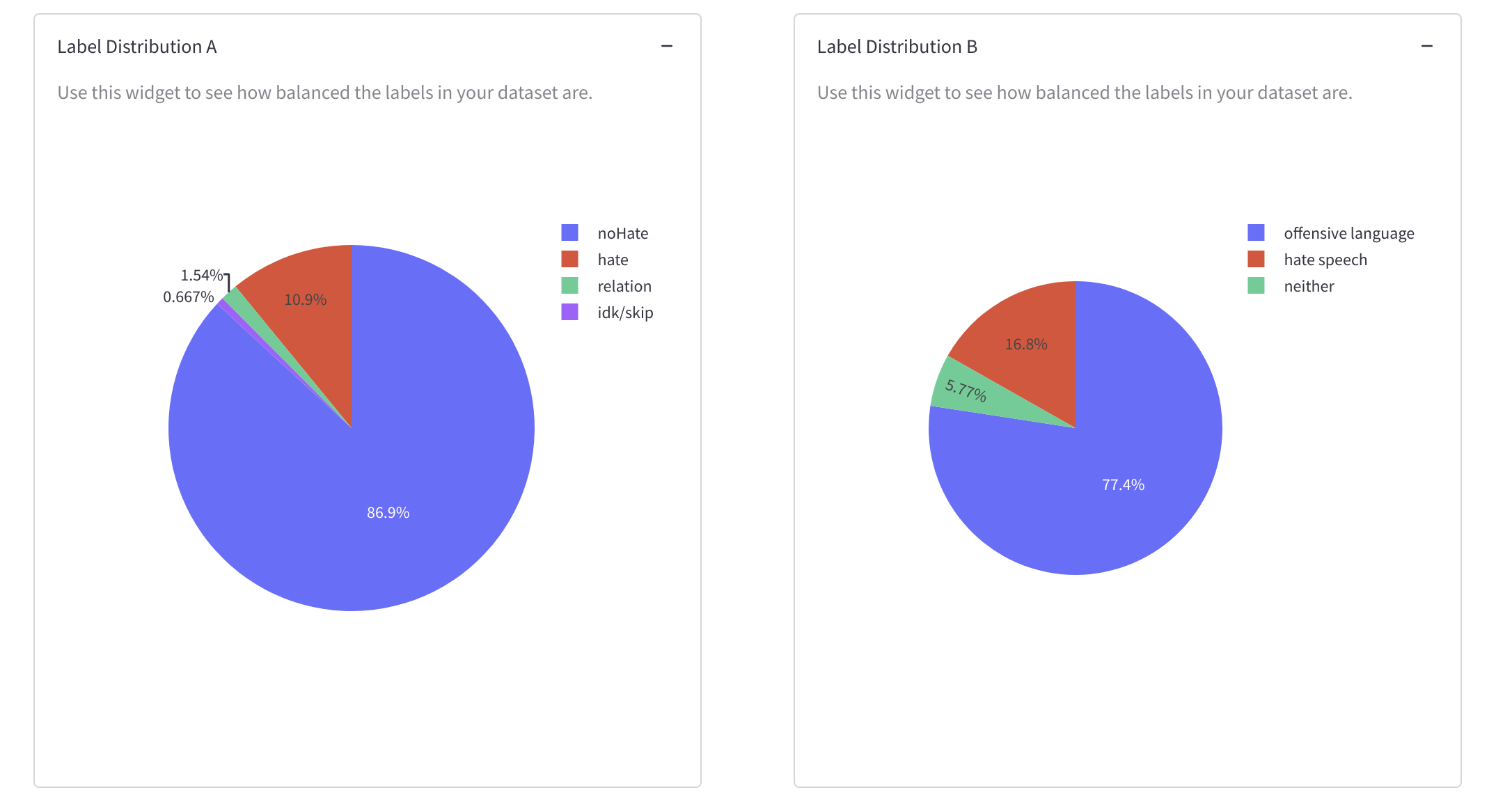
  • The dataset label distribution and information about class (im)balance. image
  • The mean, median, range, and distribution of instance lengths.

  • The number of duplicates in the dataset and how many times they are repeated.

You can use these widgets to check whether what is most and least represented in the dataset make sense for the goals of the dataset. These measurements are intended to inform whether the dataset can be useful in capturing a variety of contexts or if what it captures is more limited, and to measure how ''balanced'' the labels and instance lengths are. You can also use these widgets to identify outliers and duplicates you may want to remove.

Distributional Statistics

To measure the language patterns in the dataset

This begins to answer questions like “How does the language behave in this dataset?”
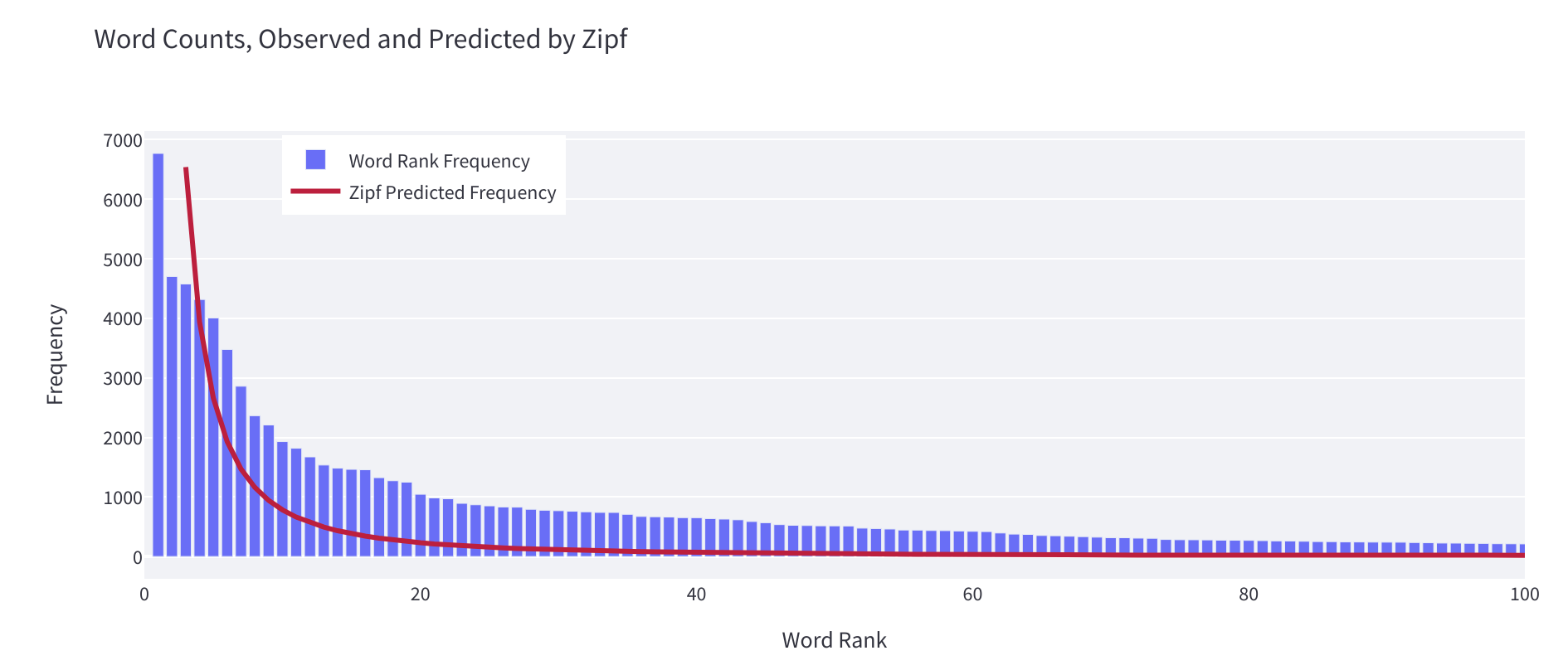
  • Adherence to Zipf’s law, which provides measurements of how closely the distribution over words in the dataset fits to the expected distribution of words in natural language.

image

You can use this to figure out whether your dataset represents language as it tends to behave in the natural world or if there are things that are more unnatural about it. If you’re someone who enjoys optimization, then you can view the alpha value this widget calculates as a value to get as close as possible to 1 during dataset development. Further details on alpha values following Zipf’s law in different languages is available here.

In general, an alpha greater than 2 or a minimum rank greater than 10 (take with a grain of salt) means that your distribution is relatively unnatural for natural language. This can be a sign of mixed artefacts in the dataset, such as HTML markup. You can use this information to clean up your dataset or to guide you in determining how further language you add to the dataset should be distributed.

Comparison statistics

This begins to answer questions like “What kinds of topics, biases, and associations are in this dataset?”

  • Embedding clusters to pinpoint any clusters of similar language in the dataset. Taking in the diversity of text represented in a dataset can be challenging when it is made up of hundreds to hundreds of thousands of sentences. Grouping these text items based on a measure of similarity can help users gain some insights into their distribution. We show a hierarchical clustering of the text fields in the dataset based on a Sentence-Transformer model and a maximum dot product single-linkage criterion. To explore the clusters, you can:

    • hover over a node to see the 5 most representative examples (deduplicated)
    • enter an example in the text box to see which leaf clusters it is most similar to
    • select a cluster by ID to show all of its examples
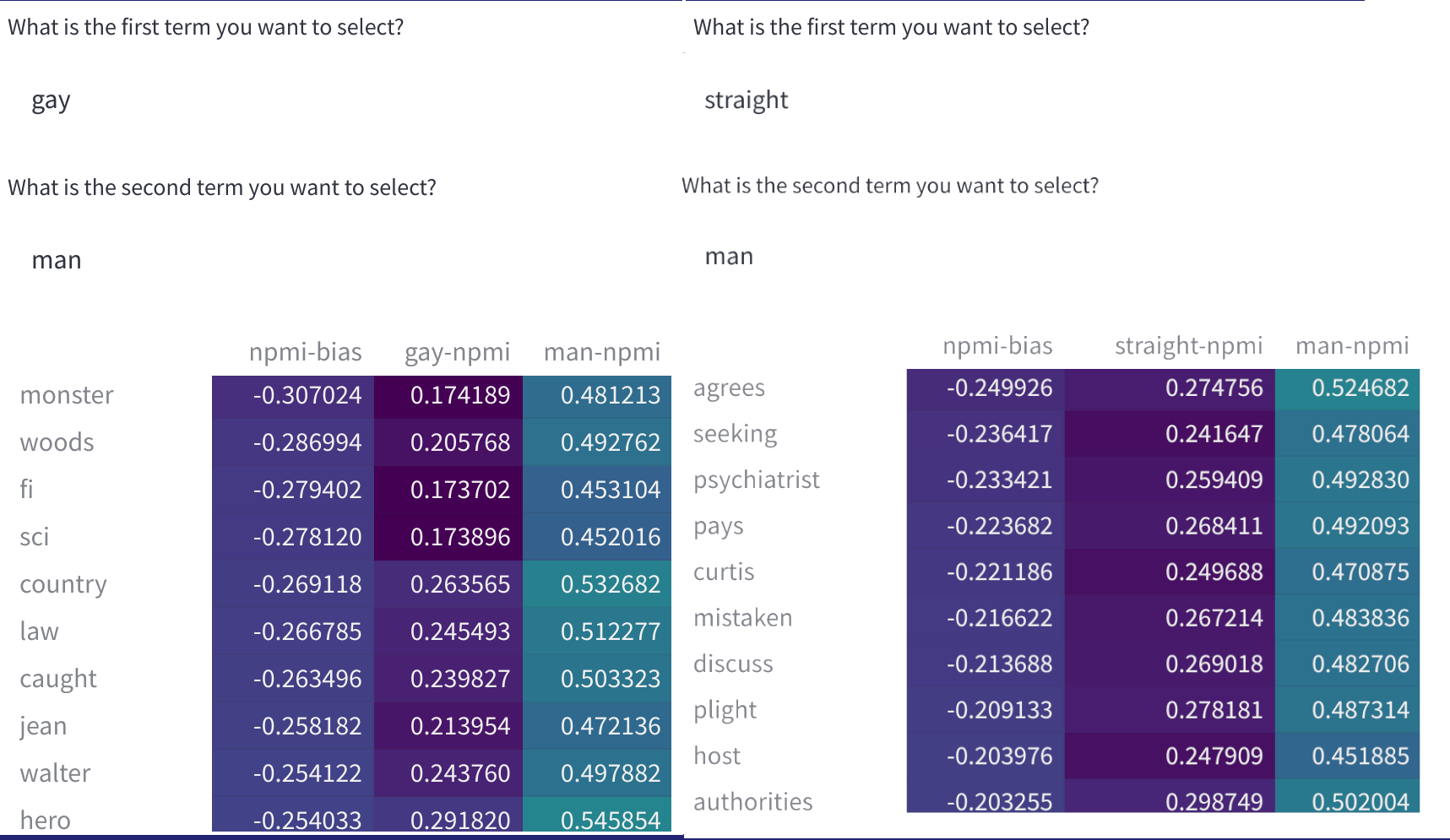
  • The normalized pointwise mutual information (nPMI) between word pairs in the dataset, which may be used to identify problematic stereotypes. You can use this as a tool in dealing with dataset “bias”, where here the term “bias” refers to stereotypes and prejudices for identity groups along the axes of gender and sexual orientation. We will add further terms in the near future.
image

What is the status of 🤗 Data Measurements Tool development?

We currently present the alpha version (v0) of the tool, demonstrating its usefulness on a handful of popular English-language datasets (e.g. SQuAD, imdb, C4, ...) available on the Dataset Hub, with the functionalities described above. The words that we selected for nPMI visualization are a subset of identity terms that came up frequently in the datasets that we were working with.

In coming weeks and months, we will be extending the tool to:

  • Cover more languages and datasets present in the 🤗 Datasets library.
  • Provide support for user-provided datasets and iterative dataset building.
  • Add more features and functionalities to the tool itself. For example, we will make it possible to add your own terms for the nPMI visualization so you can pick the words that matter most to you.

Acknowledgements

Thank you to Thomas Wolf for initiating this work, as well as other members of the 🤗 team (Quentin, Lewis, Sylvain, Nate, Julien C., Julien S., Clément, Omar, and many others!) for their help and support.