惯性聚合 高效追踪和阅读你感兴趣的博客、新闻、科技资讯
阅读原文 在惯性聚合中打开

推荐订阅源

L
LINUX DO - 热门话题
Exploit-DB.com RSS Feed
S
Security @ Cisco Blogs
W
WeLiveSecurity
N
News and Events Feed by Topic
Security Archives - TechRepublic
V2EX - 技术
V2EX - 技术
TaoSecurity Blog
TaoSecurity Blog
L
LINUX DO - 最新话题
Cloudbric
Cloudbric
S
Secure Thoughts
Recent Commits to openclaw:main
C
CXSECURITY Database RSS Feed - CXSecurity.com
Forbes - Security
Forbes - Security
奇客Solidot–传递最新科技情报
奇客Solidot–传递最新科技情报
T
The Blog of Author Tim Ferriss
博客园 - 【当耐特】
NISL@THU
NISL@THU
F
Full Disclosure
博客园_首页
Blog — PlanetScale
Blog — PlanetScale
腾讯CDC
B
Blog
cs.AI updates on arXiv.org
B
Blog RSS Feed
Jina AI
Jina AI
N
News | PayPal Newsroom
G
Google Developers Blog
P
Proofpoint News Feed
雷峰网
雷峰网
Threat Intelligence Blog | Flashpoint
P
Proofpoint News Feed
PCI Perspectives
PCI Perspectives
H
Heimdal Security Blog
GbyAI
GbyAI
Project Zero
Project Zero
Hacker News - Newest:
Hacker News - Newest: "LLM"
Y
Y Combinator Blog
S
Schneier on Security
Hacker News: Ask HN
Hacker News: Ask HN
S
Security Affairs
P
Privacy & Cybersecurity Law Blog
Attack and Defense Labs
美团技术团队
T
Threat Research - Cisco Blogs
T
Threatpost
The Hacker News
The Hacker News
C
Cisco Blogs
Last Week in AI
Last Week in AI
Google DeepMind News

Hugging Face - Blog

Waypoint-1.5: Higher-Fidelity Interactive Worlds for Everyday GPUs ALTK‑Evolve: On‑the‑Job Learning for AI Agents Safetensors is Joining the PyTorch Foundation Holo3: Breaking the Computer Use Frontier Any Custom Frontend with Gradio's Backend A New Framework for Evaluating Voice Agents (EVA) Bringing Robotics AI to Embedded Platforms: Dataset Recording, VLA Fine‑Tuning, and On‑Device Optimizations One-Shot Any Web App with Gradio's gr.HTML CUGA on Hugging Face: Democratizing Configurable AI Agents New in llama.cpp: Model Management Building Deep Research: How we Achieved State of the Art OVHcloud on Hugging Face Inference Providers 🔥 20x Faster TRL Fine-tuning with RapidFire AI Building for an Open Future - our new partnership with Google Cloud Aligning to What? Rethinking Agent Generalization in MiniMax M2 Building a Healthcare Robot from Simulation to Deployment with NVIDIA Isaac Sentence Transformers is joining Hugging Face! Unlock the power of images with AI Sheets Supercharge your OCR Pipelines with Open Models Google Cloud C4 Brings a 70% TCO improvement on GPT OSS with Intel and Hugging Face Get your VLM running in 3 simple steps on Intel CPUs Nemotron-Personas-India: Synthesized Data for Sovereign AI Introducing RTEB: A New Standard for Retrieval Evaluation Accelerating Qwen3-8B Agent on Intel® Core™ Ultra with Depth-Pruned Draft Models VibeGame: Exploring Vibe Coding Games Nemotron-Personas-Japan: ソブリン AI のための合成データセット Swift Transformers Reaches 1.0 – and Looks to the Future Smol2Operator: Post-Training GUI Agents for Computer Use SyGra: The One-Stop Framework for Building Data for LLMs and SLMs Gaia2 and ARE: Empowering the community to study agents Scaleway on Hugging Face Inference Providers 🔥 Democratizing AI Safety with RiskRubric.ai Public AI on Hugging Face Inference Providers 🔥 `LeRobotDataset:v3.0`: Bringing large-scale datasets to `lerobot` Visible Watermarking with Gradio Introducing the Palmyra-mini family: Powerful, lightweight, and ready to reason! Tricks from OpenAI gpt-oss YOU 🫵 can use with transformers Fine-tune Any LLM from the Hugging Face Hub with Together AI Jupyter Agents: training LLMs to reason with notebooks mmBERT: ModernBERT goes Multilingual Welcome EmbeddingGemma, Google's new efficient embedding model SAIR: Accelerating Pharma R&D with AI-Powered Structural Intelligence Make your ZeroGPU Spaces go brrr with ahead-of-time compilation NVIDIA Releases 6 Million Multi-Lingual Reasoning Dataset Generate Images with Claude and Hugging Face From Zero to GPU: A Guide to Building and Scaling Production-Ready CUDA Kernels MCP for Research: How to Connect AI to Research Tools Kimina-Prover-RL Arm & ExecuTorch 0.7: Bringing Generative AI to the masses Neural Super Sampling is here! TextQuests: How Good are LLMs at Text-Based Video Games? 🇵🇭 FilBench - Can LLMs Understand and Generate Filipino? Introducing AI Sheets: a tool to work with datasets using open AI models! Accelerate ND-Parallel: A guide to Efficient Multi-GPU Training Vision Language Model Alignment in TRL ⚡️ Welcome GPT OSS, the new open-source model family from OpenAI! Measuring Open-Source Llama Nemotron Models on DeepResearch Bench 📚 3LM: A Benchmark for Arabic LLMs in STEM and Code Implementing MCP Servers in Python: An AI Shopping Assistant with Gradio Introducing Trackio: A Lightweight Experiment Tracking Library from Hugging Face Say hello to `hf`: a faster, friendlier Hugging Face CLI ✨ Parquet Content-Defined Chunking TimeScope: How Long Can Your Video Large Multimodal Model Go? Fast LoRA inference for Flux with Diffusers and PEFT Accelerate a World of LLMs on Hugging Face with NVIDIA NIM Arc Virtual Cell Challenge: A Primer Consilium: When Multiple LLMs Collaborate Back to The Future: Evaluating AI Agents on Predicting Future Events Five Big Improvements to Gradio MCP Servers Ettin Suite: SoTA Paired Encoders and Decoders Migrating the Hub from Git LFS to Xet Kimina-Prover: Applying Test-time RL Search on Large Formal Reasoning Models Asynchronous Robot Inference: Decoupling Action Prediction and Execution ScreenEnv: Deploy your full stack Desktop Agent Building the Hugging Face MCP Server Reachy Mini - The Open-Source Robot for Today's and Tomorrow's AI Builders Creating custom kernels for the AMD MI300 Upskill your LLMs With Gradio MCP Servers SmolLM3: smol, multilingual, long-context reasoner Three Mighty Alerts Supporting Hugging Face’s Production Infrastructure Efficient MultiModal Data Pipeline Announcing NeurIPS 2025 E2LM Competition: Early Training Evaluation of Language Models Training and Finetuning Sparse Embedding Models with Sentence Transformers Welcome the NVIDIA Llama Nemotron Nano VLM to Hugging Face Hub Gemma 3n fully available in the open-source ecosystem! Transformers backend integration in SGLang (LoRA) Fine-Tuning FLUX.1-dev on Consumer Hardware Groq on Hugging Face Inference Providers 🔥 How Long Prompts Block Other Requests - Optimizing LLM Performance Learn the Hugging Face Kernel Hub in 5 Minutes Convert Transformers to ONNX with Hugging Face Optimum Intel and Hugging Face Partner to Democratize Machine Learning Hardware Acceleration Director of Machine Learning Insights [Part 3: Finance Edition] The Annotated Diffusion Model Deep Q-Learning with Space Invaders Graphcore and Hugging Face Launch New Lineup of IPU-Ready Transformers Introducing Pull Requests and Discussions 🥳 Efficient Table Pre-training without Real Data: An Introduction to TAPEX An Introduction to Q-Learning Part 2/2 How Sempre Health is leveraging the Expert Acceleration Program to accelerate their ML roadmap
Proximal Policy Optimization (PPO)
Thomas Simonini · 2022-08-05 · via Hugging Face - Blog

Back to Articles

Thomas Simonini's avatar

Unit 8, of the Deep Reinforcement Learning Class with Hugging Face 🤗

⚠️ A new updated version of this article is available here 👉 https://huggingface.co/deep-rl-course/unit1/introduction

This article is part of the Deep Reinforcement Learning Class. A free course from beginner to expert. Check the syllabus here. Thumbnail

⚠️ A new updated version of this article is available here 👉 https://huggingface.co/deep-rl-course/unit1/introduction

This article is part of the Deep Reinforcement Learning Class. A free course from beginner to expert. Check the syllabus here.

In the last Unit, we learned about Advantage Actor Critic (A2C), a hybrid architecture combining value-based and policy-based methods that help to stabilize the training by reducing the variance with:

  • An Actor that controls how our agent behaves (policy-based method).
  • A Critic that measures how good the action taken is (value-based method).

Today we'll learn about Proximal Policy Optimization (PPO), an architecture that improves our agent's training stability by avoiding too large policy updates. To do that, we use a ratio that will indicates the difference between our current and old policy and clip this ratio from a specific range [1ϵ,1+ϵ] [1 - \epsilon, 1 + \epsilon] .

Doing this will ensure that our policy update will not be too large and that the training is more stable.

And then, after the theory, we'll code a PPO architecture from scratch using PyTorch and bulletproof our implementation with CartPole-v1 and LunarLander-v2.

Sounds exciting? Let's get started!

The intuition behind PPO

The idea with Proximal Policy Optimization (PPO) is that we want to improve the training stability of the policy by limiting the change you make to the policy at each training epoch: we want to avoid having too large policy updates.

For two reasons:

  • We know empirically that smaller policy updates during training are more likely to converge to an optimal solution.
  • A too big step in a policy update can result in falling “off the cliff” (getting a bad policy) and having a long time or even no possibility to recover.
Policy Update cliff
Taking smaller policy updates improve the training stability
Modified version from RL — Proximal Policy Optimization (PPO) Explained by Jonathan Hui: https://jonathan-hui.medium.com/rl-proximal-policy-optimization-ppo-explained-77f014ec3f12

So with PPO, we update the policy conservatively. To do so, we need to measure how much the current policy changed compared to the former one using a ratio calculation between the current and former policy. And we clip this ratio in a range [1ϵ,1+ϵ] [1 - \epsilon, 1 + \epsilon] , meaning that we remove the incentive for the current policy to go too far from the old one (hence the proximal policy term).

Introducing the Clipped Surrogate Objective

Recap: The Policy Objective Function

Let’s remember what is the objective to optimize in Reinforce: Reinforce
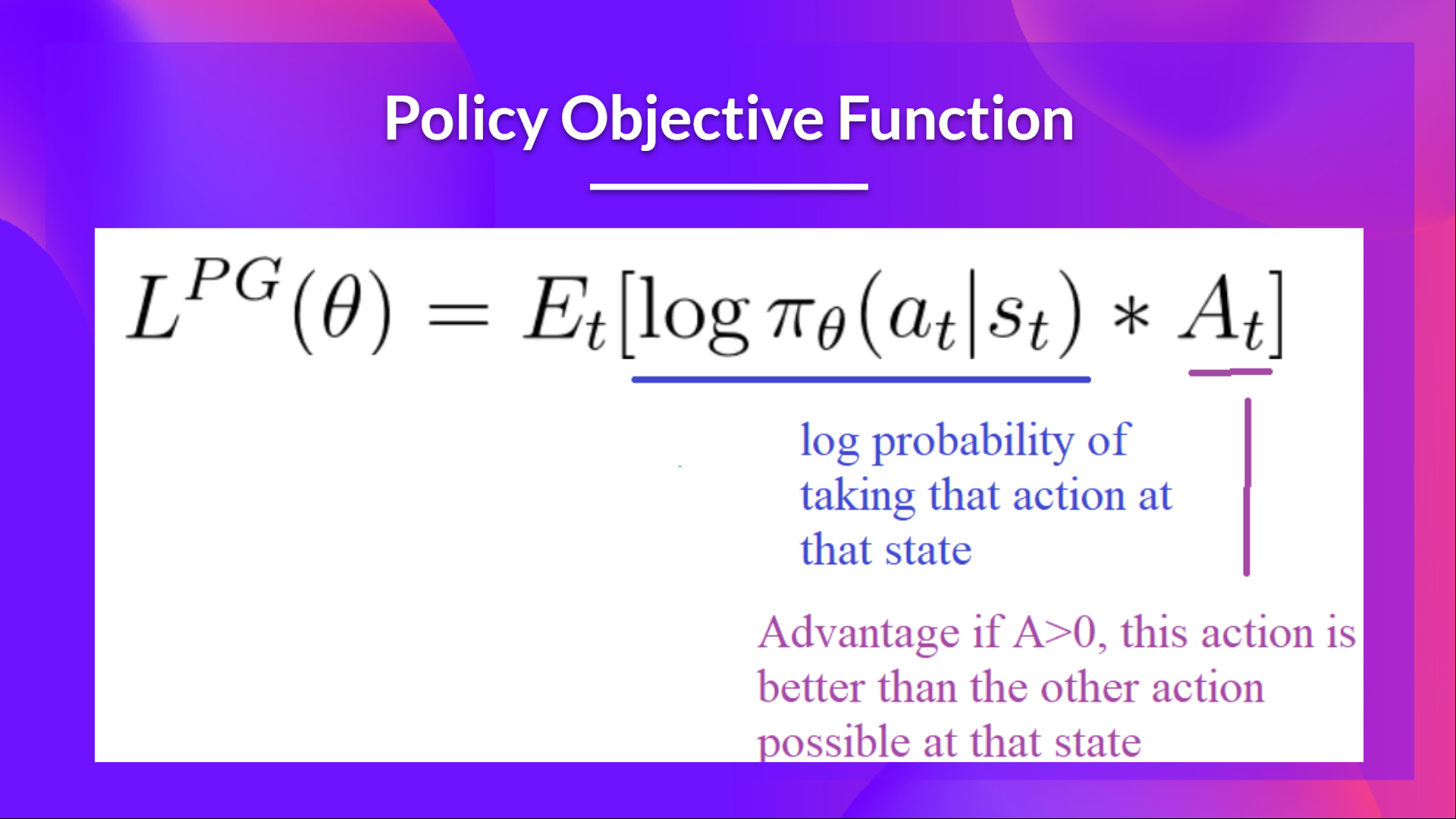
The idea was that by taking a gradient ascent step on this function (equivalent to taking gradient descent of the negative of this function), we would push our agent to take actions that lead to higher rewards and avoid harmful actions.

However, the problem comes from the step size:

  • Too small, the training process was too slow
  • Too high, there was too much variability in the training

Here with PPO, the idea is to constrain our policy update with a new objective function called the Clipped surrogate objective function that will constrain the policy change in a small range using a clip.

This new function is designed to avoid destructive large weights updates :
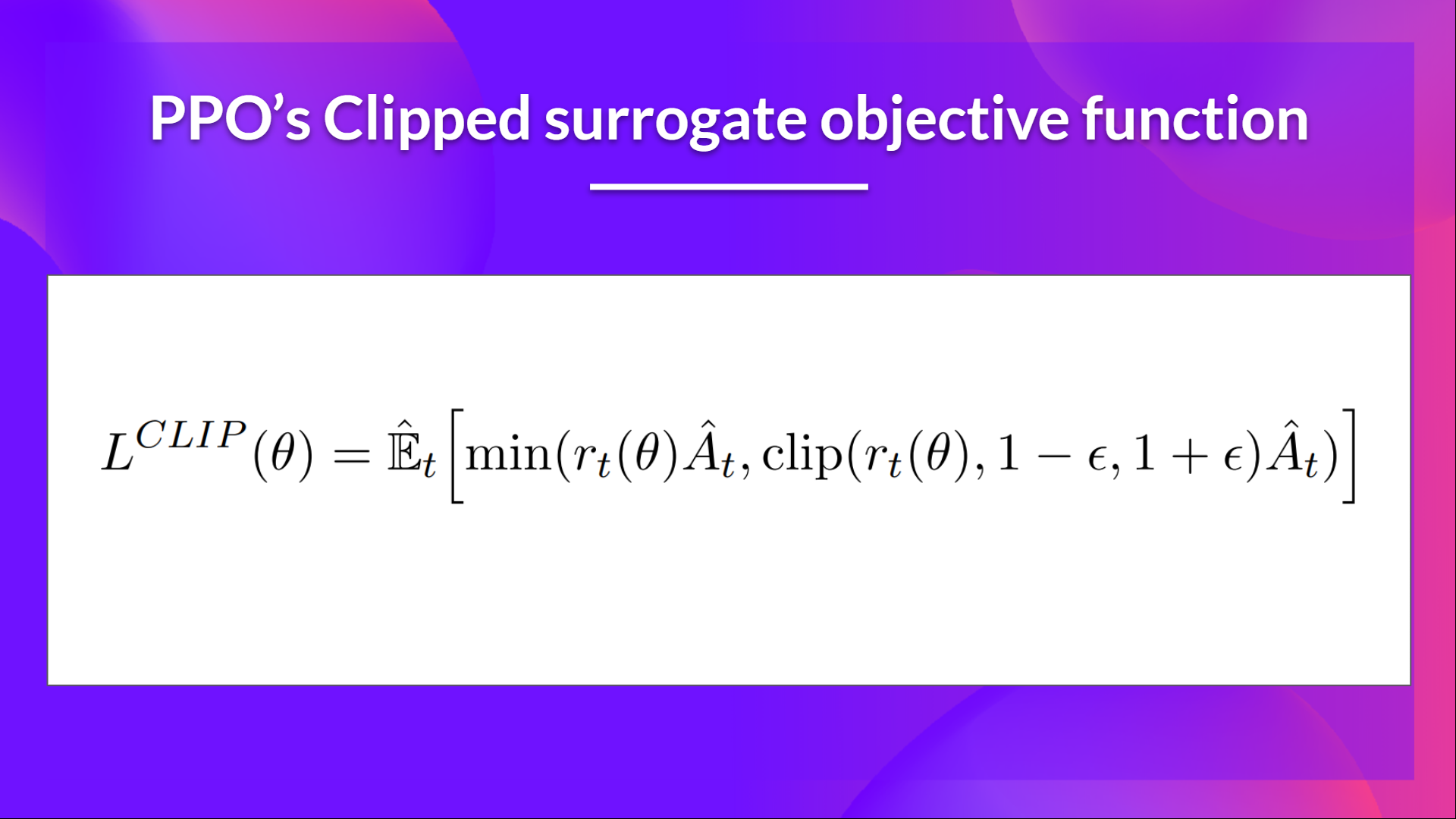
PPO surrogate function

Let’s study each part to understand how it works.
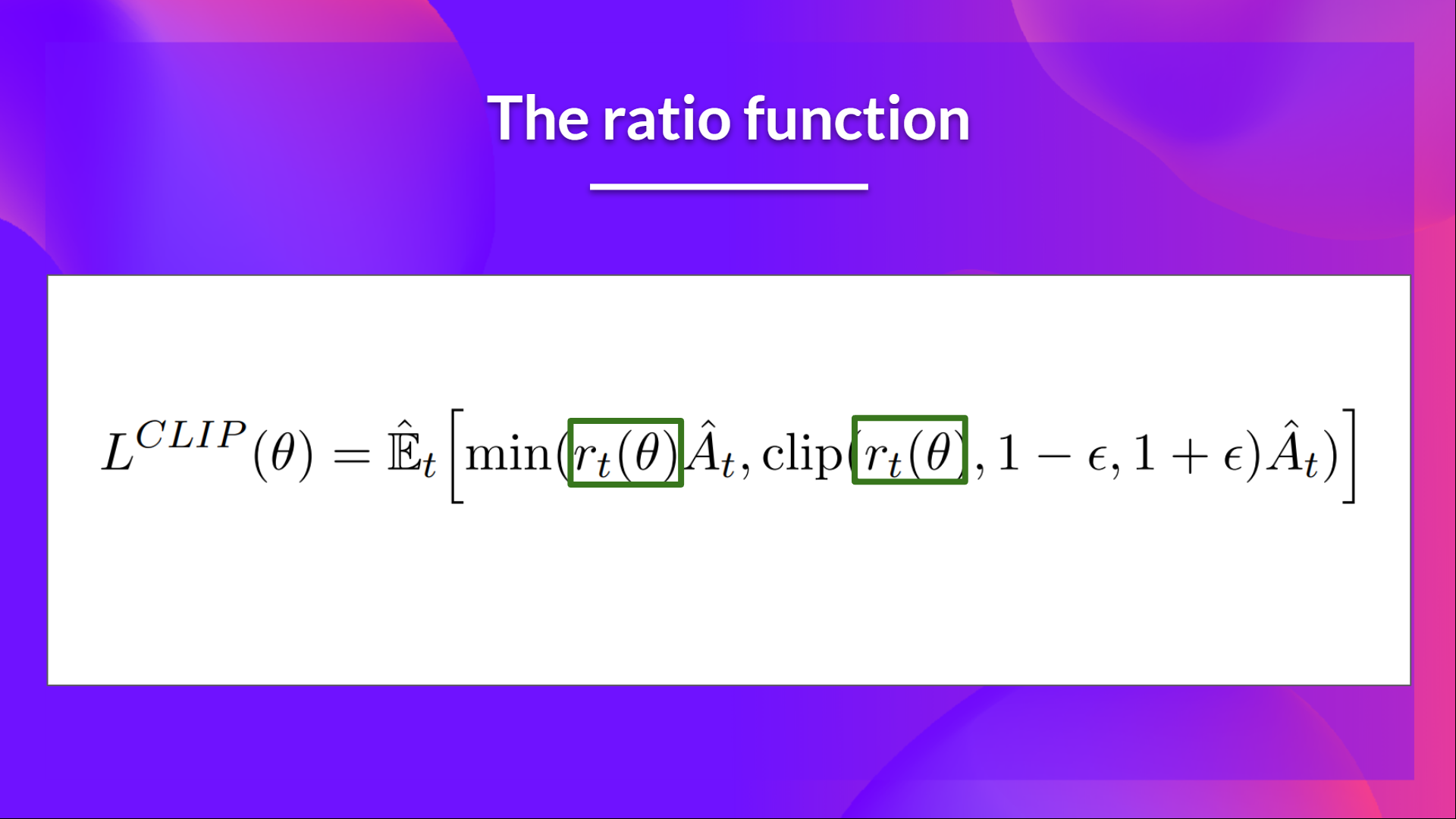
The Ratio Function

Ratio

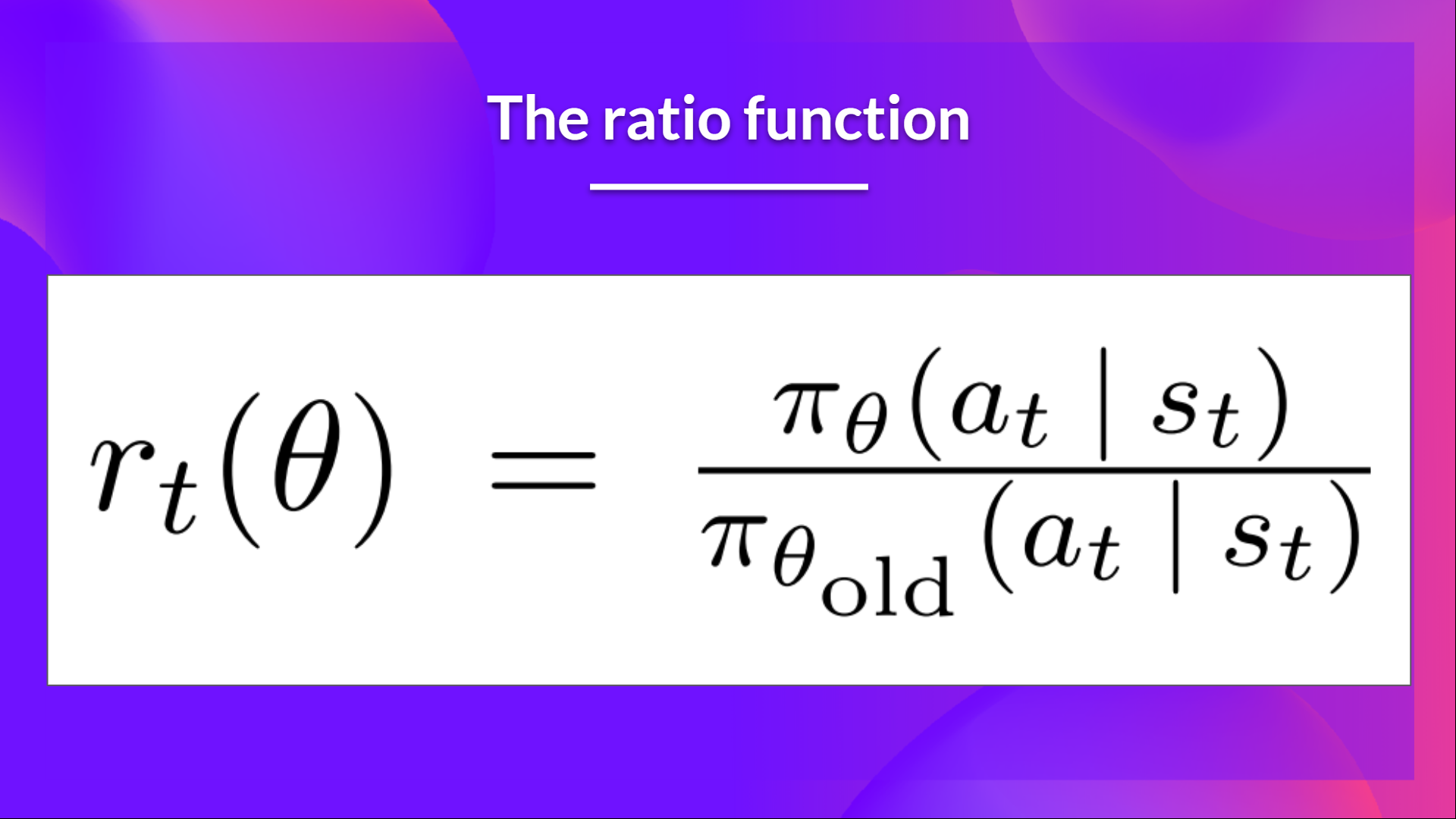
This ratio is calculated this way:

Ratio

It’s the probability of taking action at a_t at state st s_t in the current policy divided by the previous one.

As we can see, rt(θ) r_t(\theta) denotes the probability ratio between the current and old policy:

  • If rt(θ)>1 r_t(\theta) > 1 , the action at a_t at state st s_t is more likely in the current policy than the old policy.
  • If rt(θ) r_t(\theta) is between 0 and 1, the action is less likely for the current policy than for the old one.

So this probability ratio is an easy way to estimate the divergence between old and current policy.
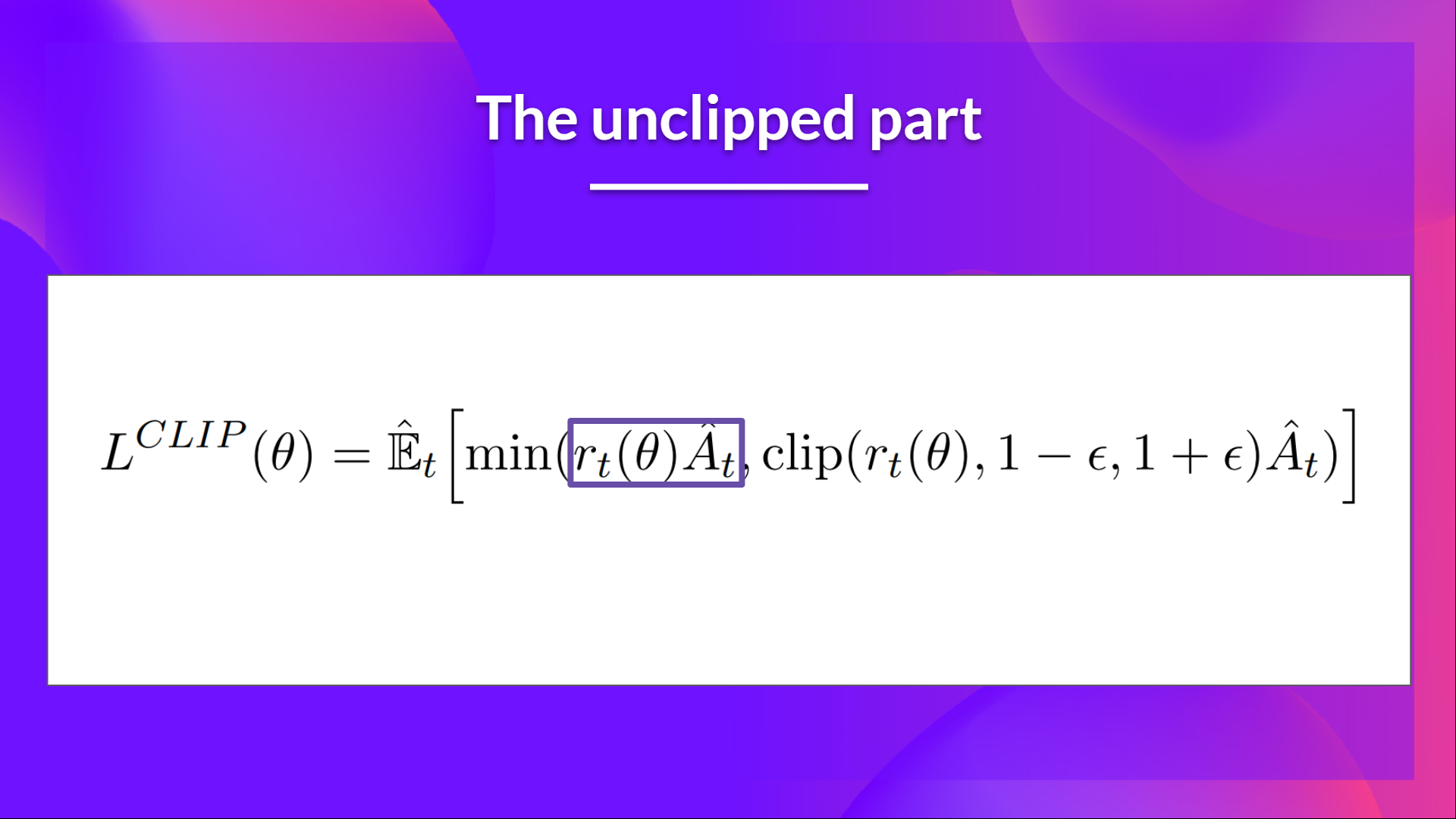
The unclipped part of the Clipped Surrogate Objective function

PPO

This ratio can replace the log probability we use in the policy objective function. This gives us the left part of the new objective function: multiplying the ratio by the advantage.
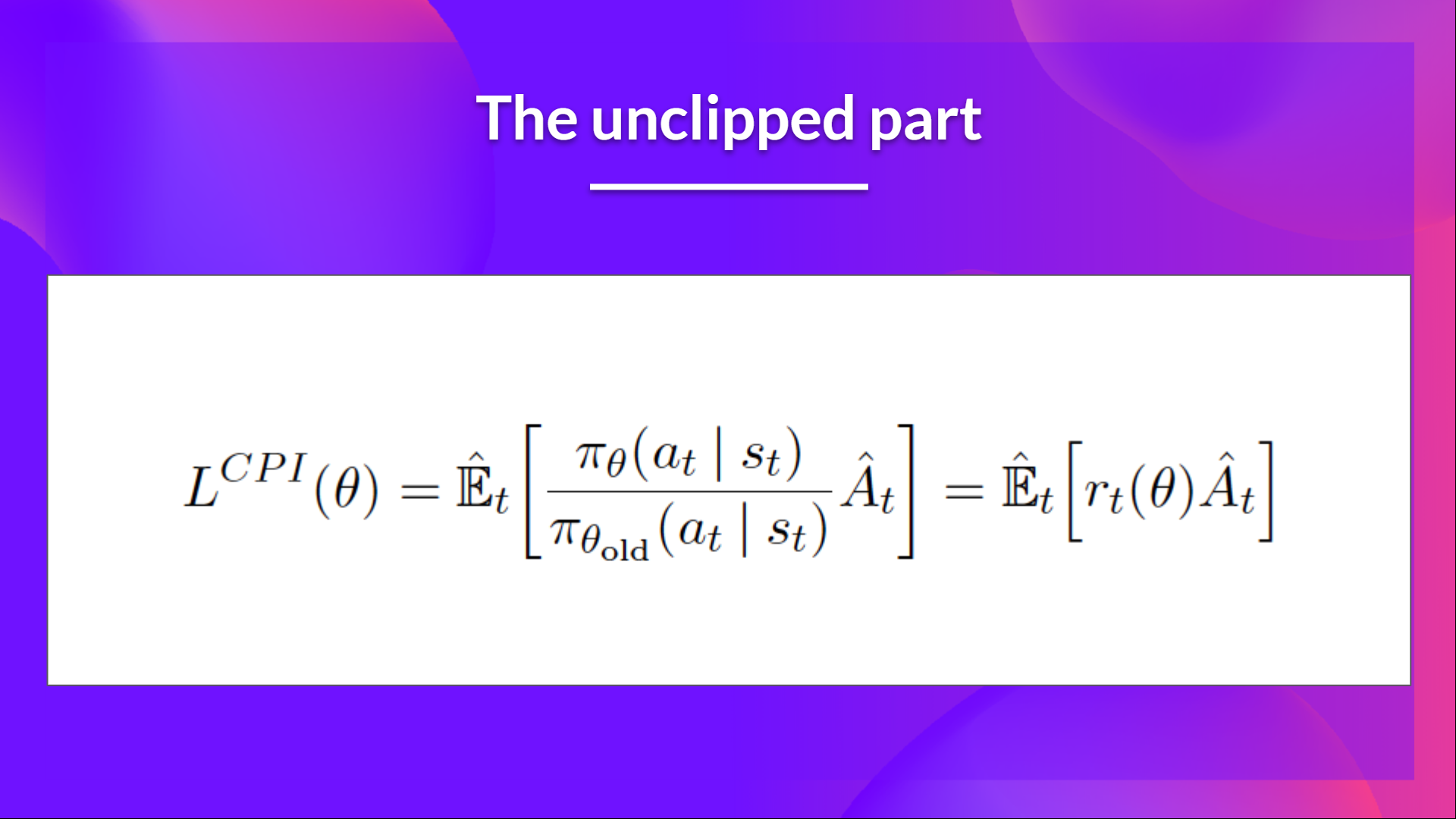
PPO
Proximal Policy Optimization Algorithms

However, without a constraint, if the action taken is much more probable in our current policy than in our former, this would lead to a significant policy gradient step and, therefore, an excessive policy update.
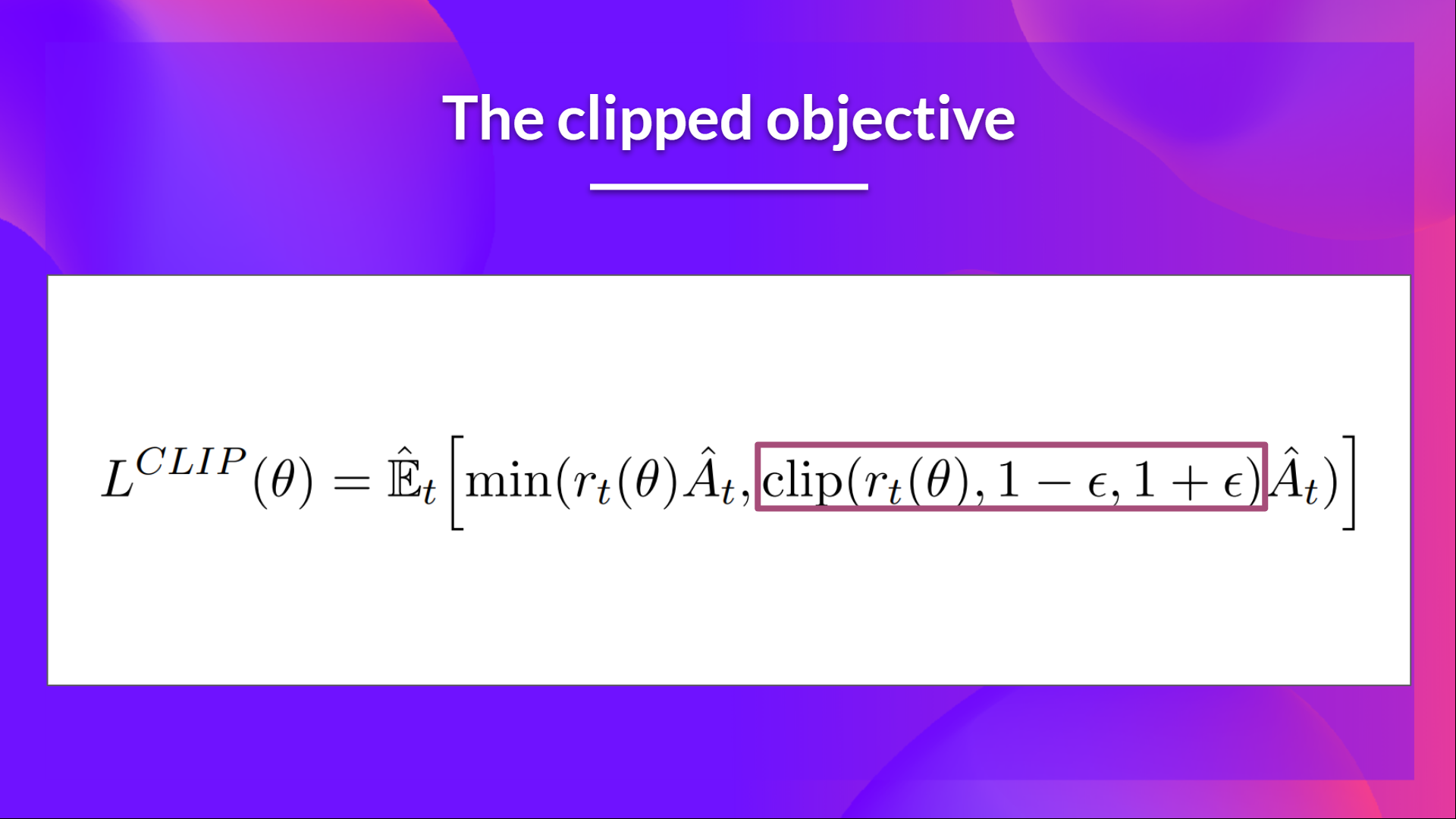
The clipped Part of the Clipped Surrogate Objective function

PPO

Consequently, we need to constrain this objective function by penalizing changes that lead to a ratio away from 1 (in the paper, the ratio can only vary from 0.8 to 1.2).

By clipping the ratio, we ensure that we do not have a too large policy update because the current policy can't be too different from the older one.

To do that, we have two solutions:

  • TRPO (Trust Region Policy Optimization) uses KL divergence constraints outside the objective function to constrain the policy update. But this method is complicated to implement and takes more computation time.
  • PPO clip probability ratio directly in the objective function with its Clipped surrogate objective function.

PPO

This clipped part is a version where rt(theta) is clipped between [1ϵ,1+ϵ] [1 - \epsilon, 1 + \epsilon] .

With the Clipped Surrogate Objective function, we have two probability ratios, one non-clipped and one clipped in a range (between [1ϵ,1+ϵ] [1 - \epsilon, 1 + \epsilon] , epsilon is a hyperparameter that helps us to define this clip range (in the paper ϵ=0.2 \epsilon = 0.2 .).

Then, we take the minimum of the clipped and non-clipped objective, so the final objective is a lower bound (pessimistic bound) of the unclipped objective.

Taking the minimum of the clipped and non-clipped objective means we'll select either the clipped or the non-clipped objective based on the ratio and advantage situation.

Visualize the Clipped Surrogate Objective

Don't worry. It's normal if this seems complex to handle right now. But we're going to see what this Clipped Surrogate Objective Function looks like, and this will help you to visualize better what's going on.
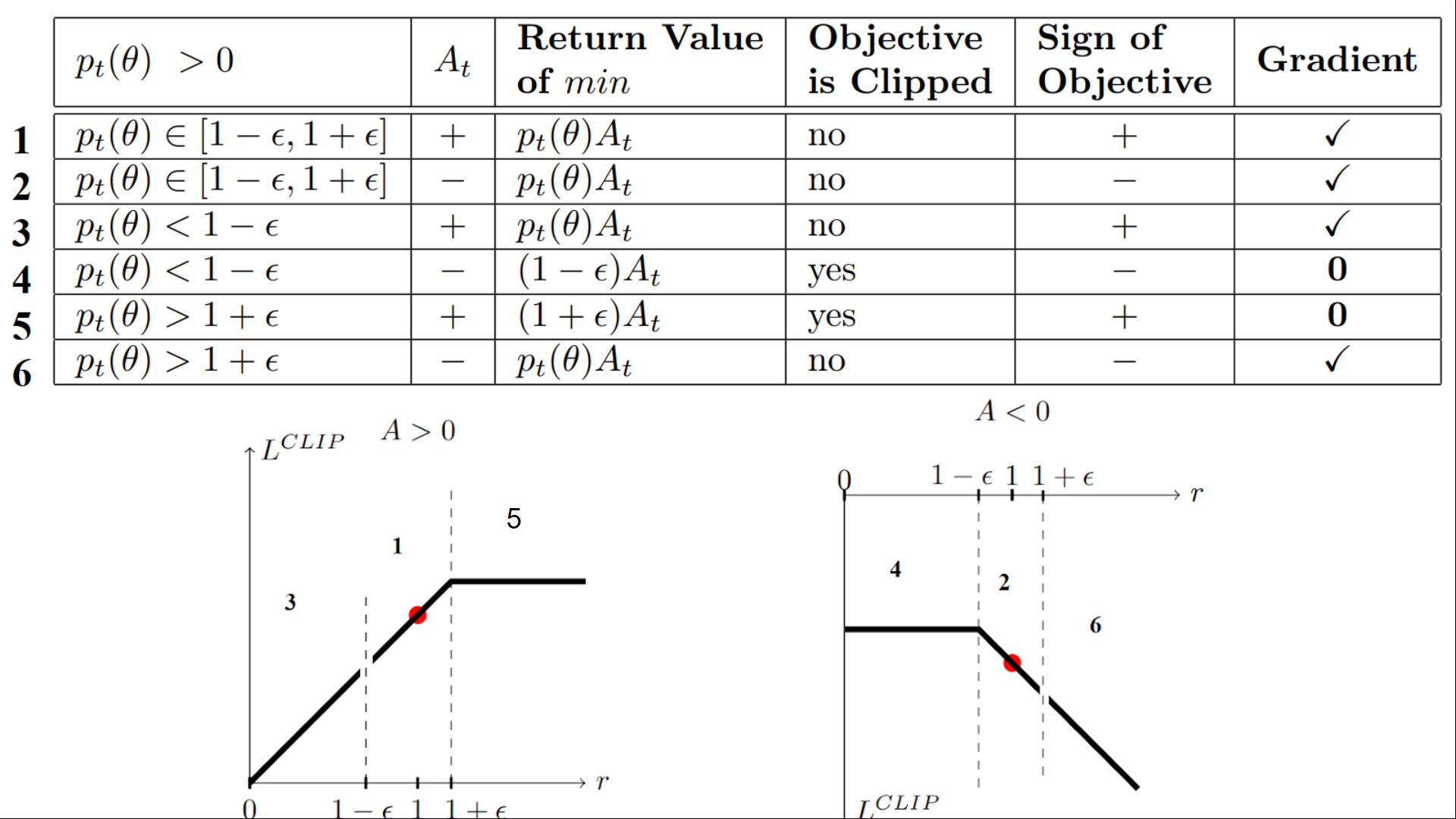
PPO
Table from "Towards Delivering a Coherent Self-Contained Explanation of Proximal Policy Optimization" by Daniel Bick

We have six different situations. Remember first that we take the minimum between the clipped and unclipped objectives.

Case 1 and 2: the ratio is between the range

In situations 1 and 2, the clipping does not apply since the ratio is between the range [1ϵ,1+ϵ] [1 - \epsilon, 1 + \epsilon]

In situation 1, we have a positive advantage: the action is better than the average of all the actions in that state. Therefore, we should encourage our current policy to increase the probability of taking that action in that state.

Since the ratio is between intervals, we can increase our policy's probability of taking that action at that state.

In situation 2, we have a negative advantage: the action is worse than the average of all actions at that state. Therefore, we should discourage our current policy from taking that action in that state.

Since the ratio is between intervals, we can decrease the probability that our policy takes that action at that state.

Case 3 and 4: the ratio is below the range

PPO
Table from "Towards Delivering a Coherent Self-Contained Explanation of Proximal Policy Optimization" by Daniel Bick

If the probability ratio is lower than [1ϵ] [1 - \epsilon] , the probability of taking that action at that state is much lower than with the old policy.

If, like in situation 3, the advantage estimate is positive (A>0), then you want to increase the probability of taking that action at that state.

But if, like situation 4, the advantage estimate is negative, we don't want to decrease further the probability of taking that action at that state. Therefore, the gradient is = 0 (since we're on a flat line), so we don't update our weights.

Case 5 and 6: the ratio is above the range

PPO
Table from "Towards Delivering a Coherent Self-Contained Explanation of Proximal Policy Optimization" by Daniel Bick

If the probability ratio is higher than [1+ϵ] [1 + \epsilon] , the probability of taking that action at that state in the current policy is much higher than in the former policy.

If, like in situation 5, the advantage is positive, we don't want to get too greedy. We already have a higher probability of taking that action at that state than the former policy. Therefore, the gradient is = 0 (since we're on a flat line), so we don't update our weights.

If, like in situation 6, the advantage is negative, we want to decrease the probability of taking that action at that state.

So if we recap, we only update the policy with the unclipped objective part. When the minimum is the clipped objective part, we don't update our policy weights since the gradient will equal 0.

So we update our policy only if:

  • Our ratio is in the range [1ϵ,1+ϵ] [1 - \epsilon, 1 + \epsilon]
  • Our ratio is outside the range, but the advantage leads to getting closer to the range
    • Being below the ratio but the advantage is > 0
    • Being above the ratio but the advantage is < 0

You might wonder why, when the minimum is the clipped ratio, the gradient is 0. When the ratio is clipped, the derivative in this case will not be the derivative of the rt(θ)At r_t(\theta) * A_t but the derivative of either (1ϵ)At (1 - \epsilon)* A_t or the derivative of (1+ϵ)At (1 + \epsilon)* A_t which both = 0.

To summarize, thanks to this clipped surrogate objective, we restrict the range that the current policy can vary from the old one. Because we remove the incentive for the probability ratio to move outside of the interval since, the clip have the effect to gradient. If the ratio is > 1+ϵ 1 + \epsilon or < 1ϵ 1 - \epsilon the gradient will be equal to 0.

The final Clipped Surrogate Objective Loss for PPO Actor-Critic style looks like this, it's a combination of Clipped Surrogate Objective function, Value Loss Function and Entropy bonus:
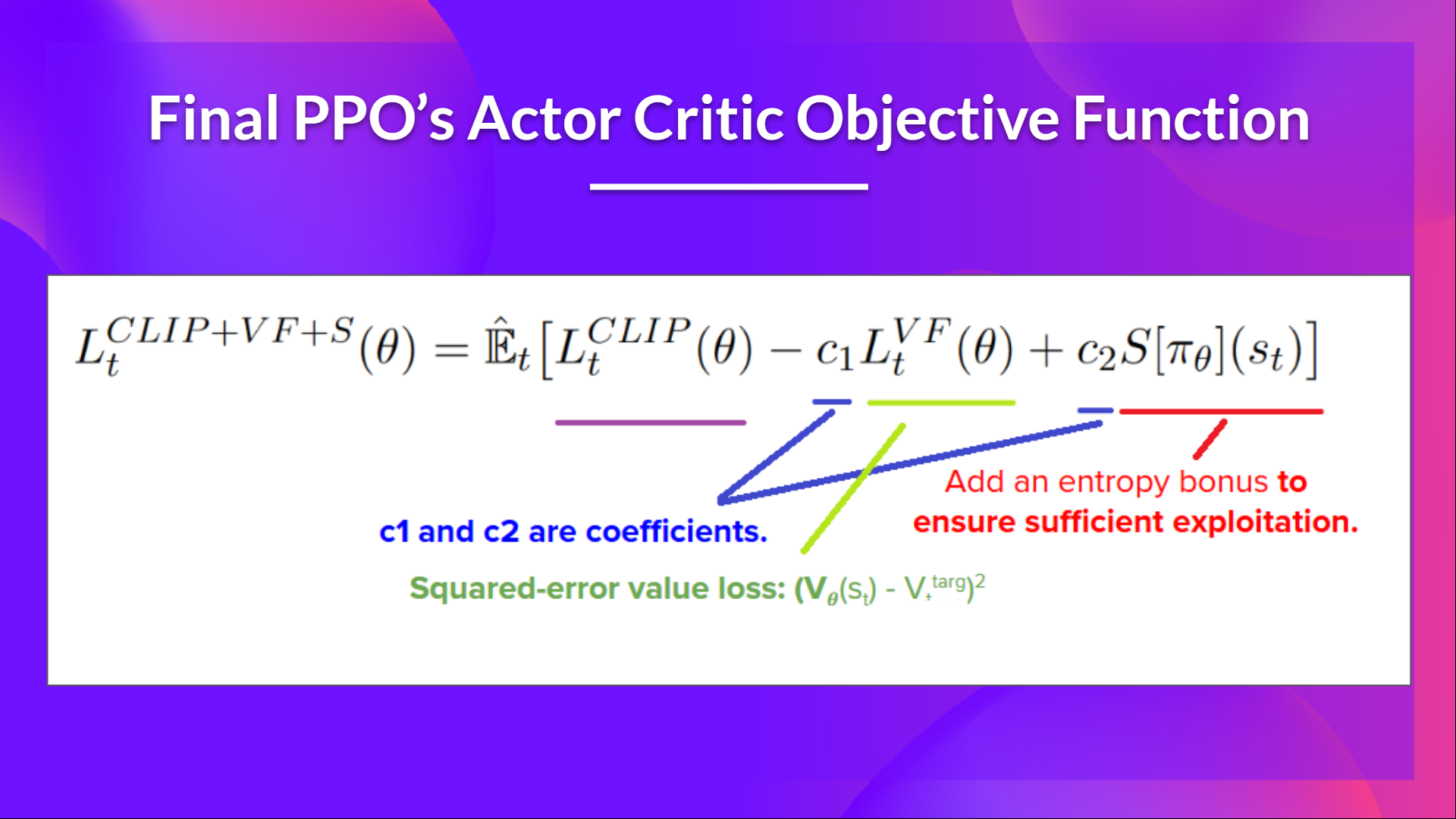
PPO objective

That was quite complex. Take time to understand these situations by looking at the table and the graph. You must understand why this makes sense. If you want to go deeper, the best resource is the article Towards Delivering a Coherent Self-Contained Explanation of Proximal Policy Optimization" by Daniel Bick, especially part 3.4.

Let's code our PPO Agent

Now that we studied the theory behind PPO, the best way to understand how it works is to implement it from scratch.

Implementing an architecture from scratch is the best way to understand it, and it's a good habit. We have already done it for a value-based method with Q-Learning and a Policy-based method with Reinforce.

So, to be able to code it, we're going to use two resources:

Then, to test its robustness, we're going to train it in 2 different classical environments:

And finally, we will be push the trained model to the Hub to evaluate and visualize your agent playing.

LunarLander-v2 is the first environment you used when you started this course. At that time, you didn't know how it worked, and now, you can code it from scratch and train it. How incredible is that 🤩.

via GIPHY

Start the tutorial here 👉 https://github.com/huggingface/deep-rl-class/blob/main/unit8/unit8.ipynb


Congrats on finishing this chapter! There was a lot of information. And congrats on finishing the tutorial. 🥳, this was one of the hardest of the course.

Don't hesitate to train your agent in other environments. The best way to learn is to try things on your own!

I want you to think about your progress since the first Unit. With these eight units, you've built a strong background in Deep Reinforcement Learning. Congratulations!

But this is not the end, even if the foundations part of the course is finished, this is not the end of the journey. We're working on new elements:

  • Adding new environments and tutorials.
  • A section about multi-agents (self-play, collaboration, competition).
  • Another one about offline RL and Decision Transformers.
  • Paper explained articles.
  • And more to come.

The best way to keep in touch is to sign up for the course so that we keep you updated 👉 http://eepurl.com/h1pElX

And don't forget to share with your friends who want to learn 🤗!

Finally, with your feedback, we want to improve and update the course iteratively. If you have some, please fill this form 👉 https://forms.gle/3HgA7bEHwAmmLfwh9

See you next time!

Keep learning, stay awesome 🤗,