





惯性聚合 高效追踪和阅读你感兴趣的博客、新闻、科技资讯
阅读原文 在惯性聚合中打开

推荐订阅源

T
Threatpost
AI
AI
T
Threat Research - Cisco Blogs
Know Your Adversary
Know Your Adversary
C
CERT Recently Published Vulnerability Notes
V
Vulnerabilities – Threatpost
S
Securelist
cs.CL updates on arXiv.org
T
Tenable Blog
C
Cybersecurity and Infrastructure Security Agency CISA
AWS News Blog
AWS News Blog
Cisco Talos Blog
Cisco Talos Blog
Cloudbric
Cloudbric
P
Privacy & Cybersecurity Law Blog
N
News and Events Feed by Topic
D
Docker
博客园 - 司徒正美
Last Week in AI
Last Week in AI
Google DeepMind News
O
OpenAI News
人人都是产品经理
人人都是产品经理
腾讯CDC
博客园 - 三生石上(FineUI控件)
奇客Solidot–传递最新科技情报
奇客Solidot–传递最新科技情报
Scott Helme
Scott Helme
freeCodeCamp Programming Tutorials: Python, JavaScript, Git & More
The GitHub Blog
The GitHub Blog
Microsoft Security Blog
Threat Intelligence Blog | Flashpoint
cs.CV updates on arXiv.org
博客园 - 叶小钗
N
News and Events Feed by Topic
J
Java Code Geeks
D
DataBreaches.Net
爱范儿
爱范儿
N
Netflix TechBlog - Medium
OSCHINA 社区最新新闻
OSCHINA 社区最新新闻
IT之家
IT之家
H
Heimdal Security Blog
F
Full Disclosure
L
LINUX DO - 最新话题
W
WeLiveSecurity
Blog — PlanetScale
Blog — PlanetScale
V
V2EX
M
MIT News - Artificial intelligence
Apple Machine Learning Research
博客园 - Franky
K
KPMG report finds enterprise disconnect between AI and its ROI | CIO
钛媒体:引领未来商业与生活新知
钛媒体:引领未来商业与生活新知
U
Unit 42

Hugging Face - Blog

Waypoint-1.5: Higher-Fidelity Interactive Worlds for Everyday GPUs Safetensors is Joining the PyTorch Foundation Holo3: Breaking the Computer Use Frontier Any Custom Frontend with Gradio's Backend A New Framework for Evaluating Voice Agents (EVA) Bringing Robotics AI to Embedded Platforms: Dataset Recording, VLA Fine‑Tuning, and On‑Device Optimizations One-Shot Any Web App with Gradio's gr.HTML CUGA on Hugging Face: Democratizing Configurable AI Agents New in llama.cpp: Model Management Building Deep Research: How we Achieved State of the Art OVHcloud on Hugging Face Inference Providers 🔥 20x Faster TRL Fine-tuning with RapidFire AI Building for an Open Future - our new partnership with Google Cloud Aligning to What? Rethinking Agent Generalization in MiniMax M2 Building a Healthcare Robot from Simulation to Deployment with NVIDIA Isaac Sentence Transformers is joining Hugging Face! Unlock the power of images with AI Sheets Supercharge your OCR Pipelines with Open Models Google Cloud C4 Brings a 70% TCO improvement on GPT OSS with Intel and Hugging Face Get your VLM running in 3 simple steps on Intel CPUs Nemotron-Personas-India: Synthesized Data for Sovereign AI Introducing RTEB: A New Standard for Retrieval Evaluation Accelerating Qwen3-8B Agent on Intel® Core™ Ultra with Depth-Pruned Draft Models VibeGame: Exploring Vibe Coding Games Nemotron-Personas-Japan: ソブリン AI のための合成データセット Swift Transformers Reaches 1.0 – and Looks to the Future Smol2Operator: Post-Training GUI Agents for Computer Use SyGra: The One-Stop Framework for Building Data for LLMs and SLMs Gaia2 and ARE: Empowering the community to study agents Scaleway on Hugging Face Inference Providers 🔥 Democratizing AI Safety with RiskRubric.ai Public AI on Hugging Face Inference Providers 🔥 `LeRobotDataset:v3.0`: Bringing large-scale datasets to `lerobot` Visible Watermarking with Gradio Introducing the Palmyra-mini family: Powerful, lightweight, and ready to reason! Tricks from OpenAI gpt-oss YOU 🫵 can use with transformers Fine-tune Any LLM from the Hugging Face Hub with Together AI Jupyter Agents: training LLMs to reason with notebooks mmBERT: ModernBERT goes Multilingual Welcome EmbeddingGemma, Google's new efficient embedding model SAIR: Accelerating Pharma R&D with AI-Powered Structural Intelligence Make your ZeroGPU Spaces go brrr with ahead-of-time compilation NVIDIA Releases 6 Million Multi-Lingual Reasoning Dataset Generate Images with Claude and Hugging Face From Zero to GPU: A Guide to Building and Scaling Production-Ready CUDA Kernels MCP for Research: How to Connect AI to Research Tools Kimina-Prover-RL Arm & ExecuTorch 0.7: Bringing Generative AI to the masses Neural Super Sampling is here! TextQuests: How Good are LLMs at Text-Based Video Games? 🇵🇭 FilBench - Can LLMs Understand and Generate Filipino? Introducing AI Sheets: a tool to work with datasets using open AI models! Accelerate ND-Parallel: A guide to Efficient Multi-GPU Training Vision Language Model Alignment in TRL ⚡️ Welcome GPT OSS, the new open-source model family from OpenAI! Measuring Open-Source Llama Nemotron Models on DeepResearch Bench 📚 3LM: A Benchmark for Arabic LLMs in STEM and Code Implementing MCP Servers in Python: An AI Shopping Assistant with Gradio Introducing Trackio: A Lightweight Experiment Tracking Library from Hugging Face Say hello to `hf`: a faster, friendlier Hugging Face CLI ✨ Parquet Content-Defined Chunking TimeScope: How Long Can Your Video Large Multimodal Model Go? Fast LoRA inference for Flux with Diffusers and PEFT Accelerate a World of LLMs on Hugging Face with NVIDIA NIM Arc Virtual Cell Challenge: A Primer Consilium: When Multiple LLMs Collaborate Back to The Future: Evaluating AI Agents on Predicting Future Events Five Big Improvements to Gradio MCP Servers Ettin Suite: SoTA Paired Encoders and Decoders Migrating the Hub from Git LFS to Xet Kimina-Prover: Applying Test-time RL Search on Large Formal Reasoning Models Asynchronous Robot Inference: Decoupling Action Prediction and Execution ScreenEnv: Deploy your full stack Desktop Agent Building the Hugging Face MCP Server Reachy Mini - The Open-Source Robot for Today's and Tomorrow's AI Builders Creating custom kernels for the AMD MI300 Upskill your LLMs With Gradio MCP Servers SmolLM3: smol, multilingual, long-context reasoner Three Mighty Alerts Supporting Hugging Face’s Production Infrastructure Efficient MultiModal Data Pipeline Announcing NeurIPS 2025 E2LM Competition: Early Training Evaluation of Language Models Training and Finetuning Sparse Embedding Models with Sentence Transformers Welcome the NVIDIA Llama Nemotron Nano VLM to Hugging Face Hub Gemma 3n fully available in the open-source ecosystem! Transformers backend integration in SGLang (LoRA) Fine-Tuning FLUX.1-dev on Consumer Hardware Groq on Hugging Face Inference Providers 🔥 How Long Prompts Block Other Requests - Optimizing LLM Performance Learn the Hugging Face Kernel Hub in 5 Minutes Featherless AI on Hugging Face Inference Providers 🔥 Convert Transformers to ONNX with Hugging Face Optimum Intel and Hugging Face Partner to Democratize Machine Learning Hardware Acceleration Director of Machine Learning Insights [Part 3: Finance Edition] The Annotated Diffusion Model Deep Q-Learning with Space Invaders Graphcore and Hugging Face Launch New Lineup of IPU-Ready Transformers Introducing Pull Requests and Discussions 🥳 Efficient Table Pre-training without Real Data: An Introduction to TAPEX An Introduction to Q-Learning Part 2/2 How Sempre Health is leveraging the Expert Acceleration Program to accelerate their ML roadmap
ALTK‑Evolve: On‑the‑Job Learning for AI Agents
2026-04-08 · via Hugging Face - Blog

Back to Articles

Vatche Isahagian's avatar

Vinod Muthusamy's avatar

Jayaram Radhakrishnan's avatar

Gaodan Fang's avatar

Punleuk Oum's avatar

G Thomas's avatar

Ayhan Sebin's avatar

TL;DR

  • Most AI agents re‑read transcripts instead of learning principles, so they repeat mistakes and don’t transfer lessons to new situations.
  • ALTK‑Evolve turns raw agent trajectories into reusable guidelines.
  • In benchmarks, the approach boosted reliability, especially on hard (Δ 14.2% on AppWorld), multi‑step tasks, without bloating context.

The “eternal intern” problem

Imagine a brilliant line cook who has memorized every cookbook but forgets your kitchen every morning. They don’t remember your oven runs hot, or that regulars like extra salt; they’ll follow a recipe card yet freeze when you’re out of lemons. That’s most AI agents: excellent at following prompts, poor at accumulating wisdom about your environment. Feeding yesterday’s logs back into the prompt just makes them re‑read history; it doesn’t help them generalize from it.

A junior needs different recipes for “vinaigrette” and “duck à l’orange.” A chef learns “acid balances fat” and applies it everywhere. Likewise, reliable agents should distill principles from experience and apply them to new tasks, not just near duplicates of old ones. This long‑term memory subsystem does exactly that: it converts interaction traces into candidate guidelines, filters for quality, and injects only relevant guidance at the moment of action. Agents need principles, not transcripts.

A recent MIT study found that 95% of pilots fail because agents don't adapt and learn on the job. ALTK-Evolve addresses this learning gap using long term episodic memory to help agents reason better.

Solution: long term memory with ALTK-Evolve

Evolve is a memory system for AI agents, that can help agents improve over time, learning from and using guidelines generated from previous executions.

Operationally, the system runs as a continuous loop:
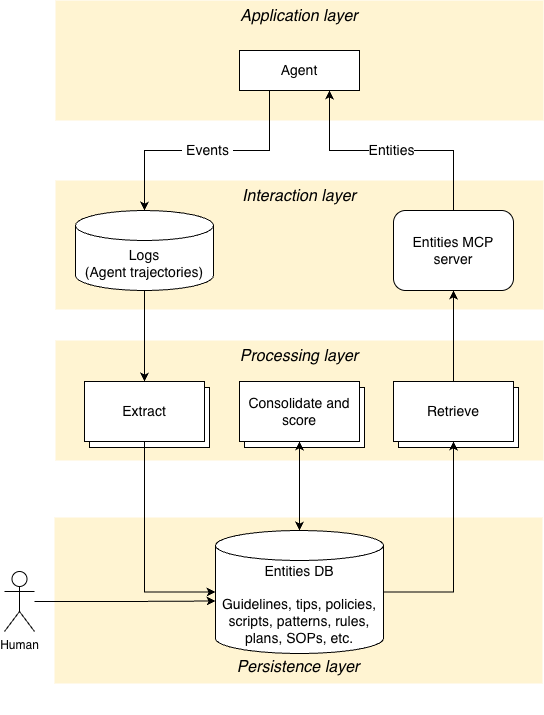
  1. Downward flow (observation & extraction): Capture full agent trajectories (user utterances, thoughts, tool calls, results) in an Interaction Layer (e.g., Langfuse or another OpenTelemetry‑based observability tool). Pluggable extractors mine traces for structural patterns and persist them as candidate entities.
  2. Upward flow (refinement & retrieval): A background consolidate‑and‑score job merges duplicates, prunes weak rules, and boosts proven strategies, evolving a high‑quality library of entities such as guidelines, policies, and SOPs. Retrieval pulls only the relevant items via the Interaction Layer and injects them back into context at the Application Layer.

architecture (1)

This approach works for a few key reasons:

  • Teaches judgment: Converts one‑off events into portable strategies that transfer across tasks.
  • Controls noise: Scoring keeps memory lean and useful, not a growing junk drawer.
  • Progressive Disclosure: Retrieval is just‑in‑time, not stuffing everything into the context.

Results: better reliability, especially on hard tasks

We evaluated the framework on AppWorld, where agents complete realistic multi‑step tasks via APIs, averaging 9.5 APIs across 1.8 apps, with hard cases requiring more complex control flow. A ReAct agent received the task instruction plus the top 5 retrieved guidelines generated on a prior run (train/dev) and tested on an unseen partition (test-normal). We report Scenario Goal Completion (SGC), a strict consistency metric requiring success across variants.

Difficulty Baseline SGC + Memory Δ
Easy 79.0% 84.2% +5.2
Medium 56.2% 62.5% +6.3
Hard 19.1% 33.3% +14.2
Aggregate 50.0% 58.9% +8.9

Here are some key conclusions from the evaluations:

  • Generalization: The agent improves on the unseen Test‑Normal tasks, evidence that it’s learning principles, not memorizing recipes.
  • Complexity scaling: The harder the task, the more the agent benefits from concise learned guidelines, with the largest lift on the more difficult tasks. The Hard tasks saw a 74% relative increase in success, where guidelines are useful to navigate the intricate control flows.
  • Consistency: SGC gains exceeded raw pass‑rate improvements, reducing “flaky” behavior across scenario variants. The guidelines don’t just help the agent solve tasks, they help them solve them reliably across variants.

Find more details about the experiments in the paper at https://arxiv.org/abs/2603.10600.

Getting started (choose your path)

You have a choice in how to integrate ALTK‑Evolve into your agent.

No‑code with Claude Code, Codex, and IBM Bob (Lite mode)

Install the plugin into Claude Code:

claude plugin marketplace add AgentToolkit/altk-evolve
claude plugin install evolve-lite@evolve-marketplace

That’s it! The plugin extracts entities from trajectories and stores them as files on your filesystem. It uses Claude Code’s hooks for automatic retrieval.

Prefer to watch instead of read? See the short Evolve-Lite Claude Code walkthrough (video): Demo

Check out the walkthroughs here for examples of how to learn with Claude Code in Lite mode.

Lite mode is easy to test‑drive but has limitations. For example, it doesn’t glean insights from across agent sessions or perform consolidation and garbage collection of entities. The low‑code and pro‑code versions below address these limitations.

There are also one-step integrations with Codex and IBM Bob. Try them out!

Low‑code with a ReAct agent

Add a single altk_evolve.auto import and flip a flag to emit traces to an Arize Phoenix UI. Then sync traces to generate improvement guidelines without changing your current stack. It works with popular LLM clients and agent frameworks (e.g., OpenAI, LiteLLM, and Hugging Face agents), so you keep your current stack and simply gain visibility.

To see just how easily this fits into existing projects, explore our hands‑on examples showcasing different framework integrations. For full details on configuration and capabilities, read our low‑code tracing documentation.

Pro‑code with CUGA

We integrated ALTK‑Evolve directly into CUGA via MCP to create a tight, low‑overhead learning loop. Before each run, the get_guidelines MCP tool is called to surface task‑specific steering and reduce trial‑and‑error. After the run, CUGA sends back structured execution traces via save_trajectory, so Evolve can learn from what actually happened and improve future guidance. The result is an integration that gets better over time while staying transparent, composable, and easy to adopt.

Prefer a visual tour? Watch the CUGA integration walkthrough: video

Try it & tell us what your agent learned

Your agent shouldn’t wake up as an intern every morning. This approach helps it learn on the job. If you're using Claude Code, Codex, and IBM Bob, try it out in minutes and see how it improves your agent.

Star the repo, it helps others discover the project and directly guides what we build next.

Watch the demos

  • Claude Code walkthrough (video): Demo
  • OpenAI Codex walkthrough (video): Demo
  • IBM Bob demo walkthrough (video): Demo
  • CUGA integration walkthrough: video