


惯性聚合 高效追踪和阅读你感兴趣的博客、新闻、科技资讯
阅读原文 在惯性聚合中打开

推荐订阅源

Threat Intelligence Blog | Flashpoint
V
Vulnerabilities – Threatpost
L
LINUX DO - 热门话题
H
Hacker News: Front Page
Hacker News - Newest:
Hacker News - Newest: "LLM"
L
Lohrmann on Cybersecurity
Cisco Talos Blog
Cisco Talos Blog
O
OpenAI News
S
Securelist
Security Latest
Security Latest
T
Threat Research - Cisco Blogs
H
Heimdal Security Blog
C
CXSECURITY Database RSS Feed - CXSecurity.com
CTFtime.org: upcoming CTF events
Recorded Future
Recorded Future
Microsoft Azure Blog
MyScale Blog
MyScale Blog
Webroot Blog
Webroot Blog
The Hacker News
The Hacker News
Google Online Security Blog
Latest news
Latest news
N
Netflix TechBlog - Medium
N
News and Events Feed by Topic
D
Docker
D
DataBreaches.Net
A
About on SuperTechFans
T
Tor Project blog
V
V2EX
G
Google Developers Blog
博客园 - Franky
N
News | PayPal Newsroom
T
The Blog of Author Tim Ferriss
I
InfoQ
H
Help Net Security
V2EX - 技术
V2EX - 技术
cs.CL updates on arXiv.org
S
Security Affairs
SecWiki News
SecWiki News
The Register - Security
人人都是产品经理
人人都是产品经理
NISL@THU
NISL@THU
小众软件
小众软件
B
Blog
T
Threatpost
P
Palo Alto Networks Blog
博客园 - 【当耐特】
L
LangChain Blog
AWS News Blog
AWS News Blog
月光博客
月光博客
宝玉的分享
宝玉的分享

Hugging Face - Blog

Waypoint-1.5: Higher-Fidelity Interactive Worlds for Everyday GPUs ALTK‑Evolve: On‑the‑Job Learning for AI Agents Safetensors is Joining the PyTorch Foundation Holo3: Breaking the Computer Use Frontier Any Custom Frontend with Gradio's Backend A New Framework for Evaluating Voice Agents (EVA) Bringing Robotics AI to Embedded Platforms: Dataset Recording, VLA Fine‑Tuning, and On‑Device Optimizations One-Shot Any Web App with Gradio's gr.HTML CUGA on Hugging Face: Democratizing Configurable AI Agents New in llama.cpp: Model Management Building Deep Research: How we Achieved State of the Art OVHcloud on Hugging Face Inference Providers 🔥 20x Faster TRL Fine-tuning with RapidFire AI Building for an Open Future - our new partnership with Google Cloud Aligning to What? Rethinking Agent Generalization in MiniMax M2 Building a Healthcare Robot from Simulation to Deployment with NVIDIA Isaac Sentence Transformers is joining Hugging Face! Unlock the power of images with AI Sheets Supercharge your OCR Pipelines with Open Models Google Cloud C4 Brings a 70% TCO improvement on GPT OSS with Intel and Hugging Face Get your VLM running in 3 simple steps on Intel CPUs Nemotron-Personas-India: Synthesized Data for Sovereign AI Introducing RTEB: A New Standard for Retrieval Evaluation Accelerating Qwen3-8B Agent on Intel® Core™ Ultra with Depth-Pruned Draft Models VibeGame: Exploring Vibe Coding Games Nemotron-Personas-Japan: ソブリン AI のための合成データセット Swift Transformers Reaches 1.0 – and Looks to the Future Smol2Operator: Post-Training GUI Agents for Computer Use SyGra: The One-Stop Framework for Building Data for LLMs and SLMs Gaia2 and ARE: Empowering the community to study agents Scaleway on Hugging Face Inference Providers 🔥 Democratizing AI Safety with RiskRubric.ai Public AI on Hugging Face Inference Providers 🔥 `LeRobotDataset:v3.0`: Bringing large-scale datasets to `lerobot` Visible Watermarking with Gradio Introducing the Palmyra-mini family: Powerful, lightweight, and ready to reason! Tricks from OpenAI gpt-oss YOU 🫵 can use with transformers Fine-tune Any LLM from the Hugging Face Hub with Together AI Jupyter Agents: training LLMs to reason with notebooks mmBERT: ModernBERT goes Multilingual Welcome EmbeddingGemma, Google's new efficient embedding model SAIR: Accelerating Pharma R&D with AI-Powered Structural Intelligence Make your ZeroGPU Spaces go brrr with ahead-of-time compilation NVIDIA Releases 6 Million Multi-Lingual Reasoning Dataset Generate Images with Claude and Hugging Face From Zero to GPU: A Guide to Building and Scaling Production-Ready CUDA Kernels MCP for Research: How to Connect AI to Research Tools Kimina-Prover-RL Arm & ExecuTorch 0.7: Bringing Generative AI to the masses Neural Super Sampling is here! TextQuests: How Good are LLMs at Text-Based Video Games? 🇵🇭 FilBench - Can LLMs Understand and Generate Filipino? Introducing AI Sheets: a tool to work with datasets using open AI models! Accelerate ND-Parallel: A guide to Efficient Multi-GPU Training Vision Language Model Alignment in TRL ⚡️ Welcome GPT OSS, the new open-source model family from OpenAI! Measuring Open-Source Llama Nemotron Models on DeepResearch Bench 📚 3LM: A Benchmark for Arabic LLMs in STEM and Code Implementing MCP Servers in Python: An AI Shopping Assistant with Gradio Introducing Trackio: A Lightweight Experiment Tracking Library from Hugging Face Say hello to `hf`: a faster, friendlier Hugging Face CLI ✨ Parquet Content-Defined Chunking TimeScope: How Long Can Your Video Large Multimodal Model Go? Fast LoRA inference for Flux with Diffusers and PEFT Accelerate a World of LLMs on Hugging Face with NVIDIA NIM Arc Virtual Cell Challenge: A Primer Consilium: When Multiple LLMs Collaborate Back to The Future: Evaluating AI Agents on Predicting Future Events Five Big Improvements to Gradio MCP Servers Ettin Suite: SoTA Paired Encoders and Decoders Migrating the Hub from Git LFS to Xet Kimina-Prover: Applying Test-time RL Search on Large Formal Reasoning Models Asynchronous Robot Inference: Decoupling Action Prediction and Execution ScreenEnv: Deploy your full stack Desktop Agent Building the Hugging Face MCP Server Reachy Mini - The Open-Source Robot for Today's and Tomorrow's AI Builders Creating custom kernels for the AMD MI300 Upskill your LLMs With Gradio MCP Servers SmolLM3: smol, multilingual, long-context reasoner Three Mighty Alerts Supporting Hugging Face’s Production Infrastructure Efficient MultiModal Data Pipeline Announcing NeurIPS 2025 E2LM Competition: Early Training Evaluation of Language Models Training and Finetuning Sparse Embedding Models with Sentence Transformers Welcome the NVIDIA Llama Nemotron Nano VLM to Hugging Face Hub Gemma 3n fully available in the open-source ecosystem! Transformers backend integration in SGLang (LoRA) Fine-Tuning FLUX.1-dev on Consumer Hardware Groq on Hugging Face Inference Providers 🔥 How Long Prompts Block Other Requests - Optimizing LLM Performance Learn the Hugging Face Kernel Hub in 5 Minutes Convert Transformers to ONNX with Hugging Face Optimum Intel and Hugging Face Partner to Democratize Machine Learning Hardware Acceleration Director of Machine Learning Insights [Part 3: Finance Edition] The Annotated Diffusion Model Deep Q-Learning with Space Invaders Graphcore and Hugging Face Launch New Lineup of IPU-Ready Transformers Introducing Pull Requests and Discussions 🥳 Efficient Table Pre-training without Real Data: An Introduction to TAPEX An Introduction to Q-Learning Part 2/2 How Sempre Health is leveraging the Expert Acceleration Program to accelerate their ML roadmap
Large Language Models: A New Moore's Law?
Julien Simon · 2021-10-26 · via Hugging Face - Blog

Back to Articles

Julien Simon's avatar

This article is also available in Chinese 简体中文.

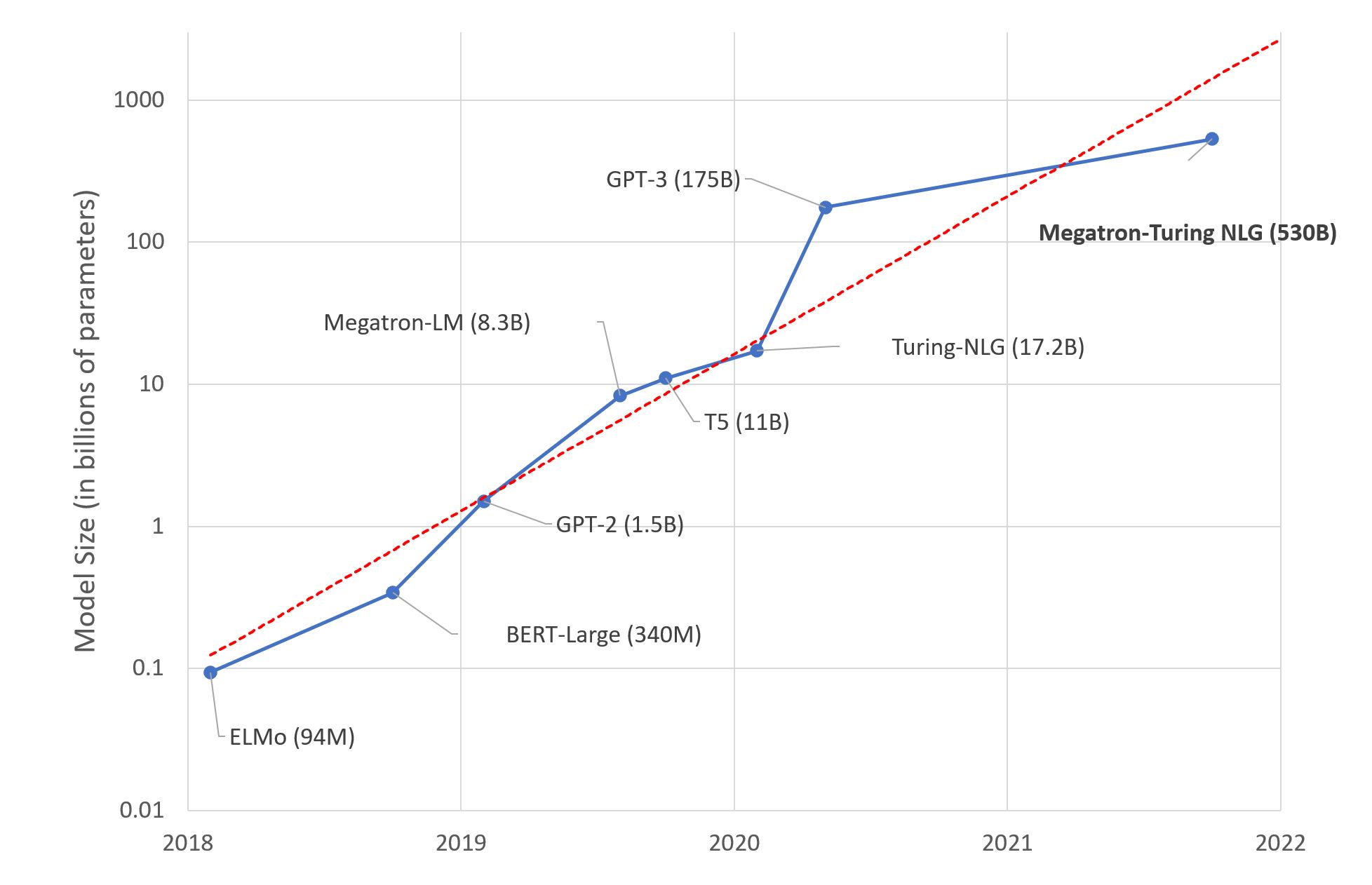
A few days ago, Microsoft and NVIDIA introduced Megatron-Turing NLG 530B, a Transformer-based model hailed as "the world’s largest and most powerful generative language model."

This is an impressive show of Machine Learning engineering, no doubt about it. Yet, should we be excited about this mega-model trend? I, for one, am not. Here's why.
This is your Brain on Deep Learning

Researchers estimate that the human brain contains an average of 86 billion neurons and 100 trillion synapses. It's safe to assume that not all of them are dedicated to language either. Interestingly, GPT-4 is expected to have about 100 trillion parameters... As crude as this analogy is, shouldn't we wonder whether building language models that are about the size of the human brain is the best long-term approach?

Of course, our brain is a marvelous device, produced by millions of years of evolution, while Deep Learning models are only a few decades old. Still, our intuition should tell us that something doesn't compute (pun intended).

Deep Learning, Deep Pockets?

As you would expect, training a 530-billion parameter model on humongous text datasets requires a fair bit of infrastructure. In fact, Microsoft and NVIDIA used hundreds of DGX A100 multi-GPU servers. At $199,000 a piece, and factoring in networking equipment, hosting costs, etc., anyone looking to replicate this experiment would have to spend close to $100 million dollars. Want fries with that?

Seriously, which organizations have business use cases that would justify spending $100 million on Deep Learning infrastructure? Or even $10 million? Very few. So who are these models for, really?

That Warm Feeling is your GPU Cluster

For all its engineering brilliance, training Deep Learning models on GPUs is a brute force technique. According to the spec sheet, each DGX server can consume up to 6.5 kilowatts. Of course, you'll need at least as much cooling power in your datacenter (or your server closet). Unless you're the Starks and need to keep Winterfell warm in winter, that's another problem you'll have to deal with.

In addition, as public awareness grows on climate and social responsibility issues, organizations need to account for their carbon footprint. According to this 2019 study from the University of Massachusetts, "training BERT on GPU is roughly equivalent to a trans-American flight".

BERT-Large has 340 million parameters. One can only extrapolate what the footprint of Megatron-Turing could be... People who know me wouldn't call me a bleeding-heart environmentalist. Still, some numbers are hard to ignore.

So?

Am I excited by Megatron-Turing NLG 530B and whatever beast is coming next? No. Do I think that the (relatively small) benchmark improvement is worth the added cost, complexity and carbon footprint? No. Do I think that building and promoting these huge models is helping organizations understand and adopt Machine Learning ? No.

I'm left wondering what's the point of it all. Science for the sake of science? Good old marketing? Technological supremacy? Probably a bit of each. I'll leave them to it, then.

Instead, let me focus on pragmatic and actionable techniques that you can all use to build high quality Machine Learning solutions.

Use Pretrained Models

In the vast majority of cases, you won't need a custom model architecture. Maybe you'll want a custom one (which is a different thing), but there be dragons. Experts only!

A good starting point is to look for models that have been pretrained for the task you're trying to solve (say, summarizing English text).

Then, you should quickly try out a few models to predict your own data. If metrics tell you that one works well enough, you're done! If you need a little more accuracy, you should consider fine-tuning the model (more on this in a minute).

Use Smaller Models

When evaluating models, you should pick the smallest one that can deliver the accuracy you need. It will predict faster and require fewer hardware resources for training and inference. Frugality goes a long way.

It's nothing new either. Computer Vision practitioners will remember when SqueezeNet came out in 2017, achieving a 50x reduction in model size compared to AlexNet, while meeting or exceeding its accuracy. How clever that was!

Downsizing efforts are also under way in the Natural Language Processing community, using transfer learning techniques such as knowledge distillation. DistilBERT is perhaps its most widely known achievement. Compared to the original BERT model, it retains 97% of language understanding while being 40% smaller and 60% faster. You can try it here. The same approach has been applied to other models, such as Facebook's BART, and you can try DistilBART here.

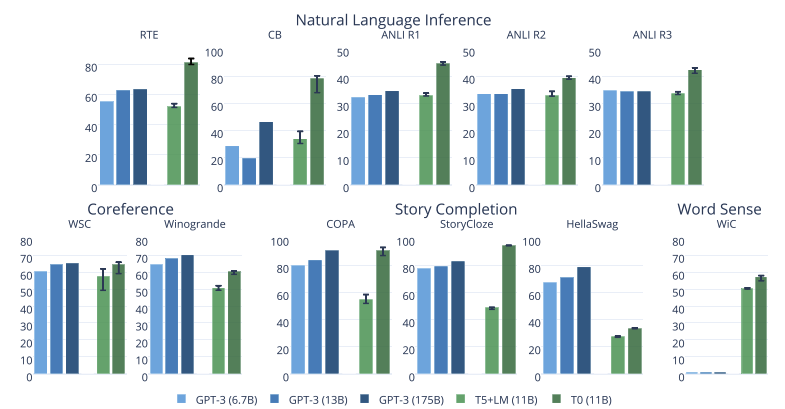
Recent models from the Big Science project are also very impressive. As visible in this graph included in the research paper, their T0 model outperforms GPT-3 on many tasks while being 16x smaller.
You can try T0 here. This is the kind of research we need more of!

Fine-Tune Models

If you need to specialize a model, there should be very few reasons to train it from scratch. Instead, you should fine-tune it, that is to say train it only for a few epochs on your own data. If you're short on data, maybe of one these datasets can get you started.

You guessed it, that's another way to do transfer learning, and it'll help you save on everything!

  • Less data to collect, store, clean and annotate,
  • Faster experiments and iterations,
  • Fewer resources required in production.

In other words: save time, save money, save hardware resources, save the world!

If you need a tutorial, the Hugging Face course will get you started in no time.

Use Cloud-Based Infrastructure

Like them or not, cloud companies know how to build efficient infrastructure. Sustainability studies show that cloud-based infrastructure is more energy and carbon efficient than the alternative: see AWS, Azure, and Google. Earth.org says that while cloud infrastructure is not perfect, "[it's] more energy efficient than the alternative and facilitates environmentally beneficial services and economic growth."

Cloud certainly has a lot going for it when it comes to ease of use, flexibility and pay as you go. It's also a little greener than you probably thought. If you're short on GPUs, why not try fine-tune your Hugging Face models on Amazon SageMaker, AWS' managed service for Machine Learning? We've got plenty of examples for you.

Optimize Your Models

From compilers to virtual machines, software engineers have long used tools that automatically optimize their code for whatever hardware they're running on.

However, the Machine Learning community is still struggling with this topic, and for good reason. Optimizing models for size and speed is a devilishly complex task, which involves techniques such as:

  • Specialized hardware that speeds up training (Graphcore, Habana) and inference (Google TPU, AWS Inferentia).
  • Pruning: remove model parameters that have little or no impact on the predicted outcome.
  • Fusion: merge model layers (say, convolution and activation).
  • Quantization: storing model parameters in smaller values (say, 8 bits instead of 32 bits)

Fortunately, automated tools are starting to appear, such as the Optimum open source library, and Infinity, a containerized solution that delivers Transformers accuracy at 1-millisecond latency.

Conclusion

Large language model size has been increasing 10x every year for the last few years. This is starting to look like another Moore's Law.

We've been there before, and we should know that this road leads to diminishing returns, higher cost, more complexity, and new risks. Exponentials tend not to end well. Remember Meltdown and Spectre? Do we want to find out what that looks like for AI?

Instead of chasing trillion-parameter models (place your bets), wouldn't all be better off if we built practical and efficient solutions that all developers can use to solve real-world problems?

Interested in how Hugging Face can help your organization build and deploy production-grade Machine Learning solutions? Get in touch at julsimon@huggingface.co (no recruiters, no sales pitches, please).