


惯性聚合 高效追踪和阅读你感兴趣的博客、新闻、科技资讯
阅读原文 在惯性聚合中打开

推荐订阅源

G
GRAHAM CLULEY
博客园_首页
博客园 - Franky
Engineering at Meta
Engineering at Meta
雷峰网
雷峰网
The GitHub Blog
The GitHub Blog
Cyber Security Advisories - MS-ISAC
C
Cisco Blogs
钛媒体:引领未来商业与生活新知
钛媒体:引领未来商业与生活新知
MyScale Blog
MyScale Blog
Apple Machine Learning Research
宝玉的分享
宝玉的分享
cs.CL updates on arXiv.org
F
Full Disclosure
Cloudbric
Cloudbric
J
Java Code Geeks
C
Cybersecurity and Infrastructure Security Agency CISA
Last Week in AI
Last Week in AI
The Hacker News
The Hacker News
量子位
T
The Blog of Author Tim Ferriss
T
Threatpost
Cisco Talos Blog
Cisco Talos Blog
C
Check Point Blog
AWS News Blog
AWS News Blog
Blog — PlanetScale
Blog — PlanetScale
T
Threat Research - Cisco Blogs
Project Zero
Project Zero
Scott Helme
Scott Helme
N
Netflix TechBlog - Medium
A
About on SuperTechFans
让小产品的独立变现更简单 - ezindie.com
T
Tenable Blog
S
Schneier on Security
T
Tor Project blog
cs.AI updates on arXiv.org
Hacker News: Ask HN
Hacker News: Ask HN
MongoDB | Blog
MongoDB | Blog
Y
Y Combinator Blog
H
Hackread – Cybersecurity News, Data Breaches, AI and More
H
Heimdal Security Blog
T
Tailwind CSS Blog
P
Privacy International News Feed
爱范儿
爱范儿
Google DeepMind News
D
DataBreaches.Net
CTFtime.org: upcoming CTF events
博客园 - 叶小钗
人人都是产品经理
人人都是产品经理
The Last Watchdog
The Last Watchdog

Hugging Face - Blog

Waypoint-1.5: Higher-Fidelity Interactive Worlds for Everyday GPUs ALTK‑Evolve: On‑the‑Job Learning for AI Agents Safetensors is Joining the PyTorch Foundation Holo3: Breaking the Computer Use Frontier Any Custom Frontend with Gradio's Backend A New Framework for Evaluating Voice Agents (EVA) Bringing Robotics AI to Embedded Platforms: Dataset Recording, VLA Fine‑Tuning, and On‑Device Optimizations One-Shot Any Web App with Gradio's gr.HTML CUGA on Hugging Face: Democratizing Configurable AI Agents New in llama.cpp: Model Management Building Deep Research: How we Achieved State of the Art OVHcloud on Hugging Face Inference Providers 🔥 20x Faster TRL Fine-tuning with RapidFire AI Building for an Open Future - our new partnership with Google Cloud Aligning to What? Rethinking Agent Generalization in MiniMax M2 Building a Healthcare Robot from Simulation to Deployment with NVIDIA Isaac Sentence Transformers is joining Hugging Face! Unlock the power of images with AI Sheets Supercharge your OCR Pipelines with Open Models Google Cloud C4 Brings a 70% TCO improvement on GPT OSS with Intel and Hugging Face Get your VLM running in 3 simple steps on Intel CPUs Nemotron-Personas-India: Synthesized Data for Sovereign AI Introducing RTEB: A New Standard for Retrieval Evaluation Accelerating Qwen3-8B Agent on Intel® Core™ Ultra with Depth-Pruned Draft Models VibeGame: Exploring Vibe Coding Games Nemotron-Personas-Japan: ソブリン AI のための合成データセット Swift Transformers Reaches 1.0 – and Looks to the Future Smol2Operator: Post-Training GUI Agents for Computer Use SyGra: The One-Stop Framework for Building Data for LLMs and SLMs Gaia2 and ARE: Empowering the community to study agents Scaleway on Hugging Face Inference Providers 🔥 Democratizing AI Safety with RiskRubric.ai Public AI on Hugging Face Inference Providers 🔥 `LeRobotDataset:v3.0`: Bringing large-scale datasets to `lerobot` Visible Watermarking with Gradio Introducing the Palmyra-mini family: Powerful, lightweight, and ready to reason! Tricks from OpenAI gpt-oss YOU 🫵 can use with transformers Fine-tune Any LLM from the Hugging Face Hub with Together AI Jupyter Agents: training LLMs to reason with notebooks mmBERT: ModernBERT goes Multilingual Welcome EmbeddingGemma, Google's new efficient embedding model SAIR: Accelerating Pharma R&D with AI-Powered Structural Intelligence Make your ZeroGPU Spaces go brrr with ahead-of-time compilation NVIDIA Releases 6 Million Multi-Lingual Reasoning Dataset Generate Images with Claude and Hugging Face From Zero to GPU: A Guide to Building and Scaling Production-Ready CUDA Kernels MCP for Research: How to Connect AI to Research Tools Kimina-Prover-RL Arm & ExecuTorch 0.7: Bringing Generative AI to the masses Neural Super Sampling is here! TextQuests: How Good are LLMs at Text-Based Video Games? 🇵🇭 FilBench - Can LLMs Understand and Generate Filipino? Introducing AI Sheets: a tool to work with datasets using open AI models! Accelerate ND-Parallel: A guide to Efficient Multi-GPU Training Vision Language Model Alignment in TRL ⚡️ Welcome GPT OSS, the new open-source model family from OpenAI! Measuring Open-Source Llama Nemotron Models on DeepResearch Bench 📚 3LM: A Benchmark for Arabic LLMs in STEM and Code Implementing MCP Servers in Python: An AI Shopping Assistant with Gradio Introducing Trackio: A Lightweight Experiment Tracking Library from Hugging Face Say hello to `hf`: a faster, friendlier Hugging Face CLI ✨ Parquet Content-Defined Chunking TimeScope: How Long Can Your Video Large Multimodal Model Go? Fast LoRA inference for Flux with Diffusers and PEFT Accelerate a World of LLMs on Hugging Face with NVIDIA NIM Arc Virtual Cell Challenge: A Primer Consilium: When Multiple LLMs Collaborate Back to The Future: Evaluating AI Agents on Predicting Future Events Five Big Improvements to Gradio MCP Servers Ettin Suite: SoTA Paired Encoders and Decoders Migrating the Hub from Git LFS to Xet Kimina-Prover: Applying Test-time RL Search on Large Formal Reasoning Models Asynchronous Robot Inference: Decoupling Action Prediction and Execution ScreenEnv: Deploy your full stack Desktop Agent Building the Hugging Face MCP Server Reachy Mini - The Open-Source Robot for Today's and Tomorrow's AI Builders Creating custom kernels for the AMD MI300 Upskill your LLMs With Gradio MCP Servers SmolLM3: smol, multilingual, long-context reasoner Three Mighty Alerts Supporting Hugging Face’s Production Infrastructure Efficient MultiModal Data Pipeline Announcing NeurIPS 2025 E2LM Competition: Early Training Evaluation of Language Models Training and Finetuning Sparse Embedding Models with Sentence Transformers Welcome the NVIDIA Llama Nemotron Nano VLM to Hugging Face Hub Gemma 3n fully available in the open-source ecosystem! Transformers backend integration in SGLang (LoRA) Fine-Tuning FLUX.1-dev on Consumer Hardware Groq on Hugging Face Inference Providers 🔥 How Long Prompts Block Other Requests - Optimizing LLM Performance Learn the Hugging Face Kernel Hub in 5 Minutes Convert Transformers to ONNX with Hugging Face Optimum Intel and Hugging Face Partner to Democratize Machine Learning Hardware Acceleration Director of Machine Learning Insights [Part 3: Finance Edition] The Annotated Diffusion Model Deep Q-Learning with Space Invaders Graphcore and Hugging Face Launch New Lineup of IPU-Ready Transformers Introducing Pull Requests and Discussions 🥳 Efficient Table Pre-training without Real Data: An Introduction to TAPEX An Introduction to Q-Learning Part 2/2 How Sempre Health is leveraging the Expert Acceleration Program to accelerate their ML roadmap
Jack of All Trades, Master of Some, a Multi-Purpose Transformer Agent
Quentin Gallouédec, Edward Beeching, Clément ROMAC, Thomas Wolf · 2024-04-22 · via Hugging Face - Blog

Back to Articles

This article is also available in Chinese 简体中文.

Introduction

We're excited to share Jack of All Trades (JAT), a project that aims to move in the direction of a generalist agent. The project started as an open reproduction of the Gato (Reed et al., 2022) work, which proposed to train a Transformer able to perform both vision-and-language and decision-making tasks. We thus started by building an open version of Gato’s dataset. We then trained multi-modal Transformer models on it, introducing several improvements over Gato for handling sequential data and continuous values.

Overall, the project has resulted in:

  • The release of a large number of expert RL agents on a wide variety of tasks.
  • The release of the JAT dataset, the first dataset for generalist agent training. It contains hundreds of thousands of expert trajectories collected with the expert agents
  • The release of the JAT model, a transformer-based agent capable of playing video games, controlling a robot to perform a wide variety of tasks, understanding and executing commands in a simple navigation environment and much more!

Global schema

Datasets & expert policies

The expert policies

RL traditionally involves training policies on single environments. Leveraging these expert policies is a genuine way to build a versatile agent. We selected a wide range of environments, of varying nature and difficulty, including Atari, BabyAI, Meta-World, and MuJoCo. For each of these environments, we train an agent until it reached state-of-the-art performance. (For BabyAI, we use the BabyAI bot instead). The resulting agents are called expert agents, and have been released on the 🤗 Hub. You'll find a list of all agents in the JAT dataset card.

The JAT dataset

We release the JAT dataset, the first dataset for generalist agent training. The JAT dataset contains hundreds of thousands of expert trajectories collected with the above-mentioned expert agents. To use this dataset, simply load it like any other dataset from the 🤗 Hub:

>>> from datasets import load_dataset
>>> dataset = load_dataset("jat-project/jat-dataset", "metaworld-assembly")
>>> first_episode = dataset["train"][0]
>>> first_episode.keys()
dict_keys(['continuous_observations', 'continuous_actions', 'rewards'])
>>> len(first_episode["rewards"])
500
>>> first_episode["continuous_actions"][0]
[6.459120273590088, 2.2422609329223633, -5.914587020874023, -19.799840927124023]

In addition to RL data, we include textual datasets to enable a unique interface for the user. That's why you'll also find subsets for Wikipedia, Oscar, OK-VQA and Conceptual-Captions.

JAT agent architecture

JAT's architecture is based on a Transformer, using EleutherAI's GPT-Neo implementation. JAT's particularity lies in its embedding mechanism, which has been built to intrinsically handle sequential decision tasks. We interleave observation embeddings with action embeddings, along with the corresponding rewards.
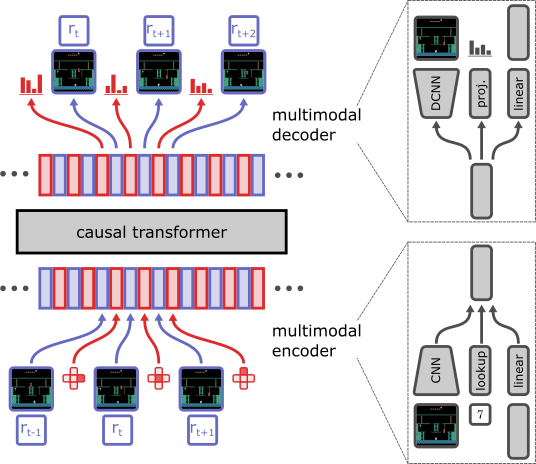
Model
Architecture of the JAT network. For sequential decision-making tasks, observations and rewards on the one hand, and actions on the other, are encoded and interleaved. The model generates the next embedding autoregressively with a causal mask, and decodes according to expected modality.

Each embedding therefore corresponds either to an observation (associated with the reward), or to an action. But how does JAT encode this information? It depends on the type of data. If the data (observation or action) is an image (as is the case for Atari), then JAT uses a CNN. If it's a continuous vector, then JAT uses a linear layer. Finally, if it's a discrete value, JAT uses a linear projection layer. The same principle is used for model output, depending on the type of data to be predicted. Prediction is causal, shifting observations by 1 time step. In this way, the agent must predict the next action from all previous observations and actions.

In addition, we thought it would be fun to train our agent to perform NLP and CV tasks. To do this, we also gave the encoder the option of taking text and image data as input. For text data, we tokenize using GPT-2 tokenization strategy, and for images, we use a ViT-type encoder.

Given that the modality of the data can change from one environment to another, how does JAT compute the loss? It computes the loss for each modality separately. For images and continuous values, it uses the MSE loss. For discrete values, it uses the cross-entropy loss. The final loss is the average of the losses for each element of the sequence. Wait, does that mean we give equal weight to predicting actions and observations? Actually, no, but we'll talk more about that below.

Experiments and results

We evaluate JAT on all 157 training tasks. We collect 10 episodes and record the total reward. For ease of reading, we aggregate the results by domain.
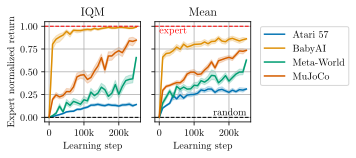
Score evolution
Aggregated expert normalized scores with 95% Confidence Intervals (CIs) for each RL domain as a function of learning step.

If we were to summarize these results in one number, it would be 65.8%, the average performance compared to the JAT expert over the 4 domains. This shows that JAT is capable of mimicking expert performance on a very wide variety of tasks. Let's go into a little more detail:
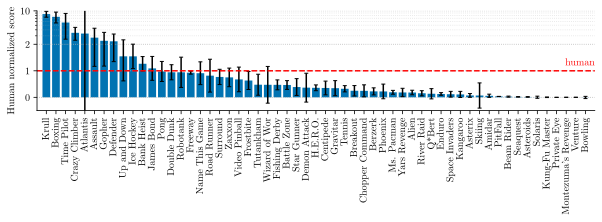
  • For Atari 57, the agent achieves 14.1% of the expert's score, corresponding to 37.6% of human performance. It exceeds human performance on 21 games.
  • For BabyAI, the agent achieves 99.0% of the expert's score, and fails to exceed 50% of the expert on just 1 task.
  • For Meta-World, the agent reached 65.5% of the expert.
  • For MuJoCo, the agent achieves 84.8% of the expert.
Score evolution
Human normalized scores for the JAT agent on the Atari 57 benchmark.

What's most impressive is that JAT achieves this performance using a single network for all domains. To take the measure of this performance, let's watch JAT's rendering on a few tasks:

Want to try it out? You can! The JAT model is available on the 🤗 Hub!

For textual tasks, our model shows rudimentary capabilities, we refer the reader to the paper for more details.

The surprising benefits of predicting observations

When training an RL agent, the primary goal is to maximize future rewards. But what if we also ask the agent to predict what it will observe in the future? Will this additional task help or hinder the learning process?

There are two opposing views on this question. On one hand, learning to predict observations could provide a deeper understanding of the environment, leading to better and faster learning. On the other hand, it could distract the agent from its main goal, resulting in mediocre performance in both observation and action prediction.

To settle this debate, we conducted an experiment using a loss function that combines observation loss and action loss, with a weighting parameter κ \kappa to balance the two objectives.
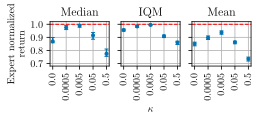
Kappa Aggregated
Aggregate measures with 95% CIs for the study on the influence of observation prediction learning for selected tasks. The results presented cover the selected range of κ values and are based on 100 evaluations per task. Optimal κ \kappa selection can significantly improve agent performance.

The results were noteworthy. When κ \kappa was too high (0.5), the additional objective of predicting observations seemed to hinder the learning process. But when κ \kappa was lower, the impact on learning was negligible, and the agent's performance was similar to that obtained when observation prediction was not part of the objective.

However, we found a sweet spot around κ=0.005 \kappa= 0.005 , where learning to predict observations actually improved the agent's learning efficiency. Our study suggests that adding observation prediction to the learning process can be beneficial, as long as it's balanced correctly. This finding has important implications for the design of such agents, highlighting the potential value of auxiliary objectives in improving learning efficiency.

So, the next time you're training an RL agent, consider asking it to predict what it will observe in the future. It might just lead to better performance and faster learning!

Conclusions

In this work, we introduced JAT, a multi-purpose transformer agent capable of mastering a wide variety of sequential decision-making tasks, and showing rudimentary capabilities in NLP and CV tasks. For all these tasks, JAT uses a single network. Our contributions include the release of expert RL agents, the JAT dataset, and the JAT model. We hope that this work will inspire future research in the field of generalist agents and contribute to the development of more versatile and capable AI systems.

What's next? A request for research

We believe that the JAT project has opened up a new direction for research in the field of generalist agents, and we've only just scratched the surface. Here are some ideas for future work:

  • Improving the data: Although pioneering, the JAT dataset is still in its early stages. The expert trajectories come from only one expert agent per environment which may cause some bias. Although we've done our best to reach state-of-the-art performance, some environments are still challenging. We believe that collecting more data and training more expert agents could help a lot.

  • Use offline RL: The JAT agent is trained using basic Behavioral Cloning. This implies two things: (1) we can't take advantage of sub-optimal trajectories and (2) the JAT agent can't outperform the expert. We've chosen this approach for simplicity, but we believe that using offline RL could really help improve the agent's performance, while not being too complex to implement.

  • Unlock the full potential of a smarter multi-task sampling strategy: Currently, the JAT agent samples data uniformly from all tasks, but this approach may be holding it back. By dynamically adjusting the sampling rate to focus on the most challenging tasks, we can supercharge the agent's learning process and unlock significant performance gains.

Links

Citation

@article{gallouedec2024jack,
    title = {{Jack of All Trades, Master of Some, a Multi-Purpose Transformer Agent}},
    author = {Gallouédec, Quentin and Beeching, Edward and Romac, Clément and Dellandréa, Emmanuel},
    journal = {arXiv preprint arXiv:2402.09844},
    year = {2024},
    url = {https://arxiv.org/abs/2402.09844}
}