





Addendum
After consulting with the authors of the IPO paper, we discovered that the implementation of IPO in TRL was incorrect; in particular, the loss over the log-likelihoods of the completions needs to be averaged instead of summed. We have added a fix in this PR and re-run the experiments. The results are now consistent with the paper, with IPO on par with DPO and performing better than KTO in the paired preference setting. We have updated the post to reflect these new results.
TL;DR
We evaluate three promising methods to align language models without reinforcement learning (or preference tuning) on a number of models and hyperparameter settings. In particular we train using different hyperparameters and evaluate on:
In this post, we perform an empirical evaluation of three promising LLM alignment algorithms: Direct Preference Optimization (DPO), Identity Preference Optimisation (IPO) and Kahneman-Tversky Optimisation (KTO). We conducted our experiments on two high quality 7b LLMs that have undergone a supervised fine-tuning step, but no preference alignment. We find that while one algorithm clearly outshines the others, there are key hyper-parameters that must be tuned to achieve the best results.
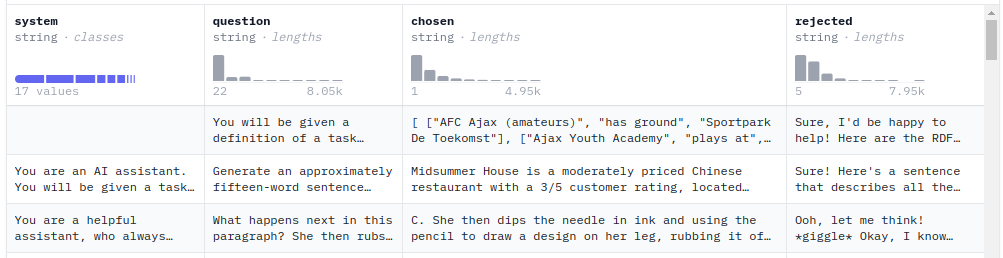
Direct Preference Optimization (DPO) has emerged as a promising alternative for aligning Large Language Models (LLMs) to human or AI preferences. Unlike traditional alignment methods, which are based on reinforcement learning, DPO recasts the alignment formulation as a simple loss function that can be optimised directly on a dataset of preferences {(x,yw,yl)} \{(x, y_w, y_l)\} , where xx is a prompt and yw,yly_w,y_l are the preferred and dispreferred responses.
 |
|---|
| Sample of a preference tuning dataset. |
This makes DPO simple to use in practice and has been applied with success to train models like Zephyr and Intel’s NeuralChat.
The success of DPO has prompted researchers to develop new loss functions that generalise the method in two main directions:
At the same time, these various methods come with hyperparameters, the most important one being β \beta , which controls how much to weight the preference of the reference model. With these alternatives now available in the practitioner’s arsenal through libraries like 🤗 TRL, a natural question then becomes which of these methods and hyperparameters produce the best chat model?
This post aims to answer this question by performing an empirical analysis of the three methods. We will sweep over key hyperparameters such as β\beta and training steps, then evaluate the resulting models’ performance via MT-Bench, which is a common benchmark to measure chat model capabilities.
We provide open-source code to replicate these results in a recent update to the 🤗 alignment-handbook.
Let’s get started!
Here are the important links associated with our analysis:
There are two main ingredients that one needs to consider when performing alignment experiments: the model we choose to optimize and the alignment dataset. To get more independent data points, we considered two models, OpenHermes-2.5-Mistral-7B and Zephyr-7b-beta-sft, and two alignment datasets Intel’s orca_dpo_pairs and the ultrafeedback-binarized dataset.
For the first experiment, we used OpenHermes-2.5-Mistral-7B as it’s one of the best 7B parameter chat models that hasn’t been subject to any alignment techniques. We then used Intel’s orca_dpo_pairs dataset, which consists of 13k prompts where the chosen response is generated by GPT-4, and the undesired response is generated by Llama-Chat 13b. This is the dataset behind NeuralChat and NeuralHermes-2.5-Mistral-7B. Since KTO doesn’t require pairwise preferences per se, we simply treat the GPT-4 responses as “good” labels and the Llama-Chat 13b ones as “bad”. While GPT-4's responses are likely to be preferred over Llama-Chat 13b, there may be some cases where Llama-Chat-13b produces a better response, we consider this to represent a small minority of the examples.
The second experiment performed preference alignment on theZephyr-7b-beta-sft model with the ultrafeedback-binarized dataset, which contains 66k prompts with pairs of chosen and rejected responses. This dataset was used to train the original Zephyr model, which at the time was the best in class 7B model on numerous automated benchmarks and human evaluations.
The alignment handbook provides an easy way to configure a single experiment, these parameters are used to configure the run_dpo.py script.
# Model arguments
model_name_or_path: teknium/OpenHermes-2.5-Mistral-7B
torch_dtype: null

# Data training arguments
dataset_mixer:
  HuggingFaceH4/orca_dpo_pairs: 1.0
dataset_splits:
- train_prefs
- test_prefs
preprocessing_num_workers: 12

# Training arguments with sensible defaults
bf16: true
beta: 0.01
loss_type: sigmoid
do_eval: true
do_train: true
evaluation_strategy: steps
eval_steps: 100
gradient_accumulation_steps: 2
gradient_checkpointing: true
gradient_checkpointing_kwargs:
  use_reentrant: False
hub_model_id: HuggingFaceH4/openhermes-2.5-mistral-7b-dpo
hub_model_revision: v1.0

learning_rate: 5.0e-7
logging_steps: 10
lr_scheduler_type: cosine
max_prompt_length: 512
num_train_epochs: 1
optim: adamw_torch
output_dir: data/openhermes-2.5-mistral-7b-dpo-v1.0
per_device_train_batch_size: 8
per_device_eval_batch_size: 8
push_to_hub_revision: true
save_strategy: "steps"
save_steps: 100
save_total_limit: 1
seed: 42
warmup_ratio: 0.1
We created a similar base configuration file for the Zephyr experiments.
Chat templates were automatically inferred from the base Chat model, with OpenHermes-2.5 using ChatML format and Zephyr using the H4 chat template. Alternatively, if you want to use your own chat format, the 🤗 tokenizers library has now enabled user-defined chat templates using a jinja format strings:
# Example of the Zephyr chat template
"{% for message in messages %}\n{% if message['role'] == 'user' %}\n{{ '<|user|>\n' + message['content'] + eos_token }}\n{% elif message['role'] == 'system' %}\n{{ '<|system|>\n' + message['content'] + eos_token }}\n{% elif message['role'] == 'assistant' %}\n{{ '<|assistant|>\n'  + message['content'] + eos_token }}\n{% endif %}\n{% if loop.last and add_generation_prompt %}\n{{ '<|assistant|>' }}\n{% endif %}\n{% endfor %}"
Which formats conversations as follows:
# <|system|>
# You are a friendly chatbot who always responds in the style of a pirate.</s>
# <|user|>
# How many helicopters can a human eat in one sitting?</s>
# <|assistant|>
# Ah, me hearty matey! But yer question be a puzzler! A human cannot eat a helicopter in one sitting, as helicopters are not edible. They be made of metal, plastic, and other materials, not food!
We trained the DPO, IPO and KTO methods via the loss_type argument TRL’s DPOTrainer with the beta going from 0.01, 0.1, 0.2, ..., 0.9. We included 0.01 as we observed that some alignment algorithms are especially sensitive to this parameter. All experiments were trained for one epoch. All other hyperparameters are kept the same during each run, including the random seed.
We then launched our scan on the Hugging Face cluster using the base configurations defined above. #GPURICH
#!/bin/bash
# Define an array containing the base configs we wish to fine tune
configs=("zephyr" "openhermes")
# Define an array of loss types
loss_types=("sigmoid" "kto_pair" "ipo")
# Define an array of beta values
betas=("0.01" "0.1" "0.2" "0.3" "0.4" "0.5" "0.6" "0.7" "0.8" "0.9")

# Outer loop for loss types
for config in "${configs[@]}"; do
    for loss_type in "${loss_types[@]}"; do
        # Inner loop for beta values
        for beta in "${betas[@]}"; do
            # Determine the job name and model revision based on loss type
            job_name="$config_${loss_type}_beta_${beta}"
            model_revision="${loss_type}-${beta}"
            # Submit the job
            sbatch --job-name=${job_name} recipes/launch.slurm dpo pref_align_scan config_$config deepspeed_zero3 \\
            "--beta=${beta} --loss_type=${loss_type} --output_dir=data/$config-7b-align-scan-${loss_type}-beta-${beta} --hub_model_revision=${model_revision}"
        done
    done
done
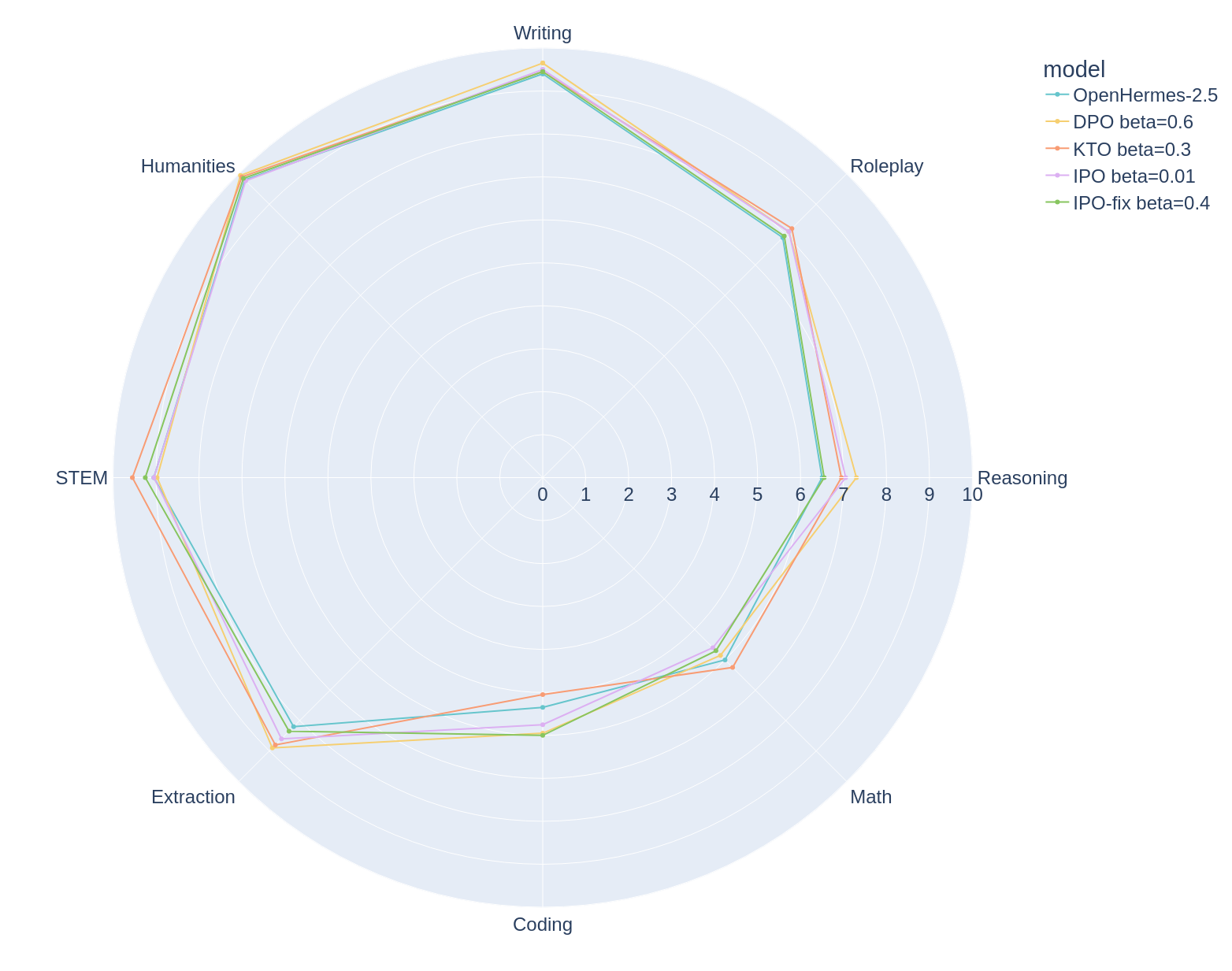
We evaluated all models using MT Bench, a multi-turn benchmark that uses GPT-4 to judge models’ performance in eight different categories: Writing, Roleplay, Reasoning, Math, Coding, Extraction, STEM, and Humanities. Although imperfect, MT Bench is a good way to evaluate conversational LLMs.
 |
|---|
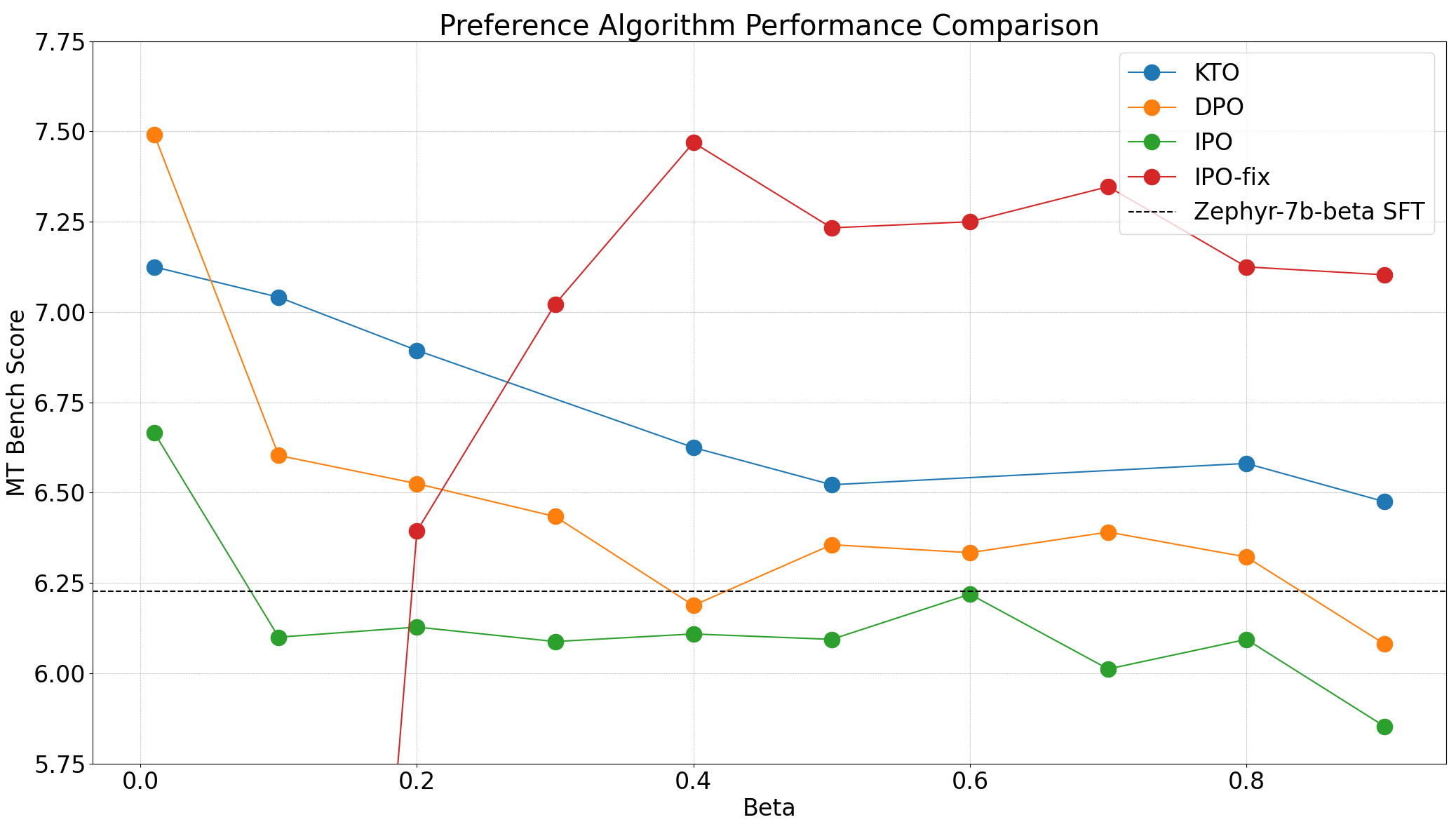
| MT-Bench scores for the Zephyr model for different β \beta . |
For the Zephyr model, we observed that the best performance was achieved with the lowest β \beta value, 0.01. This is consistent across all three of the algorithms tested, an interesting follow on experiment for the community would be a fine grained scan in the range of 0.0-0.2. While DPO can achieve the highest MT Bench score, we found that KTO (paired) achieves better results in all but one setting. IPO, while having stronger theoretical guarantees, appears to be worse than the base model in all but one setting.
 |
|---|
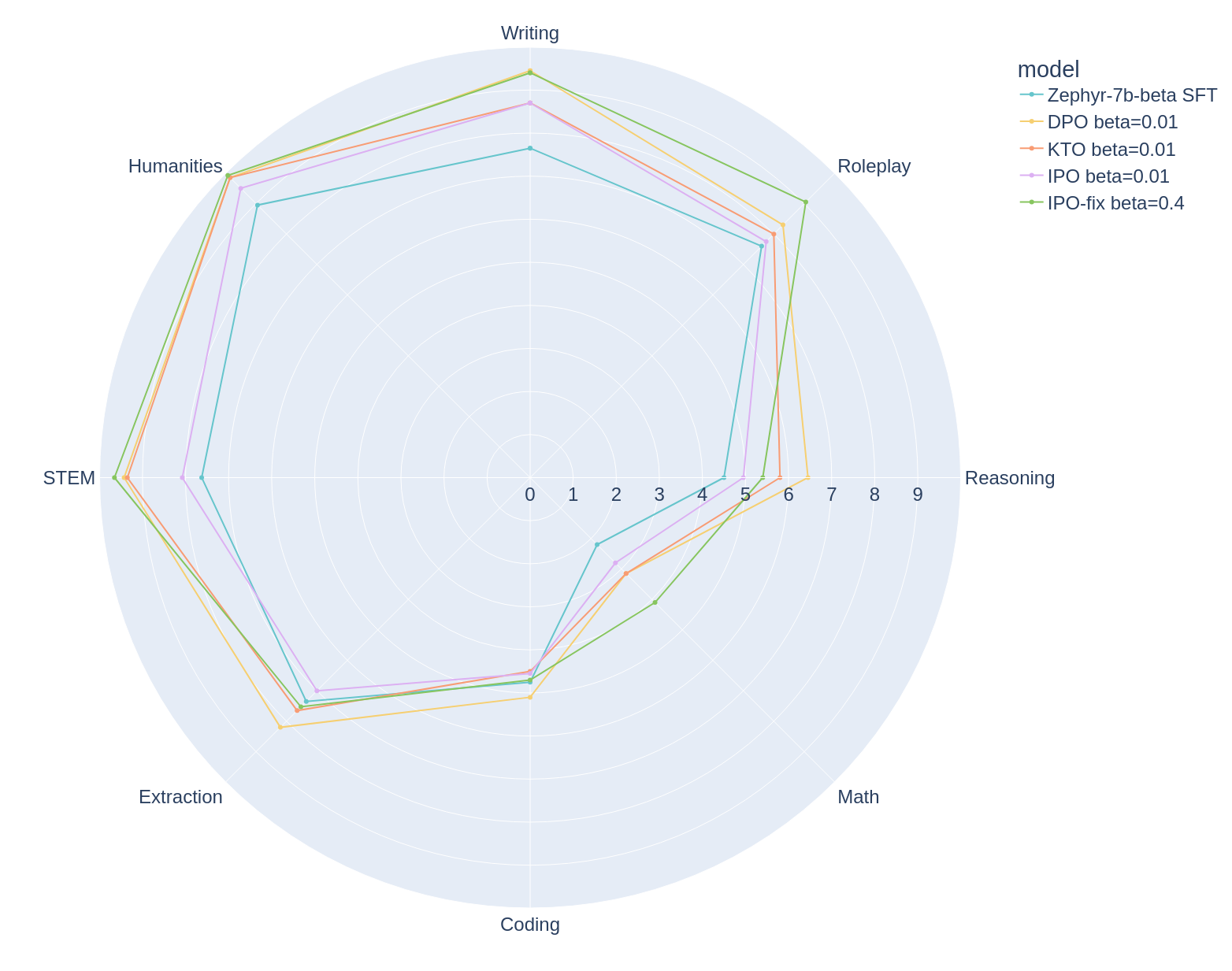
| Break down of the best Zephyr models for each algorithm across MT Bench categories. |
We can break down the best results for each algorithm across the categories that MT Bench evaluates to identify the strengths and weaknesses of these models. There is still a large area for improvement on the Reasoning, Coding, and Math axes.
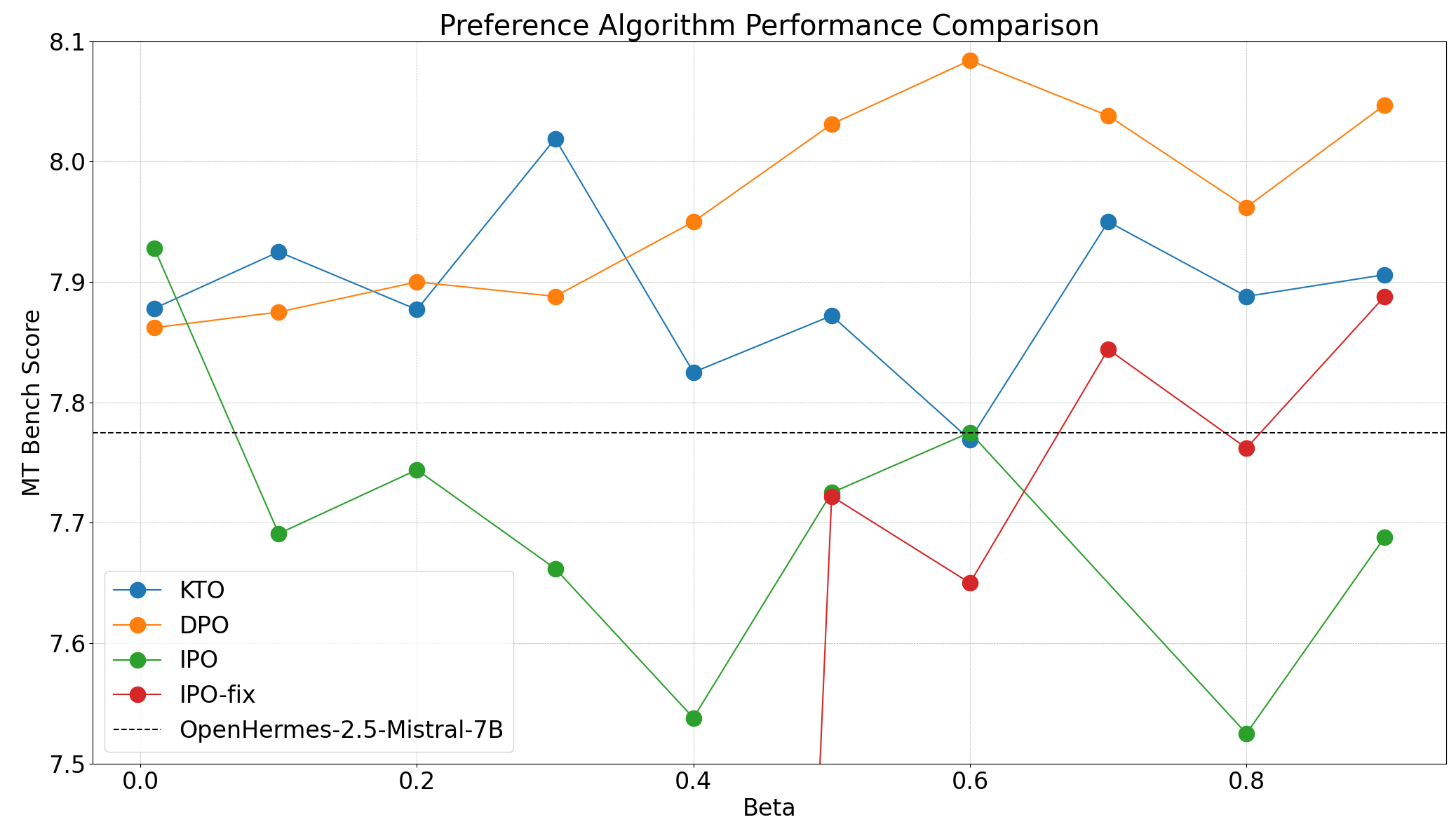
While the observations about each algorithm remain the same with OpenHermes, that is that DPO > KTO > IPO, the sweet spot for β \beta varies wildly with each algorithm. With the best choice of β \beta for DPO, KTO and IPO being 0.6, 0.3 and 0.01 respectively.
 |
|---|
| MT Bench scores for the OpenHermes model for different β \beta . |
OpenHermes-7b-2.5 is clearly a stronger base model, with a mere 0.3 improvement in MT Bench score after preference alignment.
 |
|---|
| Break down of the best OpenHermes models for each algorithm across MT Bench categories. |
In this post, we have highlighted the importance of choosing the right set of hyperparameters when performing preference alignment. We have empirically demonstrated that DPO and IPO can achieve comparable results, outperforming KTO in a paired preference setting.
All code and configuration files replicating these results are now available in the alignment-handbook. The best-performing models and datasets can be found in this collection.
We will continue our work implementing new preference alignment algorithms in TRL and evaluating their performance. It seems, at least for the time being, that DPO is the most robust and best performing LLM alignment algorithm. KTO remains an interesting development, as both DPO and IPO require pairs preference data, whereas KTO can be applied to any dataset where responses are rated positively or negatively.
We look forward to the new tools and techniques that will be developed in 2024!
此内容由惯性聚合(RSS阅读器)自动聚合整理,仅供阅读参考。 原文来自 — 版权归原作者所有。