



惯性聚合 高效追踪和阅读你感兴趣的博客、新闻、科技资讯
阅读原文 在惯性聚合中打开

推荐订阅源

阮一峰的网络日志
阮一峰的网络日志
cs.AI updates on arXiv.org
Blog — PlanetScale
Blog — PlanetScale
Jina AI
Jina AI
MyScale Blog
MyScale Blog
N
Netflix TechBlog - Medium
月光博客
月光博客
云风的 BLOG
云风的 BLOG
T
The Blog of Author Tim Ferriss
博客园_首页
GbyAI
GbyAI
The Cloudflare Blog
博客园 - 叶小钗
CTFtime.org: upcoming CTF events
MongoDB | Blog
MongoDB | Blog
Y
Y Combinator Blog
博客园 - 三生石上(FineUI控件)
量子位
博客园 - Franky
WordPress大学
WordPress大学
freeCodeCamp Programming Tutorials: Python, JavaScript, Git & More
人人都是产品经理
人人都是产品经理
F
Fortinet All Blogs
Martin Fowler
Martin Fowler
OSCHINA 社区最新新闻
OSCHINA 社区最新新闻
M
MIT News - Artificial intelligence
奇客Solidot–传递最新科技情报
奇客Solidot–传递最新科技情报
I
InfoQ
Google DeepMind News
S
SegmentFault 最新的问题
大猫的无限游戏
大猫的无限游戏
Apple Machine Learning Research
让小产品的独立变现更简单 - ezindie.com
Stack Overflow Blog
Stack Overflow Blog
钛媒体:引领未来商业与生活新知
钛媒体:引领未来商业与生活新知
Last Week in AI
Last Week in AI
J
Java Code Geeks
腾讯CDC
aimingoo的专栏
aimingoo的专栏
C
Check Point Blog
Threat Intelligence Blog | Flashpoint
V
Vulnerabilities – Threatpost
S
Schneier on Security
D
Darknet – Hacking Tools, Hacker News & Cyber Security
L
Lohrmann on Cybersecurity
S
Securelist
F
Full Disclosure
Cisco Talos Blog
Cisco Talos Blog
小众软件
小众软件
The GitHub Blog
The GitHub Blog

Hugging Face - Blog

Waypoint-1.5: Higher-Fidelity Interactive Worlds for Everyday GPUs ALTK‑Evolve: On‑the‑Job Learning for AI Agents Safetensors is Joining the PyTorch Foundation Holo3: Breaking the Computer Use Frontier Any Custom Frontend with Gradio's Backend A New Framework for Evaluating Voice Agents (EVA) Bringing Robotics AI to Embedded Platforms: Dataset Recording, VLA Fine‑Tuning, and On‑Device Optimizations One-Shot Any Web App with Gradio's gr.HTML CUGA on Hugging Face: Democratizing Configurable AI Agents New in llama.cpp: Model Management Building Deep Research: How we Achieved State of the Art OVHcloud on Hugging Face Inference Providers 🔥 20x Faster TRL Fine-tuning with RapidFire AI Building for an Open Future - our new partnership with Google Cloud Aligning to What? Rethinking Agent Generalization in MiniMax M2 Building a Healthcare Robot from Simulation to Deployment with NVIDIA Isaac Sentence Transformers is joining Hugging Face! Unlock the power of images with AI Sheets Supercharge your OCR Pipelines with Open Models Google Cloud C4 Brings a 70% TCO improvement on GPT OSS with Intel and Hugging Face Get your VLM running in 3 simple steps on Intel CPUs Nemotron-Personas-India: Synthesized Data for Sovereign AI Introducing RTEB: A New Standard for Retrieval Evaluation Accelerating Qwen3-8B Agent on Intel® Core™ Ultra with Depth-Pruned Draft Models VibeGame: Exploring Vibe Coding Games Nemotron-Personas-Japan: ソブリン AI のための合成データセット Swift Transformers Reaches 1.0 – and Looks to the Future Smol2Operator: Post-Training GUI Agents for Computer Use SyGra: The One-Stop Framework for Building Data for LLMs and SLMs Gaia2 and ARE: Empowering the community to study agents Scaleway on Hugging Face Inference Providers 🔥 Democratizing AI Safety with RiskRubric.ai Public AI on Hugging Face Inference Providers 🔥 `LeRobotDataset:v3.0`: Bringing large-scale datasets to `lerobot` Visible Watermarking with Gradio Introducing the Palmyra-mini family: Powerful, lightweight, and ready to reason! Tricks from OpenAI gpt-oss YOU 🫵 can use with transformers Fine-tune Any LLM from the Hugging Face Hub with Together AI Jupyter Agents: training LLMs to reason with notebooks mmBERT: ModernBERT goes Multilingual Welcome EmbeddingGemma, Google's new efficient embedding model SAIR: Accelerating Pharma R&D with AI-Powered Structural Intelligence Make your ZeroGPU Spaces go brrr with ahead-of-time compilation NVIDIA Releases 6 Million Multi-Lingual Reasoning Dataset Generate Images with Claude and Hugging Face From Zero to GPU: A Guide to Building and Scaling Production-Ready CUDA Kernels MCP for Research: How to Connect AI to Research Tools Kimina-Prover-RL Arm & ExecuTorch 0.7: Bringing Generative AI to the masses Neural Super Sampling is here! TextQuests: How Good are LLMs at Text-Based Video Games? 🇵🇭 FilBench - Can LLMs Understand and Generate Filipino? Introducing AI Sheets: a tool to work with datasets using open AI models! Accelerate ND-Parallel: A guide to Efficient Multi-GPU Training Vision Language Model Alignment in TRL ⚡️ Welcome GPT OSS, the new open-source model family from OpenAI! Measuring Open-Source Llama Nemotron Models on DeepResearch Bench 📚 3LM: A Benchmark for Arabic LLMs in STEM and Code Implementing MCP Servers in Python: An AI Shopping Assistant with Gradio Introducing Trackio: A Lightweight Experiment Tracking Library from Hugging Face Say hello to `hf`: a faster, friendlier Hugging Face CLI ✨ Parquet Content-Defined Chunking TimeScope: How Long Can Your Video Large Multimodal Model Go? Fast LoRA inference for Flux with Diffusers and PEFT Accelerate a World of LLMs on Hugging Face with NVIDIA NIM Arc Virtual Cell Challenge: A Primer Consilium: When Multiple LLMs Collaborate Back to The Future: Evaluating AI Agents on Predicting Future Events Five Big Improvements to Gradio MCP Servers Ettin Suite: SoTA Paired Encoders and Decoders Migrating the Hub from Git LFS to Xet Kimina-Prover: Applying Test-time RL Search on Large Formal Reasoning Models Asynchronous Robot Inference: Decoupling Action Prediction and Execution ScreenEnv: Deploy your full stack Desktop Agent Building the Hugging Face MCP Server Reachy Mini - The Open-Source Robot for Today's and Tomorrow's AI Builders Creating custom kernels for the AMD MI300 Upskill your LLMs With Gradio MCP Servers SmolLM3: smol, multilingual, long-context reasoner Three Mighty Alerts Supporting Hugging Face’s Production Infrastructure Efficient MultiModal Data Pipeline Announcing NeurIPS 2025 E2LM Competition: Early Training Evaluation of Language Models Training and Finetuning Sparse Embedding Models with Sentence Transformers Welcome the NVIDIA Llama Nemotron Nano VLM to Hugging Face Hub Gemma 3n fully available in the open-source ecosystem! Transformers backend integration in SGLang (LoRA) Fine-Tuning FLUX.1-dev on Consumer Hardware Groq on Hugging Face Inference Providers 🔥 How Long Prompts Block Other Requests - Optimizing LLM Performance Learn the Hugging Face Kernel Hub in 5 Minutes Convert Transformers to ONNX with Hugging Face Optimum Intel and Hugging Face Partner to Democratize Machine Learning Hardware Acceleration Director of Machine Learning Insights [Part 3: Finance Edition] The Annotated Diffusion Model Deep Q-Learning with Space Invaders Graphcore and Hugging Face Launch New Lineup of IPU-Ready Transformers Introducing Pull Requests and Discussions 🥳 Efficient Table Pre-training without Real Data: An Introduction to TAPEX An Introduction to Q-Learning Part 2/2 How Sempre Health is leveraging the Expert Acceleration Program to accelerate their ML roadmap
Liftoff! How to get started with your first ML project 🚀
Nima Boscarino · 2022-06-29 · via Hugging Face - Blog

Back to Articles

Nima Boscarino's avatar

People who are new to the Machine Learning world often run into two recurring stumbling blocks. The first is choosing the right library to learn, which can be daunting when there are so many to pick from. Even once you’ve settled on a library and gone through some tutorials, the next issue is coming up with your first big project and scoping it properly to maximize your learning. If you’ve run into those problems, and if you're looking for a new ML library to add to your toolkit, you're in the right place!

In this post I’ll take you through some tips for going from 0 to 100 with a new library by using Sentence Transformers (ST) as an example. We'll start by understanding the basics of what ST can do, and highlight some things that make it a great library to learn. Then, I'll share my battle-tested strategy for tackling your first self-driven project. We’ll also talk about how I built my first ST-powered project, and what I learned along the way 🥳

What is Sentence Transformers?

Sentence embeddings? Semantic search? Cosine similarity?!?! 😱 Just a few short weeks ago, these terms were so confusing to me that they made my head spin. I’d heard that Sentence Transformers was a powerful and versatile library for working with language and image data and I was eager to play around with it, but I was worried that I would be out of my depth. As it turns out, I couldn’t have been more wrong!

Sentence Transformers is among the libraries that Hugging Face integrates with, where it’s described with the following:

Compute dense vector representations for sentences, paragraphs, and images

In a nutshell, Sentence Transformers answers one question: What if we could treat sentences as points in a multi-dimensional vector space? This means that ST lets you give it an arbitrary string of text (e.g., “I’m so glad I learned to code with Python!”), and it’ll transform it into a vector, such as [0.2, 0.5, 1.3, 0.9]. Another sentence, such as “Python is a great programming language.”, would be transformed into a different vector. These vectors are called “embeddings,” and they play an essential role in Machine Learning. If these two sentences were embedded with the same model, then both would coexist in the same vector space, allowing for many interesting possibilities.

What makes ST particularly useful is that, once you’ve generated some embeddings, you can use the built-in utility functions to compare how similar one sentence is to another, including synonyms! 🤯 One way to do this is with the “Cosine Similarity” function. With ST, you can skip all the pesky math and call the very handy util.cos_sim function to get a score from -1 to 1 that signifies how “similar” the embedded sentences are in the vector space they share – the bigger the score is, the more similar the sentences are!
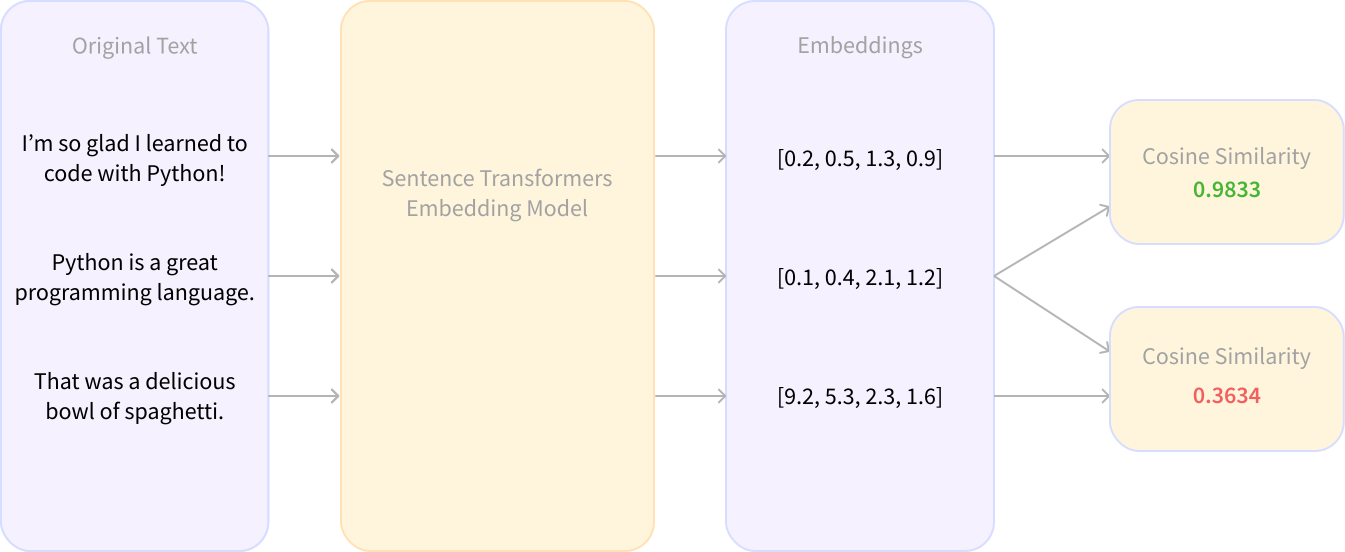
A flowchart showing sentences being embedded with Sentence Transformers, and then compared with Cosine Similarity
After embedding sentences, we can compare them with Cosine Similarity.

Comparing sentences by similarity means that if we have a collection of sentences or paragraphs, we can quickly find the ones that match a particular search query with a process called semantic search. For some specific applications of this, see this tutorial for making a GitHub code-searcher or this other tutorial on building an FAQ engine using Sentence Transformers.

Why learn to use Sentence Transformers?

First, it offers a low-barrier way to get hands-on experience with state-of-the-art models to generate embeddings. I found that creating my own sentence embeddings was a powerful learning tool that helped strengthen my understanding of how modern models work with text, and it also got the creative juices flowing for ideation! Within a few minutes of loading up the msmarco-MiniLM-L-6-v3 model in a Jupyter notebook I’d come up with a bunch of fun project ideas just from embedding some sentences and running some of ST’s utility functions on them.

Second, Sentence Transformers is an accessible entry-point to many important ML concepts that you can branch off into. For example, you can use it to learn about clustering, model distillation, and even launch into text-to-image work with CLIP. In fact, Sentence Transformers is so versatile that it’s skyrocketed to almost 8,000 stars on GitHub, with more than 3,000 projects and packages depending on it. On top of the official docs, there’s an abundance of community-created content (look for some links at the end of this post 👀), and the library’s ubiquity has made it popular in research.

Third, embeddings are key for several industrial applications. Google searches use embeddings to match text to text and text to images; Snapchat uses them to "serve the right ad to the right user at the right time"; and Meta (Facebook) uses them for their social search. In other words, embeddings allow you to build things like chatbots, recommendation systems, zero-shot classifiers, image search, FAQ systems, and more.

On top of it all, it’s also supported with a ton of Hugging Face integrations 🤗.

Tackling your first project

So you’ve decided to check out Sentence Transformers and worked through some examples in the docs… now what? Your first self-driven project (I call these Rocket Launch projects 🚀) is a big step in your learning journey, and you’ll want to make the most of it! Here’s a little recipe that I like to follow when I’m trying out a new tool:

  1. Do a brain dump of everything you know the tool’s capable of: For Sentence Transformers this includes generating sentence embeddings, comparing sentences, retrieve and re-rank for complex search tasks, clustering, and searching for similar documents with semantic search.
  2. Reflect on some interesting data sources: There’s a huge collection of datasets on the Hugging Face Hub, or you can also consult lists like awesome-public-datasets for some inspiration. You can often find interesting data in unexpected places – your municipality, for example, may have an open data portal. You’re going to spend a decent amount of time working with your data, so you may as well pick datasets that excite you!
  3. Pick a secondary tool that you’re somewhat comfortable with: Why limit your experience to learning one tool at a time? “Distributed practice” (a.k.a. “spaced repetition”) means spreading your learning across multiple sessions, and it’s been proven to be an effective strategy for learning new material. One way to actively do this is by practicing new skills even in situations where they’re not the main learning focus. If you’ve recently picked up a new tool, this is a great opportunity to multiply your learning potential by battle-testing your skills. I recommend only including one secondary tool in your Rocket Launch projects.
  4. Ideate: Spend some time brainstorming on what different combination of the elements from the first 3 steps could look like! No idea is a bad idea, and I usually try to aim for quantity instead of stressing over quality. Before long you’ll find a few ideas that light that special spark of curiosity for you ✨

For my first Sentence Transformers project, I remembered that I had a little dataset of popular song lyrics kicking around, which I realized I could combine with ST’s semantic search functionality to create a fun playlist generator. I imagined that if I could ask a user for a text prompt (e.g. “I’m feeling wild and free!”), maybe I could find songs that had lyrics that matched the prompt! I’d also been making demos with Gradio and had recently been working on scaling up my skills with the newly-released Gradio Blocks, so for my secondary tool I decided I would make a cool Blocks-based Gradio app to showcase my project. Never pass up a chance to feed two birds with one scone 🦆🐓

Here’s what I ended up making! Keep an eye out for a future blog post where we'll break down how this was built 👀

What can you expect to learn from your first project?

Since every project is unique, your learning journey will also be unique! According to the “constructivism” theory of learning, knowledge is deeply personal and constructed by actively making connections to other knowledge we already possess. Through my Playlist Generator project, for example, I had to learn about the various pre-trained models that Sentence Transformers supports so that I could find one that matched my use-case. Since I was working with Gradio on Hugging Face Spaces, I learned about hosting my embeddings on the Hugging Face Hub and loading them into my app. To top it off, since I had a lot of lyrics to embed, I looked for ways to speed up the embedding process and even got to learn about Sentence Transformers’ Multi-Processor support.


Once you’ve gone through your first project, you’ll find that you’ll have even more ideas for things to work on! Have fun, and don’t forget to share your projects and everything you’ve learned with us over at hf.co/join/discord 🤗

Further reading: