惯性聚合 高效追踪和阅读你感兴趣的博客、新闻、科技资讯
阅读原文 在惯性聚合中打开

推荐订阅源

T
Threat Research - Cisco Blogs
Cyber Security Advisories - MS-ISAC
Last Week in AI
Last Week in AI
大猫的无限游戏
大猫的无限游戏
博客园 - 三生石上(FineUI控件)
WordPress大学
WordPress大学
博客园 - Franky
V2EX - 技术
V2EX - 技术
V
V2EX
T
Tailwind CSS Blog
P
Privacy International News Feed
S
Securelist
腾讯CDC
让小产品的独立变现更简单 - ezindie.com
NISL@THU
NISL@THU
C
CXSECURITY Database RSS Feed - CXSecurity.com
有赞技术团队
有赞技术团队
人人都是产品经理
人人都是产品经理
月光博客
月光博客
T
The Blog of Author Tim Ferriss
博客园 - 【当耐特】
freeCodeCamp Programming Tutorials: Python, JavaScript, Git & More
Simon Willison's Weblog
C
Check Point Blog
Cisco Talos Blog
Cisco Talos Blog
Recorded Future
Recorded Future
L
LangChain Blog
The Hacker News
The Hacker News
Project Zero
Project Zero
GbyAI
GbyAI
Stack Overflow Blog
Stack Overflow Blog
宝玉的分享
宝玉的分享
云风的 BLOG
云风的 BLOG
Latest news
Latest news
S
Schneier on Security
Threat Intelligence Blog | Flashpoint
博客园 - 叶小钗
C
Cisco Blogs
I
Intezer
Recent Announcements
Hugging Face - Blog
Hugging Face - Blog
OSCHINA 社区最新新闻
OSCHINA 社区最新新闻
The Register - Security
I
InfoQ
Engineering at Meta
Engineering at Meta
博客园 - 司徒正美
小众软件
小众软件
V
Vulnerabilities – Threatpost
Schneier on Security
TaoSecurity Blog
TaoSecurity Blog

Snorkel AI

Building AI-Native Systems for Federal Infrastructure: A Conversation with Rezaur Rahman Code World Models and AutoHarness for LLM Agents Benchtalks #1: Alex Shaw (Terminal-Bench, Harbor) – Building the Benchmark Factory Building FinQA: An Open RL Environment for Financial Reasoning Agents How Tool Discipline Let a 4B Model Outsmart a 235B Giant on Financial Tasks Coding agents don’t need to be perfect, they need to recover Closing the Evaluation Gap in Agentic AI SlopCodeBench: Measuring Code Erosion as Agents Iterate Introducing the Snorkel Agentic Coding Benchmark 2026: The year of environments Part V: Future Direction and Emerging Trends in Rubric-Based AI Evaluation The self-critique paradox: Why AI verification fails where it’s needed most Chat With the Terminal-Bench Team | Snorkel AI Intelligence per watt: A new metric for AI’s future Terminal-Bench 2.0: Raising the bar for AI agent evaluation Snorkeling in RL environments Introducing SnorkelSpatial: A Benchmark for LLM Spatial Reasoning Scaling Trust: Rubrics in Snorkel's Quality Process Evaluating Multi-Agent Systems in Enterprise Tool Use Evaluating Coding Agents with Terminal-Bench 2.0 Parsing isn’t neutral: why evaluation choices matter The science of rubric design The right tool for the job: An A-Z of rubrics Data quality and rubrics: how to build trust in your models Building the benchmark: inside our agentic insurance underwriting dataset Evaluating AI agents for insurance underwriting LLM observability: key practices, tools, and challenges Anthropic Claude + AWS: revolutionizing pharma data analytics with Snorkel AI Data-centric development of an enterprise AI agent with Snorkel Building the data development platform for specialized AI LLM-as-a-judge for enterprises: evaluate model alignment at scale Why GenAI evaluation requires SME-in-the-loop for validation and trust Research spotlight: is long chain-of-thought structure all that matters when it comes to LLM reasoning distillation? Why enterprise GenAI evaluation requires fine-grained metrics to be insightful What is specialized GenAI evaluation, and why is it so critical to enterprise AI? LLM alignment techniques: 4 post-training approaches Research spotlight: Is intent analysis the key to unlocking more accurate LLM question answering? Why enterprises should embrace LLM distillation Retrieval-augmented generation (RAG) failure modes and how to fix them What is large language model (LLM) alignment? Databricks + Snorkel Flow: integrated, streamlined AI development How LLM evaluation drives better models in Snorkel Flow Unlock proprietary data with Snorkel Flow and Amazon SageMaker LLM evaluation in enterprise applications: a new era in ML Snorkel AI joins the AWS ISV Accelerate Program and launches Snorkel Flow Availability in AWS Marketplace AI data development: a guide for data science projects SnorkelCon 2024: Inaugural Snorkel AI user conference gathers leaders from 30+ Fortune 500 companies Snorkel Flow 2024.R3: Supercharge your AI development with enhanced data-centric workflows Explore the new GenAI Evaluation Suite: Snorkel 2024.R3 New NLP features in Snorkel Flow 2024.R3 Enterprise data compliance and security review: Snorkel Flow 2024.R3 How a global financial services company built a specialized AI copilot accurate enough for production Task Me Anything: innovating multimodal model benchmarks Alfred: Data labeling with foundation models and weak supervision RAG: LLM performance boost with retrieval-augmented generation Call center AI for customer experience management: a case study New GenAI features, data annotation: Snorkel Flow 2024.R2 How data slices transform enterprise LLM evaluation Meta’s Llama 3.1 405B is the new Mr. Miyagi, now what? Meta’s new Llama 3.1 models are here! Are you ready for it? Data-centric AI with Snorkel and MinIO Weak supervision for non-categorical applications + superalignment Snorkel AI signs strategic collaboration agreement with AWS to help enterprises cross the demo-to-production chasm AI alignment made simple: innovative solutions for businesses Vision language models: how LLMs boost image classification Long context models in the enterprise: benchmarks and beyond How to build production-grade RAG retrieval with Snorkel Flow How Bonito helps fine-tune specialized LLMs faster than ever Walking safely before building flying saucer seatbelts: introducing Enterprise Alignment Role-based access controls in Snorkel Flow secure enterprise data Accelerating AI development in manufacturing with Snorkel Flow and AWS SageMaker How ROBOSHOT boosts zero-shot foundation model performance Discover what’s new in Snorkel Flow: Flexible data and LLM connectivity, secure data controls, and more! Faster than ever document intelligence with new Snorkel Flow FM-first workflow The art of data development for Enterprise LLMs Crossing the demo-to-production chasm with Snorkel Custom How Snorkel topped the AlpacaEval leaderboard (and why we're not there anymore) CRFM's HELM and enterprise LLM evaluation beyond accuracy How we achieved 89% accuracy on contract question answering Five sessions not to miss at Google Cloud Next 24 Content filtering breakthrough: Snorkel client reaches 96% recall in 3 days Here's how Snorkel Flow + Google AI built an enterprise-ready model in a day Snorkel teams with Microsoft to showcase new AI research at NVIDIA GTC How Skill-it! enables faster, better LLM training Fine-tuned representation models boost LLM systems. Here's how Enterprise GenAI to surge in 2024: survey results Large language model training: how three training phases shape LLMs LoRA: Low-Rank Adaptation for LLMs LLM distillation demystified: a complete guide Enterprises must shift their focus from models to data in AI development Insurance’s GenAI revolution: a business perspective Scaling human preferences in AI: Snorkel's programmatic approach Building better enterprise AI: incorporating expert feedback in system development “Fall in love with your data”—Snorkel AI’s Enterprise LLM Summit Why QBE Ventures invested in Snorkel AI New benchmark results demonstrate value of Snorkel AI approach to LLM alignment Retrieval augmented generation (RAG): a conversation with its creator Snorkel Flow 2023.R4: enhanced UI + PDF and Databricks tools How Snorkel Flow users can register custom models to Databricks Stanford professor discusses exciting advances in foundation model evaluation
How does the Snorkel Flow label model work?
Chris Glaze · 2024-06-18 · via Snorkel AI

The Snorkel Flow label model plays an instrumental role in driving the enterprise value we create at Snorkel AI. It enables us to create high-accuracy machine learning training datasets quickly and iteratively based on expert knowledge, experience, and intuition.

Choosing how to craft our label model was no easy task. AI researchers continually introduce new models, each with their own strengths and limitations. In my tenure as a machine learning researcher, I’ve observed that label models generally fall into two categories: those that prioritize speed and efficiency, and those that incorporate sophisticated features to tackle specific issues.

None seemed to fit Snorkel’s needs. So, we built our own.

What is a label model?

Label models reconcile the input of labeling functions into the final labels we attach to training data.

We’ve explained labeling functions in greater detail elsewhere, but here’s a brief primer: labeling functions translate expert input into scalable and repeatable rules. They could be as simple as a substring search or as sophisticated as a deeply-instructed call to a large language model (LLM).

Each labeling function either votes or abstains on each document. The label model sorts through the votes and abstentions to apply the final label. The ways label models evaluate these signals range from incredibly simple to highly complex.
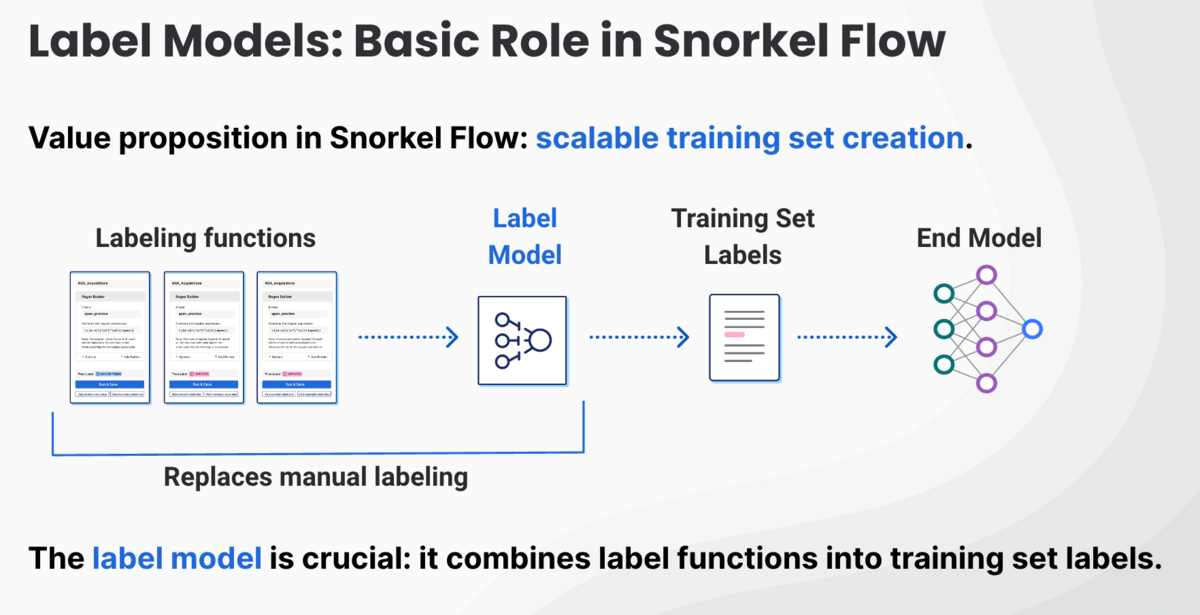
Image3

Majority vote label models

To resolve labeling function votes, we can simply take the majority vote. The majority vote model, however, operates on a few critical assumptions that I often see violated in practice. The first is that all LFs are of equal weight and quality. It doesn’t distinguish between a highly accurate LF and a mediocre one. It treats all votes equally—which can lead to skewed results if one or more LFs are inherently biased or inaccurate.

The second assumption is that classes with more LFs and LF “coverage” (the number of samples voted on by the LF) dedicated to them are more frequent. If a user happens to write many high-coverage LFs for one class and only one low coverage LF for a second class, the Majority Vote model implicitly assumes the first class is more frequent. The Majority Vote model, by design, can’t recognize whether a class is rare or not. In real-world applications, this often leads to over-voting for rare classes because users can actually devote a lot of time to writing LFs for rare classes.

A third assumption is that LFs make errors independently of each other. If one LF makes a mistake and incorrectly votes on a class, the chance that another LF will mistakenly vote on that same class is the same as it was before. This is a more subtle assumption that is also often incorrect in practice, and one of the most difficult problems for label models to solve.

One final shortcoming of majority voting is that it cannot learn from ground truth. Often customer datasets contain enough ground that a small sample could in theory be leveraged to improve the accuracy of our weak supervision process.

“Graphical” label models

On the other end of the label model spectrum, we have what I refer to as “graphical” label models. These are much more sophisticated statistical models that use machine learning to infer ground truth from LF voting patterns. They are oriented at addressing the shortcomings of majority voting and have been proven out on open-source datasets with relatively straightforward machine learning tasks such as binary classification. The theory behind these models is well established, with a number of high-profile publications from labs that include the group that founded Snorkel AI.

There are two main drawbacks to graphical models, however. One is that due to their complexity, graphical label models can demand significant computational resources and processing time. They may take hours to run, especially on tasks with many classes or more complex target variables, which is rarely feasible in a fast-paced enterprise environment. The second is that they are not always as accurate on real-world datasets due to statistical assumptions they make.
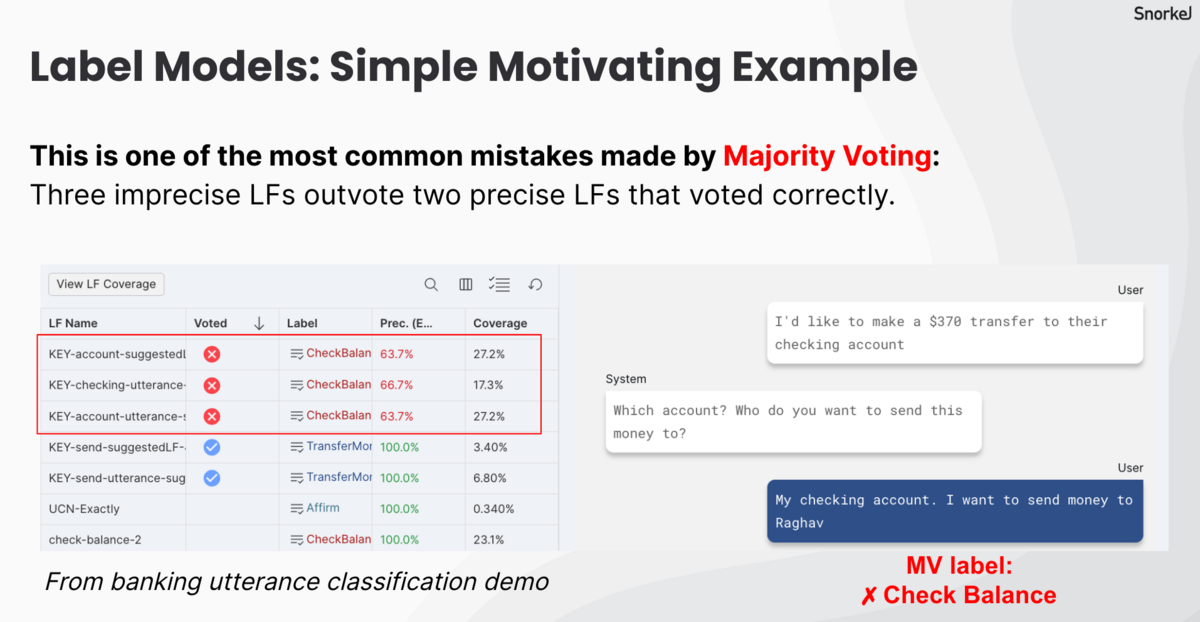
Image1

Our proprietary Snorkel Flow label model

To find a happy medium between quick-running Majority Vote models and heavier graphical models, I developed our proprietary Snorkel Flow label model. It is a direct response to the needs and feedback of our customers, who need a robust and practical solution for real-world applications. While I can’t describe our Snorkel Flow label model formula in full detail (it is proprietary, after all), I can offer some high-level insights.

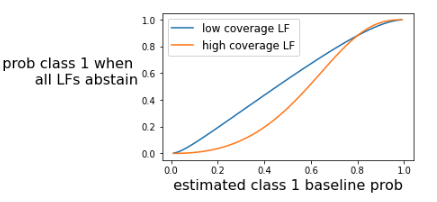
The model leverages ground truth data where it exists and learns from the patterns in the labeling functions. Labeling functions that apply to fewer examples and score higher precision on our ground truth data, for example, get a stronger vote. It also adjusts the weight of labeling functions based on the class distribution in the ground truth.

As a result, it addresses the two most common shortcomings of majority voting described above, assigning equal weight to all LFs and over-weighting classes with more LFs devoted to them. It does not address the third independence-of-errors assumption, which was a conscious choice; it seems to have less impact on accuracy in practice than the first two assumptions, and solving it would require much more sophisticated, computationally expensive models. [cite Fred’s flyingsquid model].
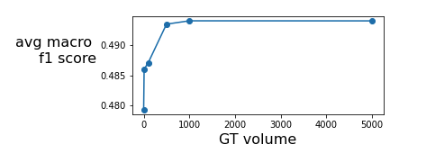
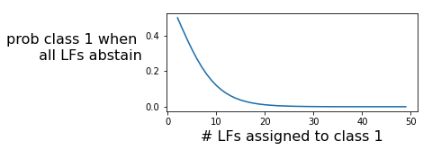
Image2
Image4
Image5

Comparing the Snorkel Flow label model to others

We tested our Snorkel Flow label model and several other options on an internal collection of 10+ datasets with varying properties and fixed labeling functions. The Snorkel Flow label model offered a significant lift in terms of performance, speed, and memory efficiency, which you can see in the table below.

Fit time diff from Majority VoteFit peak memory diff from Majority VoteAccuracy difference from Majority Vote
Snorkel Flow0.07 sec27 MB+1.2% (Up to 4.5%)
Open Source Snorkel20 sec1300 MB-0.1%
Skweak31 sec5000 MB-0.5%

On average, it provides a 1- to 2-point increase in accuracy over majority vote and wins out in 80% of experiments. Importantly, the Snorkel Flow label model is an order of magnitude faster and uses less memory than the academic alternatives.

Those differences sound small, but they add up. Due to our model’s small footprint and high processing speed, our customers can iterate quickly—spotting places where their existing labeling functions need additional help, adding it, and getting to a production-grade application faster.

The Snorkel Flow label model: a platform cornerstone

Label models are central to creating efficient and effective training sets for machine learning models. While the field of AI is not short of label models, our proprietary Snorkel Flow label mode provides a significant lift in performance, speed, and memory efficiency.

It’s a testament to our commitment to continually improve and adapt our tools to meet the real needs of our customers. The development of a label model is a constant work in progress (I’ve updated it twice), and we look forward to the exciting prospects it holds for the future.

Learn More

Follow Snorkel AI on LinkedInTwitter, and YouTube to be the first to see new posts and videos!