


惯性聚合 高效追踪和阅读你感兴趣的博客、新闻、科技资讯
阅读原文 在惯性聚合中打开

推荐订阅源

B
Blog RSS Feed
Security Archives - TechRepublic
freeCodeCamp Programming Tutorials: Python, JavaScript, Git & More
小众软件
小众软件
V
V2EX
B
Blog
腾讯CDC
D
DataBreaches.Net
H
Hackread – Cybersecurity News, Data Breaches, AI and More
月光博客
月光博客
The Cloudflare Blog
T
The Blog of Author Tim Ferriss
云风的 BLOG
云风的 BLOG
Latest news
Latest news
L
LINUX DO - 最新话题
C
Check Point Blog
Attack and Defense Labs
H
Hacker News: Front Page
Forbes - Security
Forbes - Security
H
Help Net Security
S
Securelist
D
Docker
Blog — PlanetScale
Blog — PlanetScale
Cyber Security Advisories - MS-ISAC
钛媒体:引领未来商业与生活新知
钛媒体:引领未来商业与生活新知
The Last Watchdog
The Last Watchdog
N
News and Events Feed by Topic
G
Google Developers Blog
AI
AI
I
Intezer
L
LangChain Blog
NISL@THU
NISL@THU
Threat Intelligence Blog | Flashpoint
人人都是产品经理
人人都是产品经理
Hugging Face - Blog
Hugging Face - Blog
罗磊的独立博客
T
Tenable Blog
Jina AI
Jina AI
I
InfoQ
C
Cybersecurity and Infrastructure Security Agency CISA
Cisco Talos Blog
Cisco Talos Blog
C
CERT Recently Published Vulnerability Notes
GbyAI
GbyAI
T
Tailwind CSS Blog
OSCHINA 社区最新新闻
OSCHINA 社区最新新闻
O
OpenAI News
让小产品的独立变现更简单 - ezindie.com
Know Your Adversary
Know Your Adversary
T
Troy Hunt's Blog
Google Online Security Blog

Snorkel AI

Building AI-Native Systems for Federal Infrastructure: A Conversation with Rezaur Rahman Code World Models and AutoHarness for LLM Agents Benchtalks #1: Alex Shaw (Terminal-Bench, Harbor) – Building the Benchmark Factory Building FinQA: An Open RL Environment for Financial Reasoning Agents How Tool Discipline Let a 4B Model Outsmart a 235B Giant on Financial Tasks Coding agents don’t need to be perfect, they need to recover Closing the Evaluation Gap in Agentic AI SlopCodeBench: Measuring Code Erosion as Agents Iterate Introducing the Snorkel Agentic Coding Benchmark 2026: The year of environments Part V: Future Direction and Emerging Trends in Rubric-Based AI Evaluation The self-critique paradox: Why AI verification fails where it’s needed most Chat With the Terminal-Bench Team | Snorkel AI Intelligence per watt: A new metric for AI’s future Terminal-Bench 2.0: Raising the bar for AI agent evaluation Snorkeling in RL environments Introducing SnorkelSpatial: A Benchmark for LLM Spatial Reasoning Scaling Trust: Rubrics in Snorkel's Quality Process Evaluating Multi-Agent Systems in Enterprise Tool Use Evaluating Coding Agents with Terminal-Bench 2.0 Parsing isn’t neutral: why evaluation choices matter The science of rubric design The right tool for the job: An A-Z of rubrics Data quality and rubrics: how to build trust in your models Building the benchmark: inside our agentic insurance underwriting dataset Evaluating AI agents for insurance underwriting LLM observability: key practices, tools, and challenges Anthropic Claude + AWS: revolutionizing pharma data analytics with Snorkel AI Data-centric development of an enterprise AI agent with Snorkel Building the data development platform for specialized AI LLM-as-a-judge for enterprises: evaluate model alignment at scale Why GenAI evaluation requires SME-in-the-loop for validation and trust Research spotlight: is long chain-of-thought structure all that matters when it comes to LLM reasoning distillation? Why enterprise GenAI evaluation requires fine-grained metrics to be insightful What is specialized GenAI evaluation, and why is it so critical to enterprise AI? LLM alignment techniques: 4 post-training approaches Research spotlight: Is intent analysis the key to unlocking more accurate LLM question answering? Why enterprises should embrace LLM distillation Retrieval-augmented generation (RAG) failure modes and how to fix them What is large language model (LLM) alignment? Databricks + Snorkel Flow: integrated, streamlined AI development How LLM evaluation drives better models in Snorkel Flow Unlock proprietary data with Snorkel Flow and Amazon SageMaker LLM evaluation in enterprise applications: a new era in ML Snorkel AI joins the AWS ISV Accelerate Program and launches Snorkel Flow Availability in AWS Marketplace AI data development: a guide for data science projects SnorkelCon 2024: Inaugural Snorkel AI user conference gathers leaders from 30+ Fortune 500 companies Snorkel Flow 2024.R3: Supercharge your AI development with enhanced data-centric workflows Explore the new GenAI Evaluation Suite: Snorkel 2024.R3 New NLP features in Snorkel Flow 2024.R3 Enterprise data compliance and security review: Snorkel Flow 2024.R3 How a global financial services company built a specialized AI copilot accurate enough for production Task Me Anything: innovating multimodal model benchmarks Alfred: Data labeling with foundation models and weak supervision RAG: LLM performance boost with retrieval-augmented generation Call center AI for customer experience management: a case study New GenAI features, data annotation: Snorkel Flow 2024.R2 How data slices transform enterprise LLM evaluation Meta’s Llama 3.1 405B is the new Mr. Miyagi, now what? Meta’s new Llama 3.1 models are here! Are you ready for it? Data-centric AI with Snorkel and MinIO Weak supervision for non-categorical applications + superalignment Snorkel AI signs strategic collaboration agreement with AWS to help enterprises cross the demo-to-production chasm AI alignment made simple: innovative solutions for businesses How does the Snorkel Flow label model work? Vision language models: how LLMs boost image classification Long context models in the enterprise: benchmarks and beyond How to build production-grade RAG retrieval with Snorkel Flow How Bonito helps fine-tune specialized LLMs faster than ever Walking safely before building flying saucer seatbelts: introducing Enterprise Alignment Role-based access controls in Snorkel Flow secure enterprise data Accelerating AI development in manufacturing with Snorkel Flow and AWS SageMaker How ROBOSHOT boosts zero-shot foundation model performance Discover what’s new in Snorkel Flow: Flexible data and LLM connectivity, secure data controls, and more! Faster than ever document intelligence with new Snorkel Flow FM-first workflow The art of data development for Enterprise LLMs Crossing the demo-to-production chasm with Snorkel Custom How Snorkel topped the AlpacaEval leaderboard (and why we're not there anymore) CRFM's HELM and enterprise LLM evaluation beyond accuracy How we achieved 89% accuracy on contract question answering Five sessions not to miss at Google Cloud Next 24 Content filtering breakthrough: Snorkel client reaches 96% recall in 3 days Here's how Snorkel Flow + Google AI built an enterprise-ready model in a day Snorkel teams with Microsoft to showcase new AI research at NVIDIA GTC How Skill-it! enables faster, better LLM training Enterprise GenAI to surge in 2024: survey results Large language model training: how three training phases shape LLMs LoRA: Low-Rank Adaptation for LLMs LLM distillation demystified: a complete guide Enterprises must shift their focus from models to data in AI development Insurance’s GenAI revolution: a business perspective Scaling human preferences in AI: Snorkel's programmatic approach Building better enterprise AI: incorporating expert feedback in system development “Fall in love with your data”—Snorkel AI’s Enterprise LLM Summit Why QBE Ventures invested in Snorkel AI New benchmark results demonstrate value of Snorkel AI approach to LLM alignment Retrieval augmented generation (RAG): a conversation with its creator Snorkel Flow 2023.R4: enhanced UI + PDF and Databricks tools How Snorkel Flow users can register custom models to Databricks Stanford professor discusses exciting advances in foundation model evaluation
Fine-tuned representation models boost LLM systems. Here's how
Trung Nguyen · 2024-03-05 · via Snorkel AI

Representation models significantly impact the performance of AI applications. We’ve seen this working with clients at Snorkel AI. Standard representation models often fell short on our clients’ specialized tasks, leading to poor application performance. While we use many tools to sharpen their applications, representation model fine-tuning sometimes prove the most effective.

I recently had the opportunity to delve into our work on representation models at our Enterprise LLM Summit. I explored the fundamental concepts of representation models and their crucial role in machine learning tasks.

The discussion centered on the importance of data quality and the role of data augmentation techniques in improving the robustness and effectiveness of representation models. We also ventured into the strategic use of these models in retrieval augmented generation (RAG), an AI process designed to optimize the outputs of large language models (LLMs).

I recommend you watch the whole presentation, embedded below, but I have summarized the main points here.

Understanding Representation Models

Let’s start with the basics. Representation models are a class of machine learning models designed to capture and encode meaningful features from raw data. These models enable classification, clustering, similarity calculations, information retrieval, and other tasks.

Representation models often serve as part of a broader machine learning system, and their outputs feed downstream uses. The models’ training teaches them to keep conceptually similar objects closer together in the latent feature space.

In the context of RAG pipelines, representation models can play multiple crucial roles. They fuel the indexing process where the model encodes the corpus of data into a dense vector space. The same model also encodes the user’s query for retrieval. After retrieval, another class of representation models, known as cross-encoders, takes in pairs of inputs and learns their joint representation for the re-ranking process which often improves performance. Thus, representation models are integral to the effective functioning of RAG pipelines.
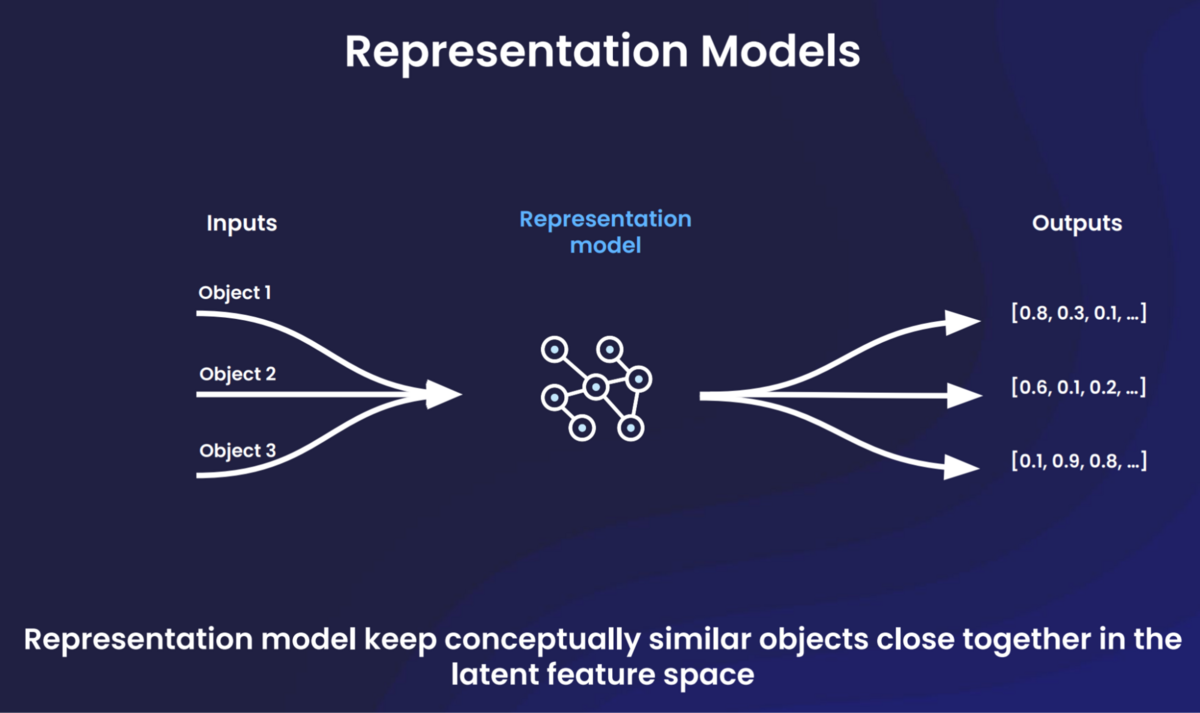
Image1

What is retrieval augmented generation (RAG)?

RAG attempts to improve LLM outputs by incorporating an additional information retrieval step—and generally succeeds in doing so. This retrieval step augments the prompt sent to the model by adding context. For example, injecting one or more paragraphs about football if someone asks a question about the National Football League.

Fine-tuning these models can help ensure the retrieval stage identifies all the documents relevant to a user’s query, and then ensures that it accurately ranks the documents in order of importance.

Fine tuning representation models

Pre-trained representation models typically learn their feature space on large and diverse datasets. While these models easily separate documents about moon landings and moon pies, they can struggle with nuance on narrow topics—which is what enterprises typically need.

This is where fine-tuning comes in. By adapting these pre-trained models to a specific task, dataset or intent, we can leverage the knowledge they gained from the pre-training phase and further optimize them for our unique needs. This results in models that better understand and encode the nuances of your specific data or domain, leading to improved performance.

Data scientists most frequently fine tune representation models through two approaches: task adaptation and full model fine tuning. Task adaptation fine tunes a portion of a network’s layer, which requires a smaller amount of data. This adapts the model to the new task efficiently and reduces the risk of overfitting. Full model fine-tuning trains the entire network on your task-specific data set. While this typically requires more data, it allows for a more comprehensive adaptation to the specific task, often leading to superior performance.
Image2

The role of data quality and augmentation

The success of fine tuned representation models heavily relies on the quality of the data used in the llm fine tuning process. Data that lacks diversity or does not capture certain edge cases may create a model that underperforms when faced with real-world scenarios. In such cases, data scientists may consider data augmentation or synthesis techniques.

Data augmentation increases the diversity and quantity of training data without collecting new examples. It applies transformations to the existing data to create new data points. This helps create a more robust and comprehensive dataset, thereby improving performance.

Our Snorkel Flow AI data development platform allows users to apply scalable and effective data augmentation techniques. It facilitates methods such as embedding and clustering techniques to determine similar or dissimilar points. This can help create “hard negatives,” which are data points that are very similar to the positive examples but not relevant. These hard negatives help fine tune the model’s ability to distinguish between similar concepts that it initially struggled to disambiguate between.

Snorkel Flow also enables users to easily slice and filter their data. This helps users identify the source of errors and allows them to focus their augmentation techniques efficiently. For instance, it can allow a user to identify that a certain subset lacks sufficient representative data, and augment it.

Data + representation mode fine tuning = better RAG

Training data quality and the use of data augmentation techniques play a crucial role in the success of fine-tuning representation models. By ensuring your data is representative and diverse, and by effectively leveraging data augmentation methods, you can significantly enhance the performance and robustness of your models.

More Snorkel AI events coming!

Snorkel has more live online events coming. Look at our events page to sign up for research webinars, product overviews, and case studies.

If you're looking for more content immediately, check out our YouTube channel, where we keep recordings of our past webinars and online conferences.