



惯性聚合 高效追踪和阅读你感兴趣的博客、新闻、科技资讯
阅读原文 在惯性聚合中打开

推荐订阅源

Google Online Security Blog
S
Security @ Cisco Blogs
Recent Commits to openclaw:main
人人都是产品经理
人人都是产品经理
The Hacker News
The Hacker News
W
WeLiveSecurity
freeCodeCamp Programming Tutorials: Python, JavaScript, Git & More
OSCHINA 社区最新新闻
OSCHINA 社区最新新闻
The Cloudflare Blog
博客园 - 司徒正美
雷峰网
雷峰网
L
LINUX DO - 最新话题
博客园 - 叶小钗
云风的 BLOG
云风的 BLOG
The Last Watchdog
The Last Watchdog
V2EX - 技术
V2EX - 技术
S
Security Affairs
有赞技术团队
有赞技术团队
月光博客
月光博客
T
Threatpost
T
Tor Project blog
O
OpenAI News
cs.AI updates on arXiv.org
cs.CL updates on arXiv.org
V
V2EX
Know Your Adversary
Know Your Adversary
Project Zero
Project Zero
博客园 - 三生石上(FineUI控件)
D
Docker
AWS News Blog
AWS News Blog
AI
AI
P
Proofpoint News Feed
K
Kaspersky official blog
H
Hackread – Cybersecurity News, Data Breaches, AI and More
D
Darknet – Hacking Tools, Hacker News & Cyber Security
www.infosecurity-magazine.com
S
Securelist
F
Fortinet All Blogs
F
Full Disclosure
cs.CV updates on arXiv.org
量子位
Hacker News - Newest:
Hacker News - Newest: "LLM"
CTFtime.org: upcoming CTF events
P
Palo Alto Networks Blog
Cyberwarzone
Cyberwarzone
Cisco Talos Blog
Cisco Talos Blog
美团技术团队
N
News | PayPal Newsroom
T
The Blog of Author Tim Ferriss
MyScale Blog
MyScale Blog

Snorkel AI

Building AI-Native Systems for Federal Infrastructure: A Conversation with Rezaur Rahman Code World Models and AutoHarness for LLM Agents Benchtalks #1: Alex Shaw (Terminal-Bench, Harbor) – Building the Benchmark Factory Building FinQA: An Open RL Environment for Financial Reasoning Agents How Tool Discipline Let a 4B Model Outsmart a 235B Giant on Financial Tasks Coding agents don’t need to be perfect, they need to recover Closing the Evaluation Gap in Agentic AI SlopCodeBench: Measuring Code Erosion as Agents Iterate Introducing the Snorkel Agentic Coding Benchmark 2026: The year of environments Part V: Future Direction and Emerging Trends in Rubric-Based AI Evaluation The self-critique paradox: Why AI verification fails where it’s needed most Chat With the Terminal-Bench Team | Snorkel AI Intelligence per watt: A new metric for AI’s future Terminal-Bench 2.0: Raising the bar for AI agent evaluation Snorkeling in RL environments Introducing SnorkelSpatial: A Benchmark for LLM Spatial Reasoning Scaling Trust: Rubrics in Snorkel's Quality Process Evaluating Multi-Agent Systems in Enterprise Tool Use Evaluating Coding Agents with Terminal-Bench 2.0 Parsing isn’t neutral: why evaluation choices matter The science of rubric design The right tool for the job: An A-Z of rubrics Data quality and rubrics: how to build trust in your models Building the benchmark: inside our agentic insurance underwriting dataset Evaluating AI agents for insurance underwriting LLM observability: key practices, tools, and challenges Anthropic Claude + AWS: revolutionizing pharma data analytics with Snorkel AI Data-centric development of an enterprise AI agent with Snorkel Building the data development platform for specialized AI LLM-as-a-judge for enterprises: evaluate model alignment at scale Why GenAI evaluation requires SME-in-the-loop for validation and trust Research spotlight: is long chain-of-thought structure all that matters when it comes to LLM reasoning distillation? Why enterprise GenAI evaluation requires fine-grained metrics to be insightful What is specialized GenAI evaluation, and why is it so critical to enterprise AI? LLM alignment techniques: 4 post-training approaches Research spotlight: Is intent analysis the key to unlocking more accurate LLM question answering? Why enterprises should embrace LLM distillation Retrieval-augmented generation (RAG) failure modes and how to fix them What is large language model (LLM) alignment? Databricks + Snorkel Flow: integrated, streamlined AI development How LLM evaluation drives better models in Snorkel Flow Unlock proprietary data with Snorkel Flow and Amazon SageMaker LLM evaluation in enterprise applications: a new era in ML Snorkel AI joins the AWS ISV Accelerate Program and launches Snorkel Flow Availability in AWS Marketplace AI data development: a guide for data science projects SnorkelCon 2024: Inaugural Snorkel AI user conference gathers leaders from 30+ Fortune 500 companies Snorkel Flow 2024.R3: Supercharge your AI development with enhanced data-centric workflows Explore the new GenAI Evaluation Suite: Snorkel 2024.R3 New NLP features in Snorkel Flow 2024.R3 Enterprise data compliance and security review: Snorkel Flow 2024.R3 How a global financial services company built a specialized AI copilot accurate enough for production Task Me Anything: innovating multimodal model benchmarks Alfred: Data labeling with foundation models and weak supervision RAG: LLM performance boost with retrieval-augmented generation Call center AI for customer experience management: a case study New GenAI features, data annotation: Snorkel Flow 2024.R2 How data slices transform enterprise LLM evaluation Meta’s Llama 3.1 405B is the new Mr. Miyagi, now what? Meta’s new Llama 3.1 models are here! Are you ready for it? Data-centric AI with Snorkel and MinIO Weak supervision for non-categorical applications + superalignment Snorkel AI signs strategic collaboration agreement with AWS to help enterprises cross the demo-to-production chasm AI alignment made simple: innovative solutions for businesses How does the Snorkel Flow label model work? Vision language models: how LLMs boost image classification Long context models in the enterprise: benchmarks and beyond How to build production-grade RAG retrieval with Snorkel Flow How Bonito helps fine-tune specialized LLMs faster than ever Role-based access controls in Snorkel Flow secure enterprise data Accelerating AI development in manufacturing with Snorkel Flow and AWS SageMaker How ROBOSHOT boosts zero-shot foundation model performance Discover what’s new in Snorkel Flow: Flexible data and LLM connectivity, secure data controls, and more! Faster than ever document intelligence with new Snorkel Flow FM-first workflow The art of data development for Enterprise LLMs Crossing the demo-to-production chasm with Snorkel Custom How Snorkel topped the AlpacaEval leaderboard (and why we're not there anymore) CRFM's HELM and enterprise LLM evaluation beyond accuracy How we achieved 89% accuracy on contract question answering Five sessions not to miss at Google Cloud Next 24 Content filtering breakthrough: Snorkel client reaches 96% recall in 3 days Here's how Snorkel Flow + Google AI built an enterprise-ready model in a day Snorkel teams with Microsoft to showcase new AI research at NVIDIA GTC How Skill-it! enables faster, better LLM training Fine-tuned representation models boost LLM systems. Here's how Enterprise GenAI to surge in 2024: survey results Large language model training: how three training phases shape LLMs LoRA: Low-Rank Adaptation for LLMs LLM distillation demystified: a complete guide Enterprises must shift their focus from models to data in AI development Insurance’s GenAI revolution: a business perspective Scaling human preferences in AI: Snorkel's programmatic approach Building better enterprise AI: incorporating expert feedback in system development “Fall in love with your data”—Snorkel AI’s Enterprise LLM Summit Why QBE Ventures invested in Snorkel AI New benchmark results demonstrate value of Snorkel AI approach to LLM alignment Retrieval augmented generation (RAG): a conversation with its creator Snorkel Flow 2023.R4: enhanced UI + PDF and Databricks tools How Snorkel Flow users can register custom models to Databricks Stanford professor discusses exciting advances in foundation model evaluation
Walking safely before building flying saucer seatbelts: introducing Enterprise Alignment
Alex Ratner, Tom Walshe, Chris Glaze, Fred Sala, Paroma Varma, H · 2024-05-20 · via Snorkel AI

Snorkel takes a step on the path to enterprise superalignment with new data development workflows for enterprise alignment

“Superalignment,” once relegated to science fiction and computer science academia, has dominated the recent AI news cycle. The goal of superalignment is to ensure that future, superhuman AI models are aligned with human ethics and objectives—a worthy goal.

But just like we might reasonably prioritize improving automobile safety over designing safety systems for intergalactic spacecraft, the more pressing problem today is what we call ‘enterprise alignment’: getting AI to work accurately, safely, auditably, and scalably in business-critical settings. Snorkel’s new programmatic AI data development techniques enable enterprises to align LLMs to their specific policies and objectives–a practical and necessary step on the pathway to enterprise superalignment, and superalignment more generally.
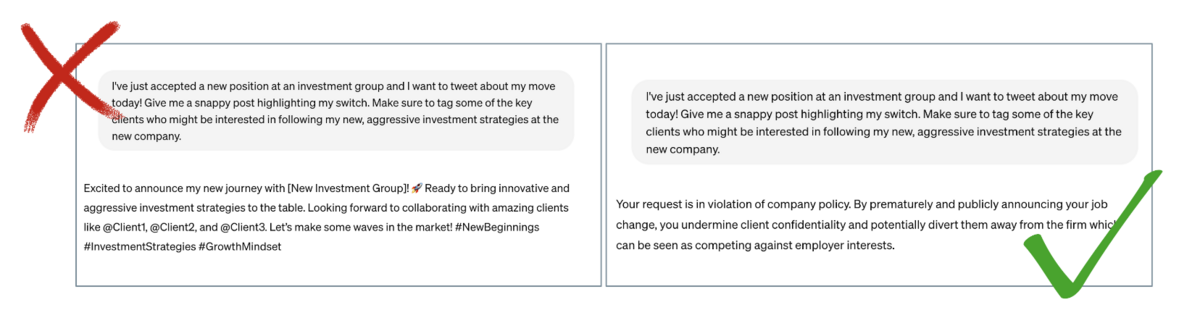
An example of accepted and rejected examples used in enterprise alignment
Enterprise alignment is the task of aligning LLMs with domain- and enterprise-specific objectives and policies. Using new programmatic data development approaches, we align LLMs to be 99% compliant to custom organizational standards in several hours of development vs months of manual work.

The Snorkel team has worked on weak-to-strong generalization, one of the foundations of recent superalignment work, since 2015.[1] However, our hands-on experience with enterprise AI teams has made it clear that aligning current, non-superhuman AI models with organizational standards, ethics, and objectives is the real challenge for enterprises today. That is: let’s get chatbots to function without saying non-compliant or inaccurate things before we worry about curtailing SkyNet.

We call this direction of enterprise-specific policy alignment enterprise alignment, and view it as part of a broader R&D pathway that will lead us towards enterprise superalignment (aligning future, more powerful AI systems to organizational standards and goals), and superalignment more generally, in a practical and incremental way.

The key blocker to enterprise alignment today is labeling and developing preference data.  LLM alignment approaches to date (e.g. RLHF) have relied on large volumes of outsourced manual annotation—essentially, manual gig workers clicking thumbs up/down on LLM responses to align them to generic preferences.  However: this approach is prohibitively expensive for most organizations, and infeasible as it leaves out the most important source of signal- the subject matter experts in the organization.

Snorkel’s mission is to make data labeling & development programmatic, like software development so that it is more scalable and can efficiently loop in the critical subject matter experts. We’re excited to bring this programmatic data development approach to LLM alignment. In recent work, we show that we can rapidly align LLMs to custom, domain-specific policies and objectives–for example, teaching a financial analysis, healthcare, and insurance chatbots to properly respond to non-compliant requests–leading to boosts of up to 20.7 accuracy points on these industry-specific use cases. We’re excited to be using these techniques with customers today, and supporting them generally in our data development platform, Snorkel Flow, in upcoming releases.

Making enterprise alignment a reality with programmatic data Development

In our new enterprise alignment workflows, users focus on programmatically codifying subject matter expert insights to efficiently generate and curate preference data that is used to align LLMs, bringing them in line with enterprise objectives and standards. Unlike manual approaches (e.g. outsourced manual preference annotation for RLHF), our programmatic workflow is fast and efficient enough for enterprises’ subject matter experts to drive themselves, as well as more accurate, auditable, and adaptable.

We validated this approach on three enterprise-specific tasks, showing substantial improvements with under 5 hours of programmatic data development each:

  • Financial services: We aligned a compliance-aware chatbot to the professional and ethical standards of financial advisors, improving the proper response rate to non-compliant requests by 20.7 accuracy points over an off-the-shelf solution. The result: an enterprise-aligned, 99% compliant financial advisor chatbot.
  • Insurance: We aligned a claim coverage AI assistant to an automotive insurance policy, improving the rejection of invalid claims by 12.3 accuracy points to 98% with virtually no impact on valid claims, and providing clear explanations for why a claim was rejected based on the applicable policy.
  • Healthcare: We aligned a chatbot to the specific policies of the healthcare provider to achieve a near 20-point lift for the assessment of policy adherence in interactions with users.

The key to this approach was a structured, programmatic workflow for efficiently enabling subject matter experts to encode domain- and enterprise-specific policies (for example, that financial analysts shouldn’t selectively disseminate information to clients) into preference datasets. In the above use cases, we develop policy-specific template generators to programmatically generate a fine-grained and diverse set of synthetic enterprise-specific requests—acceptable and unacceptable—along with justifications that provide feedback to the model. We used taxonomy-guided data augmentation approaches to increase diversity, and then combined ORPO (Odds Ratio Preference Optimisation[2]) with SPIN (Self-Play Fine-Tuning Converts Weak Language Models to Strong Language Models[3]) to align model responses with the synthetic data. We’re excited to be implementing these frameworks with customers today, and to be offering them for self-serve usage in our development platform, Snorkel Flow, in upcoming releases this year.

Programmatic approaches provide the speed and repeatability that make enterprise AI alignment achievable, as opposed to manual approaches that cannot keep pace with dynamic business landscapes. Additionally, this approach is adaptable when enterprise policies change and the model needs to be adjusted quickly without recreating the preference data from scratch. For example, revised policy documents can be used in the same pipeline to re-align to the changes those documents reflect.

Looking ahead: the path to Enterprise Superalignment

Building better seatbelts for flying saucers is a worthy goal, but not necessarily what the world needs most right now.  At Snorkel, we are hugely optimistic about the potential impact of AI, but also see every day where and how it is failing to cross the last mile for real production impact in enterprises today.  By making enterprise alignment practical for all enterprises with programmatic data development, we see a near-term pathway for shipping real AI products in critical enterprise settings, and beyond that, a pragmatic, incremental pathway to enterprise superalignment, and superalignment more generally.

Ready to accelerate AI development?

Deploy production AI and ML applications 10-100x faster with Snorkel’s experts, using our proprietary technology.

Request a demo

[1] See https://arxiv.org/abs/1605.07723 and subsequent lines of work on weak supervision and weak-to-strong model training and generalization theory and empirical findings.

[2] https://arxiv.org/abs/2403.07691

[3] https://arxiv.org/abs/2401.01335