







A multinational, multibillion-dollar financial services company set out to develop an AI copilot which could provide call center agents with helpful answers to customer questions. The goal was to generate high-quality, low-latency responses without incurring significant inference costs as usage grows. However, ChatGPT 3.5 Turbo with RAG suffered from poor accuracy and hallucinations—and annual token costs were projected to exceed $1.5M within three years.
To overcome these challenges, the company adopted a set of guiding AI principles and embraced data-centric AI.
The team successfully adopted these principles, and partnered with Snorkel, Databricks, and AWS to implement a data-centric approach to AI development—enabling them to build specialized models trained on their own domain knowledge and data, and to meet production accuracy and cost requirements.
Snorkel, Databricks, and AWS enabled the team to build and deploy small, specialized, and highly accurate models which met their AI production requirements and strategic goals.
Foundation:
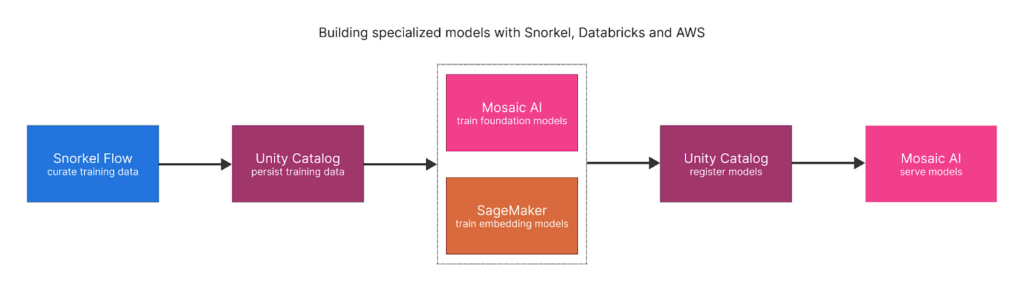
The key to ensuring their AI copilot generated accurate and complete answers, and not hallucinations, was deploying an optimized RAG pipeline which always grounded answers by relevant information contained within their knowledge base (KB). This was accomplished by fine-tuning a bge-large embedding model to increase retrieval accuracy by 16 points and fine-tuning a Mixtral 8x7B foundation model to improve response quality.
The team developed an internal LLM evaluation framework which scores models based on response accuracy, compliance, and reliability. When evaluated with this framework, their optimized RAG pipeline scored 15 points higher than an out-of-the-box RAG pipeline with a base 70B model and 26 points higher than one with GPT 3.5 Turbo.
The team began by requesting frequently asked questions from subject matter experts (SMEs), combining them with questions extracted from call center transcripts, and importing all questions into Snorkel Flow.
Next, they needed to pair these questions with relevant chunks from KB articles. This was done by taking advantage of a) collaborative data labeling to create a validation dataset for evaluating the embedding model and b) programmatic data labeling to create training and test datasets for fine-tuning it.
The question-chunk pairs created for training, testing, and validating the embedding model were transformed into question-chunk-answer triplets by generating answers with foundation models such as DBRX via RAG.
The team took advantage of collaborative data labeling to create a validation dataset for evaluating the foundation model as well as programmatic data labeling to create training and test datasets for fine-tuning it.
The good triplets were filtered out to create high-quality training data for fine-tuning both the embedding model and the foundation model. The foundation model training data was exported from Snorkel Flow and imported into Mosaic AI where it was then used to create a fine-tuned Mixtral 8x7B model. The embedding model training data was used to create a fine-tuned bge-large model with SageMaker.
This was an iterative process whereby both the training data and the models were continuously improved. The models were fine-tuned on training data. Then, the training data was improved with additional SME feedback as well as results from the fine-tuned models. The process continued until the fine-tuned models reached production accuracy.
In order to evaluate the results of the fine-tuned models, for both retrieval and generation, a separate model was created within Snorkel Flow which predicts whether triplets will be labeled good or bad based on previously captured SME acceptance criteria. After each fine-tuning iteration, this Snorkel Flow model—along with the ground truth/validation dataset—was used to evaluate both the fine-tuned bge-large embedding model and the end-to-end RAG pipeline, which included the fine-tuned Mixtral 8x7B foundation model as well.
The team chose Databricks Mosaic AI, itself built on the Databricks Data Intelligence Platform, for deploying the optimized RAG pipeline, which included both the embedding model and the foundation model, as well as native vector search. With Mosaic AI, they fine-tuned the foundation model 4x faster than alternative approaches and, once deployed, benefitted from a TTFT of 1s—far lower than their requirement of 5s or less.
By adopting Snorkel Flow for AI data development, Databricks Mosaic AI for open model fine-tuning and inference, and AWS for the cloud infrastructure upon which Snorkel Flow and Mosaic AI were deployed as well as supplemental AI/ML services, this multinational financial services leader developed a state-of-the-art platform for building and deploying small, specialized, and highly accurate AI models to support current and future GenAI initiatives.
They not only achieved success in deploying a production AI copilot, they met their goals of generating accurate responses with high confidence (and eliminating hallucinations), preventing linear growth in the tokenization costs of closed model APIs, and becoming fully model agnostic.
Watch this demo from Marty Moesta, Snorkel’s lead product manager for GenAI, and see how RAG pipelines can be optimized with Snorkel Flow. Or, register to join one of our weekly demos which regularly cover RAG optimization and LLM fine-tuning/evaluation.
此内容由惯性聚合(RSS阅读器)自动聚合整理,仅供阅读参考。 原文来自 — 版权归原作者所有。