
惯性聚合 高效追踪和阅读你感兴趣的博客、新闻、科技资讯
阅读原文 在惯性聚合中打开

推荐订阅源

C
CXSECURITY Database RSS Feed - CXSecurity.com
P
Privacy International News Feed
V
Vulnerabilities – Threatpost
The Last Watchdog
The Last Watchdog
Threat Intelligence Blog | Flashpoint
Exploit-DB.com RSS Feed
O
OpenAI News
T
Threat Research - Cisco Blogs
WordPress大学
WordPress大学
OSCHINA 社区最新新闻
OSCHINA 社区最新新闻
P
Palo Alto Networks Blog
cs.AI updates on arXiv.org
H
Help Net Security
P
Proofpoint News Feed
MyScale Blog
MyScale Blog
Security Archives - TechRepublic
T
The Blog of Author Tim Ferriss
H
Hackread – Cybersecurity News, Data Breaches, AI and More
S
Securelist
Vercel News
Vercel News
S
Security Affairs
D
Darknet – Hacking Tools, Hacker News & Cyber Security
B
Blog RSS Feed
云风的 BLOG
云风的 BLOG
K
KPMG report finds enterprise disconnect between AI and its ROI | CIO
Blog — PlanetScale
Blog — PlanetScale
让小产品的独立变现更简单 - ezindie.com
Last Week in AI
Last Week in AI
博客园_首页
Attack and Defense Labs
G
Google Developers Blog
T
Tor Project blog
Project Zero
Project Zero
腾讯CDC
Schneier on Security
月光博客
月光博客
N
Netflix TechBlog - Medium
AWS News Blog
AWS News Blog
L
LINUX DO - 最新话题
P
Proofpoint News Feed
博客园 - 司徒正美
A
About on SuperTechFans
Latest news
Latest news
Scott Helme
Scott Helme
Hacker News: Ask HN
Hacker News: Ask HN
T
Threatpost
Hacker News - Newest:
Hacker News - Newest: "LLM"
C
CERT Recently Published Vulnerability Notes
Google DeepMind News
博客园 - 聂微东

Snorkel AI

Building AI-Native Systems for Federal Infrastructure: A Conversation with Rezaur Rahman Code World Models and AutoHarness for LLM Agents Benchtalks #1: Alex Shaw (Terminal-Bench, Harbor) – Building the Benchmark Factory Building FinQA: An Open RL Environment for Financial Reasoning Agents How Tool Discipline Let a 4B Model Outsmart a 235B Giant on Financial Tasks Coding agents don’t need to be perfect, they need to recover Closing the Evaluation Gap in Agentic AI SlopCodeBench: Measuring Code Erosion as Agents Iterate Introducing the Snorkel Agentic Coding Benchmark 2026: The year of environments Part V: Future Direction and Emerging Trends in Rubric-Based AI Evaluation The self-critique paradox: Why AI verification fails where it’s needed most Chat With the Terminal-Bench Team | Snorkel AI Intelligence per watt: A new metric for AI’s future Terminal-Bench 2.0: Raising the bar for AI agent evaluation Snorkeling in RL environments Introducing SnorkelSpatial: A Benchmark for LLM Spatial Reasoning Scaling Trust: Rubrics in Snorkel's Quality Process Evaluating Multi-Agent Systems in Enterprise Tool Use Evaluating Coding Agents with Terminal-Bench 2.0 Parsing isn’t neutral: why evaluation choices matter The science of rubric design The right tool for the job: An A-Z of rubrics Data quality and rubrics: how to build trust in your models Building the benchmark: inside our agentic insurance underwriting dataset Evaluating AI agents for insurance underwriting LLM observability: key practices, tools, and challenges Anthropic Claude + AWS: revolutionizing pharma data analytics with Snorkel AI Data-centric development of an enterprise AI agent with Snorkel Building the data development platform for specialized AI LLM-as-a-judge for enterprises: evaluate model alignment at scale Why GenAI evaluation requires SME-in-the-loop for validation and trust Research spotlight: is long chain-of-thought structure all that matters when it comes to LLM reasoning distillation? Why enterprise GenAI evaluation requires fine-grained metrics to be insightful What is specialized GenAI evaluation, and why is it so critical to enterprise AI? LLM alignment techniques: 4 post-training approaches Research spotlight: Is intent analysis the key to unlocking more accurate LLM question answering? Why enterprises should embrace LLM distillation Retrieval-augmented generation (RAG) failure modes and how to fix them What is large language model (LLM) alignment? Databricks + Snorkel Flow: integrated, streamlined AI development How LLM evaluation drives better models in Snorkel Flow Unlock proprietary data with Snorkel Flow and Amazon SageMaker LLM evaluation in enterprise applications: a new era in ML Snorkel AI joins the AWS ISV Accelerate Program and launches Snorkel Flow Availability in AWS Marketplace SnorkelCon 2024: Inaugural Snorkel AI user conference gathers leaders from 30+ Fortune 500 companies Snorkel Flow 2024.R3: Supercharge your AI development with enhanced data-centric workflows Explore the new GenAI Evaluation Suite: Snorkel 2024.R3 New NLP features in Snorkel Flow 2024.R3 Enterprise data compliance and security review: Snorkel Flow 2024.R3 How a global financial services company built a specialized AI copilot accurate enough for production Task Me Anything: innovating multimodal model benchmarks Alfred: Data labeling with foundation models and weak supervision RAG: LLM performance boost with retrieval-augmented generation Call center AI for customer experience management: a case study New GenAI features, data annotation: Snorkel Flow 2024.R2 How data slices transform enterprise LLM evaluation Meta’s Llama 3.1 405B is the new Mr. Miyagi, now what? Meta’s new Llama 3.1 models are here! Are you ready for it? Data-centric AI with Snorkel and MinIO Weak supervision for non-categorical applications + superalignment Snorkel AI signs strategic collaboration agreement with AWS to help enterprises cross the demo-to-production chasm AI alignment made simple: innovative solutions for businesses How does the Snorkel Flow label model work? Vision language models: how LLMs boost image classification Long context models in the enterprise: benchmarks and beyond How to build production-grade RAG retrieval with Snorkel Flow How Bonito helps fine-tune specialized LLMs faster than ever Walking safely before building flying saucer seatbelts: introducing Enterprise Alignment Role-based access controls in Snorkel Flow secure enterprise data Accelerating AI development in manufacturing with Snorkel Flow and AWS SageMaker How ROBOSHOT boosts zero-shot foundation model performance Discover what’s new in Snorkel Flow: Flexible data and LLM connectivity, secure data controls, and more! Faster than ever document intelligence with new Snorkel Flow FM-first workflow The art of data development for Enterprise LLMs Crossing the demo-to-production chasm with Snorkel Custom How Snorkel topped the AlpacaEval leaderboard (and why we're not there anymore) CRFM's HELM and enterprise LLM evaluation beyond accuracy How we achieved 89% accuracy on contract question answering Five sessions not to miss at Google Cloud Next 24 Content filtering breakthrough: Snorkel client reaches 96% recall in 3 days Here's how Snorkel Flow + Google AI built an enterprise-ready model in a day Snorkel teams with Microsoft to showcase new AI research at NVIDIA GTC How Skill-it! enables faster, better LLM training Fine-tuned representation models boost LLM systems. Here's how Enterprise GenAI to surge in 2024: survey results Large language model training: how three training phases shape LLMs LoRA: Low-Rank Adaptation for LLMs LLM distillation demystified: a complete guide Enterprises must shift their focus from models to data in AI development Insurance’s GenAI revolution: a business perspective Scaling human preferences in AI: Snorkel's programmatic approach Building better enterprise AI: incorporating expert feedback in system development “Fall in love with your data”—Snorkel AI’s Enterprise LLM Summit Why QBE Ventures invested in Snorkel AI New benchmark results demonstrate value of Snorkel AI approach to LLM alignment Retrieval augmented generation (RAG): a conversation with its creator Snorkel Flow 2023.R4: enhanced UI + PDF and Databricks tools How Snorkel Flow users can register custom models to Databricks Stanford professor discusses exciting advances in foundation model evaluation
Why coding agents need better data, evals, and environments
Alexis Sobel · 2026-05-12 · via Snorkel AI

Coding agents have moved from tab-complete to teammate. They autonomously inspect repositories, edit files, run commands, diagnose failures, and work through multi-step engineering tasks.

That creates a harder reliability problem. A model that only suggests code is easy for a human to evaluate. A coding agent refactoring your repository and testing its own changes is much harder to supervise – evaluation has to cover the full state of the work: the task, the environment, the tests, the trace, the review criteria, and the final behavior.

The question has moved past whether coding agents can produce code that looks right. The harder question is whether they can complete real software work safely, measurably, and repeatedly – and how we supervise it.

Coding agents are becoming software workers

Coding agents have moved through three eras: autocomplete, IDE chat, and agentic coding. Each era moves the model deeper into the software workflow.

  1. Autocomplete put the model inside the editor: The developer wrote code, and the model suggested the next line or block. The tool accelerated typing, while the developer still owned the task, the context, the tests, and the final judgment.
  2. Chat moved the model into the IDE: The developer could ask for a bug fix, a refactor, or an explanation while the model looked across more of the local workspace. Tools like Cursor, Windsurf, and Kiro made the model more useful, but the workflow still centered on a human reviewing and accepting changes.
  3. Agentic coding moves the model into the execution loop: An agent can take a task, inspect files, edit code, run commands, diagnose failures, and try again. Tools like Claude Code and Codex show this pattern clearly.

The third step is the important one. The agent is no longer only helping with code – it is touching the workflow around code.

This is already changing how teams work. Developers mix these setups by task: autocomplete for local speed, IDE chat for guided edits, terminal agents for repo-level work.
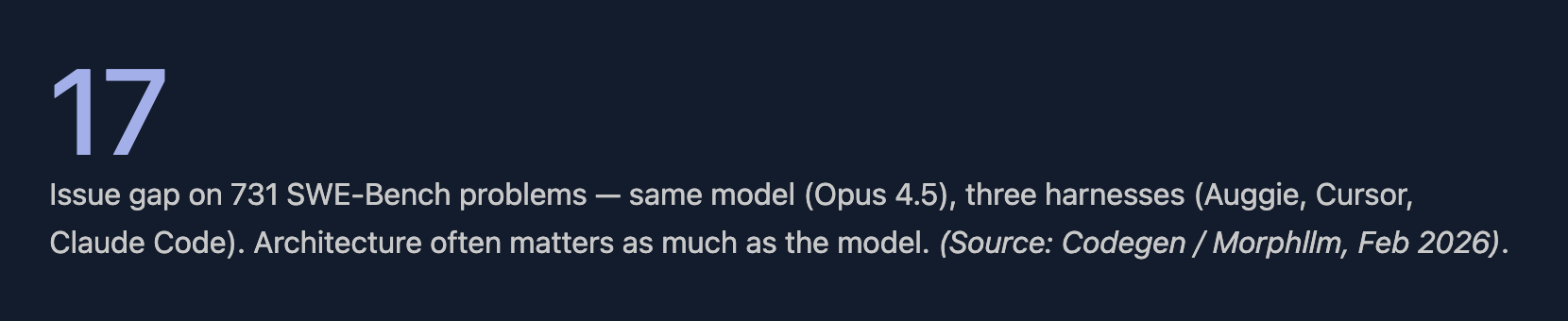
But the scaffolding around the model shapes the result. Two teams can both say they are using Claude, but one might be using Claude through Cursor and another through Claude Code. Those systems have different context windows, tool access, permissions, prompts, and execution loops.

That means performance depends on more than the base model. The harness matters. The environment matters. What the agent can see, what it can change, what it can run, and how it receives feedback all shape the results.

Faster coding creates a harder review problem

The risk is simple: vibe-coding becomes tech debt at scale. Coding agents increase output before they improve understanding.

The risk shows up in review. A patch can look coherent, pass a visible check, and still introduce a logic bug, weaken security, or add complexity that the next engineer has to unwind. The failure mode is plausible code at volume.

Recent usage patterns show why review has become the bottleneck. Anthropic’s 2026 Agentic Coding Trends Report found that engineers use AI in roughly 60% of their work but fully delegate only 0–20% of tasks. The gap matters. Coding agents are becoming constant collaborators, but most work still needs setup, supervision, validation, and human judgment.

That doesn’t mean coding agents reduce productivity. It means perceived speed and measured delivery have to be evaluated separately.

Code quality data points in the same direction. CodeRabbit reported that AI-co-authored pull requests had about 1.7x more issues overall than human-only pull requests, with higher rates of logic, correctness, and security problems. That does not make AI coding agents useless. It means teams need stronger review systems around them.

Case study: when a package install becomes a security event

The LiteLLM incident makes agentic coding security concerns concrete. LiteLLM is a widely used Python package for routing calls across LLM providers. On March 24, 2026, malicious versions 1.82.7 and 1.82.8 were published to PyPI with credential-stealing malware.

The payload targeted SSH keys, cloud credentials, API tokens, Kubernetes configs, database passwords, and other local secrets.
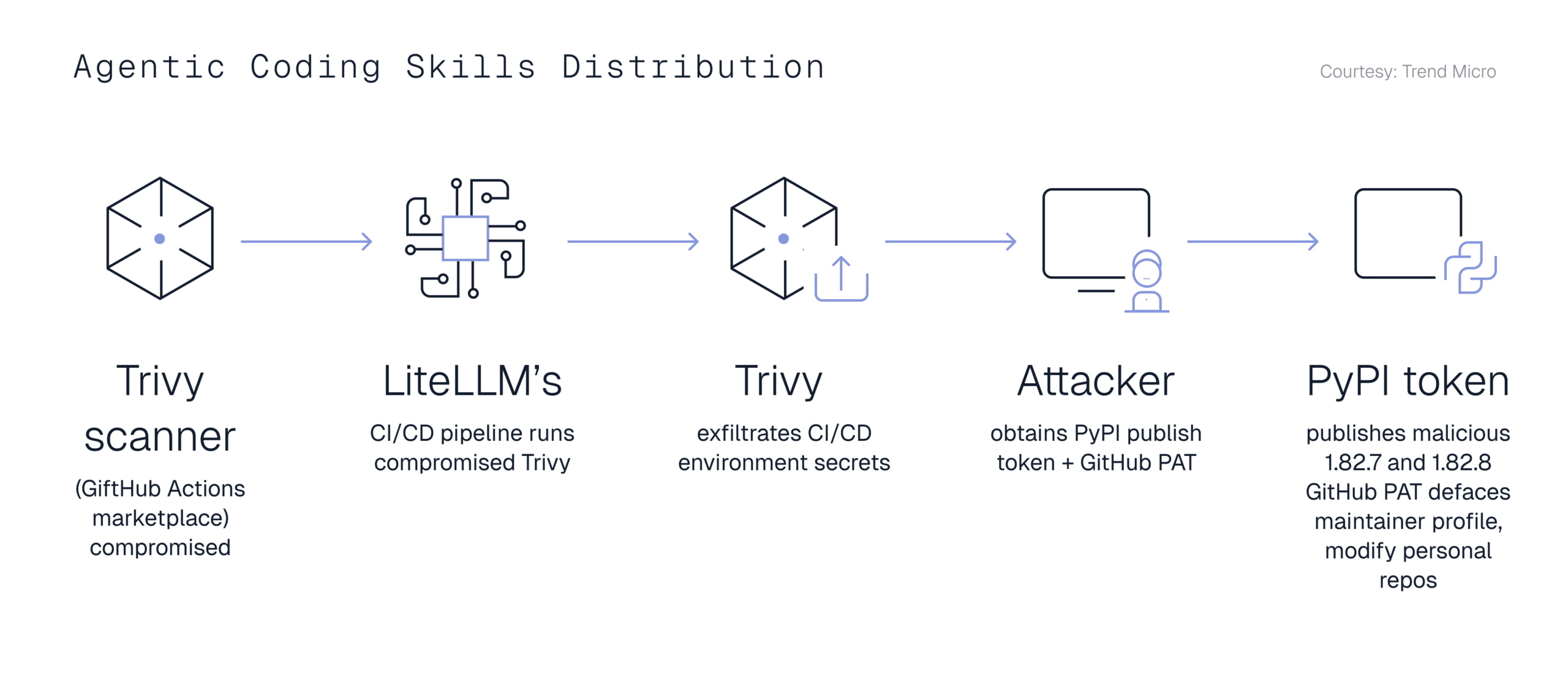
Trend Micro’s attack-chain diagram shows how a compromised Trivy scanner in LiteLLM’s CI/CD pipeline led to credential theft and the malicious PyPI releases. (Trend Micro, 2026)

The important detail is how ordinary the entry point was. Developers did not need to make a strange architectural decision. They only had to install or update a package. In version 1.82.8, a .pth file caused the payload to execute on Python startup – broader than a normal import-time bug, since the code ran whenever Python ran, with or without an explicit import.

LiteLLM is widely deployed across AI infrastructure, and a compromised dependency at that scale is an infrastructure risk, not a library risk.

That is the risk profile coding agents inherit. An agent with terminal access can install packages, update dependencies, call build tools, read environment variables, and touch internal systems. If the evaluation layer only checks whether the final code looks plausible, it misses the dangerous part of the workflow.

Faster code generation expands the review surface. Engineering teams need to know what the agent changed, what it installed, what it ran, what it skipped, and whether the result is safe to merge.

Benchmarks are moving closer to real software work

Benchmarks have always shaped how AI systems are built and compared. Coding agents give that discipline cleaner measurement surfaces, because software already produces evidence: repositories, issues, tests, CI logs, execution traces, dependency graphs, and review workflows.

A generated answer can be hard to judge. A software task can be run, inspected, reproduced, and tested against expected behavior. If an agent claims to fix a bug, teams can check the patch, rerun the tests, inspect the diff, and trace what changed.

SWE-Bench Verified helped move coding evaluation toward real repositories. It uses real GitHub issues, human-validated samples, and tests that check whether a generated patch resolves the issue – a stronger signal than isolated coding puzzles.

As basic benchmarks saturate, teams need to ask harder questions. Were the tasks public? Could they have entered training data? Was the harness standardized? Can another team reproduce the result? For enterprise use, the question is less can the model solve a known benchmark and more can the agent complete realistic work in an environment that matches how software teams actually operate.

Terminal-Bench 2.0 and Terminal-Bench 2.1, which Snorkel helped create, evaluates agents inside command-line environments on hard terminal tasks. That makes it useful for agentic coding because the agent has to inspect the environment, run commands, interpret failures, recover, and complete the task end-to-end.

The tasks include building Linux from source, training ML models, reverse-engineering binaries, and working through complex terminal operations. The benchmark measures behavior across the work.

Snorkel is building the data layer for coding agents

Better coding agent benchmarks do not appear by themselves. They require task design, executable environments, verifiers, rubrics, repair workflows, and expert review.

Once coding agents start acting inside repositories and terminals, evaluation becomes a data-development problem. The benchmark is only as useful as the tasks, environments, and signals behind it.

Snorkel Agentic Coding Benchmark: measuring multi-step coding work

The Snorkel Agentic Coding Benchmark gives that loop a public surface. It evaluates models on multi-step coding tasks with sandboxed execution environments, human-validated reference solutions, unit tests, and scoring rubrics.
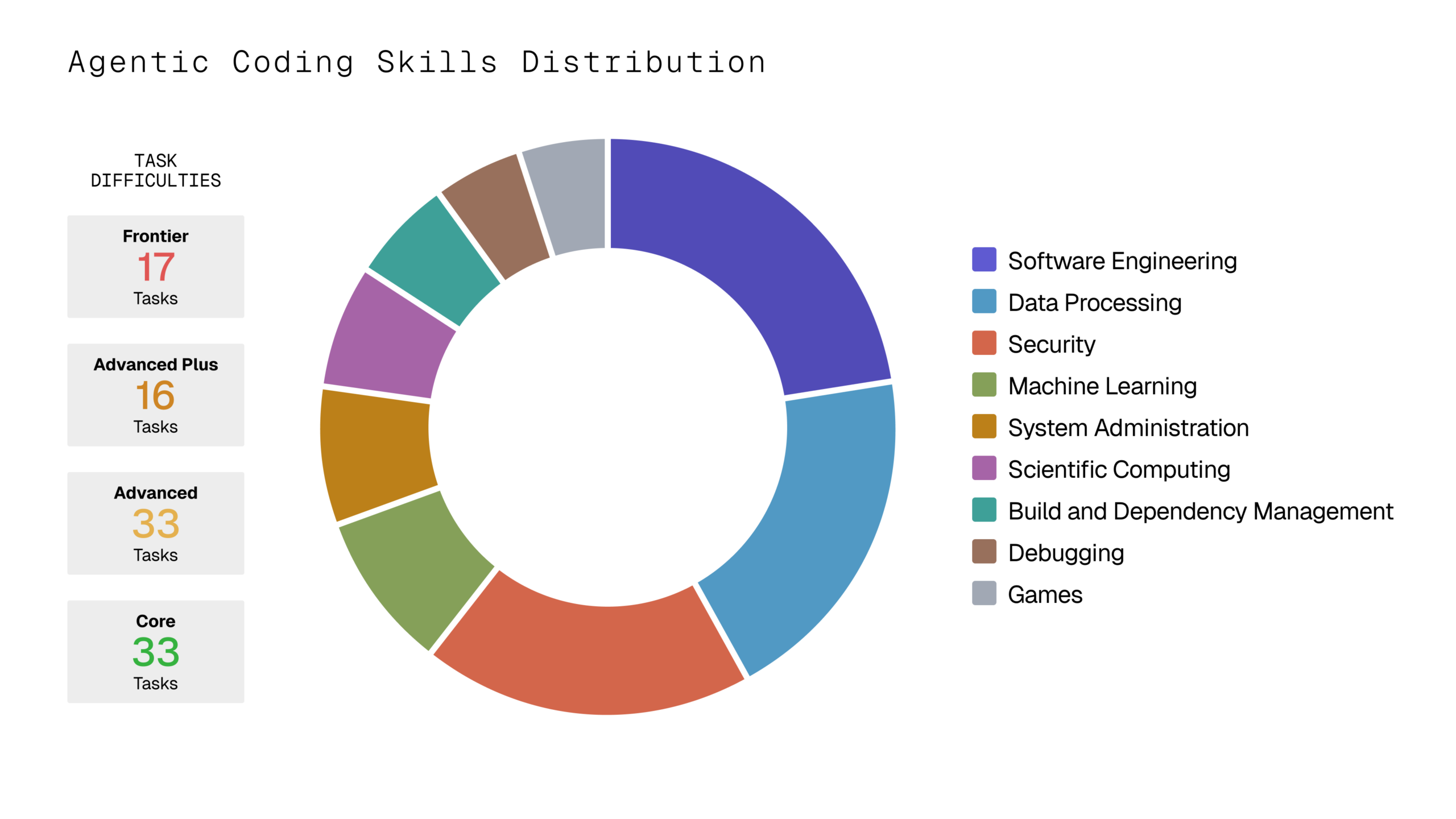
The benchmark is useful because it treats coding-agent work as a sequence, not a single answer. Agents need to understand the task, operate inside the environment, make changes, run checks, and recover when the first attempt fails.

Terminal-Bench 3.0: harder tasks, broader scope

Terminal-Bench 3.0 extends the benchmark for command-line agents. The target is 100 diverse tasks at an at-most 30% solve rate from the best models at release — difficult enough to separate frontier systems.

The scope goes beyond repository patching into realistic computer work that can be completed through the command line and verified programmatically: software engineering, system administration, security, scientific computing, data workflows, and ML tasks.

Calls for contribution are open for Terminal-Bench 3.0 →

This direction fits Snorkel’s larger work on agentic AI evaluation. Stronger benchmarks need harder tasks, richer environments, expert task design, and verifiers that survive frontier models. That is the data layer behind reliable coding agents: the task, the environment, the scoring logic, and the feedback signal.

Coding agents are becoming a broader pattern for work

Coding agents show the broader agentic loop in a concrete setting: read context, take action, verify the result, and iterate. That pattern is already moving beyond the IDE. Claude Cowork applies the same loop to research, writing, analysis, and operations work.

The next constraint is orchestration. Teams will need to coordinate multiple agents across planning, implementation, testing, review, deployment, and monitoring, while keeping human judgment in the right parts of the loop.

Software makes this transition visible because the work leaves evidence: tests, logs, traces, diffs, and review history. As agentic systems move into less structured domains, success will depend on building the same evidence layer: clear task definitions, executable environments, verifiers that match the work, and feedback signals that survive the next generation of models.

Talk to Snorkel’s research team about agentic coding and request dataset samples.

Researchers and practitioners interested in shaping the next generation of coding agent benchmarks can join Snorkel’s expert community.