

惯性聚合 高效追踪和阅读你感兴趣的博客、新闻、科技资讯
阅读原文 在惯性聚合中打开

推荐订阅源

有赞技术团队
有赞技术团队
Exploit-DB.com RSS Feed
aimingoo的专栏
aimingoo的专栏
IT之家
IT之家
G
Google Developers Blog
爱范儿
爱范儿
博客园 - 司徒正美
Recent Announcements
The Register - Security
J
Java Code Geeks
The Cloudflare Blog
M
MIT News - Artificial intelligence
Apple Machine Learning Research
Microsoft Security Blog
博客园 - Franky
雷峰网
雷峰网
酷 壳 – CoolShell
酷 壳 – CoolShell
Blog — PlanetScale
Blog — PlanetScale
Vercel News
Vercel News
宝玉的分享
宝玉的分享
CTFtime.org: upcoming CTF events
B
Blog
小众软件
小众软件
Microsoft Azure Blog
让小产品的独立变现更简单 - ezindie.com
WordPress大学
WordPress大学
T
Troy Hunt's Blog
Application and Cybersecurity Blog
H
Hacker News: Front Page
H
Help Net Security
S
Security @ Cisco Blogs
V
V2EX
Security Archives - TechRepublic
Stack Overflow Blog
Stack Overflow Blog
O
OpenAI News
L
LINUX DO - 最新话题
Cyber Security Advisories - MS-ISAC
S
Secure Thoughts
Help Net Security
Help Net Security
F
Full Disclosure
博客园 - 叶小钗
The Hacker News
The Hacker News
Spread Privacy
Spread Privacy
Threat Intelligence Blog | Flashpoint
Jina AI
Jina AI
K
Kaspersky official blog
www.infosecurity-magazine.com
V
Vulnerabilities – Threatpost
P
Privacy International News Feed
Scott Helme
Scott Helme

Snorkel AI

Building AI-Native Systems for Federal Infrastructure: A Conversation with Rezaur Rahman Code World Models and AutoHarness for LLM Agents Benchtalks #1: Alex Shaw (Terminal-Bench, Harbor) – Building the Benchmark Factory Building FinQA: An Open RL Environment for Financial Reasoning Agents How Tool Discipline Let a 4B Model Outsmart a 235B Giant on Financial Tasks Coding agents don’t need to be perfect, they need to recover Closing the Evaluation Gap in Agentic AI SlopCodeBench: Measuring Code Erosion as Agents Iterate Introducing the Snorkel Agentic Coding Benchmark 2026: The year of environments Part V: Future Direction and Emerging Trends in Rubric-Based AI Evaluation The self-critique paradox: Why AI verification fails where it’s needed most Chat With the Terminal-Bench Team | Snorkel AI Intelligence per watt: A new metric for AI’s future Terminal-Bench 2.0: Raising the bar for AI agent evaluation Snorkeling in RL environments Introducing SnorkelSpatial: A Benchmark for LLM Spatial Reasoning Scaling Trust: Rubrics in Snorkel's Quality Process Evaluating Multi-Agent Systems in Enterprise Tool Use Evaluating Coding Agents with Terminal-Bench 2.0 Parsing isn’t neutral: why evaluation choices matter The science of rubric design The right tool for the job: An A-Z of rubrics Data quality and rubrics: how to build trust in your models Building the benchmark: inside our agentic insurance underwriting dataset Evaluating AI agents for insurance underwriting LLM observability: key practices, tools, and challenges Anthropic Claude + AWS: revolutionizing pharma data analytics with Snorkel AI Data-centric development of an enterprise AI agent with Snorkel Building the data development platform for specialized AI LLM-as-a-judge for enterprises: evaluate model alignment at scale Why GenAI evaluation requires SME-in-the-loop for validation and trust Research spotlight: is long chain-of-thought structure all that matters when it comes to LLM reasoning distillation? Why enterprise GenAI evaluation requires fine-grained metrics to be insightful What is specialized GenAI evaluation, and why is it so critical to enterprise AI? LLM alignment techniques: 4 post-training approaches Research spotlight: Is intent analysis the key to unlocking more accurate LLM question answering? Why enterprises should embrace LLM distillation Retrieval-augmented generation (RAG) failure modes and how to fix them What is large language model (LLM) alignment? Databricks + Snorkel Flow: integrated, streamlined AI development How LLM evaluation drives better models in Snorkel Flow Unlock proprietary data with Snorkel Flow and Amazon SageMaker LLM evaluation in enterprise applications: a new era in ML Snorkel AI joins the AWS ISV Accelerate Program and launches Snorkel Flow Availability in AWS Marketplace AI data development: a guide for data science projects SnorkelCon 2024: Inaugural Snorkel AI user conference gathers leaders from 30+ Fortune 500 companies Snorkel Flow 2024.R3: Supercharge your AI development with enhanced data-centric workflows Explore the new GenAI Evaluation Suite: Snorkel 2024.R3 New NLP features in Snorkel Flow 2024.R3 Enterprise data compliance and security review: Snorkel Flow 2024.R3 How a global financial services company built a specialized AI copilot accurate enough for production Task Me Anything: innovating multimodal model benchmarks Alfred: Data labeling with foundation models and weak supervision RAG: LLM performance boost with retrieval-augmented generation Call center AI for customer experience management: a case study New GenAI features, data annotation: Snorkel Flow 2024.R2 How data slices transform enterprise LLM evaluation Meta’s Llama 3.1 405B is the new Mr. Miyagi, now what? Meta’s new Llama 3.1 models are here! Are you ready for it? Data-centric AI with Snorkel and MinIO Weak supervision for non-categorical applications + superalignment Snorkel AI signs strategic collaboration agreement with AWS to help enterprises cross the demo-to-production chasm AI alignment made simple: innovative solutions for businesses How does the Snorkel Flow label model work? Vision language models: how LLMs boost image classification Long context models in the enterprise: benchmarks and beyond How to build production-grade RAG retrieval with Snorkel Flow How Bonito helps fine-tune specialized LLMs faster than ever Walking safely before building flying saucer seatbelts: introducing Enterprise Alignment Role-based access controls in Snorkel Flow secure enterprise data Accelerating AI development in manufacturing with Snorkel Flow and AWS SageMaker How ROBOSHOT boosts zero-shot foundation model performance Discover what’s new in Snorkel Flow: Flexible data and LLM connectivity, secure data controls, and more! Faster than ever document intelligence with new Snorkel Flow FM-first workflow The art of data development for Enterprise LLMs Crossing the demo-to-production chasm with Snorkel Custom How Snorkel topped the AlpacaEval leaderboard (and why we're not there anymore) CRFM's HELM and enterprise LLM evaluation beyond accuracy How we achieved 89% accuracy on contract question answering Five sessions not to miss at Google Cloud Next 24 Content filtering breakthrough: Snorkel client reaches 96% recall in 3 days Here's how Snorkel Flow + Google AI built an enterprise-ready model in a day Snorkel teams with Microsoft to showcase new AI research at NVIDIA GTC How Skill-it! enables faster, better LLM training Fine-tuned representation models boost LLM systems. Here's how Enterprise GenAI to surge in 2024: survey results Large language model training: how three training phases shape LLMs LoRA: Low-Rank Adaptation for LLMs LLM distillation demystified: a complete guide Enterprises must shift their focus from models to data in AI development Insurance’s GenAI revolution: a business perspective Building better enterprise AI: incorporating expert feedback in system development “Fall in love with your data”—Snorkel AI’s Enterprise LLM Summit Why QBE Ventures invested in Snorkel AI New benchmark results demonstrate value of Snorkel AI approach to LLM alignment Retrieval augmented generation (RAG): a conversation with its creator Snorkel Flow 2023.R4: enhanced UI + PDF and Databricks tools How Snorkel Flow users can register custom models to Databricks Stanford professor discusses exciting advances in foundation model evaluation
Scaling human preferences in AI: Snorkel's programmatic approach
Hoang Tran · 2024-01-31 · via Snorkel AI

My colleagues and I at Snorkel AI recently worked with several large enterprises to help improve their generative AI applications. There are many axes where we can improve a language model, including RAG, data curation, or fine-tuning. At our recent Enterprise LLM Summit, I gave a talk entitled “Programmatically Scale Human Preferences and Alignment in GenAI” that focussed on how to align the output of large language models to enterprise users’ expectations. We do this through scalable techniques to magnify the impact of feedback from your internal experts.

Alignment follows supervised fine-tuning and further refines your large language model (LLM) responses to be more likable, adhering to certain workflows, or internal policies. This approach is shown in the last 2 phases of training ChatGPT—with reinforcement learning from human feedback (RLHF).

You can watch my entire talk below on Snorkel’s YouTube page, but I have also summarized my main points here.

User alignment techniques: two approaches

Our work explored two techniques for model alignment: RLHF and direct preference optimization (DPO).

Reward modeling centers on building a model to mimic how an expert would rate a response according to one or more factors. Data scientists supply users with a prompt-response pair. Then, they ask the user to rate that response. Then data scientists use these ratings to train the reward model, which predicts ratings for future responses. This can be interpreted as trying to approximate how the users would rate a given prompt-response pair.

RLHF would use these predicted ratings as feedback to nudge the LLM’s output toward simulated higher user expectations.
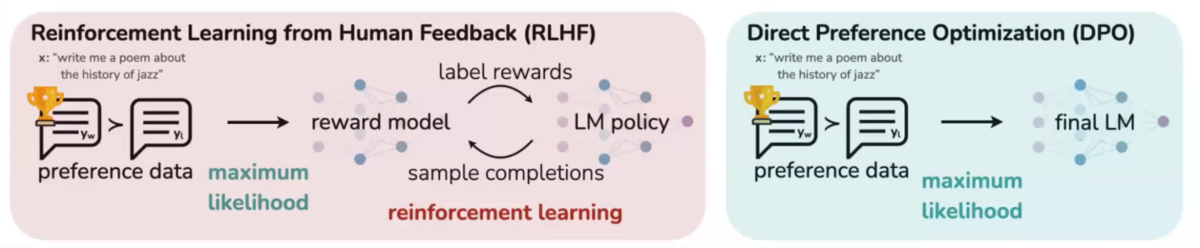
Image4

DPO operates differently. It optimizes directly on the preferences data—as now you have a pair of accepted and rejected responses. The training pipeline then encourages the LLM to decrease the likelihood of the rejected responses while making the accepted response more likely.

Reward modeling and DPO both require data that reflect human preferences. Gathering such data can be resource-intensive and time-consuming. This is where the challenge lies: how can we efficiently collect and utilize preference data to improve the alignment of our AI models? Our research sought to address this issue and find scalable solutions for enterprise settings.

Scaling human preferences programmatically

The team at Snorkel uses our Snorkel Flow AI data development platform to scale preferences programmatically. The platform leverages technologies like weak supervision to enable subject matter experts (SMEs) and data scientists to collaborate on labeling functions that express SME preferences at scale.

Using Snorkel Flow we built high-quality scoring models that successfully classified and quality-scored responses at high accuracy—and we did so quickly. Snorkel Flow allowed us to complete these models in as little as a day, bypassing the need for weeks or months of manual annotation.
Hoang Tran talks about how his team developed new approaches to scale human preferences and align LLM output to enterprise users’ expectations by magnifying SME impact.

Snorkel originally developed these tools to help enterprises build classification models. Our experiments have shown that they’re just as impactful—and perhaps more so—in fine-tuning generative AI (GenAI) models.

We can use this reward model to curate the data for DPO alignment. This is shown in our Alpaca Eval 2.0 result as we hold the 2nd place (only after gpt-4-turbo). You can read more about the approach on our model card or the diagrams below.

We also demonstrated the effectiveness of this approach when we built labeling functions to curate instruction-tuning data for Together AI’s RedPajama model. In the space of a couple of days, we curated 20,000 prompt/response pairs down to the best 10,000. In testing, users preferred the version of RedPajama we trained from that refined corpus over the original model in every category. We continue to apply the lessons we learned through that project with our recent cohort of enterprise GenAI projects.

Implementing a reward model to scale human preferences

Once we built a reward model, we integrated it into a DPO self-training pipeline. DPO proved to be the better option because it is more computationally friendly, but we believe we would have achieved similar results from other reinforcement learning approaches.
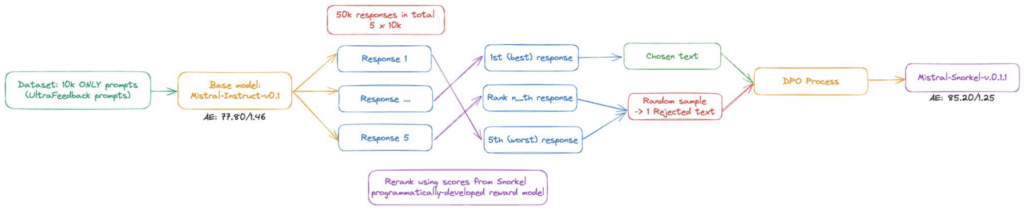
We started with a base model and 10,000 prompts For each prompt, we asked the base model to generate five responses. We then ranked these responses according to our reward model.

In the first version of our pipeline, we identified the top-ranked response as “chosen” and randomly rejected one of the remaining texts. A later version of our pipeline further improved model performance by instead rejecting the response ranked worst by our reward model.
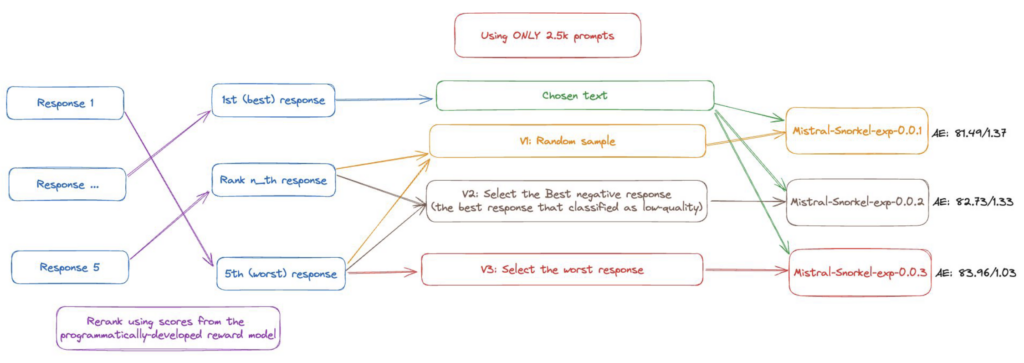
Results

Using only 10,000 prompts, our team was able to achieve a 7.4-point (9.5%) increase on the Alpaca-Eval benchmark in under a day. It’s worth noting that we achieved these results without using responses from other language models.

The reward model we developed in Snorkel Flow also outperformed a leading open-source alternative. For the sake of comparison, we trained a second LLM using the Open Assistant reward model. That resulting model achieved a score of 83.31 on the Alpaca-Eval benchmark. Our model scored 85.2.

These results demonstrate the potential of this approach in enterprise settings, where customization and efficiency are paramount.

High-performance LLM applications demand scalable alignment

Enterprise data science teams need alignment beyond fine-tuning to optimize GenAI responses. This requires human preferences and SME involvement. Historically, the labeling process made it prohibitively expensive to involve SMEs in aligning model performance. However, Snorkel’s technology and a data-centric workflow make this process more scalable, trackable, and transferable.

More Snorkel AI events coming!

Snorkel has more live online events coming. Look at our events page to sign up for research webinars, product overviews, and case studies.

If you're looking for more content immediately, check out our YouTube channel, where we keep recordings of our past webinars and online conferences.