


惯性聚合 高效追踪和阅读你感兴趣的博客、新闻、科技资讯
阅读原文 在惯性聚合中打开

推荐订阅源

Exploit-DB.com RSS Feed
A
About on SuperTechFans
IT之家
IT之家
让小产品的独立变现更简单 - ezindie.com
Blog — PlanetScale
Blog — PlanetScale
aimingoo的专栏
aimingoo的专栏
云风的 BLOG
云风的 BLOG
The GitHub Blog
The GitHub Blog
Vercel News
Vercel News
G
Google Developers Blog
J
Java Code Geeks
宝玉的分享
宝玉的分享
T
Tailwind CSS Blog
Cloudbric
Cloudbric
L
LINUX DO - 最新话题
MyScale Blog
MyScale Blog
H
Heimdal Security Blog
PCI Perspectives
PCI Perspectives
Attack and Defense Labs
S
Security @ Cisco Blogs
Latest news
Latest news
I
Intezer
L
Lohrmann on Cybersecurity
C
CXSECURITY Database RSS Feed - CXSecurity.com
月光博客
月光博客
T
Threatpost
博客园 - 【当耐特】
S
Schneier on Security
P
Privacy International News Feed
G
GRAHAM CLULEY
T
Tenable Blog
AWS News Blog
AWS News Blog
Threat Intelligence Blog | Flashpoint
雷峰网
雷峰网
博客园 - Franky
Engineering at Meta
Engineering at Meta
美团技术团队
S
Secure Thoughts
T
Troy Hunt's Blog
Microsoft Security Blog
SecWiki News
SecWiki News
V
Visual Studio Blog
人人都是产品经理
人人都是产品经理
Application and Cybersecurity Blog
Cisco Talos Blog
Cisco Talos Blog
奇客Solidot–传递最新科技情报
奇客Solidot–传递最新科技情报
Martin Fowler
Martin Fowler
Webroot Blog
Webroot Blog
Google DeepMind News
H
Hackread – Cybersecurity News, Data Breaches, AI and More

Snorkel AI

Building AI-Native Systems for Federal Infrastructure: A Conversation with Rezaur Rahman Code World Models and AutoHarness for LLM Agents Benchtalks #1: Alex Shaw (Terminal-Bench, Harbor) – Building the Benchmark Factory Building FinQA: An Open RL Environment for Financial Reasoning Agents How Tool Discipline Let a 4B Model Outsmart a 235B Giant on Financial Tasks Coding agents don’t need to be perfect, they need to recover Closing the Evaluation Gap in Agentic AI SlopCodeBench: Measuring Code Erosion as Agents Iterate Introducing the Snorkel Agentic Coding Benchmark 2026: The year of environments Part V: Future Direction and Emerging Trends in Rubric-Based AI Evaluation The self-critique paradox: Why AI verification fails where it’s needed most Chat With the Terminal-Bench Team | Snorkel AI Intelligence per watt: A new metric for AI’s future Terminal-Bench 2.0: Raising the bar for AI agent evaluation Snorkeling in RL environments Introducing SnorkelSpatial: A Benchmark for LLM Spatial Reasoning Scaling Trust: Rubrics in Snorkel's Quality Process Evaluating Multi-Agent Systems in Enterprise Tool Use Evaluating Coding Agents with Terminal-Bench 2.0 Parsing isn’t neutral: why evaluation choices matter The science of rubric design The right tool for the job: An A-Z of rubrics Data quality and rubrics: how to build trust in your models Building the benchmark: inside our agentic insurance underwriting dataset Evaluating AI agents for insurance underwriting LLM observability: key practices, tools, and challenges Anthropic Claude + AWS: revolutionizing pharma data analytics with Snorkel AI Data-centric development of an enterprise AI agent with Snorkel Building the data development platform for specialized AI LLM-as-a-judge for enterprises: evaluate model alignment at scale Why GenAI evaluation requires SME-in-the-loop for validation and trust Research spotlight: is long chain-of-thought structure all that matters when it comes to LLM reasoning distillation? Why enterprise GenAI evaluation requires fine-grained metrics to be insightful What is specialized GenAI evaluation, and why is it so critical to enterprise AI? LLM alignment techniques: 4 post-training approaches Research spotlight: Is intent analysis the key to unlocking more accurate LLM question answering? Why enterprises should embrace LLM distillation Retrieval-augmented generation (RAG) failure modes and how to fix them What is large language model (LLM) alignment? Databricks + Snorkel Flow: integrated, streamlined AI development How LLM evaluation drives better models in Snorkel Flow Unlock proprietary data with Snorkel Flow and Amazon SageMaker LLM evaluation in enterprise applications: a new era in ML Snorkel AI joins the AWS ISV Accelerate Program and launches Snorkel Flow Availability in AWS Marketplace AI data development: a guide for data science projects SnorkelCon 2024: Inaugural Snorkel AI user conference gathers leaders from 30+ Fortune 500 companies Snorkel Flow 2024.R3: Supercharge your AI development with enhanced data-centric workflows Explore the new GenAI Evaluation Suite: Snorkel 2024.R3 New NLP features in Snorkel Flow 2024.R3 Enterprise data compliance and security review: Snorkel Flow 2024.R3 How a global financial services company built a specialized AI copilot accurate enough for production Task Me Anything: innovating multimodal model benchmarks Alfred: Data labeling with foundation models and weak supervision RAG: LLM performance boost with retrieval-augmented generation Call center AI for customer experience management: a case study New GenAI features, data annotation: Snorkel Flow 2024.R2 How data slices transform enterprise LLM evaluation Meta’s Llama 3.1 405B is the new Mr. Miyagi, now what? Meta’s new Llama 3.1 models are here! Are you ready for it? Data-centric AI with Snorkel and MinIO Weak supervision for non-categorical applications + superalignment Snorkel AI signs strategic collaboration agreement with AWS to help enterprises cross the demo-to-production chasm AI alignment made simple: innovative solutions for businesses How does the Snorkel Flow label model work? Vision language models: how LLMs boost image classification Long context models in the enterprise: benchmarks and beyond How to build production-grade RAG retrieval with Snorkel Flow How Bonito helps fine-tune specialized LLMs faster than ever Walking safely before building flying saucer seatbelts: introducing Enterprise Alignment Role-based access controls in Snorkel Flow secure enterprise data How ROBOSHOT boosts zero-shot foundation model performance Discover what’s new in Snorkel Flow: Flexible data and LLM connectivity, secure data controls, and more! Faster than ever document intelligence with new Snorkel Flow FM-first workflow The art of data development for Enterprise LLMs Crossing the demo-to-production chasm with Snorkel Custom How Snorkel topped the AlpacaEval leaderboard (and why we're not there anymore) CRFM's HELM and enterprise LLM evaluation beyond accuracy How we achieved 89% accuracy on contract question answering Five sessions not to miss at Google Cloud Next 24 Content filtering breakthrough: Snorkel client reaches 96% recall in 3 days Here's how Snorkel Flow + Google AI built an enterprise-ready model in a day Snorkel teams with Microsoft to showcase new AI research at NVIDIA GTC How Skill-it! enables faster, better LLM training Fine-tuned representation models boost LLM systems. Here's how Enterprise GenAI to surge in 2024: survey results Large language model training: how three training phases shape LLMs LoRA: Low-Rank Adaptation for LLMs LLM distillation demystified: a complete guide Enterprises must shift their focus from models to data in AI development Insurance’s GenAI revolution: a business perspective Scaling human preferences in AI: Snorkel's programmatic approach Building better enterprise AI: incorporating expert feedback in system development “Fall in love with your data”—Snorkel AI’s Enterprise LLM Summit Why QBE Ventures invested in Snorkel AI New benchmark results demonstrate value of Snorkel AI approach to LLM alignment Retrieval augmented generation (RAG): a conversation with its creator Snorkel Flow 2023.R4: enhanced UI + PDF and Databricks tools How Snorkel Flow users can register custom models to Databricks Stanford professor discusses exciting advances in foundation model evaluation
Accelerating AI development in manufacturing with Snorkel Flow and AWS SageMaker
Ryan Gooch (Guest Blogger) · 2024-05-01 · via Snorkel AI

phData, an Advanced AWS Consulting Partner and Elite Snowflake Consulting Partner (plus 2x partner of the year!), provides expert end-to-end services for machine learning and data analytics. phData Senior ML Engineer Ryan Gooch recently evaluated options to accelerate ML model deployment with Snorkel Flow and AWS SageMaker.

The manufacturing industry has experienced a massive influx of data due to both digitization and the rise of IoT and telemetry technologies. However, there are significant obstacles to making that data actionable. While innovative manufacturers harness significant value with data and analytics, AI, and machine learning, many of the most ambitious AI projects remain stuck in pilot purgatory.  

At phData, we help manufacturers and other companies seamlessly collect, manage, and act upon massive amounts of data to transform how they do business. Whether it’s creating real-time reporting on manufacturing output, constructing sophisticated data engineering pipelines, architecting robust MLOps solutions, or building models to help predict when to perform maintenance, we empower leading manufacturers to bring ambitious data and analytics projects to life.

Over the past year, we’ve seen manufacturers explore a host of techniques and tools aimed at making AI data development practical and possible under the umbrella of “data-centric AI.” In many cases, machine learning (ML) teams tap research-based and industry-proven startups like Snorkel AI to capitalize on cutting-edge techniques and integrate this technology with trusted, mature enterprise platforms to build AI solutions they can operationalize at scale.

AI offers use cases across every aspect of the manufacturing business.

In this post, we will detail how a manufacturer with an extensive dealer network could use AI to empower its dealers to deliver a superior experience for their end-users. This involves developing and tuning a model customized to extract rich insights from invoices using Snorkel’s data development platform and deploying with AWS Sagemaker.

Manufacturing Solutions

For the best possible customer experience, heavy equipment manufacturers want to ensure as little equipment downtime as possible. Complex and intermittent equipment issues, scattered service records, and the unique design of each vehicle can make quick and accurate issue resolution a challenge.

What if every time a piece of equipment was taken in for service, exactly the right parts—from the complex and bespoke to nuts and bolts—arrived and ready for installation exactly on time? Data scientists can train machine learning models to predict categories of service needs, and then downstream models can precisely diagnose an issue and suggest remediation along with each part required.

However, the success of any predictive system hinges upon having a sufficient quality (and quantity) of example data representing the myriad issues and solutions complex heavy equipment might face.  

The traditional approach: brittle rules-based systems

Developing and curating datasets for machine learning applications can be an extremely labor-intensive task. Modeling teams charge ahead without data-centric tooling and build a vast array of SQL-based rules to attempt to capture all of the permutations of equipment and service needs.

Each new product launch breaks the system, and developers might spend months catching up. If a new modeling approach or new category of service needs is proposed, everything goes back to the drawing board.

Many teams have experimented with off-the-shelf large language models (LLMs), but these lack domain-specific information and terminology critical to understanding the heavy equipment space and the nuances of specific parts.

The alternative: programmatic data development with Snorkel Flow

Snorkel takes a data-centric approach to complex document and image classification challenges. The Snorkel Flow AI data development platform provides a comprehensive, iterative method for machine learning teams to start with a commercial or open-source LLM, identify subsets of data where the model makes errors, and correct those errors via programmatic data development.

Snorkel Flow enables machine learning teams to collaborate with internal experts to develop data operators that perform labeling, filtering, and sampling operations as code functions. These labeling functions can be written quickly, applied to large volumes of data, and inspected, weighted, and optimized. 

Ultimately teams can rapidly generate high-quality data sets, fine-tune an existing model, or distill an LLM to a smaller, specialized model with reduced training and inference costs.

Building and deploying production-quality AI solutions with AWS and Snorkel

In the example above, the data science team would need to start with access to dealer invoices. The easiest approach is to have PDFs of scanned invoices in Amazon S3.

The Snorkel Flow platform integrates natively with AWS to make this data available with a few clicks. The data scientist simply selects “AWS S3” as a data source when creating a new dataset in Snorkel Flow and then enters the appropriate connection details and credentials. All credentials are encrypted end-to-end, which ensures that sensitive credentials are never exposed.

Snorkel Flow has a customized AWS Textract document model that provides a method for extracting not only text in documents but also honors tabular structures inherent in structured forms. Relevant data, splits, and identifiers are recognized, allowing Snorkel Flow to ingest the dataset, making it immediately referenceable throughout the platform.  
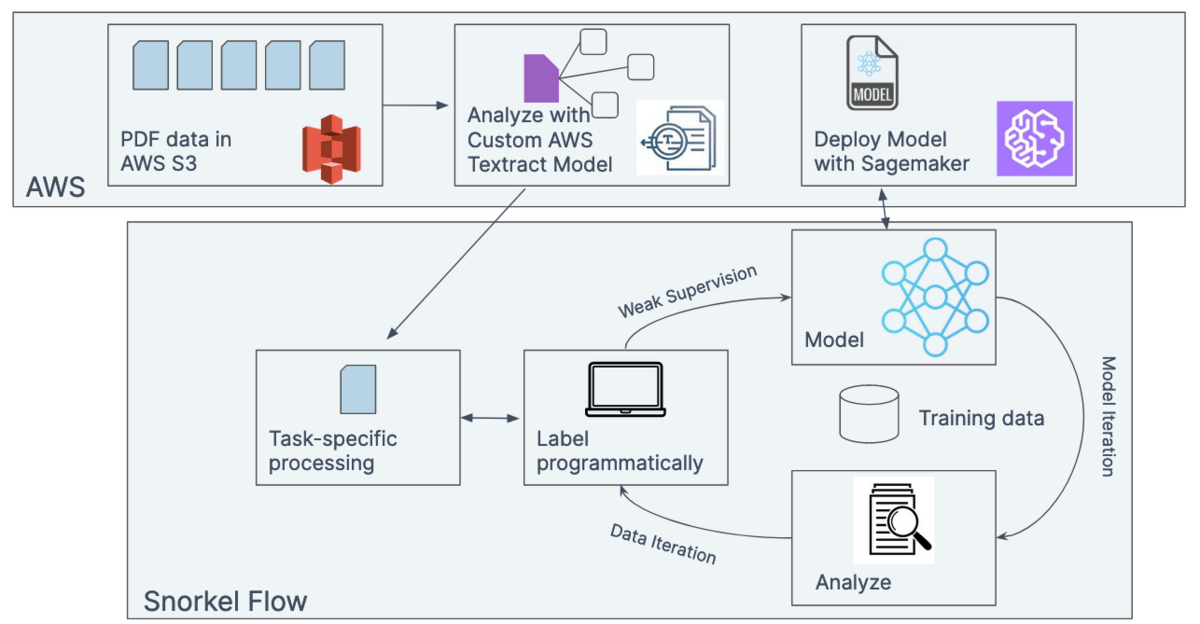
Image1

Figure. Invoices are ingested into S3. For raw PDFs, AWS Textract can be used to pull specific fields and text out of invoices for database insertion. 

In a typical workflow, users initially select a foundation model (FM) via a platform like AWS SageMaker Jumpstart and then construct a generic prompt. The output of the prompt acts as the baseline for further development. As the user identifies areas where the FM underperforms or makes errors, they employ programmatic data development to make corrections. The data science team collaborates with heavy-equipment experts to efficiently codify expertise buried in service reports. They may also adjust the data mixture by sampling, filtering, or even adding new data via augmentation or synthetic data generation.

When complete, the team can use Snorkel Flow to export a high-quality data set, fine-tune an LLM, or distill a much smaller, specialized model with drastically lower training and inference costs.

Deploying models trained in Snorkel Flow with SageMaker

AWS SageMaker is the go-to machine learning platform for many data science teams. This fully managed service brings together a broad set of tools to enable high-performance ML for a broad variety of use cases. Sagemaker makes it easy to deploy ML models at scale, with reduced inference cost and the ability to manage models effectively in production. SageMaker also offers access to hundreds of pre-trained models, including publicly available FMs via Sagemaker Jumpstart.

Models trained in Snorkel Flow are MLflow-ready and can easily be deployed using AWS SageMaker. The first step is to export a model trained using Snorkel Flow as a zip file to a local machine. You need to create a containerized runtime environment for your MLflow deployment and push this environment to Amazon ECR. After creating the container environment, push the model objects to the AWS SageMaker model registry.

From AWS SageMaker, you can view the newly created model entry. Now that the container environment and model object exist, they can be combined and deployed as an AWS SageMaker endpoint or batch transform job.

AWS SageMaker inference types should be configured based on business needs, required production inference volumes, desired latency, etc.

To deploy the model to a SageMaker endpoint:
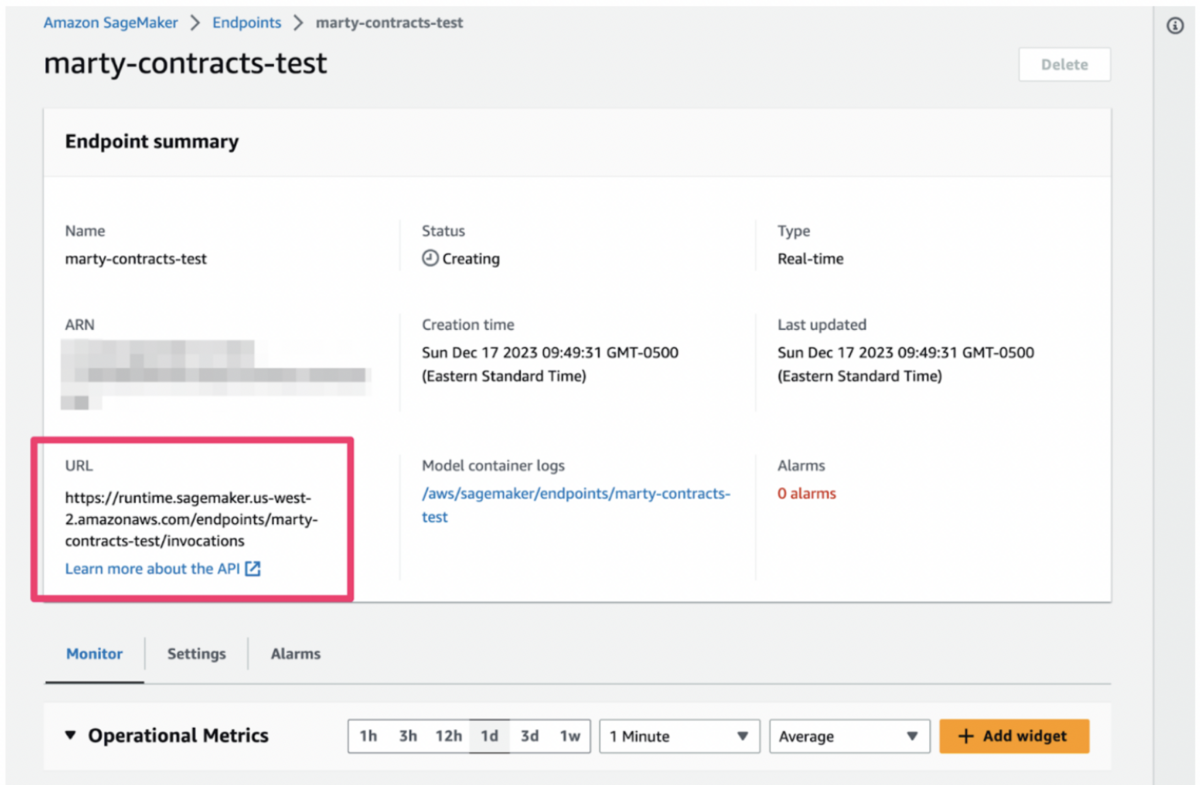
  1. Create a new endpoint configuration or use an existing configuration. The screenshot below uses SageMaker’s default endpoint configuration settings.
  2. Create the endpoint.
  3. Test model inference according to the inference type that you specified in the endpoint configuration. The base configuration uses MLflow’s native /invocations REST API endpoint. See the MLflow documentation for more information about the MLflow API specs
Image2

Snorkel AI + SageMaker: efficiently solving problems

This manufacturing use case serves as a great example of the potential of data-centric approaches to revolutionize industry practices.

By leveraging Snorkel Flow’s innovative data curation platform, heavy equipment manufacturers can rapidly prototype and iterate on data labeling functions, enabling the creation of rich training datasets that accurately reflect the complexities of real-world applications and flexibly adapt and scale with the business. SageMaker JumpStart offers a seamless pathway to both developing these datasets, with pre-trained models acting as labelers, and rapidly deploying scalable solutions.

Want to learn more about what data-centric AI could do for your business?

Schedule a free workshop with phData to dive in.