

惯性聚合 高效追踪和阅读你感兴趣的博客、新闻、科技资讯
阅读原文 在惯性聚合中打开

推荐订阅源

Y
Y Combinator Blog
Security Archives - TechRepublic
钛媒体:引领未来商业与生活新知
钛媒体:引领未来商业与生活新知
Apple Machine Learning Research
Blog — PlanetScale
Blog — PlanetScale
OSCHINA 社区最新新闻
OSCHINA 社区最新新闻
G
Google Developers Blog
F
Full Disclosure
大猫的无限游戏
大猫的无限游戏
酷 壳 – CoolShell
酷 壳 – CoolShell
T
Threat Research - Cisco Blogs
A
Arctic Wolf
Threat Intelligence Blog | Flashpoint
The Cloudflare Blog
博客园 - 【当耐特】
AWS News Blog
AWS News Blog
U
Unit 42
V
Vulnerabilities – Threatpost
P
Privacy International News Feed
T
Tor Project blog
Microsoft Security Blog
宝玉的分享
宝玉的分享
Google DeepMind News
爱范儿
爱范儿
cs.CL updates on arXiv.org
Recorded Future
Recorded Future
freeCodeCamp Programming Tutorials: Python, JavaScript, Git & More
奇客Solidot–传递最新科技情报
奇客Solidot–传递最新科技情报
C
CXSECURITY Database RSS Feed - CXSecurity.com
T
Threatpost
Latest news
Latest news
GbyAI
GbyAI
S
SegmentFault 最新的问题
MongoDB | Blog
MongoDB | Blog
N
Netflix TechBlog - Medium
Hacker News: Ask HN
Hacker News: Ask HN
美团技术团队
N
News | PayPal Newsroom
J
Java Code Geeks
Exploit-DB.com RSS Feed
Microsoft Azure Blog
K
KPMG report finds enterprise disconnect between AI and its ROI | CIO
The Hacker News
The Hacker News
The GitHub Blog
The GitHub Blog
V
V2EX
N
News and Events Feed by Topic
T
Troy Hunt's Blog
Security Latest
Security Latest
博客园 - 叶小钗
P
Palo Alto Networks Blog

Snorkel AI

Building AI-Native Systems for Federal Infrastructure: A Conversation with Rezaur Rahman Code World Models and AutoHarness for LLM Agents Benchtalks #1: Alex Shaw (Terminal-Bench, Harbor) – Building the Benchmark Factory Building FinQA: An Open RL Environment for Financial Reasoning Agents How Tool Discipline Let a 4B Model Outsmart a 235B Giant on Financial Tasks Coding agents don’t need to be perfect, they need to recover Closing the Evaluation Gap in Agentic AI SlopCodeBench: Measuring Code Erosion as Agents Iterate Introducing the Snorkel Agentic Coding Benchmark 2026: The year of environments Part V: Future Direction and Emerging Trends in Rubric-Based AI Evaluation The self-critique paradox: Why AI verification fails where it’s needed most Chat With the Terminal-Bench Team | Snorkel AI Intelligence per watt: A new metric for AI’s future Terminal-Bench 2.0: Raising the bar for AI agent evaluation Snorkeling in RL environments Introducing SnorkelSpatial: A Benchmark for LLM Spatial Reasoning Scaling Trust: Rubrics in Snorkel's Quality Process Evaluating Multi-Agent Systems in Enterprise Tool Use Evaluating Coding Agents with Terminal-Bench 2.0 Parsing isn’t neutral: why evaluation choices matter The science of rubric design The right tool for the job: An A-Z of rubrics Data quality and rubrics: how to build trust in your models Building the benchmark: inside our agentic insurance underwriting dataset Evaluating AI agents for insurance underwriting LLM observability: key practices, tools, and challenges Anthropic Claude + AWS: revolutionizing pharma data analytics with Snorkel AI Data-centric development of an enterprise AI agent with Snorkel Building the data development platform for specialized AI LLM-as-a-judge for enterprises: evaluate model alignment at scale Why GenAI evaluation requires SME-in-the-loop for validation and trust Research spotlight: is long chain-of-thought structure all that matters when it comes to LLM reasoning distillation? Why enterprise GenAI evaluation requires fine-grained metrics to be insightful What is specialized GenAI evaluation, and why is it so critical to enterprise AI? LLM alignment techniques: 4 post-training approaches Research spotlight: Is intent analysis the key to unlocking more accurate LLM question answering? Why enterprises should embrace LLM distillation Retrieval-augmented generation (RAG) failure modes and how to fix them What is large language model (LLM) alignment? Databricks + Snorkel Flow: integrated, streamlined AI development How LLM evaluation drives better models in Snorkel Flow Unlock proprietary data with Snorkel Flow and Amazon SageMaker LLM evaluation in enterprise applications: a new era in ML Snorkel AI joins the AWS ISV Accelerate Program and launches Snorkel Flow Availability in AWS Marketplace AI data development: a guide for data science projects SnorkelCon 2024: Inaugural Snorkel AI user conference gathers leaders from 30+ Fortune 500 companies Snorkel Flow 2024.R3: Supercharge your AI development with enhanced data-centric workflows Explore the new GenAI Evaluation Suite: Snorkel 2024.R3 New NLP features in Snorkel Flow 2024.R3 Enterprise data compliance and security review: Snorkel Flow 2024.R3 How a global financial services company built a specialized AI copilot accurate enough for production Task Me Anything: innovating multimodal model benchmarks Alfred: Data labeling with foundation models and weak supervision RAG: LLM performance boost with retrieval-augmented generation Call center AI for customer experience management: a case study New GenAI features, data annotation: Snorkel Flow 2024.R2 How data slices transform enterprise LLM evaluation Meta’s Llama 3.1 405B is the new Mr. Miyagi, now what? Meta’s new Llama 3.1 models are here! Are you ready for it? Data-centric AI with Snorkel and MinIO Weak supervision for non-categorical applications + superalignment Snorkel AI signs strategic collaboration agreement with AWS to help enterprises cross the demo-to-production chasm AI alignment made simple: innovative solutions for businesses How does the Snorkel Flow label model work? Vision language models: how LLMs boost image classification Long context models in the enterprise: benchmarks and beyond How to build production-grade RAG retrieval with Snorkel Flow How Bonito helps fine-tune specialized LLMs faster than ever Walking safely before building flying saucer seatbelts: introducing Enterprise Alignment Role-based access controls in Snorkel Flow secure enterprise data Accelerating AI development in manufacturing with Snorkel Flow and AWS SageMaker How ROBOSHOT boosts zero-shot foundation model performance Discover what’s new in Snorkel Flow: Flexible data and LLM connectivity, secure data controls, and more! Faster than ever document intelligence with new Snorkel Flow FM-first workflow The art of data development for Enterprise LLMs Crossing the demo-to-production chasm with Snorkel Custom CRFM's HELM and enterprise LLM evaluation beyond accuracy How we achieved 89% accuracy on contract question answering Five sessions not to miss at Google Cloud Next 24 Content filtering breakthrough: Snorkel client reaches 96% recall in 3 days Here's how Snorkel Flow + Google AI built an enterprise-ready model in a day Snorkel teams with Microsoft to showcase new AI research at NVIDIA GTC How Skill-it! enables faster, better LLM training Fine-tuned representation models boost LLM systems. Here's how Enterprise GenAI to surge in 2024: survey results Large language model training: how three training phases shape LLMs LoRA: Low-Rank Adaptation for LLMs LLM distillation demystified: a complete guide Enterprises must shift their focus from models to data in AI development Insurance’s GenAI revolution: a business perspective Scaling human preferences in AI: Snorkel's programmatic approach Building better enterprise AI: incorporating expert feedback in system development “Fall in love with your data”—Snorkel AI’s Enterprise LLM Summit Why QBE Ventures invested in Snorkel AI New benchmark results demonstrate value of Snorkel AI approach to LLM alignment Retrieval augmented generation (RAG): a conversation with its creator Snorkel Flow 2023.R4: enhanced UI + PDF and Databricks tools How Snorkel Flow users can register custom models to Databricks Stanford professor discusses exciting advances in foundation model evaluation
How Snorkel topped the AlpacaEval leaderboard (and why we're not there anymore)
Hoang Tran · 2024-04-09 · via Snorkel AI

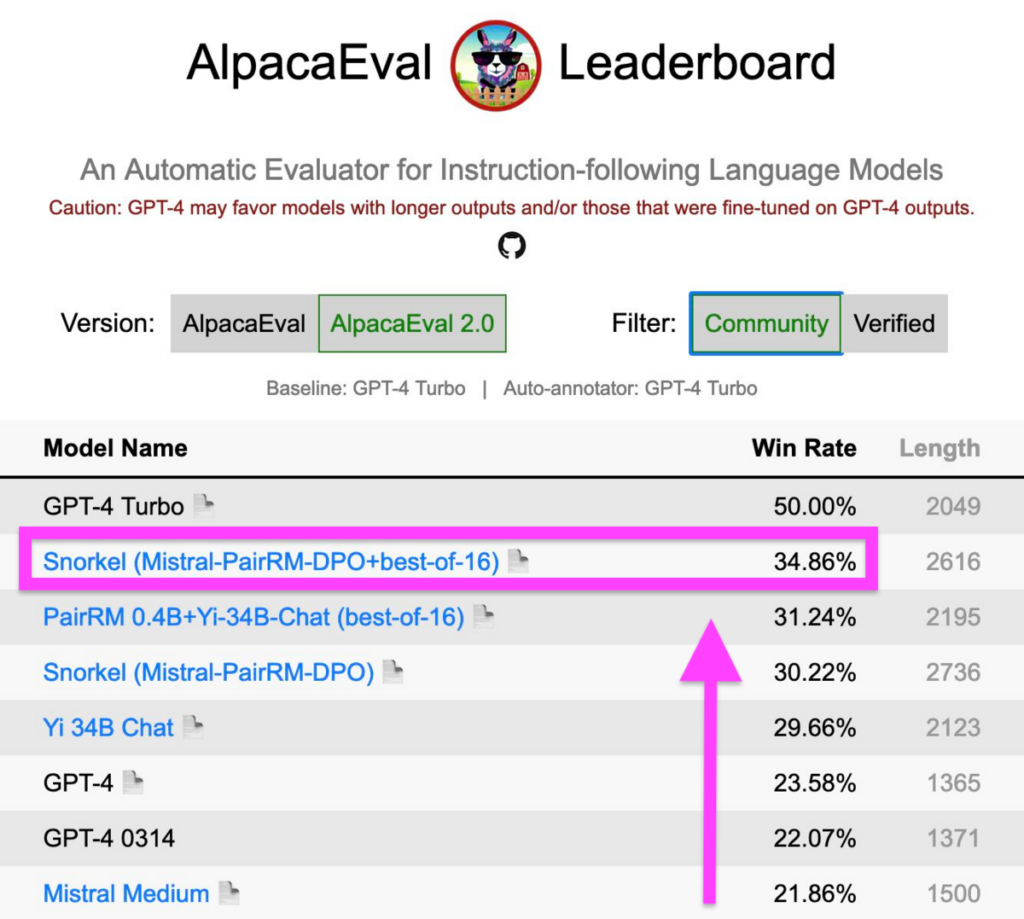
Back in January, Snorkel AI placed a model at the top of the AlpacaEval leaderboard. It beat the next-best competitor by more than seven points and maintained its rank for longer than a month. Recently, I talked with Matt Casey, data science content lead at Snorkel AI, about how we built the model using direct preference optimization, how it changed the AlpacaEval leaderboard, and how it will help us build better, more useful large language models for Snorkel’s customers.

I recommend that you watch my interview with Matt (embedded below), but I also wanted to share some of my thoughts in writing.

What is the AlpacaEval Leaderboard?

To start, let me explain our basic achievement.

The AlpacaEval tool automatically evaluates the instruction-following capabilities of large language models (LLMs). It feeds the model prompts from the AlpacaFarm evaluation set and measures how well an LLM understands and executes the given instructions by comparing the LLM’s responses to those from GPT-4. An auto-annotator model chooses which model produced the “better” response, creating a win rate.

Because the evaluation results in winning or losing, it lent itself to a leaderboard where researchers and data scientists can demonstrate how different model approaches result in better or worse win rates against GPT-4.

Our state-of-the-art open-source model placed second on the leaderboard—second only to GPT-4, which serves as the auto-evaluation standard—and beat many closed models.

For a small research project, we thought this was a significant achievement.
How we used direct preference optimization (DPO) on our model

LLM training happens in three phases: pre-training, fine-tuning with prompts and responses, and alignment. My colleague Chris Glaze and I previously worked on a successful research project to build a better LLM by curating high-quality prompt and response data, but this project focussed on alignment.

The alignment phase nudges the model’s outputs closer to what actual users want. This is tricky. User feedback data is hard to find in the wild. OpenAI hired a lot of people to rank and rate model responses. Most companies can’t afford to do that.

Data scientists can use indirect signals to infer the quality of a response—such as whether or not the user clicks on an included link—but these signals can be misleading.

Instead of trying to find or create a large, human-created preference data set, we decided to create synthetic alignment data. Using prompts from UltraFeedback and self-generated responses from our base LLM, we utilized a helper model that reliably ranks LLM responses to which one is preferred.

Then, we created a training loop. Our base LLM created several responses. Our helper model rated them. We kept the highest-rated response as “accepted” and marked the lowest-rated response as “rejected,” and used these to align the model. We performed self-generated responses to mimic the reinforcement learning with human feedback (RLHF) pipeline, and at the same time, not rely on outputs of larger models like other approaches.

Here, the ranking model is PairRM from AI2 and the base model is Mistral.

Why was DPO more preferred than RLHF for this project?

Until recently, nearly all LLM alignments used RLHF. This typically involves getting users to rate or rank multiple responses, training reward models to learn human preferences, and using reinforcement learning/PPO to train LLMs to maximize the reward scores (a proxy for human preferences).

DPO, in contrast, uses binary feedback. A response is either accepted or rejected. The model tries to adjust its output to look more like accepted responses and less like rejected ones.

DPO offered two main advantages over RLHF for this project:

  1. Improved stability.
  2. Computational efficiency.

In earlier experiments with RLHF, we saw our LLM’s loss curve explode and sometimes become very repetitive. The DPO approach avoided those over-fitting and instability pitfalls.

For reasons I won’t go into great detail about here, DPO is also much more computationally efficient than RLHF, which allowed us to run our experiments faster and at a lower cost.

Our “iterative DPO” approach also allowed the model to be more “creative” than the original DPO implementation. The original DPO utilizes human-written documents as preference data. The iterative approach with self-generation allowed the models to be rewarded for any self-creativity as long it aligned with the reward policy.

In my talk with Matt, I used the example of saying “thank you.” If you had a model that was not trained to say “thank you,” it could happen to develop that behavior during alignment with DPO—so long as users appreciated that behavior.

What happened next for the AlpacaEval Leaderboard?

If you look at the AlpacaEval leaderboard now, you won’t see Snorkel at the top. Our model has fallen quite a bit—down to 12th place, as of this writing. While part of that is due to other researchers building newer, better models, the bigger part of our model’s fall is because we asked for the leaderboard to change its rating approach, which Yann Dubois from AlpacaEval team has proactively addressed in the new version.

We noticed that AlpacaEval showed a bias for longer responses. The reward model we used also favored longer responses. That, in turn, encouraged our model to create longer responses.

But longer isn’t better. Sometimes, ten words are better than 100. We raised a GitHub issue to adjust models’ scores according to their response length. The new length adjustment lowered our score by almost five points—from 34.9 to 30.0.

That’s okay with us. We’re more interested in helping to push the field forward than we are interested in standing atop a leaderboard.
Image1

What does this mean for Snorkel Flow customers?

Snorkel AI is a research-led company, but we don’t just do research for fun. This project helped prove a path for how we can help enterprises align their LLMs in the future.

We likely won’t use the reward model we used for this project for our customers. That model and training loop aimed to create a high-performing LLM for a general audience. That’s not what we do for our customers. “Good” requires context. In the enterprise setting, only subject matter experts can supply that context.

In my talk with Matt, I gave the example of a customer-facing model built for the insurance or finance industry. That model should not give anything that resembles personal financial advice. Ever. Working with a bank’s SMEs, we could help build a reward model that would align the model to those guidelines.

From research to leaderboard to customer use

This project proved a couple of things. It proved that a DPO and a reward model in a loop could scalably align high-performance models. It proved that good-faith open-source collaboration can help nudge the field forward, and it proved a path for building better, more high-performant models for Snorkel’s customers.

Learn More

Follow Snorkel AI on LinkedInTwitter, and YouTube to be the first to see new posts and videos!