


惯性聚合 高效追踪和阅读你感兴趣的博客、新闻、科技资讯
阅读原文 在惯性聚合中打开

推荐订阅源

Recorded Future
Recorded Future
C
Cyber Attacks, Cyber Crime and Cyber Security
D
Darknet – Hacking Tools, Hacker News & Cyber Security
Scott Helme
Scott Helme
Cyberwarzone
Cyberwarzone
C
CERT Recently Published Vulnerability Notes
Threat Intelligence Blog | Flashpoint
P
Palo Alto Networks Blog
Google Online Security Blog
Security Archives - TechRepublic
WordPress大学
WordPress大学
博客园 - 聂微东
L
LINUX DO - 最新话题
月光博客
月光博客
小众软件
小众软件
T
Troy Hunt's Blog
A
Arctic Wolf
量子位
I
Intezer
大猫的无限游戏
大猫的无限游戏
T
Tailwind CSS Blog
S
Schneier on Security
NISL@THU
NISL@THU
T
Threat Research - Cisco Blogs
TaoSecurity Blog
TaoSecurity Blog
酷 壳 – CoolShell
酷 壳 – CoolShell
博客园_首页
有赞技术团队
有赞技术团队
N
News and Events Feed by Topic
美团技术团队
The Cloudflare Blog
P
Privacy International News Feed
S
Security Affairs
K
KPMG report finds enterprise disconnect between AI and its ROI | CIO
奇客Solidot–传递最新科技情报
奇客Solidot–传递最新科技情报
G
GRAHAM CLULEY
N
News | PayPal Newsroom
Apple Machine Learning Research
cs.CV updates on arXiv.org
钛媒体:引领未来商业与生活新知
钛媒体:引领未来商业与生活新知
L
LINUX DO - 热门话题
V
Vulnerabilities – Threatpost
cs.AI updates on arXiv.org
C
CXSECURITY Database RSS Feed - CXSecurity.com
宝玉的分享
宝玉的分享
Application and Cybersecurity Blog
IT之家
IT之家
Hacker News: Ask HN
Hacker News: Ask HN
雷峰网
雷峰网

Snorkel AI

Building AI-Native Systems for Federal Infrastructure: A Conversation with Rezaur Rahman Code World Models and AutoHarness for LLM Agents Benchtalks #1: Alex Shaw (Terminal-Bench, Harbor) – Building the Benchmark Factory Building FinQA: An Open RL Environment for Financial Reasoning Agents How Tool Discipline Let a 4B Model Outsmart a 235B Giant on Financial Tasks Coding agents don’t need to be perfect, they need to recover Closing the Evaluation Gap in Agentic AI SlopCodeBench: Measuring Code Erosion as Agents Iterate Introducing the Snorkel Agentic Coding Benchmark 2026: The year of environments Part V: Future Direction and Emerging Trends in Rubric-Based AI Evaluation The self-critique paradox: Why AI verification fails where it’s needed most Chat With the Terminal-Bench Team | Snorkel AI Intelligence per watt: A new metric for AI’s future Terminal-Bench 2.0: Raising the bar for AI agent evaluation Snorkeling in RL environments Introducing SnorkelSpatial: A Benchmark for LLM Spatial Reasoning Scaling Trust: Rubrics in Snorkel's Quality Process Evaluating Multi-Agent Systems in Enterprise Tool Use Evaluating Coding Agents with Terminal-Bench 2.0 Parsing isn’t neutral: why evaluation choices matter The science of rubric design The right tool for the job: An A-Z of rubrics Data quality and rubrics: how to build trust in your models Building the benchmark: inside our agentic insurance underwriting dataset Evaluating AI agents for insurance underwriting LLM observability: key practices, tools, and challenges Anthropic Claude + AWS: revolutionizing pharma data analytics with Snorkel AI Data-centric development of an enterprise AI agent with Snorkel Building the data development platform for specialized AI LLM-as-a-judge for enterprises: evaluate model alignment at scale Why GenAI evaluation requires SME-in-the-loop for validation and trust Research spotlight: is long chain-of-thought structure all that matters when it comes to LLM reasoning distillation? Why enterprise GenAI evaluation requires fine-grained metrics to be insightful What is specialized GenAI evaluation, and why is it so critical to enterprise AI? LLM alignment techniques: 4 post-training approaches Research spotlight: Is intent analysis the key to unlocking more accurate LLM question answering? Why enterprises should embrace LLM distillation Retrieval-augmented generation (RAG) failure modes and how to fix them What is large language model (LLM) alignment? Databricks + Snorkel Flow: integrated, streamlined AI development How LLM evaluation drives better models in Snorkel Flow Unlock proprietary data with Snorkel Flow and Amazon SageMaker LLM evaluation in enterprise applications: a new era in ML Snorkel AI joins the AWS ISV Accelerate Program and launches Snorkel Flow Availability in AWS Marketplace AI data development: a guide for data science projects SnorkelCon 2024: Inaugural Snorkel AI user conference gathers leaders from 30+ Fortune 500 companies Snorkel Flow 2024.R3: Supercharge your AI development with enhanced data-centric workflows Explore the new GenAI Evaluation Suite: Snorkel 2024.R3 New NLP features in Snorkel Flow 2024.R3 Enterprise data compliance and security review: Snorkel Flow 2024.R3 How a global financial services company built a specialized AI copilot accurate enough for production Task Me Anything: innovating multimodal model benchmarks Alfred: Data labeling with foundation models and weak supervision RAG: LLM performance boost with retrieval-augmented generation Call center AI for customer experience management: a case study New GenAI features, data annotation: Snorkel Flow 2024.R2 How data slices transform enterprise LLM evaluation Meta’s Llama 3.1 405B is the new Mr. Miyagi, now what? Meta’s new Llama 3.1 models are here! Are you ready for it? Data-centric AI with Snorkel and MinIO Weak supervision for non-categorical applications + superalignment Snorkel AI signs strategic collaboration agreement with AWS to help enterprises cross the demo-to-production chasm AI alignment made simple: innovative solutions for businesses How does the Snorkel Flow label model work? Long context models in the enterprise: benchmarks and beyond How to build production-grade RAG retrieval with Snorkel Flow How Bonito helps fine-tune specialized LLMs faster than ever Walking safely before building flying saucer seatbelts: introducing Enterprise Alignment Role-based access controls in Snorkel Flow secure enterprise data Accelerating AI development in manufacturing with Snorkel Flow and AWS SageMaker How ROBOSHOT boosts zero-shot foundation model performance Discover what’s new in Snorkel Flow: Flexible data and LLM connectivity, secure data controls, and more! Faster than ever document intelligence with new Snorkel Flow FM-first workflow The art of data development for Enterprise LLMs Crossing the demo-to-production chasm with Snorkel Custom How Snorkel topped the AlpacaEval leaderboard (and why we're not there anymore) CRFM's HELM and enterprise LLM evaluation beyond accuracy How we achieved 89% accuracy on contract question answering Five sessions not to miss at Google Cloud Next 24 Content filtering breakthrough: Snorkel client reaches 96% recall in 3 days Here's how Snorkel Flow + Google AI built an enterprise-ready model in a day Snorkel teams with Microsoft to showcase new AI research at NVIDIA GTC How Skill-it! enables faster, better LLM training Fine-tuned representation models boost LLM systems. Here's how Enterprise GenAI to surge in 2024: survey results Large language model training: how three training phases shape LLMs LoRA: Low-Rank Adaptation for LLMs LLM distillation demystified: a complete guide Enterprises must shift their focus from models to data in AI development Insurance’s GenAI revolution: a business perspective Scaling human preferences in AI: Snorkel's programmatic approach Building better enterprise AI: incorporating expert feedback in system development “Fall in love with your data”—Snorkel AI’s Enterprise LLM Summit Why QBE Ventures invested in Snorkel AI New benchmark results demonstrate value of Snorkel AI approach to LLM alignment Retrieval augmented generation (RAG): a conversation with its creator Snorkel Flow 2023.R4: enhanced UI + PDF and Databricks tools How Snorkel Flow users can register custom models to Databricks Stanford professor discusses exciting advances in foundation model evaluation
Vision language models: how LLMs boost image classification
Reza Esfandiarpoor · 2024-06-12 · via Snorkel AI

Vision language models demonstrate impressive off-the-shelf image classification capabilities. Still, generalist models like CLIP struggle to differentiate between subcategories with significant overlap, such as distinguishing cat breeds. I and my colleagues at Brown University set out to better understand how these models work and find ways to use large language models to improve vision language model performance—with notable results.

I recently presented two research papers, “Follow-Up Differential Descriptions: Language Models Resolve Ambiguities for Image Classification” and “If CLIP Could Talk: Understanding Vision-Language Model Representations Through Their Preferred Concept Descriptions” to an audience of Snorkel AI researchers and engineers. You can watch the entire presentation (embedded below), but I have summarized the main points here.

How do contrastive vision language models work?

Contrastive vision language models (VLMs) pair a text encoder with an image encoder. The encoders process each input of their respective media to generate an embedding vector. Researchers then train these models on images paired with their descriptions. This enables the model to understand the relationship between the text and image, allowing it to interpret visual concepts.

VLMs like CLIP (Contrastive Language-Impage Pre-training) serve as a great starting point for building image classification models, but they can sometimes use help; research has shown that querying the model with a description of a target class rather than just its label improves accuracy—though not all descriptions work equally well.

Different VLMs prioritize different attributes. For instance, when analyzing a dataset of bird species, one VLM might prioritize the size attribute, while another might prioritize the habitat attribute.
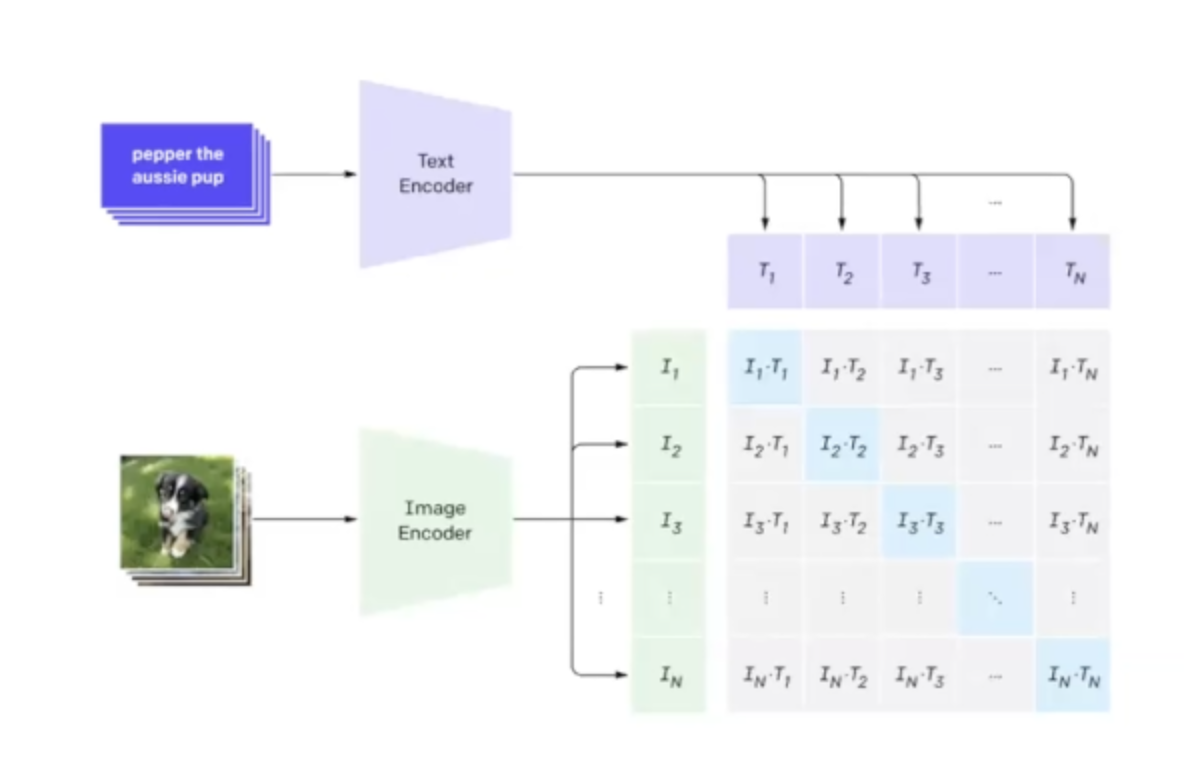
Image1
A high-level overview of how researchers train contrastive vision-language models.

Automatically enhancing VLM prompts

Our Follow-Up Differential Descriptions (FuDD) study aimed to address a key challenge in VLM performance: distinguishing between classes of images easily confused for each other. We used a zero-shot, training-free method to improve accuracy by detecting ambiguous classes and using a large language model (LLM) to generate detailed descriptions crafted to help resolve ambiguities.
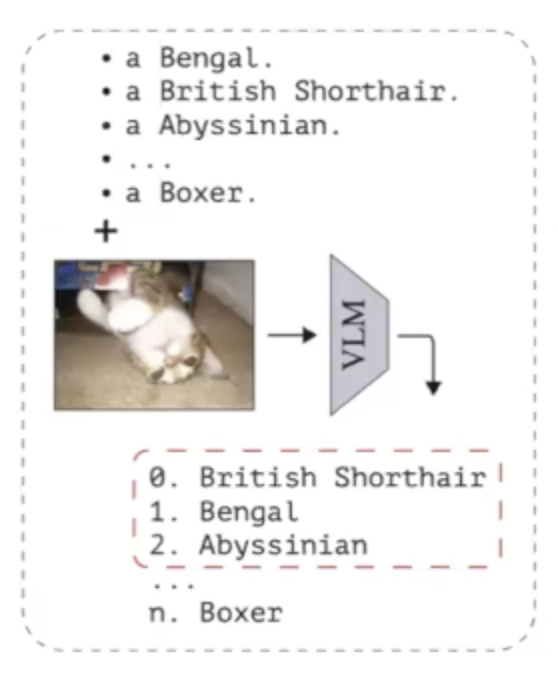
Image2
The first step in disambiguating image classes is to figure out which classes get confused for each other.

The process begins by presenting the VLM with images and text indicating the potential classes those images could belong to. By measuring the distance between the images and each of the classes, we can determine which classes are most similar to each other for this image (i.e., are ambiguous classes).

Then, we use the LLM’s generative AI capabilities to generate the information needed to resolve the ambiguity. For example, to help the VLM distinguish between images of a ‘sparrow’ and a ‘cuckoo’, we would prompt the LLM to generate descriptions highlighting differences between these bird species.

We use these contrastive descriptions to help guide CLIP to make the correct prediction for the image.  We ran extensive experiments on twelve fine-grained image classification datasets. The experiments tested two versions of CLIP and used GPT-3.5 to generate descriptions.  We also tested the impact of contrastive prompts for different levels of ambiguity, ranging from using contrastive prompts only for the five most ambiguous classes to all classes in the dataset.
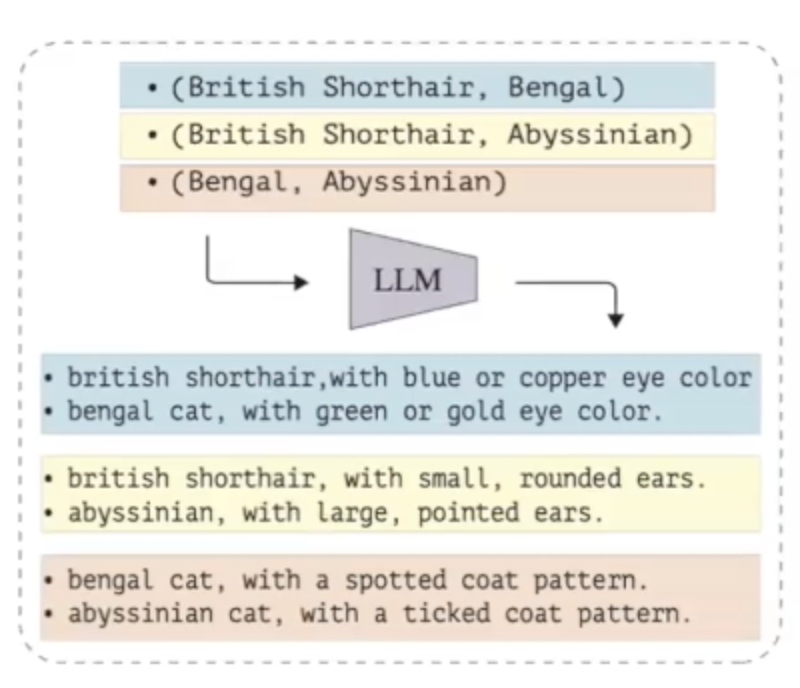
Image5
Example contrastive descriptions.

The results were encouraging: we observed that providing differential information about ambiguous classes significantly improved classification performance—and that we need not include contrastive descriptions for all classes. While including contrastive descriptions for all classes yielded the best performance, we achieved most of the performance boost by using contrastive prompts just for the five most ambiguous classes.
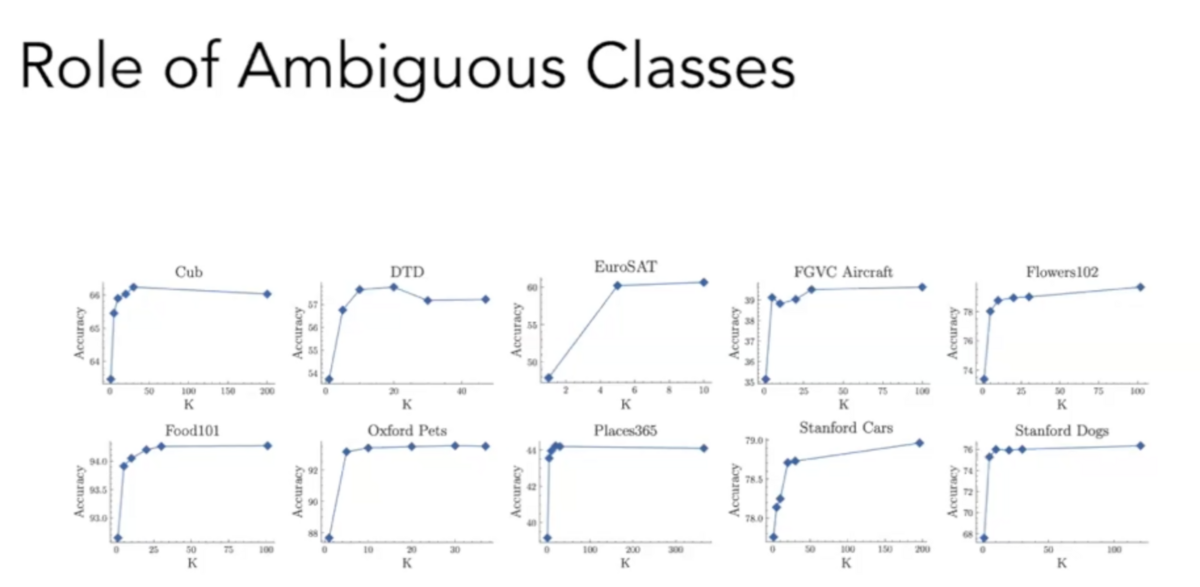
Image4
The results of including differential descriptions for the k-most ambiguous classes for different values of k (i.e., for different levels of ambiguity).

Understanding VLM contours

In our Extract and Explore (EX2) study, we used reinforcement learning to train an LLM to generate class descriptions more aligned with the preferences of specific VLMs.

The goal of this study was twofold:

  1. To better understand how different VLMs might represent the same concepts.
  2. To demonstrate an approach for training LLMs to assist image labeling tasks better.

We asked an LLM to describe a particular class, for instance, “lemur” or “sparrow.” Then, we then took the VLM’s embeddings for these descriptions and calculated the cosine similarity between them and the embeddings produced by our VLM for images of the given class. We used this cosine similarity as a reward metric to train the LLM to create descriptions more aligned with the VLM’s perspective.
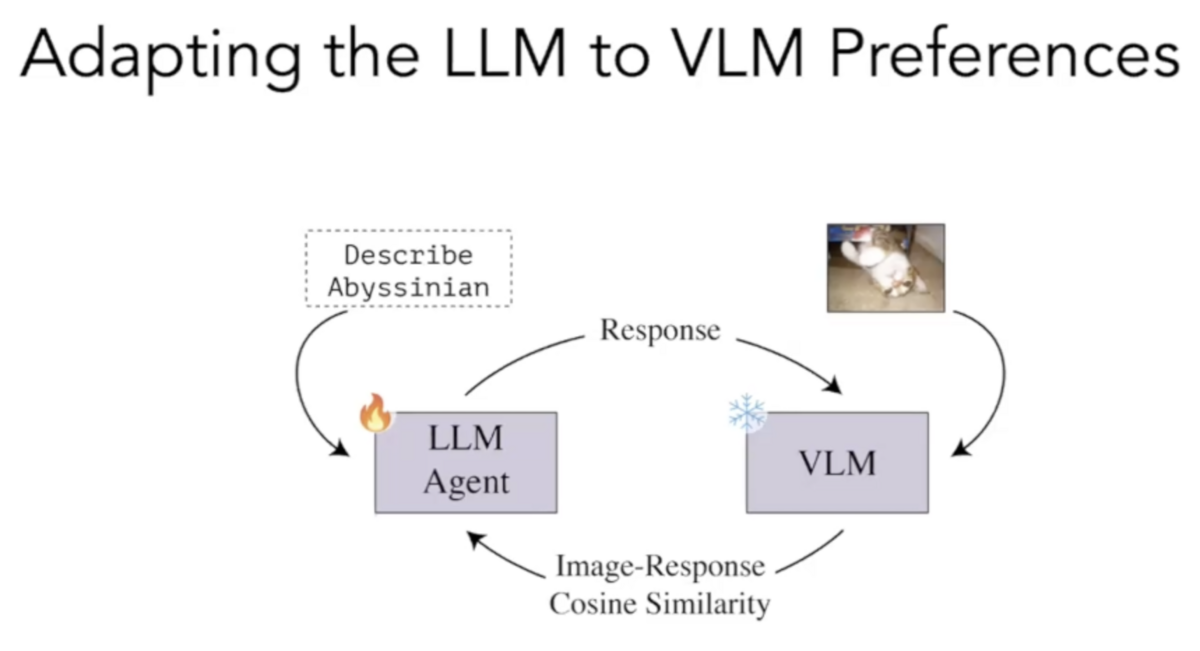
Image6
Our process for adapting LLMs to VLM preferences.

Using  EX2, we made several observations about how VLMs represent different concepts. We found that different VLMs prioritize different attributes to represent similar concepts. Some VLMs might focus on the size of an object, while others might focus on its habitat.

We also found that spurious descriptions and non-visual information significantly influence the representations in VLMs. Though non-intuitive, we found instances where VLMs were more responsive to descriptions that described where a bird lived rather than what the bird looked like.
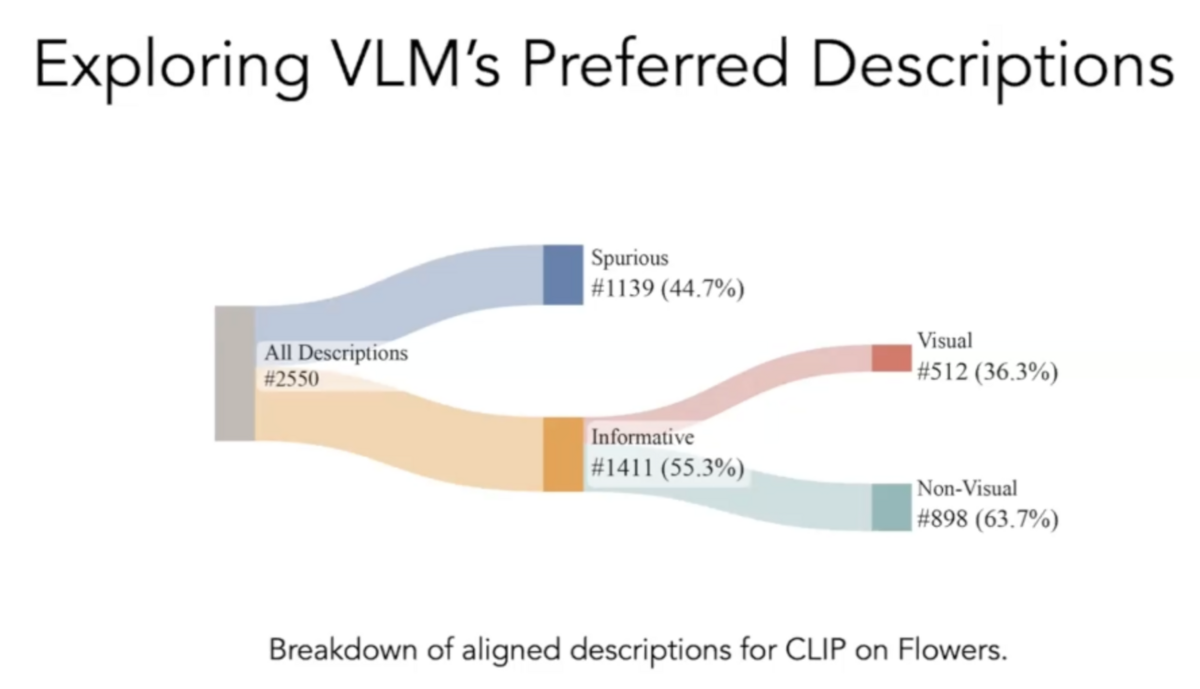
Image3
The breakdown of the types of descriptions that CLIP prefers for representing flower species.

A better understanding for better VLMs

Understanding and improving vision language models is a critical endeavor in machine learning research. These two studies have shown promising results in enhancing the performance and understanding of these models.

Our Follow-Up Differential Definitions study demonstrated how we can resolve ambiguities in VLMs to improve image classification accuracy. Our EX2 study revealed how VLMs represent different concepts and the influence of spurious descriptions and non-visual information on these representations.

These studies contribute to our understanding of VLMs and open new avenues for further research and potential applications. We look forward to continuing to explore these fascinating models and to furthering our knowledge in this exciting field.

More Snorkel AI events coming!

Snorkel has more live online events coming. Look at our events page to sign up for research webinars, product overviews, and case studies.

If you're looking for more content immediately, check out our YouTube channel, where we keep recordings of our past webinars and online conferences.