



惯性聚合 高效追踪和阅读你感兴趣的博客、新闻、科技资讯
阅读原文 在惯性聚合中打开

推荐订阅源

A
About on SuperTechFans
C
Cybersecurity and Infrastructure Security Agency CISA
N
News and Events Feed by Topic
C
Cisco Blogs
Cisco Talos Blog
Cisco Talos Blog
A
Arctic Wolf
Scott Helme
Scott Helme
P
Palo Alto Networks Blog
S
Schneier on Security
D
Darknet – Hacking Tools, Hacker News & Cyber Security
T
Tor Project blog
量子位
G
Google Developers Blog
H
Hackread – Cybersecurity News, Data Breaches, AI and More
B
Blog RSS Feed
NISL@THU
NISL@THU
Exploit-DB.com RSS Feed
AWS News Blog
AWS News Blog
爱范儿
爱范儿
Last Week in AI
Last Week in AI
Y
Y Combinator Blog
L
LINUX DO - 最新话题
Security Archives - TechRepublic
Threat Intelligence Blog | Flashpoint
S
Secure Thoughts
Cloudbric
Cloudbric
aimingoo的专栏
aimingoo的专栏
L
Lohrmann on Cybersecurity
TaoSecurity Blog
TaoSecurity Blog
Recent Commits to openclaw:main
Hacker News: Ask HN
Hacker News: Ask HN
freeCodeCamp Programming Tutorials: Python, JavaScript, Git & More
The GitHub Blog
The GitHub Blog
有赞技术团队
有赞技术团队
S
Security @ Cisco Blogs
cs.CL updates on arXiv.org
C
Cyber Attacks, Cyber Crime and Cyber Security
G
GRAHAM CLULEY
P
Proofpoint News Feed
V
V2EX
Martin Fowler
Martin Fowler
C
CERT Recently Published Vulnerability Notes
Attack and Defense Labs
C
CXSECURITY Database RSS Feed - CXSecurity.com
The Cloudflare Blog
SecWiki News
SecWiki News
罗磊的独立博客
CTFtime.org: upcoming CTF events
小众软件
小众软件
The Last Watchdog
The Last Watchdog

The Cloud Experience Everywhere articles

What I learned about Epistemia: A new way to build AI you can trust Strategy is the easy part, but can you deliver? Simplify HPE Morpheus Software automation with the new visual workflow builder AI evolution: Shifting from training to inference needs infrastructure modernization HPE Morpheus Central is here. Managing a multisite fleet just changed. Architecting your IT environment for change is key to the Great VM Reset An overview of IT service management using HPE OpsRamp Software Service Desk Beyond the basics: Deeper observability for HPE Morpheus Software – VM essentials Simpler, faster hybrid cloud management with agentic AI in HPE Morpheus Software 9.0 Navigating the signal tsunami: Why shared observability matters today HPE OpsRamp Software named as major player in the IDC MarketScape Achieving zero downtime: A deep dive into HPE Morpheus Software high availability Scaling the hybrid cloud: Unveiling HPE Morpheus Software version 9.0 The rise of agentic AI: Ushering in the next era of intelligent IT Unleashing AI factory ROI: Secure agentic AI on multitenant infrastructure Introducing HPE CloudOps Software for cloud service providers Introducing HPE CloudOps Software for cloud service providers Next-gen IT unleashed: The boom of cloud paging and application packaging The critical role of security fundamentals in the age of AI GreenLake Marketplace launches end-to-end commerce capabilities Discover what’s next with HPE Services at HPE Discover Las Vegas 2026 Secure application modernization with the Strangler Pattern to reduce security risk The private cloud resurgence by IDC—rebalancing cost, control, and AI HPE global trade integration: Enabling compliance in a connected digital world Sovereign by design for the workplace Reset with intent: Four smart moves to rationalize VMware exposure Building the high-performance data foundation for enterprise AI with HPE Storage Mastering hybrid cloud migration with HPE CloudOps Software suite Why sovereign cloud is becoming the backbone of modern workplace solutions Facilitating federated data and AI at scale with federated mesh architectures Reviving private cloud by automating day‑2 operations using Kubernetes operators From alerts to action: how Operations Copilot accelerates incident response Unleashing enterprise AI factories with Kubeflow: Overcoming multitenancy hurdles What a ride it has been—HPE Morpheus VM Essentials Software hits version 8.1 Cyber resilience: Securing the last line of defense in the digital age AI-augmented endpoint engineering: From deterministic to autonomous delivery HPE OpsRamp Software March 2026 release: Key updates for IT operations teams Simplify bare metal management with HPE Morpheus Enterprise Software BMaaS Operations Copilot from HPE OpsRamp Software: Your partner for next-gen IT operations ITIL (version 5): What’s new, what’s different, and why recertification matters Stop overpaying for platforms: Invest in GPUs for real AI value Why buying a training subscription is just like buying a gym membership HPE Morpheus Enterprise Software enhances its Kubernetes service with new features The great VM reset: Why enterprise virtualization needs a new foundation Engineering modern resilient-by-design applications for hybrid cloud PostgreSQL's BM25 ranking algorithm for enterprise-grade search quality Streamlining hybrid cloud: Announcing the unified HPE/hpe Terraform provider v1.1.0 Inside HPE Morpheus Minute: A closer look at storage types in HPE Morpheus Software Half your AI factory is sitting idle; here is the blueprint that fixes it Introducing True N-Tier Multi-Tenancy in HPE Morpheus Enterprise Software v8.1.0 Operationalizing agentic AI with NVIDIA Nemotron and HPE agents hub
Beyond observability: From signals to semantic intelligence in hybrid cloud
2026-03-13 · via The Cloud Experience Everywhere articles

Hybrid cloud observability generates signals but not understanding. This article explores how semantic, context-aware AI transforms telemetry into intelligent, risk-aware infrastructure operations.

GettyImages-926129268_800_0_72_RGB.jpg

Transforming telemetry-driven AIOps into context-aware intelligence for hybrid cloud. Enterprises operating in hybrid cloud environments generate massive volumes of infrastructure signals across distributed systems. Learn how modern hybrid architectures are evolving with hybrid cloud solutions from HPE.

Executive summary

Enterprises operating in hybrid cloud environments generate massive volumes of infrastructure signal metrics, logs, traces, and alerts. Yet, despite advanced monitoring and AIOps investments, operational teams continue to struggle with noisy alerts and delayed root cause analysis. Learn how AI-driven infrastructure solutions from HPE support intelligent operations. The core challenge is not the lack of data.
It is the lack of semantic understanding.

Traditional AI models interpret infrastructure signals syntactically (numbers, anomalies, and patterns) but fail to understand the real-world meaning behind those signal dependencies, workload intent, hardware constraints, and business criticality. This blog explores how organizations can evolve from signal-driven automation to semantic, context-aware intelligence that aligns with enterprise hybrid cloud operations.

Modern IT operations management platforms are evolving to combine observability, automation, and AI-driven insights across hybrid environments. Learn more about IT Operations Management from HPE.

The modern hybrid cloud reality: Data-rich, context-poor

Hybrid cloud infrastructures span:

  • On-prem data centers
  • Private cloud platforms
  • Public cloud environments
  • Edge and distributed workloads

Monitoring systems such as Prometheus, Grafana Labs, and enterprise observability stacks continuously collect telemetry signals. However, these signals lack semantic meaning unless correlated with infrastructure context.

Example of raw signals

  • CPU usage: 92%
  • Memory usage: 78%
  • Disk I/O latency: 45 ms
  • Pod restarts: 12

Without semantics, AI interprets this as high resource utilization.
With semantics, it may reveal:
Critical payment service impacted due to storage bottleneck on on-prem node.

Signals vs. semantics: What’s the difference?

Dimension

Signals (traditional AIOps)

Semantics (context-aware AI)

Data type

Metrics, logs, alerts

Enriched operational context

Understanding

Pattern detection

Infrastructure meaning

Automation

Reactive

Intelligent and risk aware

Decision quality

Often noisy

Operationally aligned

Hybrid cloud readiness

Limited

High

Why signal-only AI fails in infrastructure operations

1. Lack of topology awareness

Signal-based AI does not understand:

  • Service dependencies
  • Network paths
  • Cluster relationships
  • Multilayer architecture

Real enterprise scenario

A retail enterprise running hybrid cloud workloads observed frequent latency spikes.
Their AI system recommended auto-scaling public cloud nodes based on CPU metrics.

Actual root cause:

  • On-prem database storage saturation
  • Network dependency between cloud app and on-prem DB

Impact:

  • Increased cloud cost
  • No latency improvement

SLA degradation during peak sale window

2. Alert noise without operational meaning

Telemetry platforms generate thousands of alerts daily.
Without semantic correlation, AI treats each alert independently rather than understanding cascading failures.

This leads to:

  • Alert fatigue
  • Misguided automation
  • Reduced trust in AIOps platforms

The core concept: From telemetry intelligence to semantic intelligence

Traditional flow (signal centric)

Metrics + logs + alerts

          ↓

     AI pattern models

          ↓

   Generic recommendations

Semantic-aware hybrid cloud intelligence

Telemetry signals

     + Infrastructure topology

     + Workload criticality

     + Hardware telemetry

     + Policy and governance context

                    ↓

         Semantic intelligence layer

                    ↓

      Context-aware AI decisions and automation

Architecture diagram: Semantic intelligence in hybrid cloud
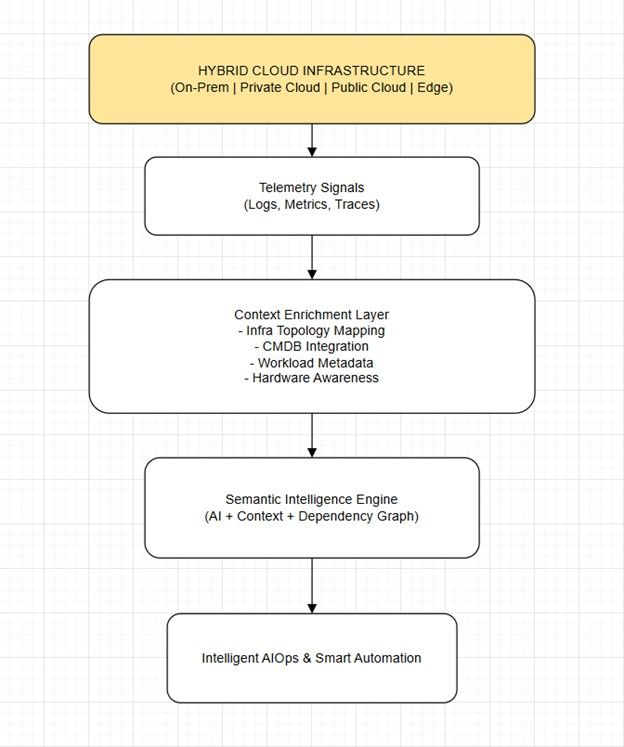
fig 1.jpg

Figure 1. Architecture of semantic intelligence enabling context-aware AIOps in hybrid cloud environments.

Key building blocks to achieve semantic understanding

  1. Context enrichment layer

Raw telemetry must be enriched with:

  • Configuration management database (CMDB) data
  • Service maps
  • Deployment metadata
  • Infrastructure hierarchy

This enables AI to understand what the signal represents rather than just detecting anomalies.

  1. Dependency graph modeling

Infrastructure components in hybrid cloud are deeply interconnected.
Using dependency graphs, AI can map:

  • Application → VM → storage → network → hardware

Frameworks like Ray and knowledge graph pipelines help operationalize semantic relationships at scale.

  1. Hardware-aware intelligence

Hybrid environments include heterogeneous hardware stacks.
Semantic AI must ingest:

  • CPU architecture signals
  • GPU workloads
  • Storage tiers
  • Network throughput constraints

Tools such as OpenVINO and inference engines such as NVIDIA Triton Inference Server can enable efficient, hardware-aware inference for infrastructure analytics.

Faster root cause analysis

Semantic correlation reduces investigation time by mapping signals to real infrastructure events.

Smarter automation

Automation decisions become:

  • Risk aware
  • Policy aligned
  • Context sensitive

Improved hybrid cloud governance

Semantic AI can incorporate:

  • Data residency constraints
  • Compliance zones
  • Workload criticality tiers

Tooling ecosystem to enable signal-to-semantic transformation

Enterprises can operationalize semantic intelligence using:

  • Observability: Prometheus, OpenTelemetry
  • Context mapping: CMDB + service mesh metadata
  • AI inference: Triton, vLLM, Ray Serve
  • Visualization: Grafana Labs dashboards with contextual overlays

This stack aligns well with hybrid cloud operational models where data remains distributed but intelligence is centralized.

Strategic alignment with hybrid cloud application engineering

For application engineering practices, semantic infrastructure intelligence enables:

  • Better workload placement decisions
  • Intelligent migration planning
  • Context-aware autoscaling
  • Resilient application modernization

Instead of reacting to signals, teams can design systems that understand infrastructure behavior holistically.

Future outlook: Toward infrastructure-native AI

The next evolution of enterprise AIOps is not more data collection but deeper semantic interpretation. AI systems will increasingly:

  • Understand infrastructure intent
  • Learn operational patterns
  • Provide explainable automation decisions
  • Align with enterprise governance frameworks

Conclusion

In hybrid cloud environments, signals alone are insufficient to drive reliable automation. Enterprises must transition from telemetry-driven AI to semantic, context-aware intelligence that understands infrastructure reality.

By embedding topology awareness, hardware context, and workload semantics into AI models, organizations can significantly enhance operational resilience, reduce alert noise, and enable intelligent automation aligned with real-enterprise infrastructure needs.

The shift from signals to semantics is not merely a technical upgrade, it is a strategic imperative for scalable, intelligent, and future-ready hybrid cloud operations.

CTA: Learn how hybrid cloud platforms enable intelligent, context-aware infrastructure operations across distributed environments.

By Authors:
Sourabh Patil - Linkedin account:  www.linkedin.com/in/sourabh-patil-5058a3157
Rutik Kalokhe 
Aarohi Bhartiya 
Rajvardhan Shinde