惯性聚合 高效追踪和阅读你感兴趣的博客、新闻、科技资讯
阅读原文 在惯性聚合中打开

推荐订阅源

奇客Solidot–传递最新科技情报
奇客Solidot–传递最新科技情报
Apple Machine Learning Research
aimingoo的专栏
aimingoo的专栏
H
Help Net Security
腾讯CDC
T
Tailwind CSS Blog
Hugging Face - Blog
Hugging Face - Blog
人人都是产品经理
人人都是产品经理
酷 壳 – CoolShell
酷 壳 – CoolShell
MongoDB | Blog
MongoDB | Blog
宝玉的分享
宝玉的分享
有赞技术团队
有赞技术团队
美团技术团队
雷峰网
雷峰网
让小产品的独立变现更简单 - ezindie.com
博客园 - 司徒正美
博客园_首页
Recent Announcements
云风的 BLOG
云风的 BLOG
B
Blog RSS Feed
钛媒体:引领未来商业与生活新知
钛媒体:引领未来商业与生活新知
D
Docker
博客园 - Franky
Jina AI
Jina AI

Latest from Tom's Hardware in Cpus

Intel Xeon 6+ ‘Clearwater Forest’ puts 18A in the data center with up to 288 cores, 576 MB of L3 cache — new Xeon 6990E+ is 30% faster per thread than 192-core AMD Epyc 9965, says Intel Intel Xeon 7 ‘Diamond Rapids’ CPUs officially launching in 2027 on Intel 18A-P — next-gen P-core Xeon features PCIe 6.0, 50% higher core counts, and twice the memory bandwidth AMD brings back Ryzen 7 5800X3D, launches Ryzen 7 7700X3D to combat rising component prices — eight-core X3D CPUs arrive under $350 for AM4 or AM5, DDR4 or DDR5 AMD confirms AM5 support through 2029 — Zen 4 and 5 platform will likely see two more generations, at least Nvidia's long-awaited N1/N1X SoC specs leak ahead of Computex launch — N1 to feature up to 20 Arm-based cores, standard N1 equipped with 12- and 10-core configs AMD Ryzen 7 5800X and Nvidia RTX 5060 combo is only $439 — deal includes a free CPU cooler, totaling out to $150… Intel’s new Bartlett Lake flagship loses fight to a four-year-old CPU — Core 9 273PQE has 50% more P-cores… $100 CPU Shootout: Comparing the Ryzen 5 5500, Core i3-14100F, and Core i3-12100F to find the top DDR4 CPU Analyst says Nvidia poised to capture two-thirds of the x86 server CPU market from Intel and AMD with expected $20 billion in revenue — 'Nvidia is already on track' to deliver 4 million Vera CPUs in FY2027 AMD Ryzen AI Max 400 ‘Gorgon Halo’ packs up to 192GB of unified memory — refreshed APU uses Zen 5 and… Ryzen 7 5800X3D AM4 10th Anniversary Edition surfaces online for $310 — return of iconic gaming CPU for budget… Intel CEO Lip-Bu Tan stamps out chip bugs with aggressive new quality standards, says major validation errors can result in termination — 'B0, you keep your job. Anything above that, you are fired' AMD rumored to ready budget-friendly Ryzen 7 7700X3D for suffering gamers — chipmaker lowers clocks and price with… The Core Ultra 7 270K was too good, so Intel scrapped the flagship Core Ultra 9 290K Plus — benchmarks of the 290K prototype find slim 2% faster performance in gaming and applications Intel Core Ultra 5 250K Plus vs AMD Ryzen 5 7600X3D faceoff — Battle for the fastest mid-range gaming CPU AMD reaches 46% of server x86 CPU revenue — Intel still controls 70% of the consumer PC market share AMD expands its Ryzen 9000 PRO lineup with six new SKUs, now featuring 3D V-Cache for the first time — new workstation CPUs have up to 170W TDPs, available with OEMs later this year China's next-gen CPUs and GPUs prepare to challenge last-gen Intel and AMD in 2027 — Loongson 3B6600 and… Arm's $2 billion in AGI CPU sales are still not enough to penetrate 5% of overall market share, analyst reveals — at least $90 million worth of CPUs to be shipped before FY2027 AMD Ryzen 9 9950X3D2 vs Ryzen 9 9950X3D faceoff — How far does dual cache take you? Intel Core Ultra 5 225 review: Arrow Lake’s forgotten CPU needs a price cut AMD to broaden and specialize EPYC CPUs, already working on Zen 7 architecture — increased customization to better… AMD posts record first-quarter results, driven by skyrocketing data center CPU demand — company expects consumer and gaming revenue to decline in Q2 over rising memory and component costs Intel's P-core Core 9 273PQE 'Bartlett Lake' CPU beats 14900K by up to 9% in gaming tests — embedded-only chip is unofficially Intel's fastest gaming CPU (at 720p) New server-focused SPEC CPU 2026 benchmarking suite has results for a Raspberry Pi 5 — updated tools feature more tests and can run a wide range of systems AMD Ryzen AI 5 435G APU breaks cover in early benchmarks — six-core Zen 5 chip goes head-to-head with the Ryzen 5 8600G for budget PC builders AMD Ryzen AI Max+ PRO 495 APU could arrive with 192GB of unified memory — leaked PassMark benchmarks suggest… AMD Ryzen 9 PRO 9965X3D spotted on Passmark — company's first PRO chip with 3D V-Cache also bumps the lineup… Tech teardown specialist delids a Xeon with a blowtorch and hunting knife — wood chopping block makes a worthy… More details emerge about how Intel now earns more revenue from each wafer by looking to the edges — analyst reports say reduced yield variability across each wafer leads to more sellable CPUs
AMD Ryzen 9 9950X3D2 review: More cache, more cash
Jake RoachSocial Links NavigationSenior Analyst, CPUs · 2026-04-21 · via Latest from Tom's Hardware in Cpus

Tom's Hardware Verdict

The Ryzen 9 9950X3D2 isn’t worth the money for the vast majority of people, but it was never meant to be. It’s a halo product with some surprising upsides in a few niche workloads, and it stands as AMD’s first-ever dual-3D V-Cache CPU.

Pros

  • +

    Matches the Ryzen 7 9800X3D in games

  • +

    Around 4% faster in multithreaded performance compared to 9950X3D

  • +

    Double-digit improvements in some specialized workloads

  • +

    Unlocked multiplier for overclocking

Cons

  • -

    Very expensive

  • -

    Slight regressions in single-threaded workloads

  • -

    Higher power consumption

Why you can trust Tom's Hardware Our expert reviewers spend hours testing and comparing products and services so you can choose the best for you. Find out more about how we test.

Given the prevalence of AMD’s dual-CCD 3D V-Cache-equipped X3D CPUs among the best CPUs for gaming and our CPU benchmark hierarchy, a natural question has formed in the minds of PC enthusiasts since the first model launched: What if you stacked cache on both CCDs? AMD has restricted its wildly popular (and marketable) 3D V-Cache to a single CCD on its Ryzen 9 models, leaving a natural slot for a CPU that stacked cache on both CCDs. The Ryzen 9 9950X3D2 Dual Edition finally brings that idea to the company’s long-lived AM5 platform.

It’s a fascinating CPU, and not just because it’s the first of its kind. For starters, it’s the most expensive Ryzen CPU AMD has ever released — Intel messed around with $1,000+ consumer CPUs years ago — with a recommended retail price of $899. Anything above that price goes into the Threadripper range. It’s also a halo product launching in a PC market that’s plagued by inflated prices, from ongoing RAM and SSD price increases to the ever-present climb of GPU prices.

Instead of just offering a binned version of the 9950X3D, similar to what we saw with the Ryzen 7 9850X3D, AMD is bridging the gap between its consumer and HEDT ranges with the 9950X3D2. It’s firmly a workstation-class processor, with little to no advantage in games, and even slight regressions in some titles. There are some minor advantages in application performance, particularly in heavily-threaded workloads like rendering and encoding, though not enough to justify the $899 price tag.

Even the packaging here hints that this is a highly-specialized CPU, sporting a neutral black and gray color scheme in stark contrast to the vibrant oranges and reds we typically see with AMD chips.

The performance improvements show up mainly in specialized workloads in fields like data science, where massive instructions can show the latency benefits of having L3 access easily available on both CCDs. Looking at overall performance, the Ryzen 7 9850X3D offers a better gaming experience while the 9950X3D delivers a greater value in applications. But for these specialized workloads, AMD is offering performance increases as large as 25%.

Our full benchmarks provide a look into those advantages, spanning gaming, productivity, and power testing. The Ryzen 9 9950X3D2 was never meant to be a mass market CPU, and our testing goes further to prove that it’s a niche product for a small audience. Take 100 PC builders, and we’d recommend another chip to 99 of them. For that small market, however, the 9950X3D2 delivers.

AMD Ryzen 9 9950X3D2 specifications and pricing

Swipe to scroll horizontally

CPU / (MSRP)

Street Price

Architecture

Cache (L2 + L3)

Cores/Threads (P+E)

Base/Boost Clock (GHz)

TDP / Maximum Power

Ryzen 9 9950X3D 2 Dual Edition ($900)

$900

Zen 5 X3D

208 MB

16 / 32

4.3 / 5.6

200W / 270W

Ryzen 9 9950X3D ($700)

$676

Zen 5 X3D

144 MB

16 / 32

4.3 / 5.7

170W / 230W

Ryzen 9 9950X ($650)

$520

Zen 5

80 MB

16 / 32

4.7 / 5/7

170W / 230W

Ryzen 9 9900X3D ($600)

$530

Zen 5 X3D

140 MB

12 / 24

4.4 / 5.5

120W / 230W

Ryzen 9 9900X ($500)

$439

Zen 5

76 MB

12 / 24

4.4 / 5.6

120W / 162W

Ryzen 7 9850X3D ($500)

$499

Zen 5 X3D

104 MB

8 / 16

4.7 / 5.6

120W / 162W

Ryzen 7 9800X3D ($480)

$464

Zen 5 X3D

104 MB

8 / 16

4.7 / 5.2

120W / 162W

Ryzen 7 9700X ($360)

$305

Zen 5

40 MB

8 / 16

3.8 / 5.5

65W / 88W

Ryzen 5 9600X ($280)

$188

Zen 5

38 MB

6 / 12

3.9 / 5.4

65W / 88W

AMD’s 12- and 16-core X3D chips only use the stacked cache on one of their two CCDs, effectively giving only eight of their cores instant access to the large pool of L3. The Ryzen 9 9950X3D2 changes things up by putting the SRAM chunk on both CCDs.

Stay On the Cutting Edge: Get the Tom's Hardware Newsletter

Get Tom's Hardware's best news and in-depth reviews, straight to your inbox.

It’s not double the cache of the 9950X3D, however, just double the amount of stacked cache. Each Zen 5 CCD has 32 MB of L3 cache, so the 9950X, for example, has 64 MB of L3 total. The 9950X3D boosts that to 128 MB by stacking an additional 64 MB under one CCD. Here, we have the extra 64 MB under both CCDs for a total of 192 MB of L3.

Particularly in heavily-threaded tasks, the goal it seems is to keep data close to the cores. For the other eight cores that otherwise wouldn’t have access to the large, shared pool of L3, they now don’t need to cross over to other CCD to get the data they need. That’s the idea, at least.

Adding extra cache comes with downsides, particularly in thermal and power demands. The Ryzen 9 9950X3D2 peaks slightly lower than its single-cache counterpart at 5.6 GHz, and it demands a 200W TDP, with a peak platform power of 270W; the highest of any consumer Zen 5 CPU. You still get the same 16 Zen 5 cores and 32 threads as the Ryzen 9 9950X3D and Ryzen 9 9950X, however.

The haircut in peak clock speed is telling here, suggesting that a dual cache X3D part wouldn’t have been possible with the previous Zen 4 design. AMD previously stacked the cache on top of the CCD, insulating the cores from direct access to the IHS. Now, the extra cache is under the CCD. That not only allows the Ryzen 9 9950X3D2 to maintain a high-end thermal design, but also to offer full overclocking support, alongside AMD’s Precision Boost Overdrive (PBO).

AMD Ryzen 9 9950X3D2 cache latency testing

The Ryzen 9 9950X3D2 is the first 3D V-Cache CPU to have stacked L3 cache on both CCDs. The natural question: Does that actually matter? More cache is more cache, but the additional stack here seems like it has less to do with capacity and more to do with latency. As mentioned, if you can access data from L3 on CCD 2, that means you don’t need to go over to CCD 1, which creates additional latency.
AMD Ryzen 9 9950X3D2

(Image credit: Tom's Hardware)

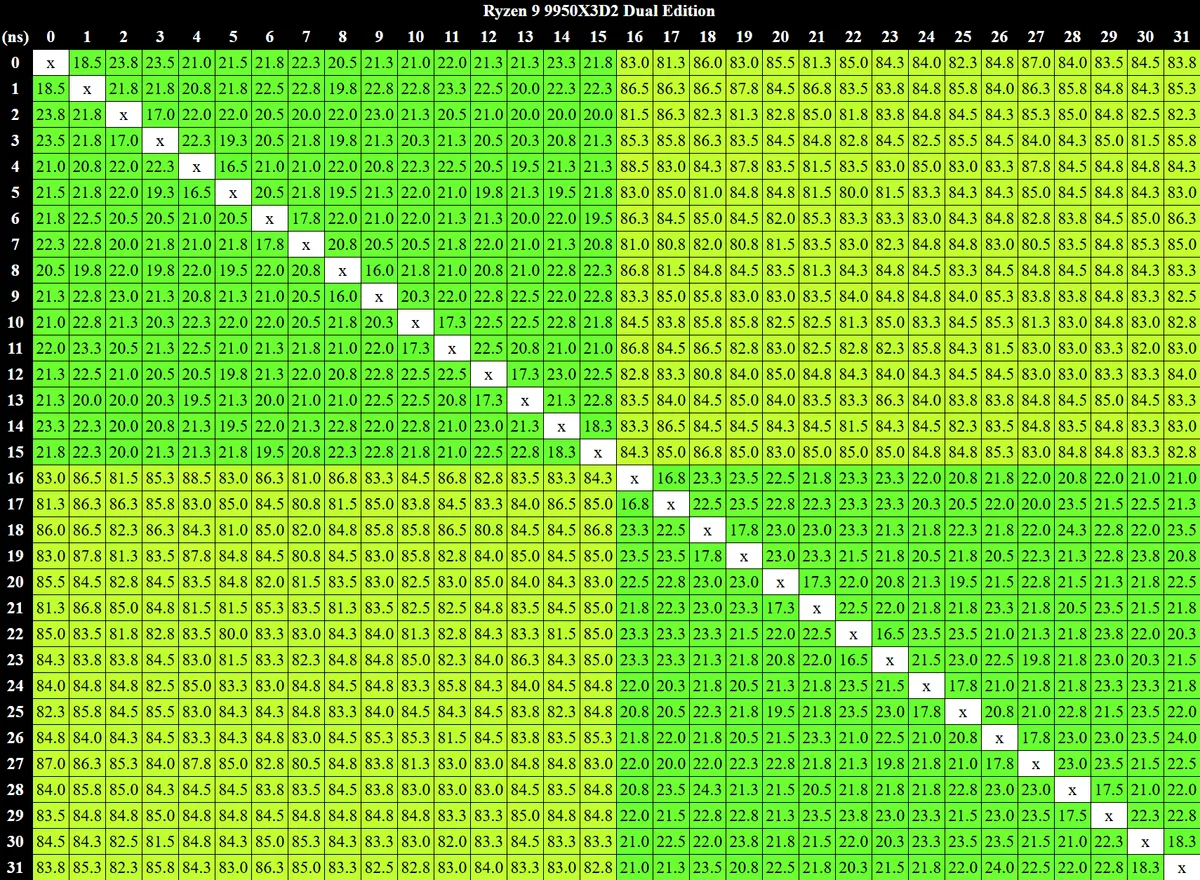
First, let’s establish that’s actually the case. Above, you can see a core-to-core heatmap for the Ryzen 9 9950X3D2. This is all about core-to-core communication, and it’s just an illustration to establish that, yes, there’s an additional latency penalty when a core has to cross over to the other CCD. So, if core 16 on CCD 2 needs to get data from the L3 stored on CCD 1, there’s an additional latency hit.
AMD Ryzen 9 9950X3D2

(Image credit: Tom's Hardware)

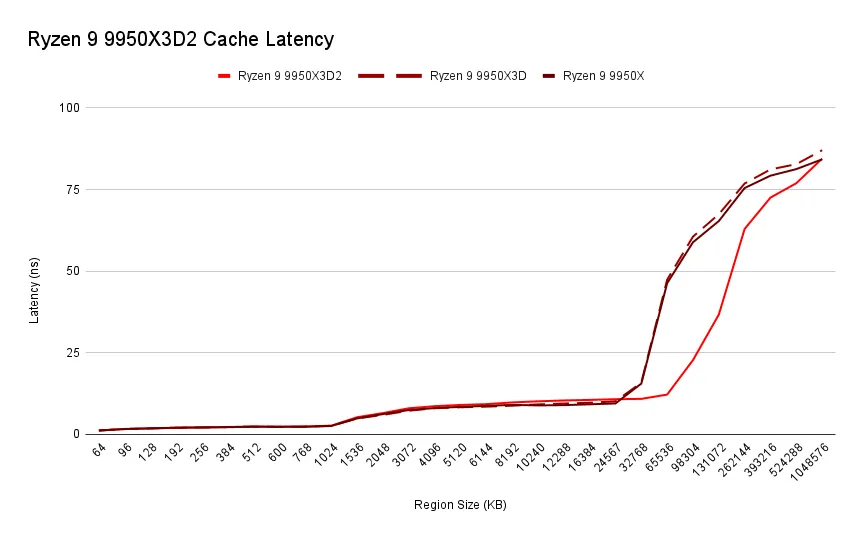
Now, we can look at our latency testing, which measures the time in nanoseconds when allocating different region sizes. Both the Ryzen 9 9950X3D and the non-X3D model see a big increase in latency past about 32 MB, which is the amount of L3 that’s actually on the CCD (the extra 64 MB is stacked for the Ryzen 9 9950X3D). The Ryzen 9 9950X3D2 extends that further, to around 64 MB.

This doesn’t translate directly into better performance, mind you. Lower latency is better performance, but we’re already looking at a truncated version of this chart, starting with a 64 KB region size. The benefits show up when you’re pushing past that normal 32 MB L3 chunk on a Zen 5 CCD.

Jake Roach

Jake Roach is the Senior CPU Analyst at Tom’s Hardware, writing reviews, news, and features about the latest consumer and workstation processors.

  • Gururu

    How was it decided to find a bunch of obscure benchmarks that are rarely used in CPU testing? Seems like a little voice whispered in someone's ear...

    Reply

  • Marlin1975

    Seems like a chip that with the right software will be a beast. I'm assuming since most is not written for this much cache its left spinning its wheels when it has more to go.

    Reply

  • yznc

    Admin said:

    The Ryzen 9 9950X3D2 is one of the most unique CPUs we’ve ever reviewed, and although its price feels like a kick in the gut, it offers some interesting, highly specialized improvements in certain workloads based on our testing.

    AMD Ryzen 9 9950X3D2 review: More cache, more cash : Read more

    Very nice and informative article! Can I get a clean pdf version for education use? Thank you!

    Reply

  • JakeRoach

    Gururu said:

    How was it decided to find a bunch of obscure benchmarks that are rarely used in CPU testing? Seems like a little voice whispered in someone's ear...

    It's the same list of benchmarks we use in every review, AMD and Intel.

    Reply

  • Gururu

    JakeRoach said:

    It's the same list of benchmarks we use in every review, AMD and Intel.

    Yes, I don't see anything wrong. It's just a little confusing on the SPECWorkstation 4 Benchmarks where if you compare the 270K review to this review, some tests seem different. Maybe they are just listed in a different order.

    Reply

  • TerryLaze

    Marlin1975 said:

    Seems like a chip that with the right software will be a beast. I'm assuming since most is not written for this much cache its left spinning its wheels when it has more to go.

    Cache is completely transparent (invisible) to apps, they either have enough data to fill the cache or they don't.
    You would need to invent an app that causes the problem of needing that much cache for it to use that much cache. (Which is what a lot of the benchmarks do, they use a lot more data (or at least coherent/fixed amount of data that never needs to change) than what a normal real world usage would be)

    Reply

  • zworykin

    Not "one of the most unique" CPUs you've reviewed. It's unique, or it isn't. There are no degrees of "more unique" or "less unique" - it's a binary concept.

    Reply

  • drea.drechsler

    "A terrible value, but one of the most unique...isn’t worth the money for the vast majority of people, but it was never meant to be. It’s a halo product.....one of the most unique .... ever reviewed, and although its price feels like a kick in the gut...."

    Sounds like summary statements appropriate to an Nvidia GPU reviews.

    Reply

  • qxp

    TerryLaze said:

    Cache is completely transparent (invisible) to apps, they either have enough data to fill the cache or they don't.
    You would need to invent an app that causes the problem of needing that much cache for it to use that much cache. (Which is what a lot of the benchmarks do, they use a lot more data (or at least coherent/fixed amount of data that never needs to change) than what a normal real world usage would be)

    No need to invent anything. If you just consider an app that at its core does FFT or vector arithmetic then as soon as the size of the data is larger than cache of 9950 but smaller than 9950X3D2 you will see a big difference in speed.

    The reason you don't quite see this in charts of this article is because most apps are in two categories - either they are written without much attention to performance, in which case they spend most time in CPU executing some byte code or inefficient loops and the extra cache does not matter.

    Or they have been well optimized and part of that optimization was to fit them into the cache of the CPUs they were designed for, and the case of my data is larger than cache was treated as a slow path.

    Reply

  • bit_user

    Thanks for the comprehensive benchmarks! I had always wondered how such a product would perform - now I know!

    In your intro, I didn't notice a reference to why AMD said they didn't offer this before. I'd have to go searching for it, but they've previously said they didn't think it would be cost-effective. It seems they were right.

    I'm glad to see very few regressions vs. the 9950X and 9950X3D, however. That means it's a safe buy for someone who wants the top AM5 multithreaded performer, if money is no object.

    Reply

Show more comments