





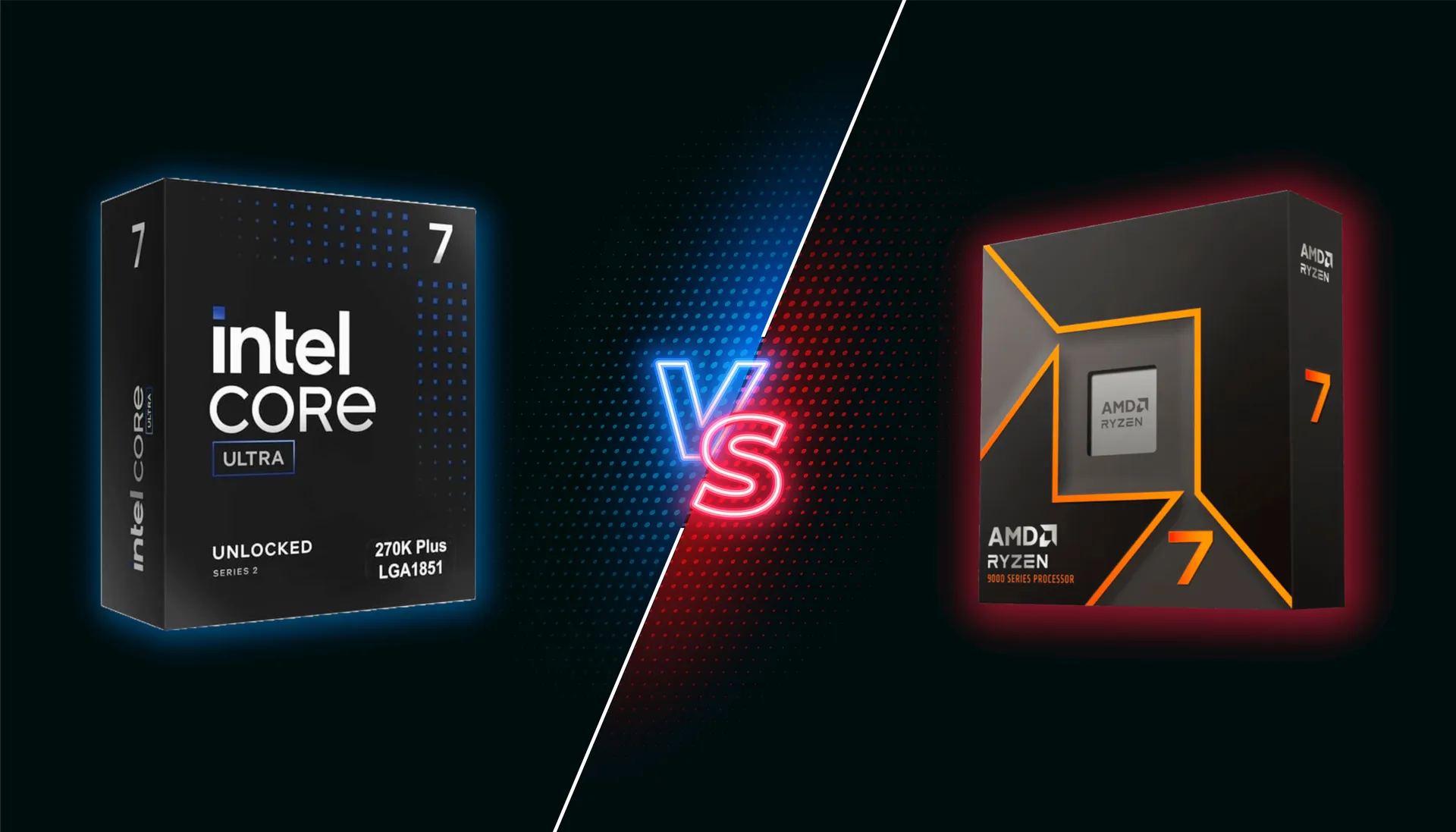
Intel’s Arrow Lake platform was a huge disappointment at launch. It barely managed to compete with its predecessor, Raptor Lake Refresh, in gaming performance, all while AMD’s X3D CPUs continued to dominate the rankings among the best CPUs for gaming. Intel responded with heavy price cuts, but the situation was too far gone by then.
Now, we have a new challenger. The Core Ultra 7 270K Plus has launched at a remarkable $300 price point, $100 cheaper than what the Core Ultra 7 265K launched at, all while showing big increases in gaming and productivity performance. Intel is trying (maybe desperately) to regain the ground it lost with the original Arrow Lake and succeeding.
Its competitor for today’s faceoff is the Ryzen 7 9700X. Although on paper it has a lot fewer cores than the Core Ultra 7 270K Plus, it is in the same price bracket as the Intel chip. This is a purchase decision potential buyers may face when they have $300-$350 to spend on a new CPU.
Let’s run these two CPUs through our rigorous six-round gauntlet to determine which CPU is truly the best, and if Intel has made a successful attempt at redemption.
Features and Specifications: Intel Core Ultra 7 270K Plus vs Ryzen 7 9700X
Swipe to scroll horizontally
CPU | Street (MSRP) | Arch | Cores / Threads (P+E) | P-Core Base / Boost Clock (GHz) | E-Core Base / Boost Clock (GHz) | Cache (L2/L3) | TDP / PBP or MTP | Memory |
|---|---|---|---|---|---|---|---|---|
Core Ultra 7 270K Plus | $330 ($300) | Arrow Lake Refresh | 24 / 24 (8+16) | 3.7 / 5.4 | 3.2 / 4.7 | 76MB (40+36) | 125W / 250W | DDR5-7200 |
Ryzen 7 9700X | $305 ($359) | Zen 5 | 8 / 16 | 3.8 / 5.5 | N/A | 40MB (8+32) | 65W / 88W (105W / 142W) | DDR5-5600 |
Under the hood, Arrow Lake Refresh is exactly what it sounds like. The Core Ultra 7 270K Plus is based on the same microarchitecture as the 265K, built using TSMC’s 3nm process. Intel has provided 24 total cores in the 270K Plus, split into 8 Lion Core P-cores and 16 Skymont E-cores. There is only one thread per core across all Arrow Lake CPUs, bringing the total thread count to 24.
Intel claims that the 270K Plus is not just a better binned Arrow Lake CPU, but rather a new wafer and product code. Nevertheless, the main difference between the 270K Plus and the 265K is the clock speed. The Core Ultra 7 270K can climb up to 5.4 GHz on the P-cores, while the E-cores can boost up to 4.7 GHz. Being a K-series SKU, the multiplier is unlocked, giving you full access to overclocking.
Core clocks aren’t too different, but uncore clocks have shifted a lot. Intel increased the die-to-die frequency by 900 MHz compared to stock Arrow Lake chips, as well as bumped the fabric frequency by 400 MHz.
The chip also supports DDR5 memory at 7200 MT/s and 20 lanes of PCIe Gen 5. There is a total of 76MB of cache on the chip, with 36MB of that being L3 cache. Intel has kept the same power limits for the 270K Plus as the previous Ultra 7 CPUs, with a TDP of 125W and MTP boosting to 250W. The CPU uses the same Intel LGA 1851 socket and is compatible with existing 800-series Intel motherboards.
Its competitor, the Ryzen 7 9700X, is also no slouch on the spec sheet. Based on the Zen 5 architecture and built on TSMC’s 4nm production process, the Ryzen 7 9700X is compatible with the AM5 socket and existing 800-series AMD motherboards. It uses AMD’s chiplet-based design with core complexes, which has been very successful in previous Ryzen CPUs.
The 9700X has 8 cores and 16 threads, with no P-core and E-core split. The CPU supports DDR5 memory at 5600 MT/s and provides 24 PCIe Gen 5 lanes. Although it does not have the ridiculous amount of L3 cache as its X3D siblings, it still has a respectable total of 36MB. AMD markets the 9700X with a TDP of 65W and an extended TDP of 105W.
The boost clock of the Ryzen 7 9700X is 5.5 GHz, which is exactly the same as the maximum turbo boost of the 270K Plus. All AMD Ryzen CPUs are unlocked, so you can overclock the Ryzen 7 9700X as well.
Comparing the two CPUs on paper is a bit complicated since their architectures and core layouts are so different. Intel clearly has the superior core/thread count and a slightly more modern underlying architecture. The clock speeds are very similar, but Intel supports higher-speed memory as standard. On the flip side, Intel has much higher power draw ratings.
⭐ Winner: Intel Core Ultra 7 270K Plus
While it is not possible to say which CPU is better just by looking at specs on paper, Intel clearly puts up a better showing in this round. The 9700X does provide more PCIe lanes and a lower TDP, but Intel wins out in almost all other categories.
Gaming Benchmarks and Performance: Intel Core Ultra 7 270K Plus vs Ryzen 7 9700X
We ran both CPUs through a gauntlet of games across a wide variety of genres to get a good idea of average performance. The 1080p resolution was chosen since it maximizes the CPU usage and allows us to see the difference between the two chips. We also used the GeForce RTX 5090 graphics card to minimize GPU bottlenecks. You can read our individual reviews of both the Core Ultra 7 270K Plus and the Ryzen 7 9700X to get a more in-depth analysis.
Image 1 of 23

Kicking things off with our 17-game 1080p performance geomean, the Core Ultra 7 270K Plus puts out an average FPS score of 162.2, leading the Ryzen 7 9700X’s average score by 2.4%. The gap between the two CPUs is slightly larger when looking at 1% lows. In our geomean, the Core Ultra 7 270K Plus scores 6.1% better 1% lows than the Ryzen 7 9700X. So far, so good for Intel.
Looking at individual benchmarks tells an interesting story. In A Plague Tale: Requiem at 1080p, the Core Ultra 7 270K Plus actually trails the Ryzen 7 9700X by 3.2% on average. However, the 1% low numbers are flipped, as the Core Ultra 7 270K actually has a 14% better result in this particular title. The trend returns to normalcy in Cyberpunk 2077, where the Core Ultra 7 270K is 8% faster in both average FPS and 1% low results.
Elsewhere, we saw wins for the Ryzen 7 9700X, including in F1 2024, where it leads by a noticeable 13% on average. The 9700X also crushed it in Minecraft, leading by 33% in average FPS. However, both CPUs were tied in 1% low results at exactly 57 FPS, which is a peculiar result. Arrow Lake CPUs broadly don’t play nicely with Minecraft with a maximum render chunk distance of 96.
The Core Ultra 7 270K Plus also saw some big wins. In Hitman 3, the new Intel chip scored a 13% lead over the Ryzen 7 9700X, while also being 7% faster in 1% lows. Hogwarts Legacy also favored Intel heavily, leading to a 12.4% better average FPS result for the 270K Plus in this game. Both of these games support Intel’s new iBOT feature, which improves gaming performance in select titles.
It is safe to say that the two CPUs trade blows when it comes purely to gaming performance. We also saw some results that were essentially tied, such as Monster Hunter Wilds, Final Fantasy XIV, TES Oblivion Remastered, and Baldur’s Gate 3. However, the Core Ultra 7 270K Plus slightly edges the Ryzen 7 9700X, delivering 2-3% better average gaming performance.
While gaming, the Core Ultra 7 270K Plus drew 107.7W, which is a big bump over the Core Ultra 7 265K. It is also 18% higher than the Ryzen 7 9700X, which drew an average of 87.8W while gaming. However, when we look at efficiency numbers calculated in FPS/W, the new Core Ultra 7 270K Plus is still 2.6% more efficient while gaming than the Ryzen 7 9700X. The temperatures of the two CPUs were not significantly different in our testing.
Intel has launched the Core Ultra 7 270K Plus at a very competitive $300 price point, and that favors it quite well in the value conversation. Calculating the value using FPS-per-dollar, the Intel CPU edges out the Ryzen chip by 5.5%. The $10 price premium of the Ryzen 7 9700X, combined with its marginally lower gaming performance, makes it a slightly worse value compared with the Intel Core Ultra 7 270K Plus.
⭐ Winner: Intel Core Ultra 7 270K Plus
Intel’s new CPU puts up an impressive showing in the gaming round of this faceoff. While the advantages are marginal, it provides slightly better gaming performance than the Ryzen 7 9700X at a lower price, though it consumes a bit more power.
Productivity Performance: Intel Core Ultra 7 270K Plus vs Ryzen 7 9700X
We also put the Core Ultra 7 270K Plus through its paces against the Ryzen 7 9700X in a series of productivity tasks. These tests cover both single-threaded and multi-threaded applications to give us a good idea of the general performance level of the two CPUs. While the Core Ultra 7 270K Plus clearly has way more cores, the comparison makes sense since both CPUs are very similar in price at the time of writing.
Image 1 of 11

We have a huge result for the new Core Ultra 7 270K Plus right off the bat when we look at our multithreaded performance ranking geomean. The Ultra 7 270K Plus delivers chart-topping multi-core performance in our testing, and leaves the Ryzen 7 9700X in the dust. Comparing the geomeans, the Core Ultra 7 270K Plus is a whopping 77% better than the Ryzen 7 9700X in our multi-core tests on average. That is almost double the productivity performance.
Looking at individual benchmark results, we see the Core Ultra 7 270K Plus take a gigantic 90% lead over the Ryzen 7 9700X in the Cinebench 2024 multi-core test. The POV-Ray test isn’t much better for the Red Team, as the Core Ultra 7 270K Plus has a staggering 127% higher score in this test. The lead is 74% in Blender Junkshop, 92% in V-Ray 6, and 73% in HandBrake x265 10-bit encoding test. You get the idea.
The driving force behind Intel’s dominance in this round is the superior core/thread count of the Core Ultra 7 270K Plus. While the Ryzen 7 9700X is quite a competent 8-core, 16-thread CPU, its core layout pales in comparison to the 24-core, 24-thread 270K Plus. You can argue that the 16 E-cores don’t really contribute a lot in performance, but you can’t really bet against raw core count when it comes to multithreaded productivity performance.
Image 1 of 6

Single-threaded performance also follows the same trend, though the differences are much less dramatic this time around. Our single-threaded performance ranking geomean still has the Core Ultra 7 270K Plus at the top of the pile, with an average 10% higher score than the Ryzen 7 9700X. It also improves upon the Core Ultra 7 265K by about 3.3%, which is a welcome bump in single-threaded performance.
Cinebench 2024’s single-core test puts the Core Ultra 7 270K Plus ahead of the Ryzen 7 9700X by 5.4%, while Cinebench 2026 sees the lead grow to about 7.8%. In the Lame Extended single-thread audio encoder, the Core Ultra 7 270K Plus was about 3% faster than the Ryzen 7 9700X to deliver the finished file. The POV-Ray chart shows the Intel CPU pulling ahead by a much larger margin of 36.2%, but that result seems to be more of an outlier.
With a standout lead in both multi-core and single-core performance, the Core Ultra 7 270K Plus should be the clear choice for consumers who are looking to use their PCs for both gaming and productivity. Frankly, the Core Ultra 7 270K Plus gives much more expensive CPUs in this category a tough time, making it an excellent value for productivity.
⭐ Winner: Intel Core Ultra 7 270K Plus
Thanks to its superior core count, the Intel Core Ultra 7 270K Plus absolutely dominates the Ryzen 7 9700X in our productivity benchmarks, taking home this round by a landslide.
Overclocking: Intel Core Ultra 7 270K Plus vs Ryzen 7 9700X
The Core Ultra 7 270K Plus ships with a 900 MHz bump in die-to-die clock speed compared to the Core Ultra 7 265K. This suggests that Intel has pretty much cranked all the knobs to the maximum straight from the factory. However, a unique new feature is that the bump in die-to-die frequency is now standard, and you don’t need a Z-series board to unlock it.
With a Z-series motherboard, you can get more granular in your overclocking. Intel has controls for core overclocking, of course, but also levers for uncore frequencies and official support for far higher memory speeds. Although the disappointment of Arrow Lake has stained its reputation, this generation introduced some of the deepest overclocking features we’ve ever seen, and they shine on the Core Ultra 7 270K Plus.
AMD’s Zen 5 chips still feature the same tried-and-tested overclocking suite, with the main focus on Precision Boost Overdrive 2 (PBO2) and Curve Optimizer. PBO2 allows users to let the CPU govern itself and adjust its frequencies based on available power and thermal headroom.
Curve Optimizer is another key feature that enables finer control. You can achieve even greater gains by fine-tuning the voltage offsets per core. This can often lead to sustained higher boost clocks without manually setting fixed high voltages or frequencies. While manual overclocking is still possible on Zen 5 CPUs, the best and most consistent results often come from Curve Optimizer and Precision Boost Overdrive 2.
While both CPUs offer unlocked multipliers, they take different approaches to overclocking. Intel’s approach offers slightly greater flexibility, and its CPUs traditionally have more overclocking headroom, though this is subject to the silicon lottery. AMD has better automated features, such as PBO, but overclocking gains are often minimal.
⭐ Winner: Intel Core Ultra 7 270K Plus
Both CPUs have compelling overclocking features, but Intel just edges it out in this round thanks to greater flexibility with its overclocking tools.
Power Consumption, Efficiency, and Cooling: Intel Core Ultra 7 270K Plus vs Ryzen 7 9700X
With the launch of Arrow Lake, Intel shifted its focus to efficiency, sacrificing some performance in the process. The Core Ultra 7 270K Plus takes things back slightly in the power consumption department, pushing the power limits for more performance. We’re using the default 65W TDP for the Ryzen 7 9700X here, though note its power consumption will increase significantly with its optional 105W TDP mode.
Image 1 of 13

Starting with idle power consumption, the Core Ultra 7 270K Plus consumes an average of 29 watts in this test, while the Ryzen 7 9700X is around 31% lower at 22 watts. The Core Ultra 7 270K Plus also consumes 4 more watts at idle than the Ultra 7 265K. When in an active idle state, such as YouTube playback, the Core Ultra 7 270K Plus spikes to 38 watts, a clear and noticeable 52% increase over the Ryzen 7 9700X.
Moving on to all-core workloads to gauge peak power consumption, the Core Ultra 7 270K Plus consumes a whopping 198% more power than the Ryzen 7 9700X in the y-cruncher multi-threaded AVX test. That largely comes down to Zen 5’s implementation of AVX-512, which allows the Ryzen 7 9700X to run these SMID-style instructions far more efficiently.
In Cinebench 2024’s multi-core render, the Core Ultra 7 270K Plus consumes around 160% more power than the Ryzen 7 9700X. Of course, as we saw earlier, the 270K Plus also delivers around 90% better performance than the Ryzen 7 9700X in this test, but the raw efficiency numbers still favor AMD.
Looking at a few more benchmarks, the same trend can be seen in Blender - Monster, where the Core Ultra 7 270K Plus consumes 151% more power than the 9700X. Interestingly, the new Arrow Lake Refresh CPU also demands 45% more power on average than the Core Ultra 7 265K, a significant difference. Between the 270K Plus and the Ryzen 7 9700X, the power demand gap is around 145% in HandBrake x265 encoding, 161% in HandBrake SVT_AV1, and 179% in Blender Classroom.
Image 1 of 3

We can also look at the performance-per-watt numbers from various benchmarks to gauge the efficiency of the two CPUs. First, in HandBrake x265 encoding, the Core Ultra 7 270K Plus is around 29% worse in watts-per-fps than the Ryzen 7 9700X. In Linpack, the efficiency gap narrows to around 10%, still in favor of the Ryzen 7 9700X. Cinebench 2024 also shows the points-per-watt calculation favoring the AMD chip by about 20%.
Image 1 of 3

Another neat way to visualize the power consumption difference is by a scatter plot, which shows the relationship between power and performance a bit more clearly. In the Linpack efficiency graph, the Core Ultra 7 270K Plus is plotted to the far bottom right, while the 9700X is a bit to the middle. This means that the 270K Plus delivers much better performance with only a slight increase in power draw.
The Blender Classroom scatter plot is much more interesting. While the 270K Plus is still plotted to the far right, it is much higher on the task energy axis this time around. The 9700X is almost at the bottom-left of the graph, making it much more efficient than the 270K Plus at this task, even though its performance is quite a bit lower.
The entire conversation about power consumption is quite interesting. On the one hand, the Ryzen 7 9700X is much more efficient and consumes much, much less power than the 270K Plus, but its overall performance level is also quite a bit lower. It almost seems like the two CPUs are not in the same class, but their price tags suggest otherwise.
⭐ Winner: AMD Ryzen 7 9700X
The AMD Ryzen 7 9700X consumes less than half the power on average than the Core Ultra 7 270K Plus, and is also more efficient in several tests, making it the clear winner in this round.
Pricing: Intel Core Ultra 7 270K Plus vs Ryzen 7 9700X
Intel has launched the Arrow Lake refresh CPUs at a very competitive price point. The $300 Core Ultra 7 270K Plus is almost $100 cheaper than the Core Ultra 7 265K when it launched. This puts it in the same ballpark as the Ryzen 7 9700X, which can be found at around $310 at the time of writing. However, comparing the prices of the two CPUs is not as straightforward as just comparing the numbers on the box.
To get a clearer idea of how much each CPU costs, we need to evaluate the total cost of the platform. While the Core Ultra 7 270K Plus is slightly cheaper up front, it may not be more affordable once we factor in the cost of other components such as RAM, a compatible motherboard, and a CPU cooler. Due to how recent the Core Ultra 7 270K Plus is, prices have shifted up toward $350, as well.
DRAM prices are absolutely ridiculous at the time of writing due to the global memory shortage, so the numbers here may change. Both CPUs are compatible with DDR5 memory, which is why this particular cost is shared. A decent 32GB (16x2) DDR5 memory kit running at 6000 MT/s at CL36 can run you about $350-$400 at current rates.
The pricing conversation becomes more interesting once we get to the motherboards. Intel’s LGA1851 platform offers multiple chipsets at different price points, but we would go with Z890 motherboards to take advantage of the unlocked multiplier. A basic Z890 motherboard is currently in the $200-300 range, but you can go with more feature-rich variants that can cost as much as $600 for the really fancy ones.
On the AMD side, the AM5 platform has matured a bit and is not quite as expensive as Intel. Our chipset of choice for the 9700X is the X670E, the top-of-the-line AM5 chipset for this generation. A basic X670E motherboard can be found in the $150-200 range, while a more competent offering can be in the $300-400 range, slightly less than Intel’s offerings. You can even go with a more affordable B-series motherboard and still take advantage of the 9700X’s overclocking capabilities.
For cooling, both CPUs need competent aftermarket solutions. For the 270K Plus, a high-end dual-tower air cooler ($100-120) or a 360mm AiO liquid cooler ($150-250) is recommended, given its higher power draw. You can get away with a 240mm AiO liquid cooler on the Ryzen 7 9700X ($80-150), but just to be on the safe side, investing in a 360mm AiO is not a bad idea.
Currently, AMD makes a much stronger case for total platform cost. It can be paired with more affordable motherboards without losing functionality, and it is also easier and cheaper to cool. Plus, it draws much less power, which can affect other purchasing decisions, such as the power supply.
Moreover, Intel’s LGA1851 is basically a dead-end platform. We do not expect another CPU release on this platform, which is a big factor in determining the overall value of this investment. On the flip side, AMD has committed to supporting the AM5 socket until at least 2027, which makes it much better from a longevity standpoint.
⭐ Winner: AMD Ryzen 7 9700X
While the Core Ultra 7 270K Plus is slightly cheaper up front, its total platform cost is higher, which makes it a difficult bargain. Socket LGA1851 is also on its last legs, which does not do the value proposition any favors.
Bottom Line: Intel Core Ultra 7 270K Plus vs Ryzen 7 9700X
Swipe to scroll horizontally
| Row 0 - Cell 0 | Intel Core Ultra 7 270K Plus | AMD Ryzen 7 9700X |
Features and Specifications | ❌ | Row 1 - Cell 2 |
Gaming | ❌ | Row 2 - Cell 2 |
Productivity Applications | ❌ | Row 3 - Cell 2 |
Overclocking | ❌ | Row 4 - Cell 2 |
Power Consumption, Efficiency, and Cooling | Row 5 - Cell 1 | ❌ |
Pricing | Row 6 - Cell 1 | ❌ |
Total | 4 | 2 |
With a dominant 4-2 lead in our six-round gauntlet, the new Intel Core Ultra 7 270K Plus decimates the Ryzen 7 9700X. Intel is seeking redemption with Arrow Lake Refresh, and they seem to have taken a step in the right direction with the 270K Plus.
The Ryzen 7 9700X put up a respectable showing in our gaming and productivity tests, but it was beaten in both rounds by the Core Ultra 7 270K Plus. The productivity numbers are particularly astonishing, as the gap is so big that you are almost forced to double-check the numbers.
The obvious caveat is power draw. Intel has increased the power draw of the 270K Plus quite significantly over the 265K. This also means that it consumes around 150-200% more power than the Ryzen 7 9700X in certain all-core workloads, though that gap shrinks if you plan on running the 9700X in its 105W mode. It is also a bit more costly once you factor in the price of the entire platform. Not to mention, the LGA1851 platform is on its way out with Nova Lake, which Intel says is on-track to launch this year.
Nevertheless, the Core Ultra 7 270K Plus has its place. It is a very competent $300 CPU that decimates most of our lineup in productivity, though it is still a bit behind the Ryzen X3D CPUs in gaming. As for the Ryzen 7 9700X, it seems overdue for a price cut, as it doesn't justify its $310 price tag when more compelling options are available at a similar price.
⭐ Winner: Intel Core Ultra 7 270K Plus