










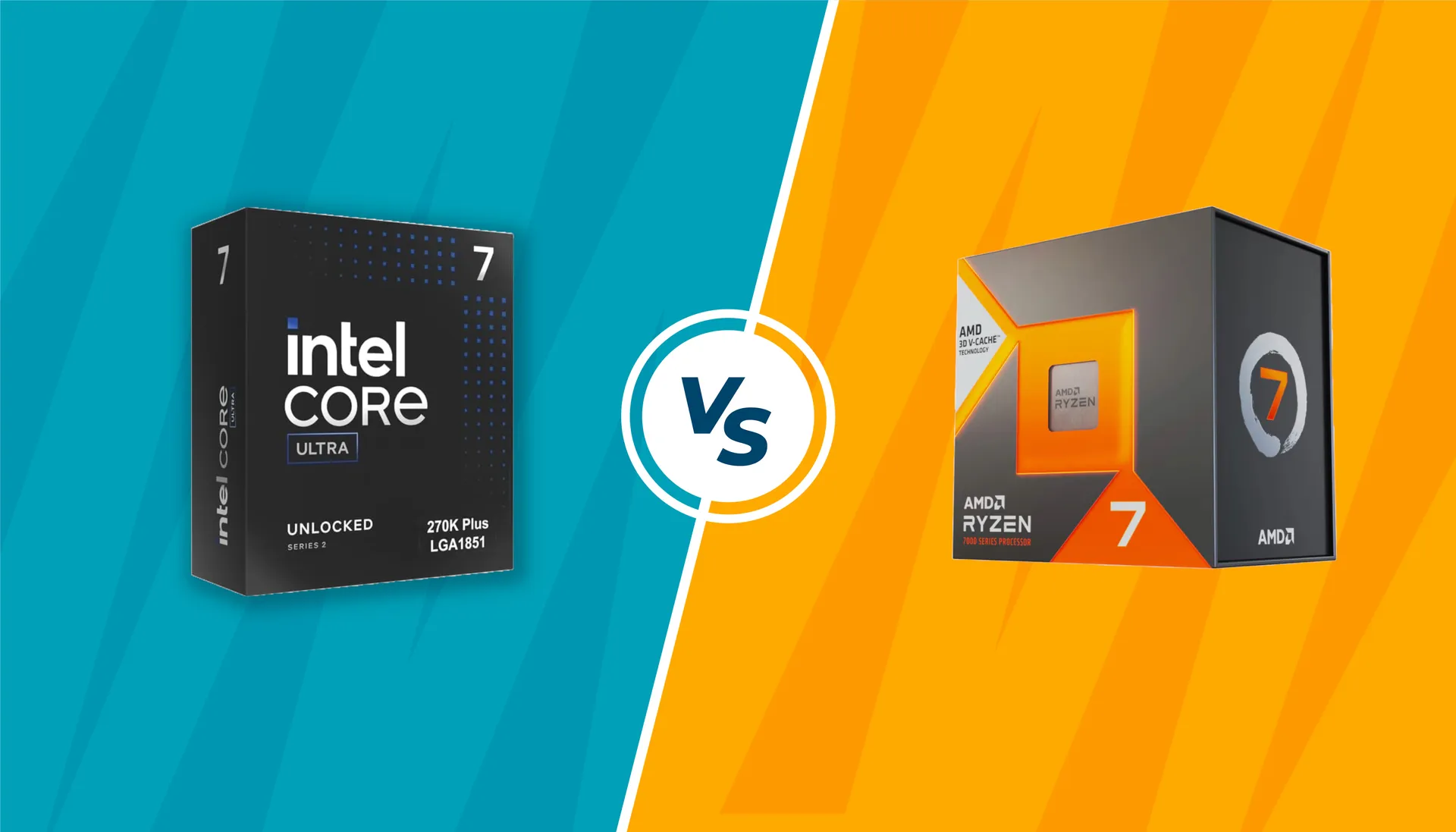
Arrow Lake fell far short of expectations from gamers and enthusiasts. It was a one-two punch for Intel, not only falling short of AMD’s competition on the X3D front in games, but also barely matching the regular Zen 5 range in applications.
Now, Intel is trying to make a big impact with Arrow Lake Refresh. Intel has launched the Core Ultra 270K Plus and 250K Plus at competitive price points in an effort to regain some of the ground they lost with Arrow Lake, and both chips have earned a spot among the best CPUs for gaming.
Even with a big leap forward, AMD holds the cards on the gaming front. Chips like the Ryzen 7 9850X3D rule the roost, and even the last-gen Ryzen 7 7800X3D is holding its own. Intel is catching up quickly, however, especially with the 270K Plus, and without access to the massive cache available on X3D chips.
Is the Ryzen 7 7800X3D still fast enough to beat the newly-launched Core Ultra 7 270K Plus? Or should you go for the newer Intel chip for its productivity benefits and advanced architecture? That is what we are going to uncover in today’s faceoff by putting these two CPUs through a gauntlet of tests based on the data from our CPU benchmark hierarchy.
If you’d like to compare these chips more broadly, make sure to read our Intel Core Ultra 7 270K Plus review and AMD Ryzen 7 7800X3D review.
Features and Specifications: Intel Core Ultra 7 270K Plus vs Ryzen 7 7800X3D
Swipe to scroll horizontally
CPU | Street (MSRP) | Arch | Cores / Threads (P+E) | P-Core Base / Boost Clock (GHz) | E-Core Base / Boost Clock (GHz) | Cache (L2/L3) | TDP / PBP or MTP | Memory |
|---|---|---|---|---|---|---|---|---|
Core Ultra 7 270K Plus | $330 ($300) | Arrow Lake Refresh | 24 / 24 (8+16) | 3.7 / 5.4 | 3.2 / 4.7 | 76MB (40+36) | 125W / 250W | DDR5-7200 |
Ryzen 7 7800X3D | $374($449) | Zen 5 | 8 / 16 | 3.8 / 5.5 | N/A | 40MB (8+32) | 65W / 88W (105W / 142W) | DDR5-5600 |
Arrow Lake Refresh is more of an iterative update than a radical rethink. Under the hood, the Core Ultra 7 270K Plus has the same architecture as the older Core Ultra 7 265K, with a few tweaks to the silicon. It is built using the same 3nm production process from TSMC, and contains 8 Lion Cove P-cores and 16 Skymont E-cores. The total count for the 270K Plus is 24 cores (8P+16E) and 24 threads in total, matching the higher-end 285K.
Intel also altered the clock speeds on the 270K Plus. The new chip can boost to 5.5 GHz on the P-Cores, with the E-Cores boosting to 4.7 GHz. Of course, you can manually overclock the CPU as well, given its unlocked multiplier. The bigger boost comes from uncore frequency, particularly in a 900 MHz boost in die-to-die frequency and a 400 MHz jump with the memory controller.
The 270K Plus has a total of 76MB of onboard cache, of which 36MB is L3 cache. It supports DDR5 memory at 7200 MT/s, and for connectivity, the 270K Plus provides 20 lanes of PCIe Gen 5. The power limits are the same as the standard Arrow Lake chips, with a TDP of 125W and an MTP of up to 250W. Socket compatibility is the same, so you can drop the 270K PLus into an 800-series motherboard with the LGA 1851 socket.
On the flip side, the Ryzen 7 7800X3D could not be more different on an architectural level. It is based on AMD’s Zen 4 architecture and built using TSMC’s 5nm process. It was launched in January of 2023 at $449, but it has seen some price cuts since then, with the chip now available around $375. The 7800X3D is compatible with the AM5 socket and 600-series chipset motherboards.
The 7800X3D is part of AMD’s X3D lineup of CPUs that employ 3D V-Cache technology. For this reason, it has a staggering 96MB of L3 cache compared to the 270K Plus’s 36MB. Unlike the 270K Plus, it does not feature a hybrid core layout, with just 8 cores and 16 threads without any division of P-cores and E-cores.
The chip can boost up to 5.0 GHz and has a base clock of 4.2 GHz. It also supports DDR5 memory exclusively, but has a lower rated speed at 5200 MT/s. AMD provides 24 PCIe Gen 5 lanes with the 7800X3D, along with integrated Radeon graphics. The TDP of the chip is 120W, and the PPT is set to 162W.
It is a bit difficult to compare the two CPUs based on specs alone when their underlying architectures are completely different. However, we can judge the metrics common to both, such as core count, clock speeds, and onboard cache. The only significant advantage that AMD brings to the table is its vast L3 cache; however, Intel pretty much wins in every other major category.
⭐ Winner: Intel Core Ultra 7 270K Plus
On paper, Intel puts up a better showing than AMD across several key categories, including core count, clock speeds, and memory support. The 7800X3D does have a few niche strengths, but they are not enough to win this round.
Gaming Benchmarks and Performance: Intel Core Ultra 7 270K Plus vs Ryzen 7 7800X3D
For this face-off, we tested both CPUs across 17 games spanning a variety of genres. This allowed us to get a good idea of how each CPU performs in gaming, and what its respective strengths and weaknesses are. We chose to test at 1080p with the RTX 5090 to avoid any GPU-imposed bottlenecks.
Image 1 of 22
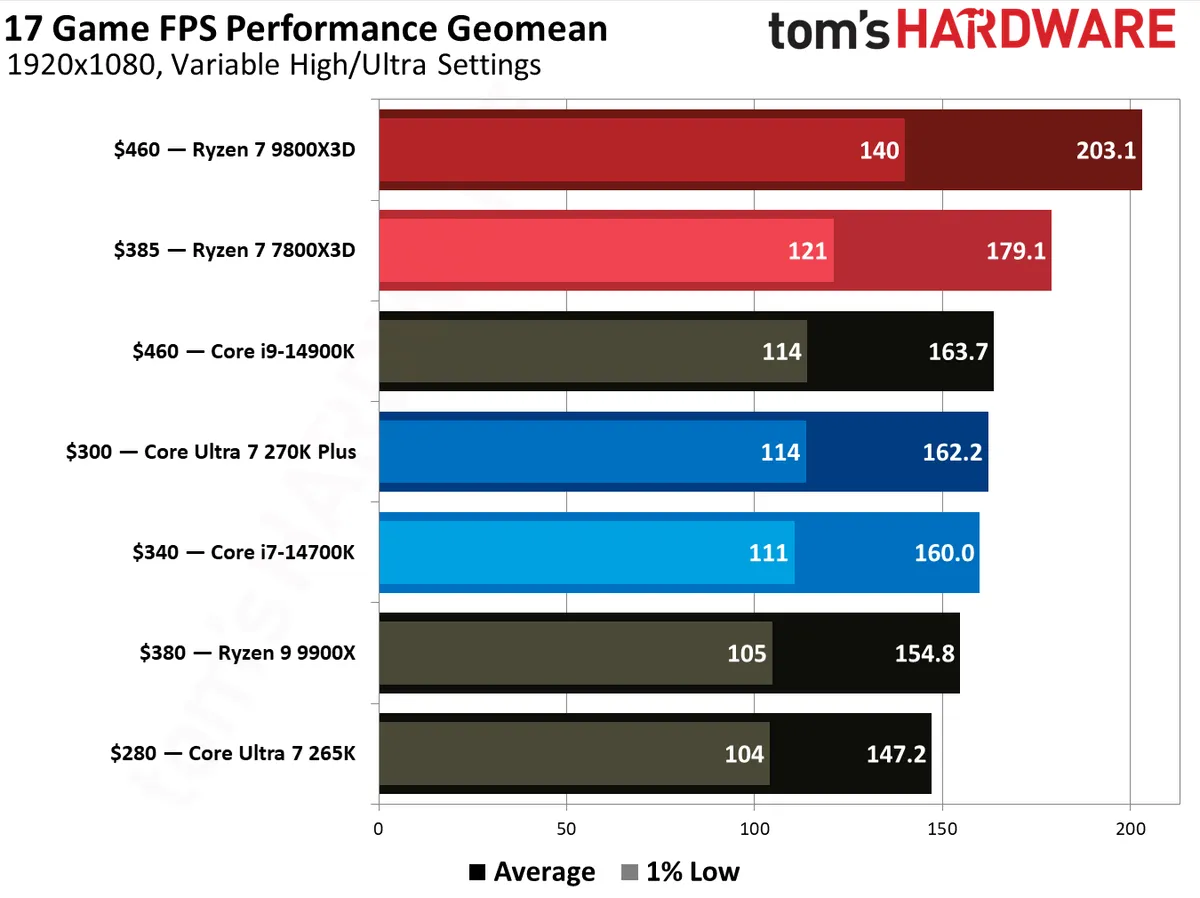
In our 17-game geomean, which averages performance across all our tested titles, the Ryzen 7 7800X3D is the clear winner, with the Ultra 7 270K Plus a close second. The Ryzen 7 7800X3D leads the Core Ultra 7 270K Plus by 10.4% on average across all tested titles. The Ultra 7 270K Plus does well in this ranking compared to non-X3D Ryzen chips or its older Intel counterparts.
Staying on this chart and analyzing it a bit more, we can see that the Ryzen 7 7800X3D also leads the pack in 1% lows, which measures framerate stability and consistency of frametimes. It is a measure of how smooth your gameplay experience is likely to be, and the Ryzen 7 7800X3D leads the Core Ultra 7 270K Plus by 6.1% on average in 1% lows.
We get a better sense of the two CPUs' gaming prowess by looking at individual titles. On average, the Ryzen 7 7800X3D leads the Core Ultra 7 270K Plus by 8% in A Plague Tale: Requiem, 22% in Baldur’s Gate 3, and 5% in Cyberpunk 2077. Its biggest victories come in F1 2024 with a 34% lead, Final Fantasy XIV with a 24% lead, and Minecraft RT with a substantial 76% lead.
The Core Ultra 7 270K Plus also fights back in some titles, essentially tying the average FPS of the Ryzen 7 7800X3D in DOOM: The Dark Ages, Flight Simulator 24, Monster Hunter Wilds, Spider-Man 2, and The Last of Us Part 1. It also manages to flip the script in Hogwarts Legacy, with a nice 5.6% lead over the 7800X3D in average FPS due to that game’s support for Intel’s Binary Optimization Tool.
We also see some interesting frametime inconsistencies in some titles that paint the Core Ultra 7 270K Plus in a positive light. In A Plague Tale: Requiem, while being 8% behind on average FPS, the 270K Plus provides essentially identical 1% lows. The same can be seen in Baldur’s Gate 3, and it even manages to provide 6% better 1% lows in TES Oblivion Remastered, while having a slightly lower average score.
In our tests, the Ryzen 7 7800X3D drew an average of 70.5 watts while gaming. The Core Ultra 7 270K Plus is quite power hungry, as you might have gathered from our review, and it consumed 107.7 watts while gaming, a 52.7% worse result. This affects the efficiency numbers of the Core Ultra 7 270K Plus quite a bit, as seen in the FPS-per-watt figures. The Ryzen 7 7800X3D is the efficiency king, leading the Core Ultra 7 270K Plus by 68% in FPS/W.
The value conversation is quite interesting, despite the 7800X3D’s better average performance and lower power draw. At the time of writing, it costs around $365, which is about 22% more than the Core Ultra 7 270K Plus. If we calculate the FPS-per-dollar figure, the Core Ultra 7 270K Plus actually comes out on top, providing 10% better value than the 7800X3D.
This makes the comparison a bit more nuanced than it initially seems. The Ryzen 7 7800X3D offers better average gaming performance, and it may consume a bit less power, but the Core Ultra 7 270K Plus just has a better price-to-performance ratio. It comes down to the buyer's preference whether the additional price is worth paying.
⭐ Winner: AMD Ryzen 7 7800X3D
Although the Core Ultra 7 270K Plus makes a strong case for itself with its excellent value proposition, it does still lose to the Ryzen 7 7800X3D in raw gaming performance, which is the focus in this round.
Productivity Performance: Intel Core Ultra 7 270K Plus vs Ryzen 7 7800X3D
The X3D processors from AMD have never been the best at application performance, and Intel has maintained its application performance while gaming slipped. The Core Ultra 7 270K Plus pushes that idea further. It is a productivity monster at a competitive price. Therefore, our productivity test suite can serve as the proving ground for Intel to get back into the race. We tested both CPUs in a host of productivity benchmarks, both single-threaded and multi-threaded.
Image 1 of 11
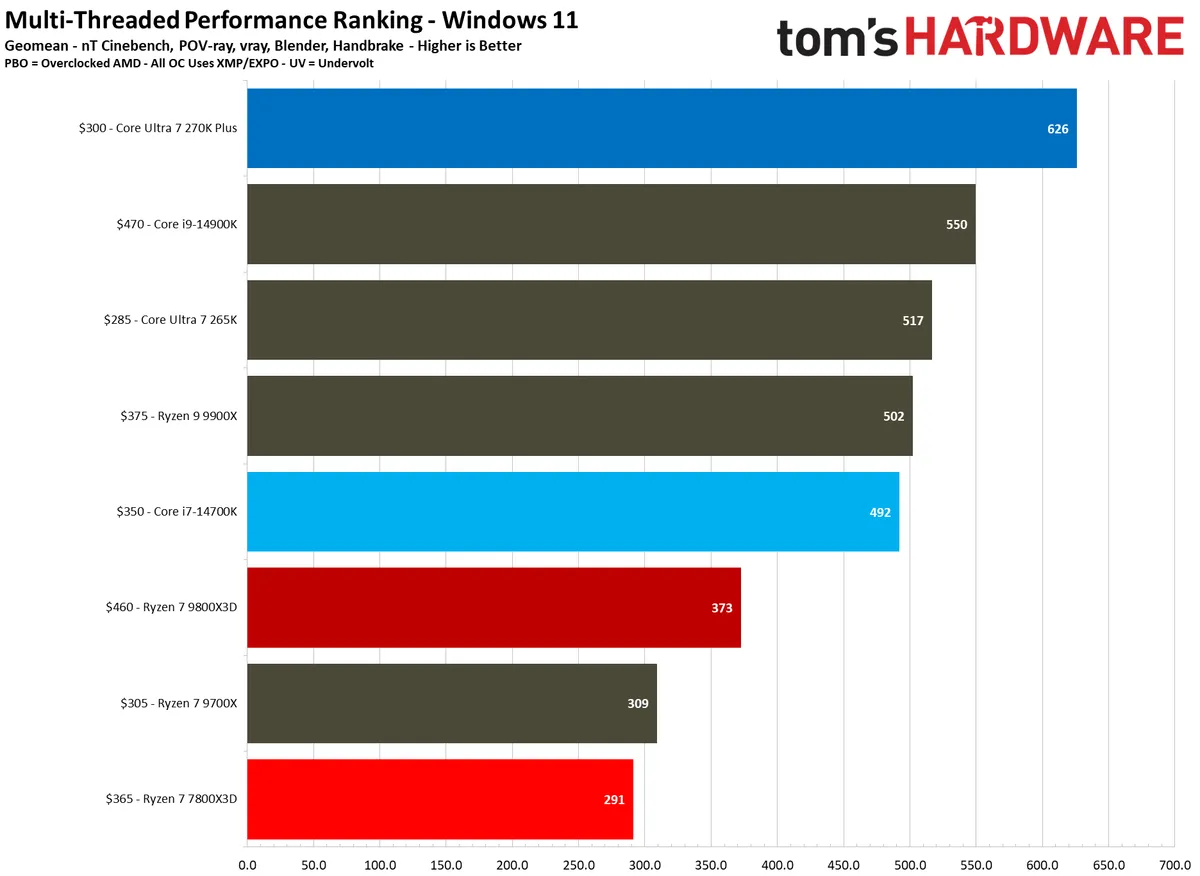
The difference in multithreaded performance comes mainly from the 270K Plus's superior core count. While the 7800X3D is a respectable last-gen chip with an 8-core, 16-thread configuration, it is simply no match for the 270K Plus's 24 total cores. On top of that, the Arrow Lake Refresh CPU has a more modern architecture, which can translate to even superior per-core performance.
We get a clearer picture of the Core Ultra 7 270K Plus’s dominance in multi-core scenarios when we look at individual benchmarks in more detail. In the Cinebench 2026 multi-core test, the Core Ultra 7 270K Plus decimates the competition with a gigantic 122% lead over the Ryzen 7 7800X3D. We see a similar pattern in V-Ray 6 with a 117% lead, LuxMark CPU C++ with a 139% lead, and Blender Monster with a 116% performance uplift over the 7800X3D.
The 7800X3D makes up some ground in other benchmarks, such as DAV1D video decoding, where it trails the 270K Plus by 28%. It also lags behind the 270K Plus by only 4% in Adobe Premiere Pro RAW Codec processing, but these results are few and far between. For the most part, the Core Ultra 7 270K Plus is in a completely different realm than the Ryzen 7 7800X3D.
Image 1 of 8
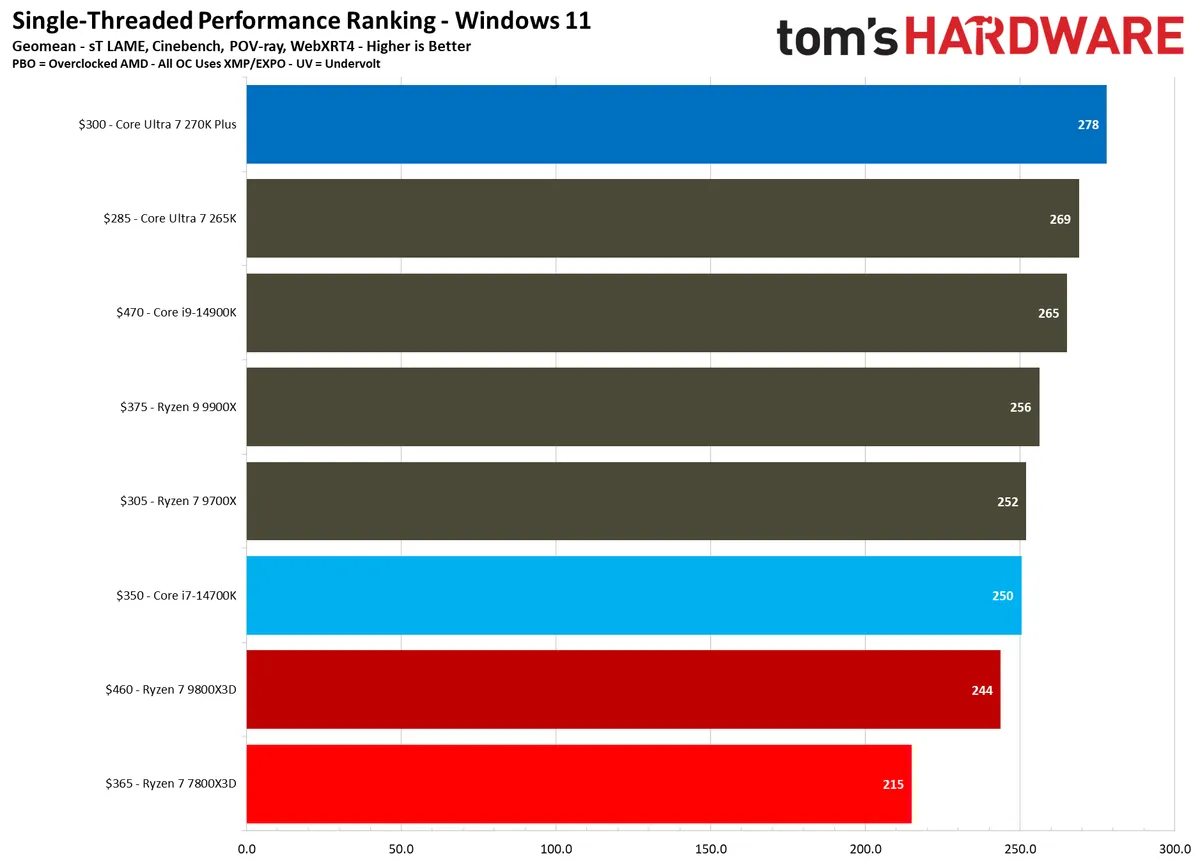
It is also important to look at per-thread performance to better understand how they perform on tasks that don’t scale well across multiple cores. In our single-threaded performance ranking geomean, the Core Ultra 7 270K Plus still holds a substantial 29% lead over the Ryzen 7 7800X3D. We’re normally dealing in single-digit margins for single-threaded performance, so that’s a massive jump forward.
In Cinebench 2024’s single-core test, the Core Ultra 7 270K Plus leads by 27% over the 7800X3D. The lead is 64% in POV-Ray’s single-core test, and it stays more-or-less in this range in all the single-threaded benchmarks we ran. Evidently, the Core Ultra 7 270K Plus is just a superior productivity chip and should be the clear choice in this budget if you want a multi-purpose CPU.
⭐ Winner: Intel Core Ultra 7 270K Plus
The Core Ultra 7 270K Plus blows the competition out of the water with its excellent productivity performance on all fronts. It more than doubles the performance you get from the Ryzen 7 7800X3D across most workloads. While the power draw might be something to keep an eye on, the Core Ultra 7 270K Plus is the obvious pick for productivity-focused machines, even when compared against chips that cost hundreds more.
Overclocking: Intel Core Ultra 7 270K Plus vs Ryzen 7 7800X3D
AMD’s X3D CPUs on the Zen 4 platform are traditionally limited in overclocking capabilities. While they support Curve Optimizer and Precision Boost Overdrive 2, they do not have an unlocked multiplier, and the Ryzen 7 7800X3D is no exception. You can’t manually overclock it. You’re limited only to PBO, which is a powerful tool, but nowhere near as granular as what you can achieve with a manual, tuned overclock.
Intel’s Arrow Lake Refresh CPUs, on the other hand, are equipped with Intel’s latest overclocking features. The Core Ultra 7 270K Plus is a fully unlocked K-series SKU that can be tuned using various methods. The unlocked multiplier allows users to manually tune the CPU on a per-core basis, adjusting settings like voltage and power limits.
With the Core 200 Plus series, Intel introduced a feature called iBOT, or Intel’s Binary Optimization Tool. This feature can squeeze even more performance out of the CPU, acting as a translation layer that optimizes instructions to better leverage a particular architecture. It may not be like traditional “overclocking”, but you can’t say no to free performance. iBOT is still in its early stages, and although it holds a lot of promise, the feature alone isn’t winning Intel this round. The vast suite of overclocking features available to all Arrow Lake CPUs is what gives Team Blue the edge.
All in all, Intel’s Core Ultra 7 270K Plus is just more overclocking-friendly and offers way more performance-enhancing features. The Ryzen 7 7800X3D is limited in its capabilities, and the first-generation 3D V-cache design creates several thermal challenges that make overclocking difficult.
⭐ Winner: Intel Core Ultra 7 270K Plus
The Ryzen 7 7800X3D has a locked multiplier and faces thermal challenges due to its 3D V-Cache, while the Core Ultra 7 270K Plus is fully unlocked and offers some cool new performance-enhancing features. This round goes to Intel.
Power Consumption, Efficiency, and Cooling: Intel Core Ultra 7 270K Plus vs Ryzen 7 7800X3D
Intel has cranked all the knobs up to 11 with Arrow Lake Refresh, which means squeezing more performance at the cost of a big increase in power consumption. That’s the trend we see clearly in our power consumption benchmarks: the Core Ultra 7 270K Plus not only consumes more power on average than the Ryzen 7 7800X3D, but also than the Core Ultra 9 285K.
Image 1 of 13
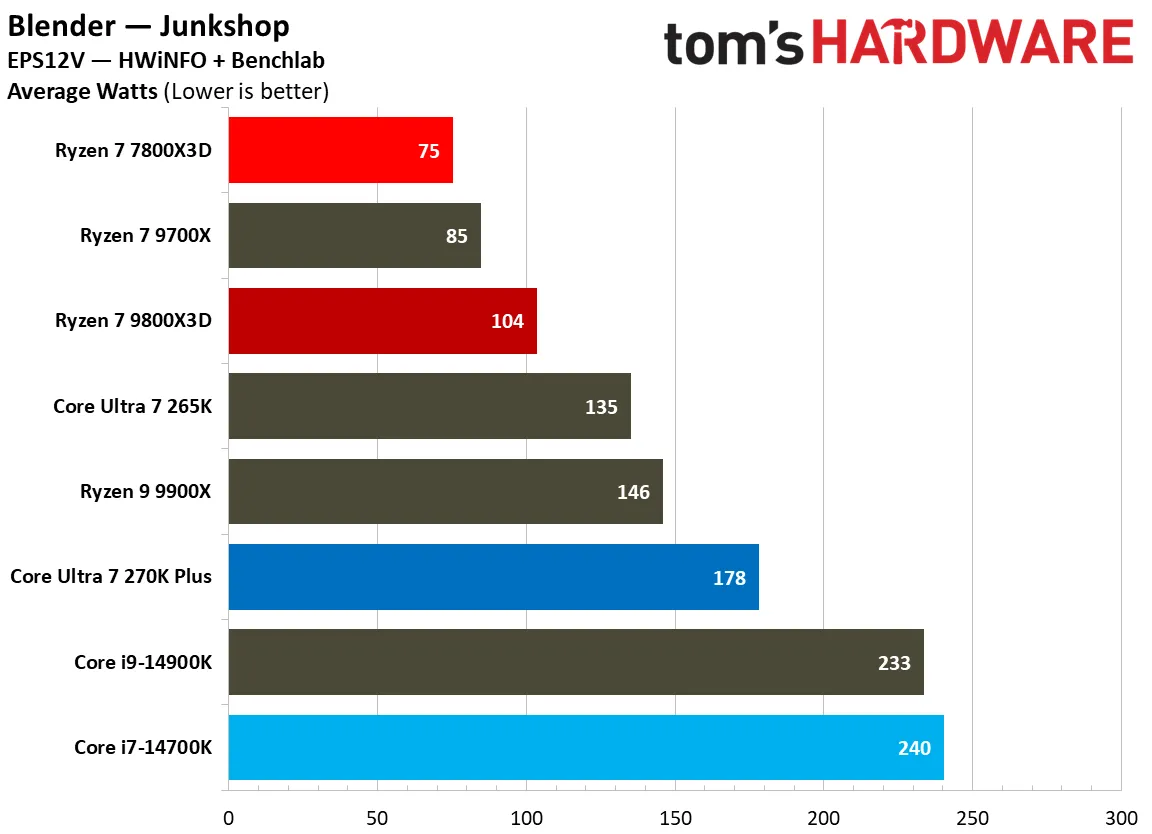
Starting this round with idle power consumption, the Core Ultra 7 270K Plus consumes 29 watts on average, the highest among the CPUs tested. It is 4 watts (or 13%) higher than the 25 watts consumed by the 7800X3D. In an active-idle scenario like YouTube playback, we see the Core Ultra 7 270K Plus pull further away from the stack. At 38 watts during this test, it is 35% more power-hungry than the Ryzen 7 7800X3D while running background tasks.
Moving on to more hard-hitting benchmarks that stress all cores and give us an idea of peak power consumption, we see the Core Ultra 7 270K Plus consume a staggering 175% more power than the Ryzen 7 7800X3D in Cinebench 2024’s multi-core render. The lead is 193% in HandBrake Power SVT_AV1 all-core test, and 219% in the y-cruncher multi-threaded AVX test.
We see similar margins in the HandBrake Power x264 test, where the Core Ultra 7 270K Plus consumes 187% more power than the 7800X3D. Power consumption increases by 137% in Blender Junkshop and by 182% in Linpack. The vast difference in power consumption gives us a clear idea of the sacrifices Arrow Lake Refresh had to make to achieve its superior performance.
Image 1 of 4
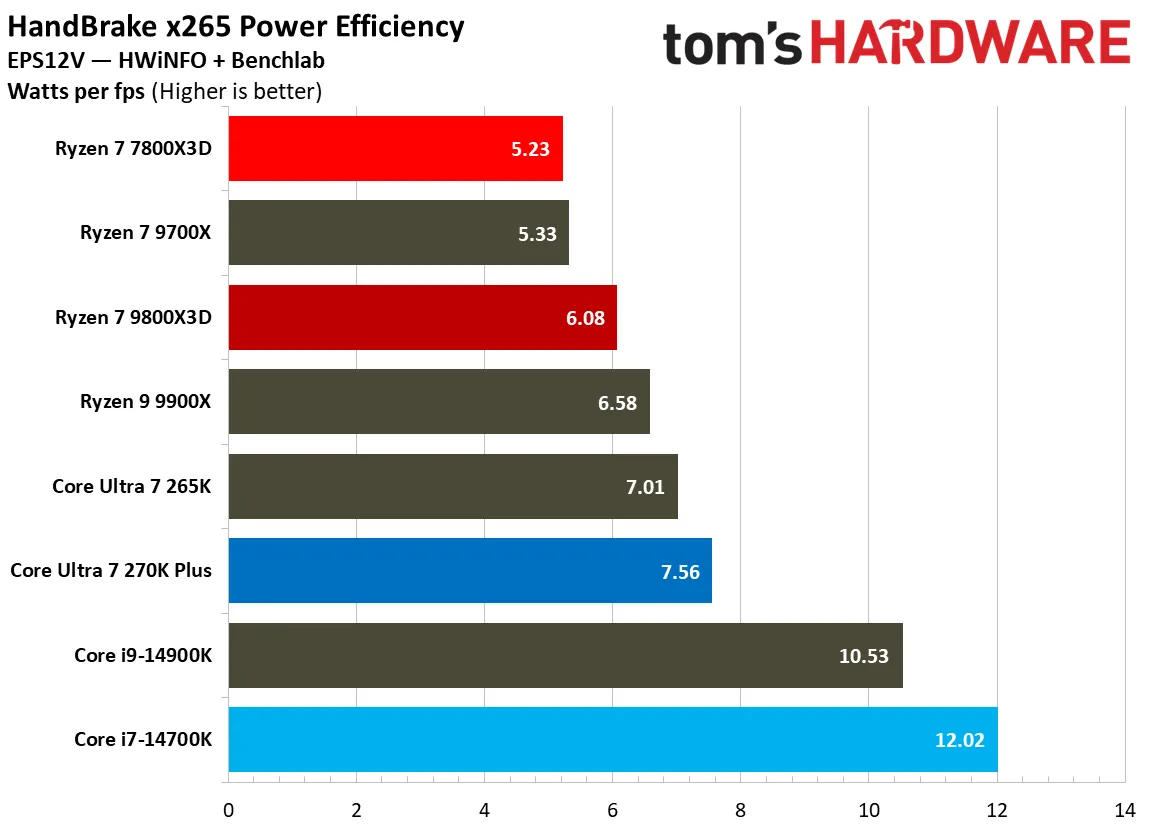
The 270K Plus may be a power-hungry CPU, but raw power consumption figures don’t give us a good sense of the chip's overall efficiency. For that, we look at the watts-per-fps graph in HandBrake x265, where the Core Ultra 7 270K Plus is 44.5% less efficient than the Ryzen 7 7800X3D. Looking at watts-per-point in Cinebench 2024, the Core Ultra 7 270K Plus again trails the Ryzen 7 7800X3D by 17.4% in efficiency. In Linpack, the 7800X3D provides 7% more GFLOPs per watt-hour than the Core Ultra 7 270K Plus. At least at the peak of power consumption, the Core Ultra 7 270K Plus is clearly less efficient.
Image 1 of 3
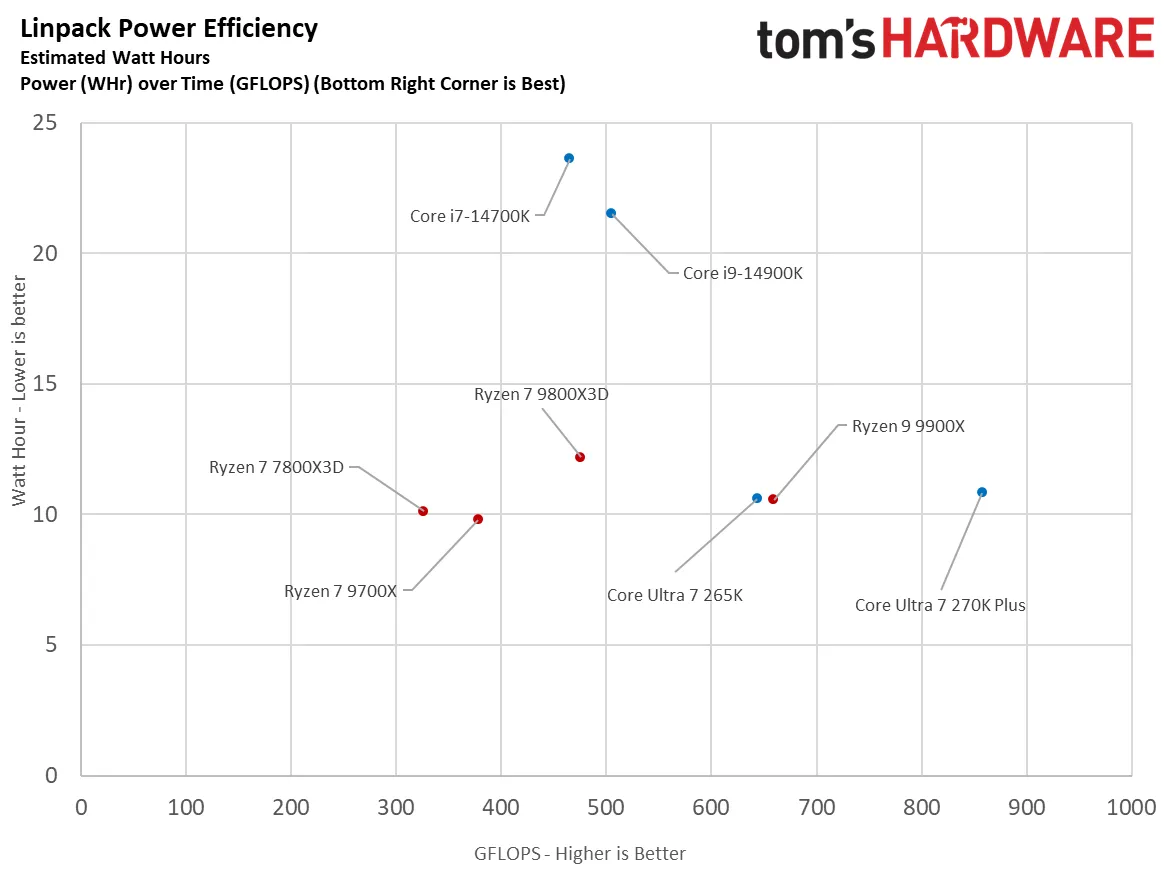
While these results give us a good idea of which CPU is more efficient, a better way to visualize the disparity is through a scatter plot. These graphs plot performance against task energy, providing a visual sense of efficiency. In these graphs, the bottom-right corner is where the most efficient CPUs are located.
In the HandBrake x265 power efficiency scatter plot, the Ryzen 7 7800X3D is located more towards the bottom left, while the Core Ultra 7 270K Plus is farther to the right and higher. This means that while the 7800X3D consumes less power, it also delivers way less performance than the Core Ultra 7 270K Plus in this task.
The disparity is on full display in the Blender Classroom scatter plot, where the Core Ultra 7 270K Plus and the Ryzen 7 7800X3D are almost on opposite ends of the chart. This visualizes the sheer difference in power consumption and performance between the two CPUs.
⭐ Winner: AMD Ryzen 7 7800X3D
The Ryzen 7 7800X3D consumes less than half the power in most of our tests, and is more efficient in a few tests as well. While the Core Ultra 7 270K Plus has superior productivity performance, that is not enough for a victory in this round.
Pricing: Intel Core Ultra 7 270K Plus vs Ryzen 7 7800X3D
The pricing conversation surrounding the Core Ultra 7 270K Plus and the Ryzen 7 7800X3D is very interesting. At first glance, the Core Ultra 7 270K Plus is around $65 cheaper than the Ryzen 7 7800X3D at the time of writing. So, case closed, Intel wins, right? Well, not exactly. To judge the two CPUs fairly, we must consider the price of the entire platform.
Both the Core Ultra 7 270K Plus and the Ryzen 7 7800X3D support only DDR5 memory, so this is not a factor that differentiates the two. At the time of this faceoff, the global DRAM shortage is in full swing, making DDR5 memory prohibitively expensive. A decent 32GB (16x2) DDR5 kit at 6000 MT/s CL36 costs about $350-400 right now, which is a bit ridiculous. However, the important thing is that this factor cancels out between the two CPUs we are comparing.
Since we have an unlocked K-series SKU in the Core Ultra 7 270K Plus, we need a Z890 motherboard to fully utilize this CPU. A basic Z890 motherboard can be had for around $200-300, but you can even go with more feature-rich options that can run you north of $600.
On the flip side, the AMD X670E motherboards are slightly more affordable while providing a similar feature set. These boards can start as low as $150, but you should go for a more reasonable option at $200-250 to avoid missing out on key features. However, you can also get a B650 motherboard and save an extra $50-100, depending on the model. AMD supports overclocking on B-series chipsets, and since you can’t manually overclock the 7800X3D anyway, you don’t need to spring for a high-end board.
We must also consider the cooling differences between the two CPUs. Given its higher power draw, the Core Ultra 7 270K Plus needs a beefier cooling solution. A dual-tower air cooler ($100-120) or a 360mm AiO liquid cooler ($150-250) is more appropriate for the Core Ultra 7 270K Plus, while the Ryzen 7 7800X3D can be paired with a 240mm AIO ($80-150) without any significant issues. The Core Ultra 7 270K Plus isn’t as power-hungry as something like the Core i9-14900K, so you don’t need to resort to top-shelf cooling.
A key point in AMD's favor in this scenario is its platform longevity. The AM5 platform is here to stay, as AMD has confirmed, and it plans to support this socket at least through 2027. Intel, on the other hand, has made no such promises, and with Nova Lake-S just around the corner, the LGA 1851 socket seems to be on its last legs.
This makes the Core Ultra 7 270K Plus essentially a dead-end platform. You can choose the Ryzen 7 7800X3D on an X670 motherboard, and then easily upgrade to a Zen 6 CPU in the future without changing your motherboard or RAM. This does not look likely on Intel’s platform, which diminishes its overall value proposition.
Putting all these factors together, the Ryzen 7 7800X3D offers better value overall, despite a slightly higher sticker price at the time of writing. Its motherboards are cheaper, it can run comfortably with lower-cost cooling solutions, and it offers a better path for future upgrades. The Core Ultra 7 270K Plus is a fantastic choice, but it carries with it the baggage of the LGA 1851 socket.
⭐ Winner: AMD Ryzen 7 7800X3D
The Ryzen 7 7800X3D might be a bit more expensive up front, but its lower platform costs and better upgrade potential give it the edge in this round.
Bottom Line: Intel Core Ultra 7 270K Plus vs Ryzen 7 7800X3D
Swipe to scroll horizontally
| Row 0 - Cell 0 | Intel Core Ultra 7 270K Plus | AMD Ryzen 7 7800X3D |
Features and Specifications | ❌ | Row 1 - Cell 2 |
Gaming | Row 2 - Cell 1 | ❌ |
Productivity Applications | ❌ | Row 3 - Cell 2 |
Overclocking | ❌ | Row 4 - Cell 2 |
Power Consumption, Efficiency, and Cooling | Row 5 - Cell 1 | ❌ |
Pricing | Row 6 - Cell 1 | ❌ |
Total | 3 | 3 |
After our rounds, it's a tie between the Ryzen 7 7800X3D and Core Ultra 7 270K Plus. Both are excellent CPUs, and the choice between them really comes down to your use case. That means crowning a winner here is up to you, but keep in mind that the choice could flip if you use particular applications.
Overall, the Core Ultra 7 270K Plus is our winner. That's because it trades a touch of gaming performance for application performance that leapfrogs not only the Ryzen 7 7800X3D, but also most of AMD's Zen 5 lineup. It's a balanced CPU, offering excellent performance in productivity apps and games in equal stride.
The Ryzen 7 7800X3D, on the other hand, is specialized. It's squarely focused on gaming, and if that's all you're concerned about, it's the clear winner. Not only do you get in edge in frame rates, you also gain the advantage of the AM5 platform and future upgrade potential.
⭐ Winner: Tie