






The US Supreme Court gave the Trump administration two major wins in immigration cases on Thursday, as a myriad of major decisions are set to come down.
The first decision allows the government to turn away asylum seekers when officials deem the US-Mexico border crossings too overburdened to handle additional claims.
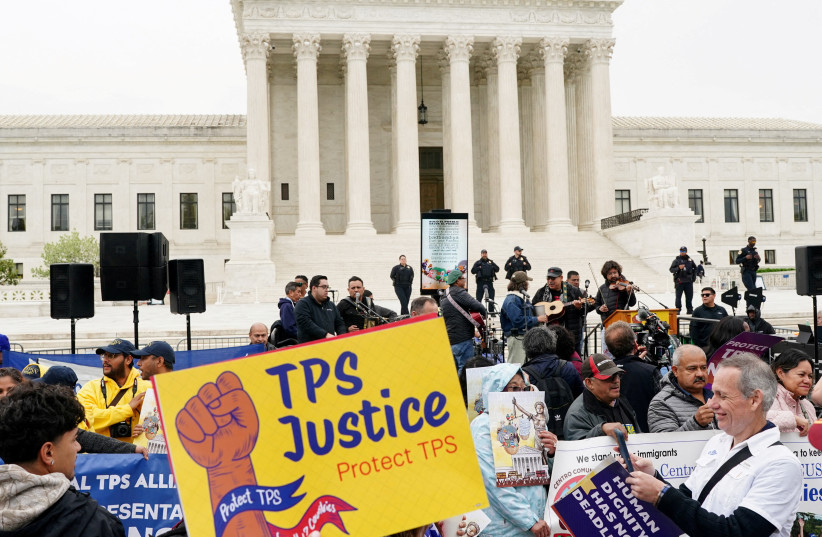
The second ends protected status for hundreds of thousands of Haitian and Syrian immigrants who are under a humanitarian status that protects them from deportation.
Both rulings were 6-3, decided by the court's conservative supermajority.
SCOTUS sides with Trump in asylum-processing case, allows Trump to restart metering policy
In the first decision, the court overturned a lower court's finding that the metering policy violated federal law. The Trump administration has said it may seek to revive the policy after it was dropped by Trump's predecessor, Joe Biden.
The metering policy allowed US immigration officials to stop asylum seekers at the border and indefinitely decline to process their claims. It is separate from a sweeping policy to deny entry to asylum seekers at the border that Trump announced after returning to the presidency last year. That policy also faces an ongoing legal challenge.
Under US law, a migrant who "arrives in the United States" may apply for asylum and must be inspected by a federal immigration official. The legal issue in the current case is whether asylum seekers who are stopped on the Mexican side of the border have arrived in the United States.
US immigration officials began turning away asylum seekers at the border in 2016 under Democratic former President Barack Obama amid a migrant surge. The metering policy was formalized in 2018 during Trump's first term in office, with border officials authorized to decline to process asylum claims when the government determines it is unable to handle additional applications. Biden rescinded the policy in 2021.
The Trump administration has said it would likely resume metering "as soon as changed border conditions warranted that step," without providing specifics. Trump has pursued hardline immigration policies since returning to office last year.
The advocacy group Al Otro Lado launched the long-running legal challenge in 2017. The San Francisco-based 9th US Circuit Court of Appeals in 2024 ruled that federal law requires border agents to inspect all asylum seekers who "arrive" at designated border crossings, even if they have not yet crossed into the United States, and the metering policy violated that obligation.
The Trump administration, in its legal defense of the policy, argued that the words "arrive in" refer to "entering a specified place, not just coming close to it."
In the majority opinion, Justice Samuel Alito wrote that: "In ordinary speech, no one would say that a person 'arrives in' a place — for example, a house, a city or a country — before the person enters that place.
"The context in which the phrase 'arrives in the United States' is used in the immigration statutes at issue here supports an ordinary-meaning reading."
“We hold that an alien who is standing in Mexico does not ‘arriv[e] in the United States’ by attempting, and failing, to set foot in this country. An alien ‘arrives in the United States’ only when he crosses the border,” Alito wrote.
Justice Sonia Sotomayor, along with the court's two other liberal justices, slammed the decision in her dissent.
"The consequences of today’s decision are predictable. More people will die," she wrote with Justices Kagan and Brown Jackson.
“If the refugees on the MS St. Louis were to walk up to a port of entry on our southern border today, the majority’s interpretation would allow immigration officers to refuse even to consider their asylum applications by physically blocking them from stepping foot onto US soil," the dissenting opinion reads.
SCOTUS ends deportation protections for Haitians, Syrians
In the second case, the court overturned decisions by federal judges in New York and Washington, DC, that had halted the administration's actions terminating Temporary Protected Status, or TPS, for more than 350,000 people from Haiti and 6,100 from Syria.
TPS is a designation that allows migrants from countries stricken by war, natural disaster, or other catastrophes to live and work in the United States while it is unsafe for them to return to their home countries. The United States first provided TPS to Haitians after a major earthquake in 2010 and to Syrians after their country descended into civil war in 2012.
Conservative Justice Samuel Alito, who authored the ruling, wrote that courts cannot review the administration's decisions concerning TPS, a decision that could doom legal challenges going forward on the revocation of this status for any country.
The law governing TPS "plainly bars" such judicial review, Alito wrote.
Alito also wrote that the Haitian TPS holders who sued the administration were unlikely to succeed in their argument that the administration's actions were racially biased, violating the US Constitution's Fifth Amendment promise of equal protection under the law.
The legal fight over TPS presented another test of Trump's executive power and the Supreme Court's traditional deference to presidents on matters of immigration, national security, and foreign policy.
Trump has long sought to rescind TPS protections, and while running for reelection in 2024, vowed to revoke TPS for Haitian immigrants after making false and derogatory claims that they were eating household pets in Ohio.
The dispute carried potentially wide implications, affecting 1.3 million immigrants from all 17 countries currently designated for TPS. Trump's administration has said such protections were always meant to be temporary.
Lower courts ruled against the TPS terminations, finding that administration officials failed to follow mandatory protocols to assess conditions in a country before revoking its designation.
The administration had said it followed proper procedures and made the broader argument that courts cannot second-guess its TPS determinations.
The challenges centered on actions last year by Kristi Noem, who at the time served as Trump's Department of Homeland Security secretary, to revoke the TPS designations for Syria and Haiti, stating that providing this status to them was contrary to US national interests. Noem's TPS decisions were not at issue when Trump fired her in March.
Groups of Syrian and Haitian TPS holders filed class-action lawsuits separately challenging the administration's moves. They said Noem's actions and the pattern of ending humanitarian designations for various countries show that the decisions were a preordained effort to eliminate the TPS program.
Also at issue in the Haitian case was a finding by Washington-based US District Judge Ana Reyes that the administration's action likely was motivated in part by "racial animus," violating the Constitution's Fifth Amendment. Reyes said it was likely that Noem preordained her termination decision "because of hostility to nonwhite immigrants."
In his ruling on Thursday, Alito said that "ironically" the plaintiffs themselves undermined this argument by highlighting a "strong, race-neutral explanation for Haiti’s termination: namely, that the current administration, which has terminated every TPS designation that has come up for renewal, simply opposes the TPS program, at least as it has been implemented in the past."
Both cases related to Trump's broader rollback of legal and illegal immigration since returning to office in January 2025.
The Supreme Court previously granted Trump's requests to immediately implement several key immigration policies while legal challenges continued to play out in courts. For instance, it lets Trump deport immigrants to countries where they have no ties and lets federal agents target people for deportation based in part on their race or language.
Later on Thursday, the court is expected to rule on whether or not Trump can overturn birthright citizenship.