

惯性聚合 高效追踪和阅读你感兴趣的博客、新闻、科技资讯
阅读原文 在惯性聚合中打开

推荐订阅源

MyScale Blog
MyScale Blog
奇客Solidot–传递最新科技情报
奇客Solidot–传递最新科技情报
人人都是产品经理
人人都是产品经理
V
Visual Studio Blog
博客园 - 叶小钗
A
About on SuperTechFans
Last Week in AI
Last Week in AI
量子位
博客园 - 三生石上(FineUI控件)
让小产品的独立变现更简单 - ezindie.com
MongoDB | Blog
MongoDB | Blog
T
The Blog of Author Tim Ferriss
Vercel News
Vercel News
博客园 - 司徒正美
博客园 - Franky
博客园 - 【当耐特】
月光博客
月光博客
Cyber Security Advisories - MS-ISAC
Apple Machine Learning Research
Hugging Face - Blog
Hugging Face - Blog
S
SegmentFault 最新的问题
大猫的无限游戏
大猫的无限游戏
博客园 - 聂微东
J
Java Code Geeks

Latest from Tom's Hardware in Semiconductors

Post-silicon era gets closer as industry giants crack the 2D transistor scaling bottleneck with breakthrough tech — imec, ASML, and TSMC fab complementary 2D-material transistors at 50nm pitch on a 300mm wafer Intel Intel’s performance-enhanced 18A-P process enters risk production — drop-in 18A upgrade promises 9% performance improvement at iso-power, cuts thermal resistance by 40% TSMC says panel packaging won Analyzing TSMC's fab expansion roadmap — multi-fab N2 ramp, CoWoS, SoIC, and uncorking bottlenecks Chinese startup claims photonic chip production without DUV lithography, says nanoimprint process cuts costs by 90%… ASML becomes Europe's most valuable company ever as analysts bet on higher EUV output — its market cap hit… TSMC CEO C.C. Wei says, ‘It will be a long time before we can meet customer demand’ — tells shareholders that he will keep prices stable, refrain from implementing price hikes Samsung shows first HBM5 mockup with Heat Path Block cooling — thermal race with SK hynix shaping up Seven hospitalized after toxic gas fire at SK hynix advanced memory plant — Cheongju 4th campus incident today led… TikTok owner ByteDance is reportedly developing its own custom AI CPUs — company looks to ease China's… Trailing-edge foundry roadmaps for GlobalFoundries, UMC, and SMIC — mature node chipmakers each pursue differing… Chinese university builds 3D chip design tool tailored to Huawei's ‘LogicFolding’ architecture — 3D design delivers increased performance and better thermal management China adds homegrown AI chips to 'secure and reliable' procurement list for the first time — nine options added as move away from Nvidia continues SK hynix unveils 'iHBM' thermal architecture that cools AI memory at the source — integrated cooling elements inside HBM interface cut thermal resistance by 30%, target next-gen HBM5 accelerators and dense AI data centers Imec builds world's first High-NA EUV-fabricated quantum dot qubit device — breakthrough could pull quantum computing onto the same manufacturing roadmap as next-gen AI processors, compressing timelines Huawei claims sanctions-busting breakthrough with 1.4nm-class chips by 2031, claims 55% higher transistor density — firm claims new LogicFolding chip architecture can bypass EUV restrictions, introduces 'Tau Scaling Law' to replace Moore's Law Samsung's $400,000 payout for memory workers sparks revolt as other divisions get only $4,000, fueling intentional production slowdowns — internal resentment disrupts packaging operations, major AI chip project decisions to a complete halt The custom AI ASIC state of play (May 2026) — Broadcom deals, Google TPUs, Meta MTIA & beyond AMD begins production ramp of 256-core EPYC Venice — first 2nm HPC chip claims 70% performance leap Intel kicks off development on next-decade 10A and 7A process technologies — 14A node remains on track for… SMIC founder and AMEC CEO urge Chinese fabs to test domestic chipmaking tools on active production lines — equipment makers post record revenue but falling margins Russia’s Mikron is selling framed test wafers with up to 120,000 processors as souvenirs — 12 designs, priced around $170 each, sold alongside $2 vials of cleanroom air Trump calls $14 billion Taiwan arms deal a 'negotiating chip' with China after Xi said Taiwan issue could lead to 'clashes and even conflicts' — Trump says 'Taiwan would be very smart to cool it a little bit' Leading-edge foundry roadmaps for TSMC, Intel and Samsung — outlining the path to 1.4nm nodes and beyond TSMC allocates $20 billion to Arizona expansion — project faces water and labor shortages, complicated by visa… NASA partners with Microchip to build next-generation spaceflight chips with 100x the power of current offerings — chip designed to withstand radiation for extended missions on the Moon and Mars Intel, SK hynix shares surge following reports of chip packaging partnership — SK is said to be testing… Apple reportedly strikes deal for Intel to make some of its chips — two tech giants reached a preliminary… Global semiconductor sales hit nearly $300 billion in Q1 2026 — chips are on track to top $1 trillion for this…
Chinese fab SMIC
https://www.tomshardware.com/author/luke-james · 2026-06-16 · via Latest from Tom's Hardware in Semiconductors
SMIC headquarters logo
(Image credit: Getty / Bloomberg)

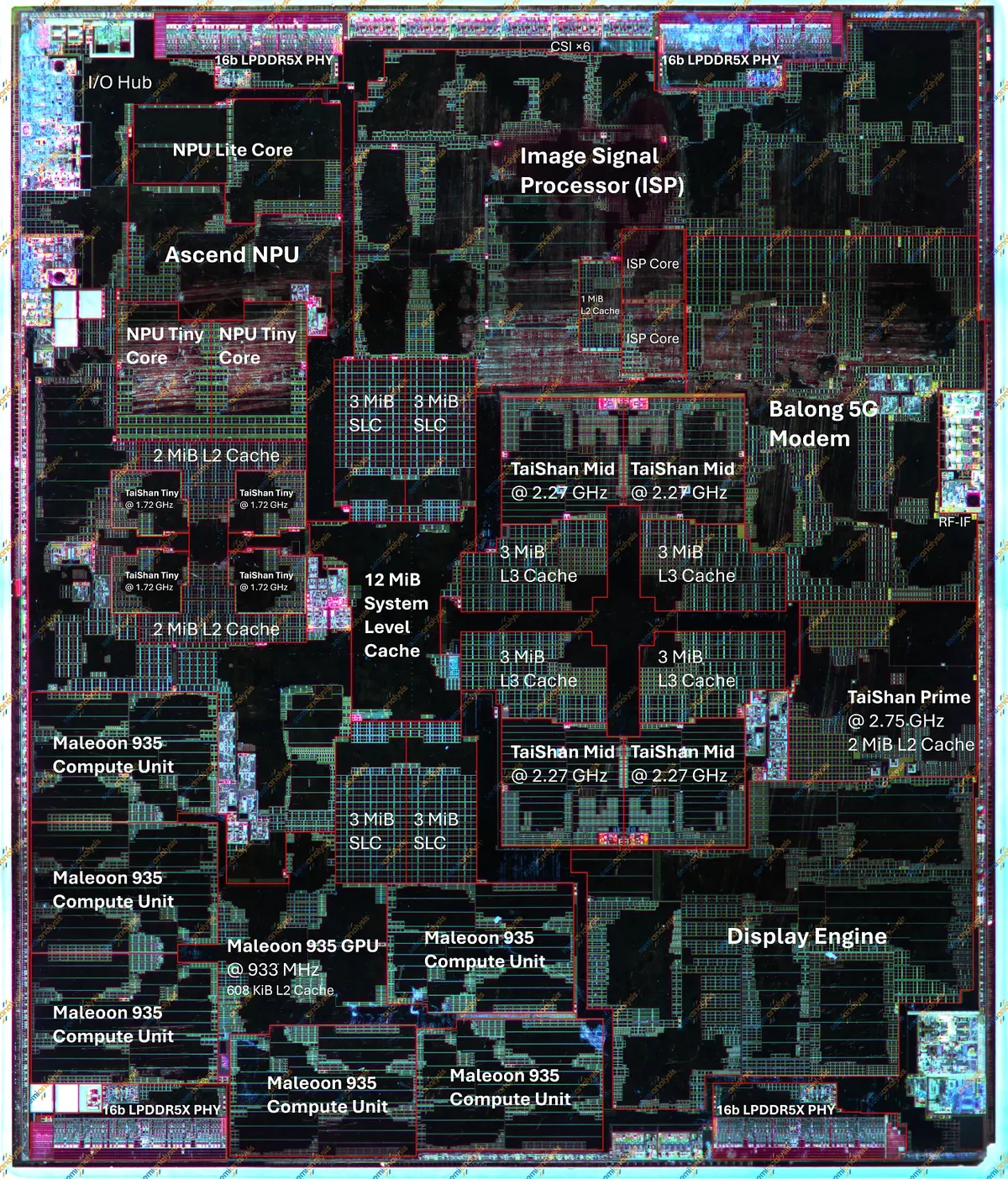
SemiAnalysis has published the first teardown from its new in-house lab, focusing on the minimum local metal pitch on SMIC’s third-gen 7nm at 32.5nm, tighter than the 36nm pitch shipping in Intel’s Panther Lake chips on 18A. The analysis was conducted on a HiSilicon Kirin 9030, the processor found inside Huawei’s Mate 80 phones and built on the N+3 process, which SemiAnalysis says trails Intel’s 18A high-density library by 38%. The SemiAnalysis Teardown Engineering & Evaluation Lab (STEEL) has been opened in Hillsboro, Oregon, and built to take on TechInsights in advanced-node reverse engineering.

A 36nm pitch is what Panther Lake ships with, but the 18A process on the whole supports a 32nm minimum metal pitch. With Panter Lake, Intel opted to relax the pitch because routing power through the back of the wafer — via PowerVia — clears the front-side metal stack for signal wiring.
HiSilicon Kirin 9030 die annotation

(Image credit: SemiAnalysis)

Intel has said doing this buys roughly 10% higher density and looser front-side pitches, which is how a node built on GAA RibbonFET transistors and backside power can ship a wider local pitch than a DUV Chinese process and maintain a wide overall lead. SMIC reached 32.5nm without EUV lithography, leaning on DUV tools and quadruple-patterning that needs extra masking and etch passes.

Counting transistors per area, SemiAnalysis put N+3 at 113.4 million per square millimeter, just ahead of TSMC's mature N6 at 107.7 million and well behind 18A. SMIC got there by spending every density trick available without EUV: two fins per transistor, contacts landed directly over the active gate, and single diffusion breaks between cells.

Each of those workarounds obviously adds complexity and cost, with N+3’s ceiling ultimately showing a huge trade-off. The Kirin 9030 Pro's prime core runs at 2.75 GHz and lands near Arm's 2021-era Cortex-X2 per clock, leaving the chip roughly level with Android flagships from three years ago and behind current parts from Apple, Qualcomm, MediaTek, and Samsung. Huawei’s roadmap does say that it’s targeting 5 GHz by 2031, but, as SemiAnalysis notes, that’s “far beyond what planar scaling alone could deliver.”
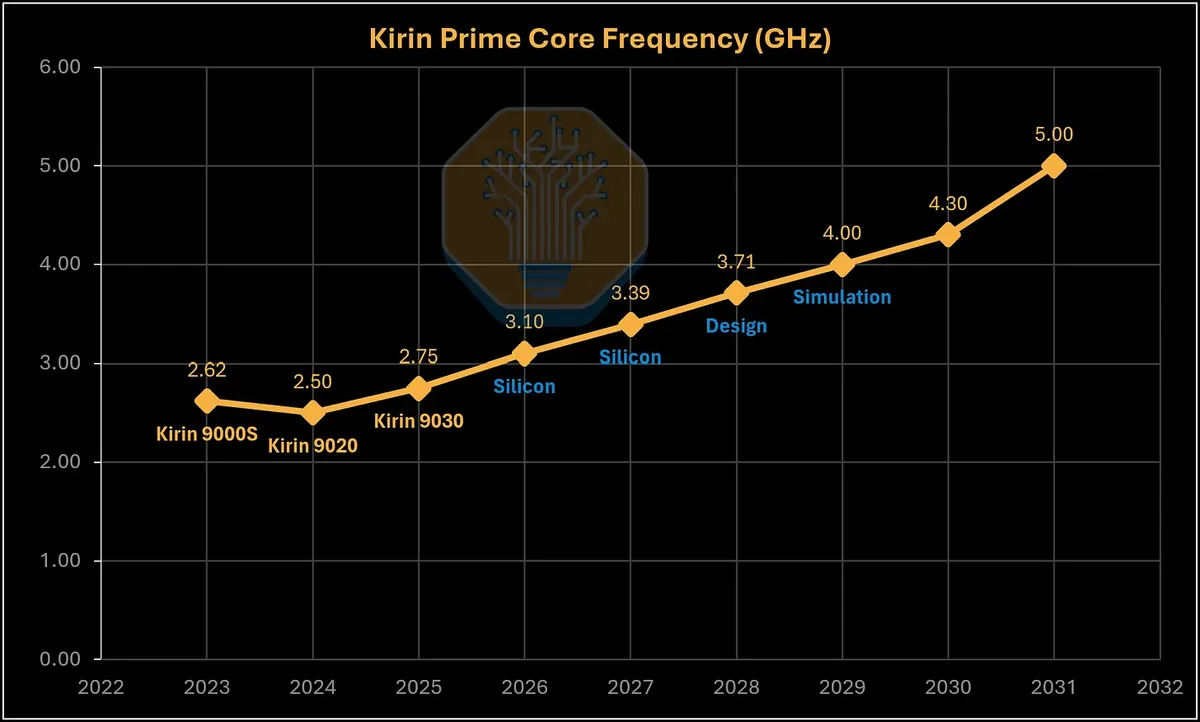
Huawei Prime Core Frequency Roadmap.

(Image credit: Huawei, SemiAnalysis)

SemiAnalysis said it spent the past 18 months building the lab and has already earned revenue analyzing datacenter silicon. “We have already generated revenue on advanced datacenter chip teardowns, including our recent reverse engineering of a major TSMC customer’s COUPE CPO optical engine + EIC 3D stack.”

The company is taking aim at the Ottawa-based TechInsights, which is backed by private equity and held by the likes of Oakley Capital and CVC Growth. SemiAnalysis claims its rival is up for sale and has underinvested in equipment as a result, though that hasn’t been officially confirmed. The teardown also found the Kirin 9030 Pro carrying Samsung LPDDR5X memory, with 16 GB variants turning up DRAM from Chinese maker CXMT as well.

Get Tom's Hardware's best news and in-depth reviews, straight to your inbox.

Google Preferred Source

Follow Tom's Hardware on Google News, or add us as a preferred source, to get our latest news, analysis, & reviews in your feeds.

Luke James is a freelance writer and journalist.  Although his background is in legal, he has a personal interest in all things tech, especially hardware and microelectronics, and anything regulatory.