







Streaming services keep getting more expensive, content keeps rotating off platforms, and you're still paying monthly for the privilege of watching things you've already bought. Jellyfin lets you take your own media library and turn it into something that looks and feels like Netflix, but it's running on your hardware, with your rules, and no subscription fees.
We're going to set up Jellyfin using Docker Compose through Portainer on Ubuntu Server, configure storage for your media libraries, enable Intel Quick Sync for hardware transcoding, and set up secure remote access with NetBird so you can stream from anywhere.
There are a bunch of different ways to install Jellyfin—Mac, Windows, various Linux distros, Docker, Synology, TrueNAS, and more. It's impossible to cover absolutely everything in one guide.
If you're running something like TrueNAS, there's a Jellyfin app you can search for and install directly. Just point it to your media and you're good to go. Same with Unraid—search for Jellyfin in the Community Applications, click install, point the data directory to where your movies and TV shows are, and that's it. Generally with any NAS operating system, the process is the same: search for Jellyfin, install, point it at your media.
If you install Jellyfin directly on Linux (not through Docker), keep in mind that you'll need to edit the systemctl service to give yourself the right permissions if you want to use features like DVR or anything that writes media or manipulates files on the system.
For this guide, we're going with Docker Compose on Ubuntu Server, which gives you the most flexibility and portability.
The two big names in self-hosted media servers are Plex and Emby . Both are solid, but both come with caveats. Plex locks several features behind a paid Plex Pass, routes some traffic through their servers, and has been adding ad-supported content and social features that a lot of self-hosters aren't interested in. Emby went closed-source back in 2018 and also requires a paid premiere license for things like hardware transcoding and offline sync.
Jellyfin is a fork of Emby's last open-source release, created in December 2018 after Emby announced it was going closed-source. It's completely free and open source. No premium tiers, no phoning home, no accounts required. Hardware transcoding, sync play, live TV support, it's all included. The client ecosystem is broad too. There are apps for Android, iOS, Android TV, Fire TV, Roku, web browsers, and desktop platforms. It's not perfect and the UI isn't quite as polished as Plex, but the gap has been closing fast.
If you want full control over your media server with zero strings attached, Jellyfin is the way to go.
You don't need anything exotic to run Jellyfin. If you're only doing direct play, where the client can handle the file format natively, even a Raspberry Pi could manage it. Transcoding is where hardware matters.
CPU: Any modern Intel processor with Quick Sync is the sweet spot for transcoding. Quick Sync handles video encoding and decoding in dedicated hardware on the chip, so your CPU barely breaks a sweat. Intel N100 mini PCs are incredibly popular for this since they support AV1 decoding and are cheap and power-efficient. AMD processors work too, but Intel's Quick Sync support in Jellyfin is more mature. Nvidia GPUs are also a solid option for hardware transcoding if you have one available.
Hardware transcoding isn't strictly necessary—you won't need it all the time. It's most helpful when you have something like a 4K video and want to stream it to your phone at 720p to save data, or when you have a file format that an older smart TV doesn't natively support. If all your clients can direct play your media, you can skip it entirely.
RAM: 4GB is the minimum, 8GB is comfortable. Jellyfin itself isn't memory-hungry, but if you're running other containers alongside it, give yourself headroom.
Storage: This is the big one. Media libraries get large fast. A single 4K movie can be 50-80GB. A full TV series in 1080p can easily hit 100GB+. Plan your storage around what you actually have and what you plan to collect. If you're running this alongside a NAS like TrueNAS or Unraid , you can mount network shares for the media while keeping Jellyfin's config on local SSD storage.
Network: Gigabit ethernet is the minimum for a good experience. If you're streaming 4K remuxes, you'll want that wired connection. WiFi can work for lower bitrate content, but wired is always better for a media server.
I'm running this on Ubuntu Server as a VM, but bare metal works the same way. If you need a full walkthrough of the Ubuntu Server installation process, I covered that in detail in the Docker guide . The short version:
That's it for the base OS. Let's get Docker going.
I covered Docker and Portainer installation in detail in the getting started with Docker guide , so I won't repeat all of that here. The short version is you run Docker's convenience script, add your user to the docker group, then spin up Portainer Community Edition. Once Portainer is running, access it at and create your admin account.
We'll use Portainer's Stack feature to deploy Jellyfin. In Portainer:
Adjust the values to match your setup:
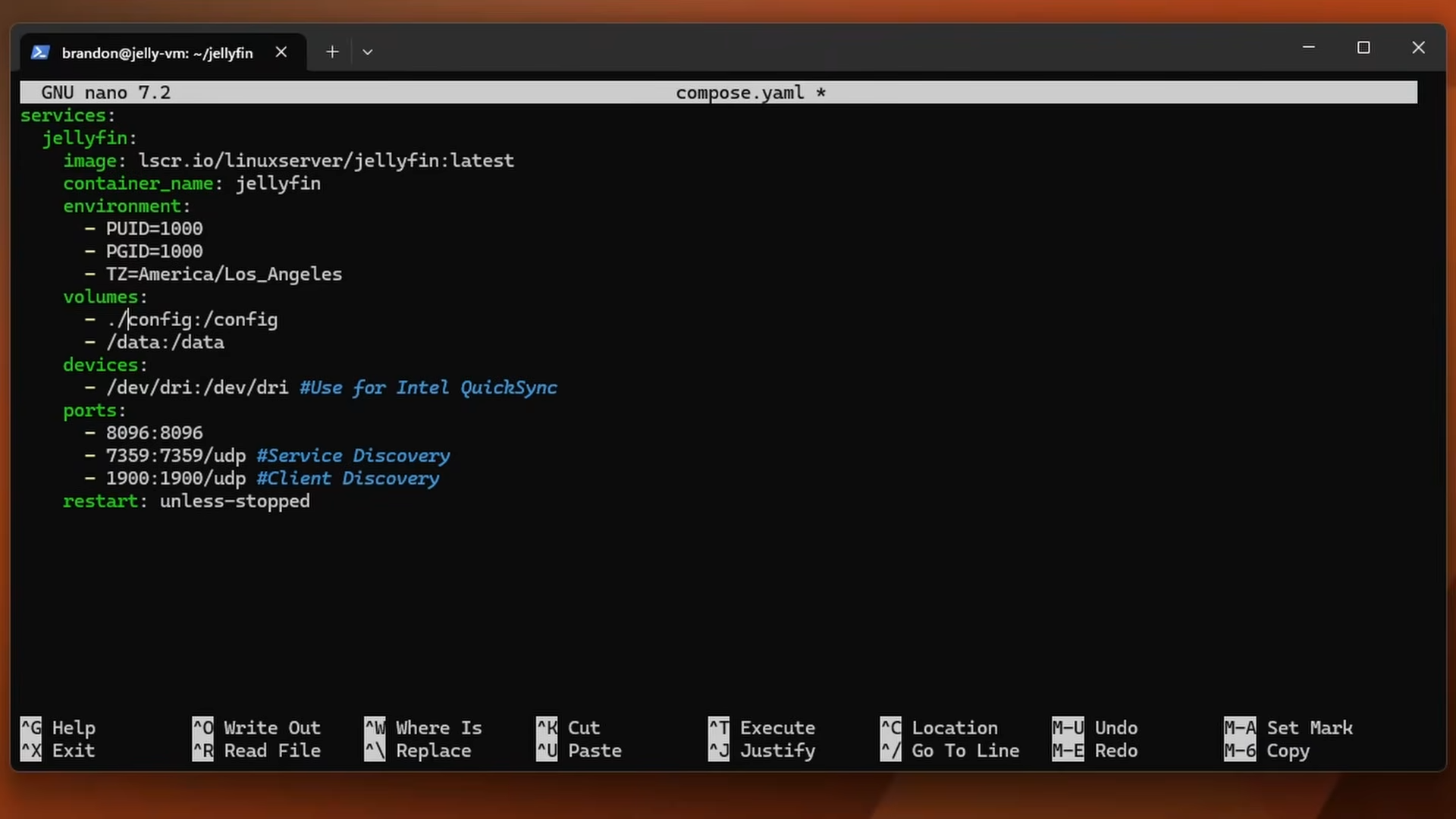
Click Deploy the stack and give it a minute to pull the image.
How you organize storage matters more than you'd think. Jellyfin's config directory and media directory serve very different purposes and should live in different places.
Config and cache ( and ): These contain the database, metadata images, subtitles, and transcoding temp files. Put these on SSD storage. The database in particular does not belong on a network share since you'll get corruption and performance issues.
Data (): This is a single directory that holds all your media, mounted into the container as . This can absolutely be a NAS share, a large spinning disk array, or whatever bulk storage you have available. If you're mounting a network share, add it to so it persists across reboots:
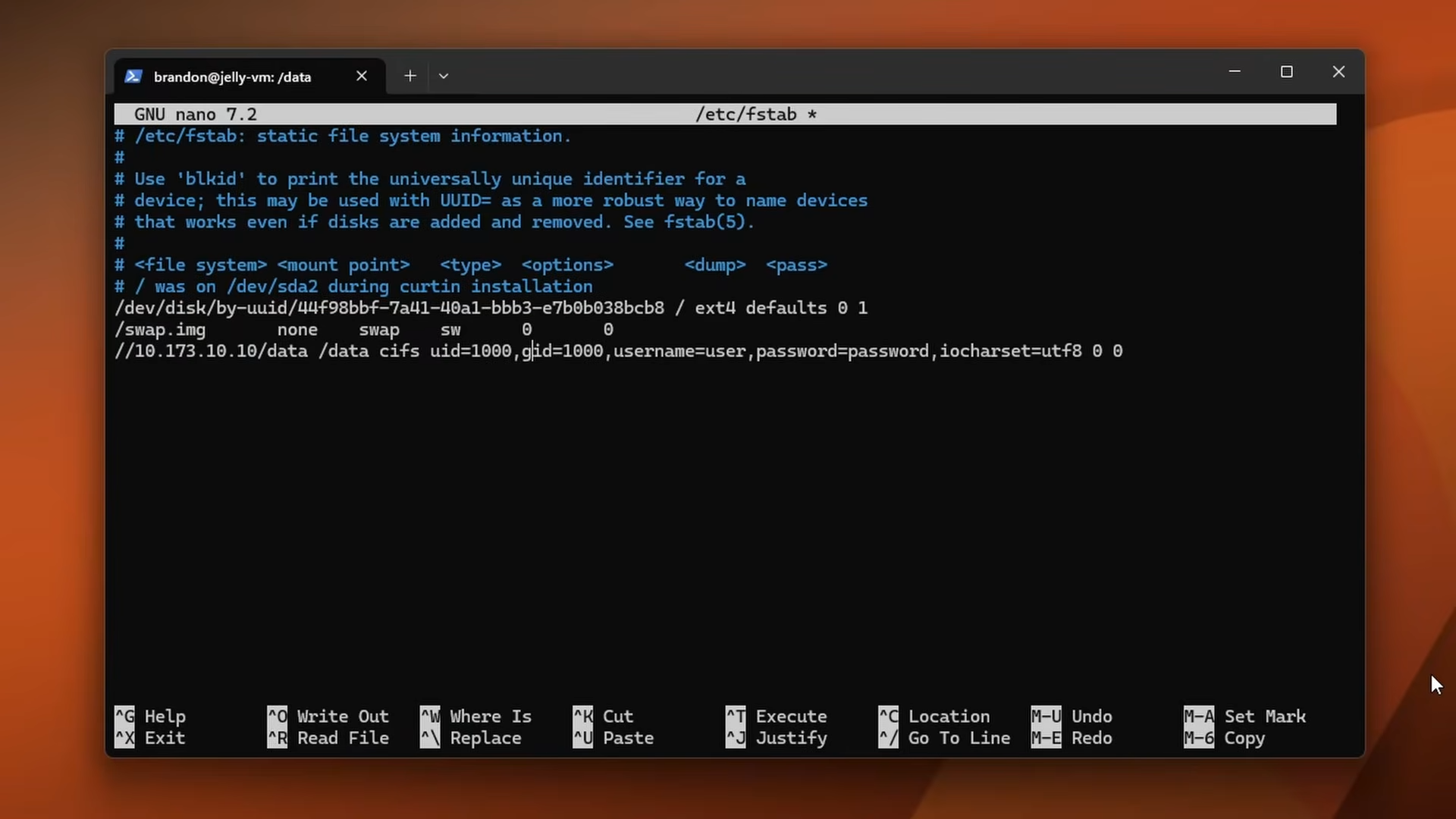
Inside your data directory, create subdirectories for each content type. Jellyfin expects a specific folder structure to identify content correctly:
Each movie should be in its own folder with the year in parentheses. TV shows should follow the and naming convention. Jellyfin's scrapers rely heavily on this naming to pull the correct metadata from TMDb .
If Jellyfin is pulling the wrong metadata for a title (common with remakes or movies that share a name), you can add the TMDb ID directly to the folder name to force an exact match: . You can find the ID in the URL of any TMDb page.
Permissions: Make sure the user running Jellyfin (the / you set) has read access to your media directories. If you're getting permission denied errors:
If you have an Intel CPU with Quick Sync, hardware transcoding is one of the best upgrades you can make. It offloads video encoding and decoding from the CPU to dedicated hardware on the chip, which means you can transcode multiple streams simultaneously without breaking a sweat.
First, verify the device exists on your system:
You should see and (or similar). If this directory doesn't exist or is empty, Quick Sync either isn't available on your CPU or isn't enabled. Check your BIOS for integrated graphics settings. On some systems, plugging in a dedicated GPU disables the iGPU by default, so you may need to explicitly enable it.
If you're running in a VM on Proxmox, you'll need to pass through the iGPU. Add the device in your VM's hardware configuration.
The compose file we created already includes the device mapping:
This passes the entire DRI subsystem into the container. The Jellyfin container needs access to the render device to use hardware acceleration.
Make sure the container user has permission to access the render device:
Now configure Jellyfin itself. In the web dashboard:
To verify it's working, play something that triggers a transcode (change the quality in the player) and check the Dashboard → Active Devices section. You should see the transcode method listed as your hardware acceleration method rather than software.
You can also monitor Quick Sync usage in real-time from the host with . Install it and run it:
This gives you a live view of the GPU engines, including the video encode and decode blocks. When a transcode is active, you'll see the Video and VideoEnhance engines light up. If those stay at zero while Jellyfin is transcoding, something isn't configured correctly. It's the quickest way to confirm hardware acceleration is actually being used.
Once the stack is deployed and all containers show as running in Portainer, access Jellyfin at .
You'll be greeted with the initial setup wizard:
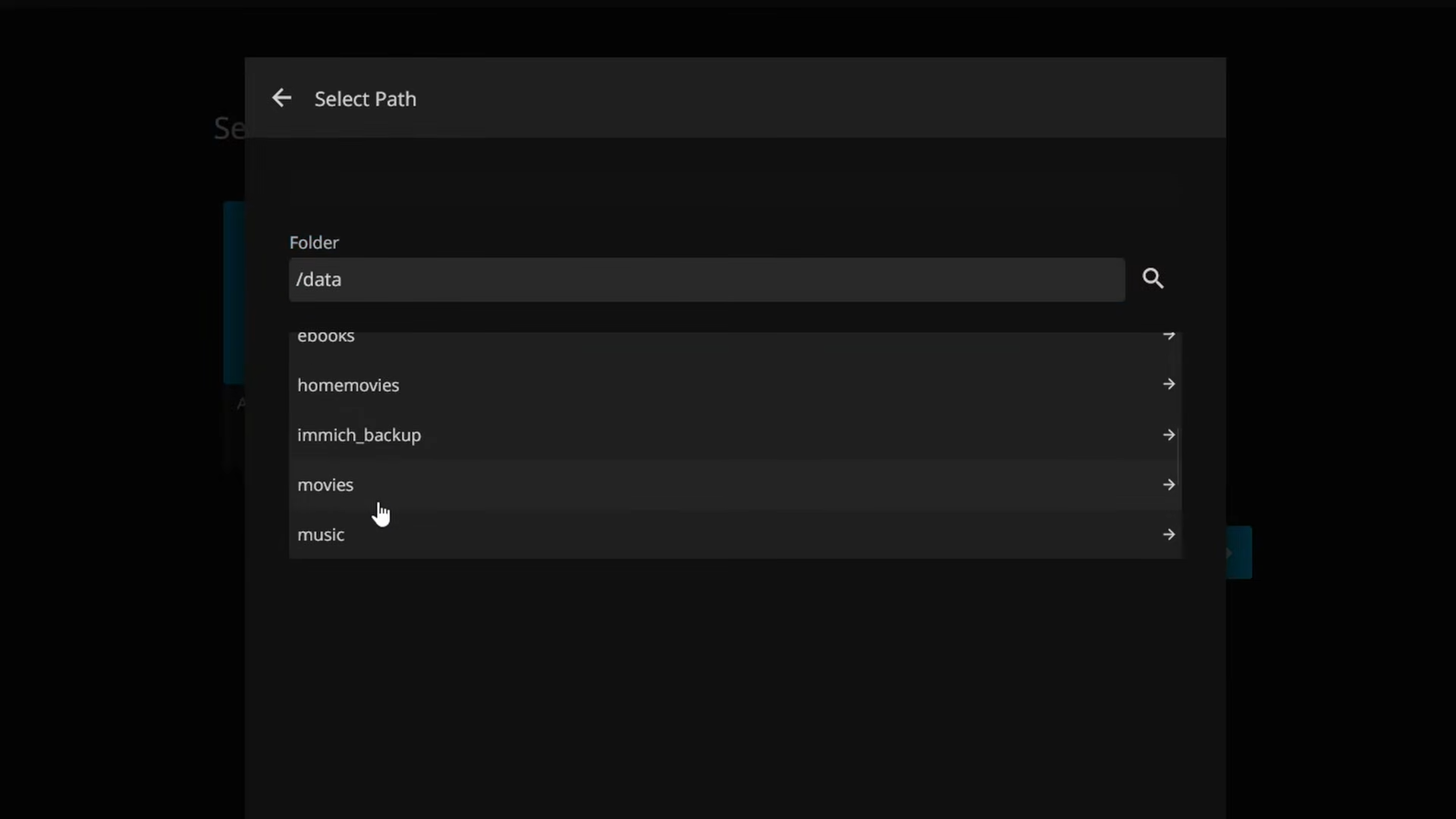 4. Metadata Language: Set your preferred language and country for scraping
5. Remote Access: Leave the defaults for now, we'll handle remote access with NetBird
4. Metadata Language: Set your preferred language and country for scraping
5. Remote Access: Leave the defaults for now, we'll handle remote access with NetBird
After completing the wizard, Jellyfin will start scanning your libraries. Depending on how much media you have, this can take anywhere from a few minutes to several hours. You can monitor the progress under Administration → Dashboard.
A few settings I recommend checking after the initial scan:
Library scan schedule: Under each library's settings, you can set up scheduled scans so new content gets picked up automatically. I do a scan every 12 hours, but you can also trigger them manually or set up filesystem monitoring.
Networking: Under Administration → Networking, make sure the local addresses and known proxies are configured correctly. If you're only using NetBird for remote access, you don't need to touch the remote access settings here.
Users: If other people will be using your server, create individual accounts under Administration → Users. You can control what libraries each user can access, whether they can download content, transcode limits, and more.
Exposing Jellyfin directly to the internet with port forwarding is asking for trouble. Instead, we'll use NetBird to create a secure connection. There are two approaches: direct peer-to-peer access where every client device runs NetBird, or using NetBird's reverse proxy to expose Jellyfin through a custom domain with an SSL certificate. We'll cover both.
Install NetBird on your Ubuntu Server:
Then connect it to your NetBird network using a setup key. You can create a setup key in the NetBird dashboard under Setup Keys. Give it a name like and assign it to your preferred group:
Head over to the NetBird dashboard and verify your server shows up under Peers. It should appear with the hostname you set during Ubuntu installation.
Now create an access policy so your devices can reach Jellyfin. In the NetBird dashboard:
Once the policy is active, any device on your NetBird network that matches the source group can reach Jellyfin using the NetBird IP or DNS name. Open a browser and navigate to and you should see the Jellyfin login page, no matter where you are.
This also works for all the Jellyfin client apps. Just use the NetBird address as the server URL when setting them up. NetBird has native clients for Apple TV and Android TV, so you can install it directly on your streaming device and access Jellyfin without needing to set up a VPN on your router or run NetBird on a separate device. Your TV becomes a peer on the network just like your phone or laptop.
If you don't want to install NetBird on every client device, you can use NetBird's reverse proxy feature to give Jellyfin a public-facing domain with an automatically issued SSL certificate. This is great for sharing access with family or friends who don't have NetBird installed.
For media streaming, self-hosted NetBird is strongly recommended. Streaming large 4K files uses a lot of bandwidth, and with a self-hosted setup there are no usage limits since the traffic stays on your infrastructure.
First, make sure your Jellyfin server's IP is within a network configured in NetBird with routing peers that can forward traffic to it. Then in the NetBird dashboard:
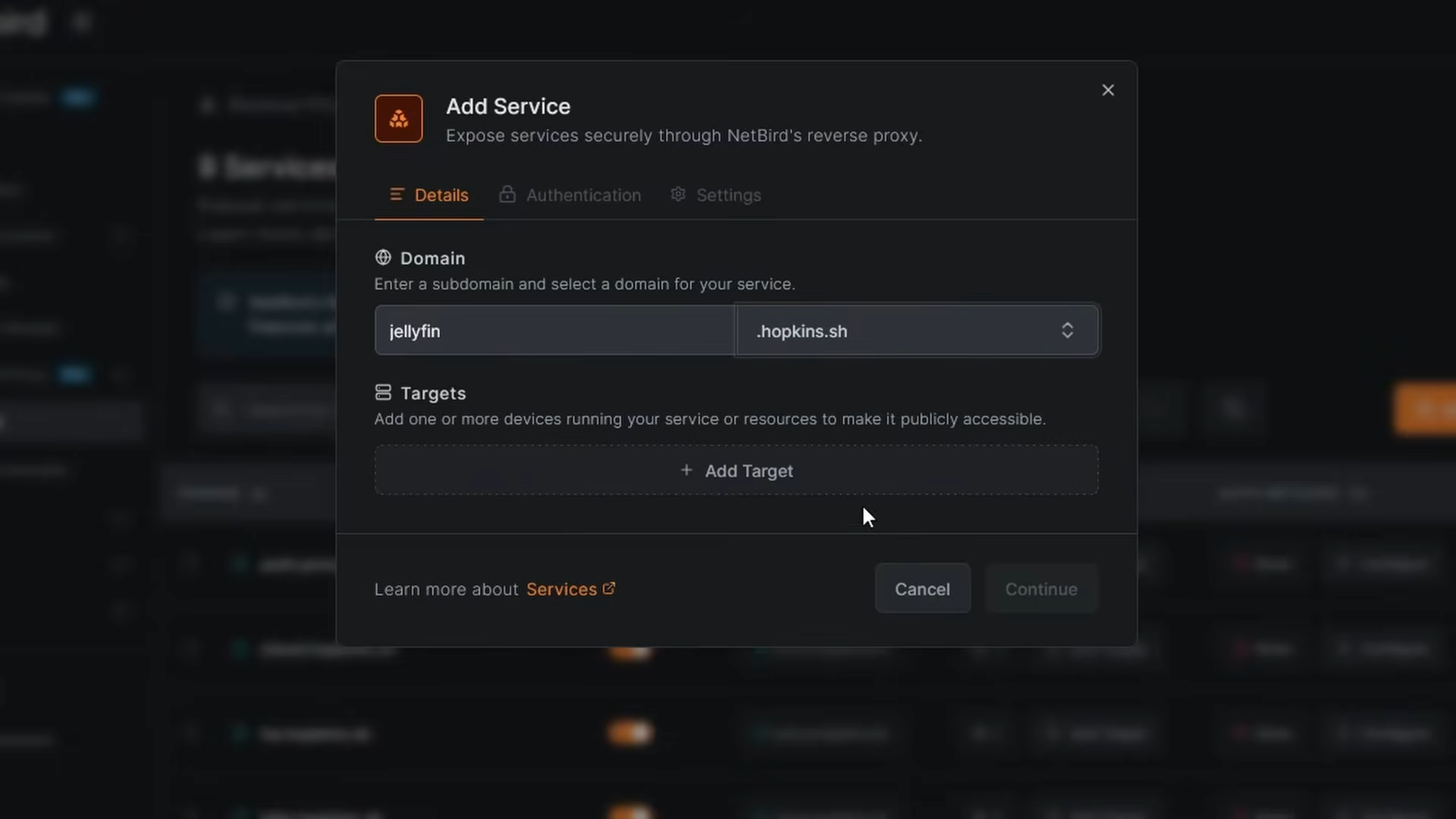
NetBird will automatically issue an SSL certificate for your domain. Once it's ready, you can access Jellyfin at from anywhere.
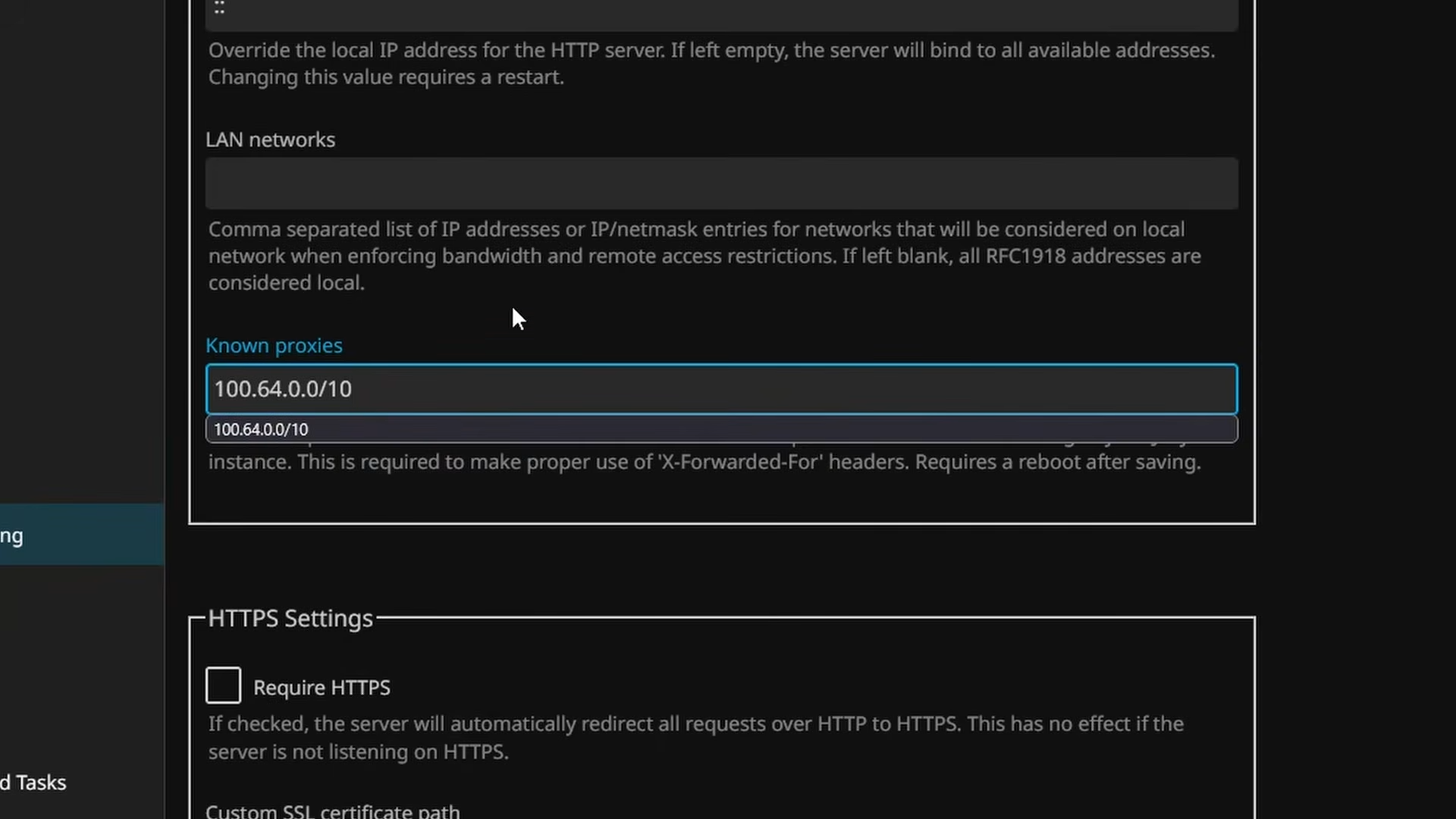
There's one more step inside Jellyfin. Go to Administration → Dashboard → Networking and add the NetBird IP range (e.g., ) under Known Proxies. This tells Jellyfin to trust the proxy connection so everything works correctly. Click Save.
One thing that catches people off guard: Jellyfin applies database migrations immediately when you upgrade, and you cannot downgrade without a backup from before the upgrade. If an update goes wrong, you're stuck unless you have a prior backup.
Back up the config directory regularly—that's where the database, metadata, user accounts, and all your settings live. The media files themselves don't need to be part of the Jellyfin backup since they're just files on disk.
Before backing up, stop the Jellyfin container first to avoid database locks:
Then copy or archive the config directory:
Start the container again when you're done:
Consider automating this on a schedule with a cron job, especially before major version upgrades.
That's Jellyfin running on Docker with Portainer, hardware transcoding enabled, and remote access through NetBird. You've got a fully functional media server that you can reach from anywhere without exposing anything to the public internet.
From here, there's a lot more you can explore:
The official Jellyfin documentation is a great resource for all of this. The community on Reddit and the Jellyfin Forum is also genuinely helpful if you run into issues.
Your media, your server, your rules.
此内容由惯性聚合(RSS阅读器)自动聚合整理,仅供阅读参考。 原文来自 — 版权归原作者所有。