
惯性聚合 高效追踪和阅读你感兴趣的博客、新闻、科技资讯
阅读原文 在惯性聚合中打开

推荐订阅源

罗磊的独立博客
Recent Announcements
奇客Solidot–传递最新科技情报
奇客Solidot–传递最新科技情报
有赞技术团队
有赞技术团队
J
Java Code Geeks
T
The Blog of Author Tim Ferriss
MyScale Blog
MyScale Blog
人人都是产品经理
人人都是产品经理
aimingoo的专栏
aimingoo的专栏
U
Unit 42
The GitHub Blog
The GitHub Blog
云风的 BLOG
云风的 BLOG
T
Tailwind CSS Blog
H
Hackread – Cybersecurity News, Data Breaches, AI and More
酷 壳 – CoolShell
酷 壳 – CoolShell
博客园 - 三生石上(FineUI控件)
Apple Machine Learning Research
小众软件
小众软件
Hugging Face - Blog
Hugging Face - Blog
博客园 - 司徒正美
腾讯CDC
I
InfoQ
GbyAI
GbyAI
博客园_首页

NetBird - Networking Knowledge Hub - RSS Feed

NetBird Is Now on the Vultr Marketplace Native NetBird on the GL.iNet Comet Pro (GL-RM10) NetBird v0.71 - IPv6 Overlay Addressing NetBird Exit Nodes - Appear at Home, or Anywhere Else Reporting Bugs and Requesting Features in NetBird Setup and Use Local AdGuard Home Anywhere with NetBird DNS How to Set Up NetBird on PiKVM for Secure Remote KVM Access NetBird v0.69 - CrowdSec IP Reputation for the Reverse Proxy Cloudflare Mesh vs NetBird vs Tailscale: Performance Compared Self-Hosting Nextcloud with Docker and NetBird Implementing Zero Trust with NetBird NetBird v0.67 - Layer 4 Proxy Support for TCP, UDP, and TLS Solwr Enhances Remote Connectivity with NetBird Self-Hosting NetBird with Authentik Jellyfin Media Server - Self-Host Your Movies, TV, and Music Cloudflare Tunnels vs. NetBird Reverse Proxy INFITX Builds Zero-Touch Kubernetes Networking with NetBird NetBird v0.66 - Expose Local Services to the Internet from the CLI Pangolin vs. NetBird Home Assistant Setup Guide with EASY Remote Access NetBird v0.65 - Built-in Reverse Proxy with Custom Domains Docker for Beginners - Everything You Need to Get Started NetBird for SOC 2 Compliance NetBird v0.63 - Custom DNS Zones for Private Network Resolution Vibecode This in a Weekend and Take 5% of the Company NetBird v0.62 - Built-in Local Users with Optional IdP Integration NetBird v0.61.0 - Granular SSH Access Control and Automatic Updates Top 5 Alternatives to OpenVPN Top 5 Open Source Alternatives to Tailscale Top 5 Alternatives to ZeroTier
Optimizing Network Efficiency with NetBird's Lazy Connect...
Written byJack Carter · 2025-06-30 · via NetBird - Networking Knowledge Hub - RSS Feed

Early versions of NetBird maintained persistent WireGuard connections between peers. This approach kept WireGuard connections open even if there was no actual traffic, consuming unnecessary resources on the devices. As a result, maintaining continuous peer connections can lead to scalability issues and inefficient performance, particularly within large-scale or resource-constrained environments.

NetBird has introduced a new feature called lazy connections to address these challenges. This feature allows NetBird to establish peer connections only when there is actual network activity, significantly improving network efficiency and resource utilization.

What Are Lazy Connections?

The lazy connections feature greatly improves how NetBird handles connectivity. Instead of constant connections, peers now connect on-demand, and are activated by network activity such as pinging a remote peer, or accessing an internal resource via a browser, ssh, etc. When enabled, lazy connections:

  • Establish connections only when required.
  • Monitor activity, automatically disconnecting peers that become inactive.

Benefits for Your Network

Lazy Connections significantly improve network performance and resource efficiency. By activating connections only as needed, the feature:

  • Reduces unnecessary network overhead.
  • Conserves valuable system resources, crucial for IoT and mobile environments.

Getting Started

Enabling Lazy Connections is straightforward:

  • Via environment variable:


  • Via CLI:


  • Or easily through the NetBird Dashboard:
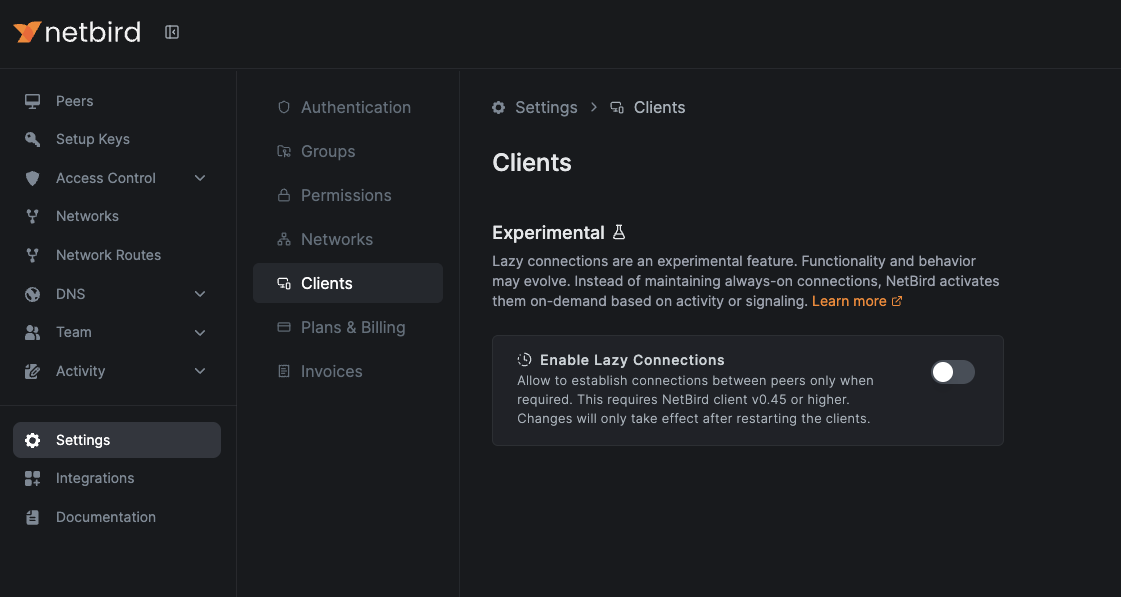
NetBird Lazy Connections

Ensure your NetBird agent and Management server are updated to version 0.45.0 or higher.

Looking Ahead

NetBird continues to refine Lazy Connections, enhancing disconnection logic and supporting resource access via routing peers. Your feedback helps shape these improvements.

Explore the Lazy Connections documentation .