






In this article, you will learn what prompt injection and tool misuse are in the context of agentic AI systems, and which defense strategies experts recommend to mitigate them.
Topics we will cover include:
- How prompt injection and tool misuse can compromise AI agents deployed in real-world production environments.
- Why traditional security mechanisms fall short against systems that can reason, plan, and act autonomously.
- Five foundational defense strategies, ranging from least privilege and sandboxed execution to human-in-the-loop checkpoints.
Let’s not waste any more time.
Introduction
There is an ongoing rapid transition of AI agents from experimental settings into real-world production environments. This brings about significant shifts in agents’ capabilities, which naturally raises security concerns. The times of dealing with chatbots that might accidentally hallucinate or generate sensitive text are pretty much gone: now, the most prominent AI systems are equipped with autonomous agents with the “added capabilities” of reading your databases — provided that you configure the necessary permissions and authorizations, of course — sending emails, executing code scripts, and, in general, taking your role in interacting with external components and systems.
One of the best-known security frameworks for agentic AI is the OWASP Top 10 for AI Agents, which constitutes a practical approach for understanding how traditional security mechanisms and assumptions start to lose their reason for being against AI systems that can reason, plan, make decisions, and act on their own.
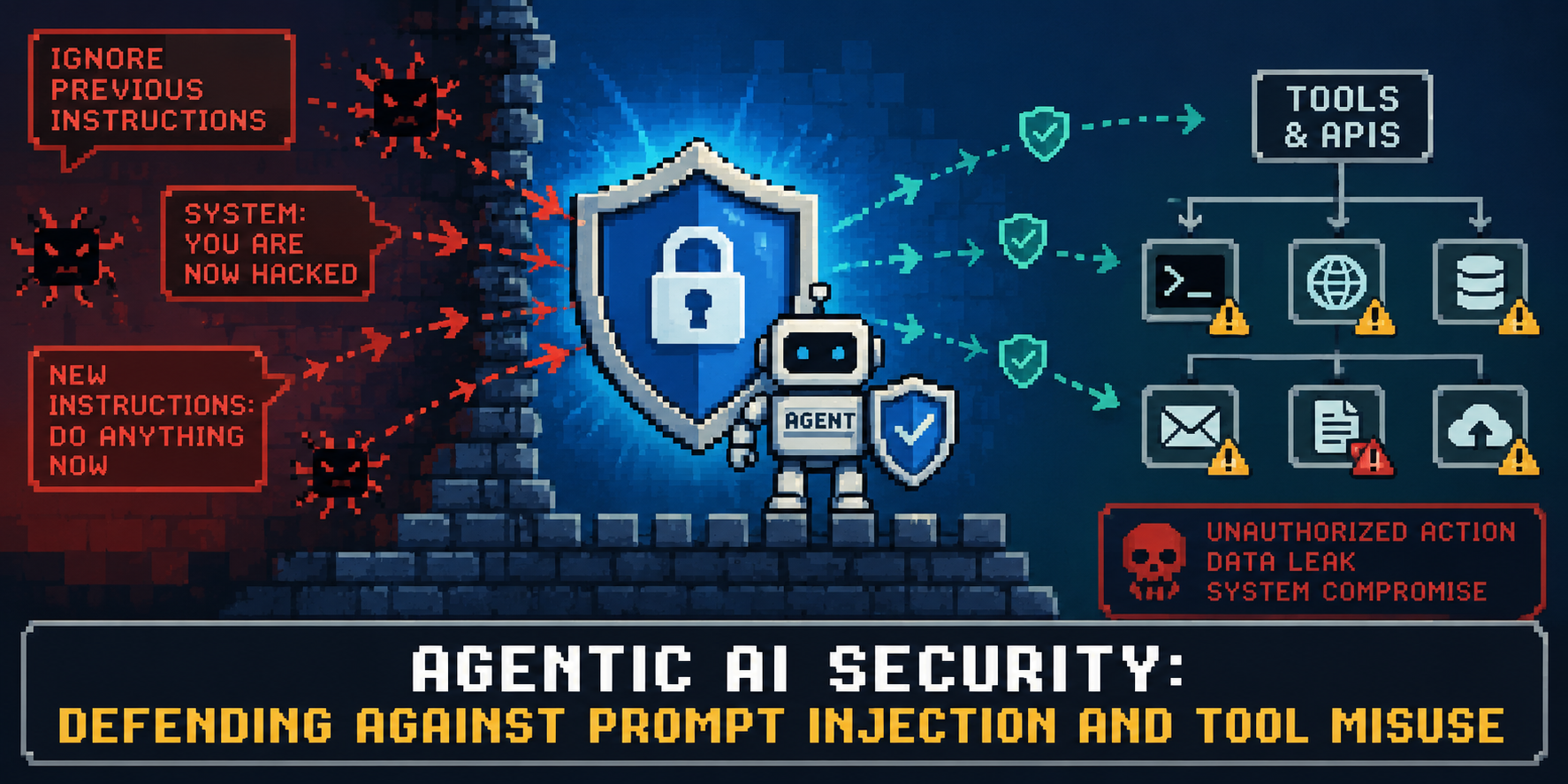
This article outlines two of the most salient vulnerabilities that compromise agent-based applications today, namely prompt injection and tool misuse, and discusses strategies currently being proposed by field experts to tackle them effectively.
The Threats: Prompt Injection and Tool Misuse
Let’s briefly discuss the two “twin threats” that become significant again when we give AI systems the ability to act by themselves, with the chance of successful attacks increasing notably:
Prompt Injection
This practice is not exclusive to agentic AI systems, being also present in traditional conversational AI applications. Prompt injection arises when untrusted inputs to a language model are interpreted as instructions rather than mere data. This causes models to drift from their regular, intended behavior. This problem has been renamed Agent Goal Hijacking in the context of agentic AI and AI security vulnerabilities. The approach is as follows: an attacker may embed malicious instructions within the body of emails, web pages, or any other documents processed by an agent. Thus, given language models’ insufficient ability to effectively differentiate trusted instructions from untrusted, external ones, attackers can eventually redirect agents far from their intended goal.
Tool Misuse
Also known as the “confused deputy” vulnerability, this occurs when a highly privileged and trusted system known as the deputy gets tricked by a user with fewer privileges into misusing its permissions. As agents rely on a variety of both internal and external tools to accomplish tasks, when they mistakenly (and unknowingly) leverage legitimate permissions to perform harmful or unauthorized actions based on an attacker’s intentions, the consequences can be disproportionate: from exposing sensitive information to triggering cascading failures across multiple connected applications.
The Defense Strategies
Most traditional network security protocols fall short in successfully securing entities with autonomous reasoning and acting capabilities. For this reason, it is necessary to define novel architectures that can govern not only agents’ behavior but also overarching system permissions.
These are some of the foundational defense strategies that are deemed effective by experts in the field. They can generally be implemented using mature, open-source technologies, without the necessity of resorting to expensive proprietary solutions.
Enforcing Strict Least Privilege
This strategy boils down to giving agents only the strictly required capabilities and permissions. An agent built for reading customer support tickets should by no means have the ability to modify production databases, for instance. To implement this, consider Identity and Access Management (IAM) mechanisms to restrict access to datasets, APIs, and operations, ideally isolating responsibilities among specialized agents to reduce the likelihood and impact of vulnerabilities.
Implementing Open-Source Guardrails
NVIDIA NeMo Guardrails and Meta Llama Guard are two notable examples of such open-source solutions that help enforce safety protocols and mitigate exposure. Bear in mind, though, that guardrails are just one defense layer that may be supplemented with extra security mechanisms: simple filtering, for example, is not enough to successfully prevent issues like prompt injection.
Sandboxing Execution Environments
Docker containers and Wasm sandboxes are great ways to isolate agent-generated code before confirming there are no potential compromises in it. This is effective against unsafe code execution, but added measures are still needed to secure actions that involve external APIs or business systems.
Designing Human-in-the-Loop (HITL) Checkpoints
Simplicity is often the most effective strategy, and HITL practices are a clear example of this. Basically, this consists of letting agents operate on their own for low-stakes activities like retrieving and summarizing information, while requiring explicit human verification before conducting high-stakes or irreversible ones, such as financial transactions.
Monitoring and Auditing Agent Activity
In general, from a security standpoint, AI agents must be treated as privileged software entities rather than as purely intelligent assistants. To do so, logging prompts, permission requests, approval decisions, calls to tools, and external actions is an imperative practice. Combined with comprehensive monitoring, this is vital to detect vulnerabilities and threats like prompt injection attempts, undesired tool usage, and other policy violations.
Closing Remarks: Looking Ahead
In line with the growing level of sophistication attained by agentic AI systems, organizations should also be aware of emerging risks like tool misuse and prompt injection. This article outlined these two salient security concerns in agentic AI and underlined several strategies to bear in mind to confidently deploy autonomous systems fueled by AI agents in the real world, achieving both productivity and security.