


In this article, you will learn the conceptual and practical differences between retrieval and memory in agentic AI systems, and how to combine both effectively.
Topics we will cover include:
- What separates retrieval from memory, and why the distinction matters for long-running agents.
- How retrieval pipelines and memory systems are each built, illustrated with a concrete worked example.
- How to combine retrieval and memory into a single, effective agent architecture.
Introduction
An AI agent that can’t remember its previous interactions is not very helpful. Every large language model has a fixed context window, and once a conversation, a set of tool outputs, or a pile of retrieved documents grows past that limit, something has to be dropped, summarized, or fetched fresh. Developers building long-running agents run into this constantly. The agent re-asks questions it already answered, contradicts decisions it made earlier, or fails to recognize that a document it needs even exists.
Retrieval and memory are the two mechanisms that address this, and they solve different halves of the problem. Retrieval pulls in outside knowledge the model was never trained on and should not have to carry by default, such as documentation, code, and database records. Memory persists what the agent itself has learned or done, across a session or across many, so it isn’t starting from zero every time. Confusing the two, or building only one, is where a lot of agent architectures break down. This article covers:
- What separates retrieval from memory at a conceptual level
- How a retrieval pipeline and a memory system are each built, with a worked example
- A side-by-side comparison of the two
- How to combine both into a single, effective agentic system
We start with why the split exists in the first place.
Understanding Why Context Forces a Split
A context window is the total set of tokens the model can see at once: system prompt, conversation history, tool outputs, anything inserted ahead of time. It is finite, and every token in it gets attended to on every forward pass, so simply making the window bigger doesn’t scale the way it sounds like it should. Context engineering has emerged as the discipline of curating and managing that limited resource, treating it as the full state available to the model at a given moment, not just a place to stuff instructions.
Given that constraint, an agent has two kinds of information it needs but can’t keep permanently in context:
- Information that exists outside the model and outside the current conversation, such as a knowledge base, a codebase, or a set of policy documents. This is what retrieval handles.
- Information the agent generated or learned itself, that needs to outlive the current context window, such as a decision made ten turns ago or a fact about a specific user. This is what memory handles.
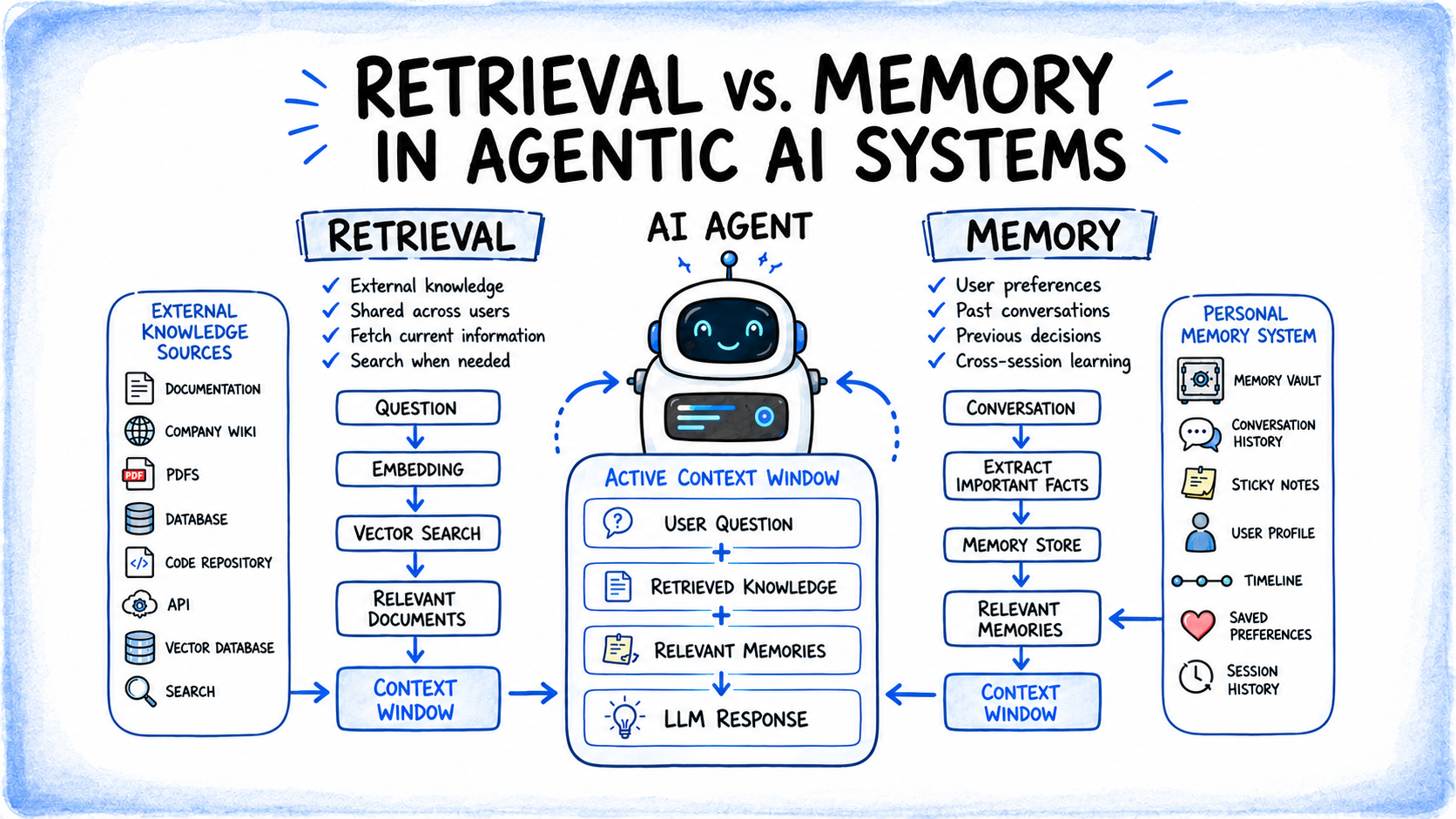
Both get implemented with similar tools: embeddings, vector search, structured stores. The key difference is what they store and where the information comes from. Retrieval searches a corpus outside the agent, while memory stores information from the agent’s own interactions and past actions.
Defining Retrieval in Agentic Systems
Retrieval is how an agent answers “what does the world know about this that I don’t have in my weights or my current context.” The most common implementation is retrieval-augmented generation, or RAG:
- Source documents get chunked into passages small enough to be useful.
- Each chunk is converted into an embedding and stored in a vector index.
- At query time, the incoming question is embedded the same way, and the index returns the nearest matches.
- Those matches get inserted into the prompt alongside the user’s question.
This pattern typically runs on managed datastores with an orchestration layer that ties the retrieval step into the rest of the agent’s reasoning — the approach behind most retrieval-augmented generation architectures in production today. The corpus itself is shared — every user asking about the same product documentation hits the same index — and it is refreshed on its own schedule, independent of any individual conversation.
Defining Memory in Agentic Systems
Memory is how an agent answers “what have I already learned or done that I need to carry forward.” It splits into two layers that behave differently:
- Short-term memory is the running session state: the conversation so far, plus anything the agent has written to a scratchpad during the current task. It’s cheap, and it disappears when the session ends.
- Long-term memory persists across sessions. It has to answer a harder question than retrieval does: not just “what’s relevant,” but “what’s worth keeping in the first place.”
Some agent memory systems automatically extract useful facts, preferences, and context from conversations and store them for later use. At the start of a new session, the agent can query that memory much like it would query a retrieval index, but the results are specific to a user, task, or agent rather than a shared document corpus. When designing this layer, teams can explore different agent memory strategies and agent memory frameworks depending on what they need to store and retrieve.
A quick worked example makes the split concrete. A customer messages a support agent about a delayed order.
For a delayed order, the agent first checks its memory for the customer’s previous history. It finds a note from three weeks ago saying they prefer email follow-up and that a similar shipping issue was resolved with a partial refund. That is memory, because it comes from the agent’s record of this specific customer.
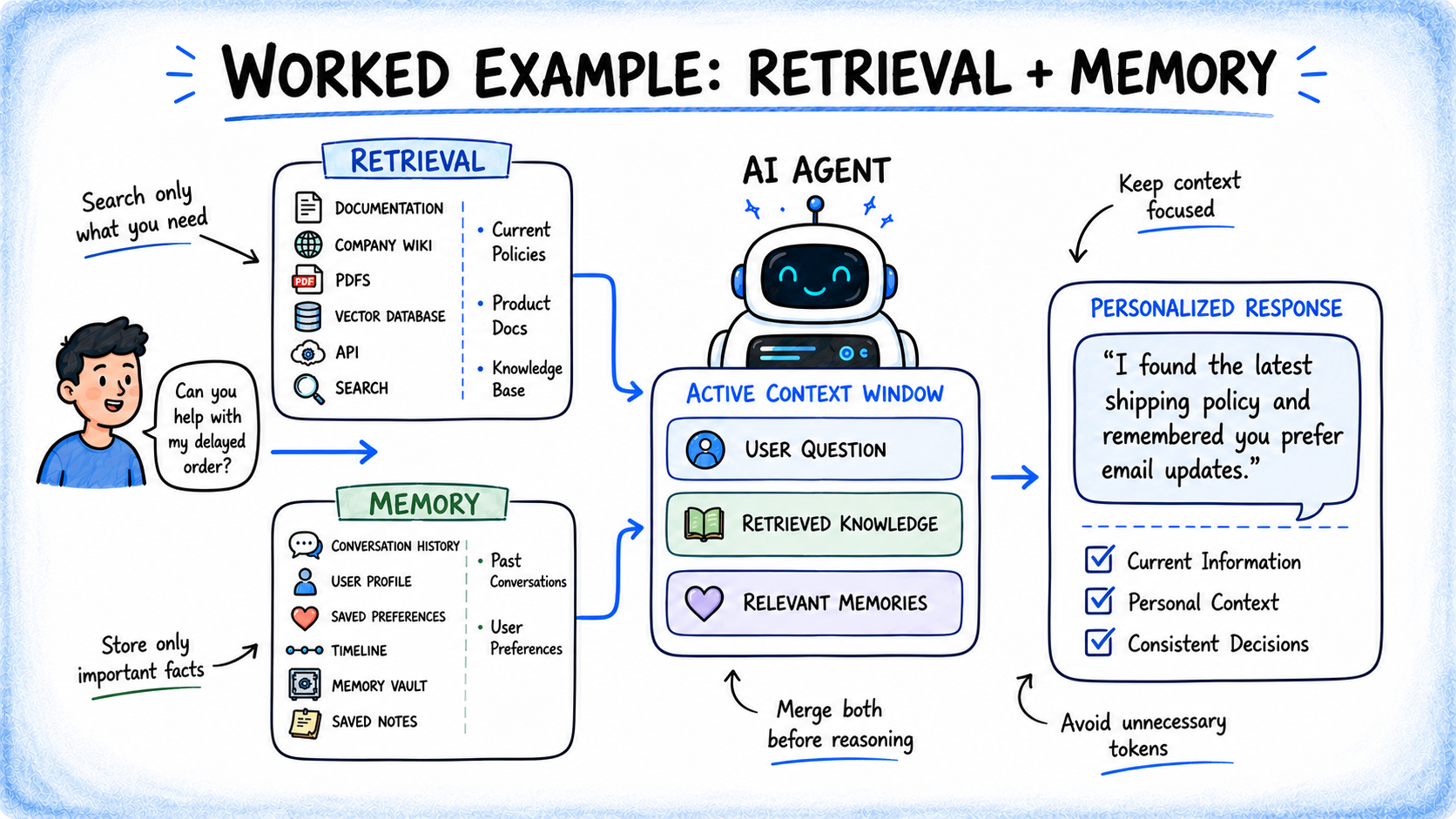
The agent then needs the current shipping policy, which changed last month, so it searches the company’s documentation and retrieves the relevant section. That is retrieval, because the information comes from an external source and applies to all customers. Both results are added to the same prompt, but they answer different questions.
Comparing Retrieval and Memory
Laid out side by side, the differences between retrieval and memory are easier to see at a glance:
| Dimension | Retrieval | Memory |
|---|---|---|
| Source of information | External corpus the agent didn’t create | The agent’s own past interactions or reasoning |
| Scope | Shared across all users and sessions | Specific to a user, task, or session |
| What it answers | “What does the world know about this?” | “What have I already learned or done?” |
| Freshness mechanism | Re-index the corpus on a schedule or on write | Consolidate, update, or expire stored facts |
| Typical failure mode | Stale or missing documents in the index | Contradictory or outdated facts about a user |
| Cost pattern | Read-heavy; one lookup per query | Read and write; extraction runs after every interaction |
The failure modes listed in the table above explain why an agent built with only one of the two tends to break in predictable ways, and why most working systems end up needing both.
Combining Retrieval and Memory into an Effective System
An agent with retrieval but no memory re-derives the same conclusions every session and can’t personalize anything. An agent with memory but no retrieval knows its own history but has no way to ground itself in anything outside that history; it can’t answer questions about a policy that changed after its training data ended. Getting the combination right comes down to a few things:
- Filtering matters more than window size. Adding more retrieved documents or memory entries does not necessarily improve answers. Beyond a point, extra context can make answers worse because the model has to process and weigh every additional token. Small, targeted searches are often more effective than one broad search and can keep retrieval token-efficient.
- Staleness works differently for retrieval and memory. A retrieval index becomes stale when the underlying documents change without being re-indexed. Memory becomes stale when information about a user changes — such as a preference or plan — but the stored fact is not updated or removed.
- Memory adds a write cost. Retrieval usually involves looking up information when the agent needs it. Memory also requires deciding what information is worth saving after an interaction, which can add model calls and processing time. This extraction is often handled asynchronously so it does not slow down the agent’s response.
- The two sources need to be merged carefully. Retrieval and memory can return information that overlaps or conflicts. The agent needs clear rules for deciding how much weight to give each source and how to use both in the same context.
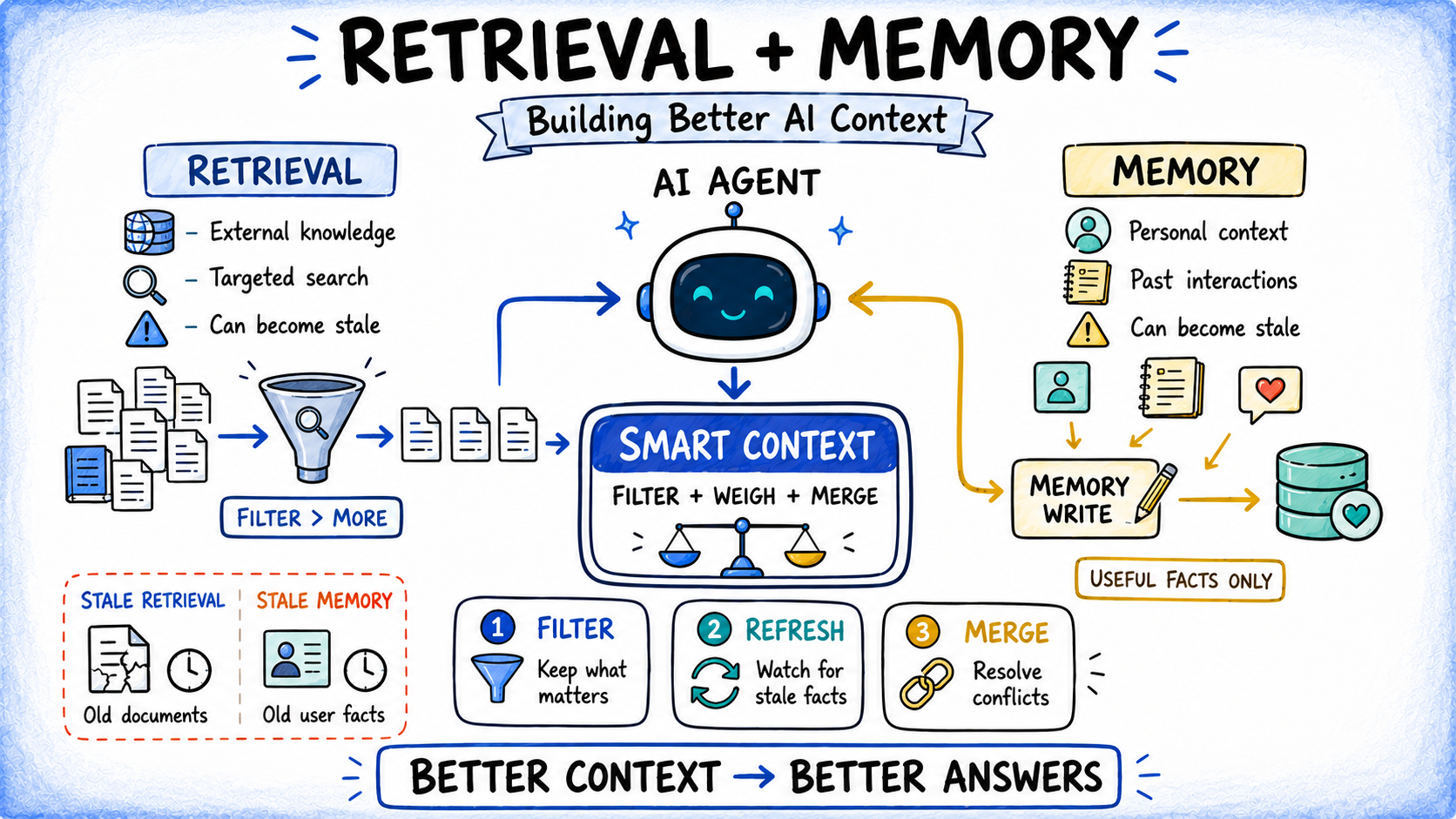
The design work for retrieval and memory comes down to deciding what belongs in each, how aggressively to prune both, and how they come together into a single prompt without handing the model tokens it doesn’t need.
Summary
Retrieval and memory solve different problems in long-running agent systems. Retrieval brings in external information the agent needs at the moment, such as documentation, policies, code, or database records. Memory carries forward information from previous interactions, such as decisions, preferences, and user-specific context. The distinction matters because the two systems have different scopes, freshness concerns, and failure modes. Retrieval depends on keeping external sources up to date, while memory depends on deciding what is worth storing and when stored information is no longer valid.
The most effective agent architectures use both. They filter what enters the context, keep information reasonably fresh, and merge retrieved knowledge with relevant memory instead of treating either as a complete record of everything the agent needs to know.
The goal, therefore, is to give the agent the context it needs, when it needs it, without carrying unnecessary information.