


惯性聚合 高效追踪和阅读你感兴趣的博客、新闻、科技资讯
阅读原文 在惯性聚合中打开

推荐订阅源

I
InfoQ
S
SegmentFault 最新的问题
N
Netflix TechBlog - Medium
B
Blog
Jina AI
Jina AI
人人都是产品经理
人人都是产品经理
奇客Solidot–传递最新科技情报
奇客Solidot–传递最新科技情报
H
Hackread – Cybersecurity News, Data Breaches, AI and More
博客园 - 聂微东
Last Week in AI
Last Week in AI
freeCodeCamp Programming Tutorials: Python, JavaScript, Git & More
V
V2EX
Cyber Security Advisories - MS-ISAC
大猫的无限游戏
大猫的无限游戏
U
Unit 42
J
Java Code Geeks
IT之家
IT之家
aimingoo的专栏
aimingoo的专栏
博客园 - 叶小钗
T
The Blog of Author Tim Ferriss
博客园 - 【当耐特】
Hugging Face - Blog
Hugging Face - Blog
WordPress大学
WordPress大学
腾讯CDC

Hackread – Cybersecurity News, Data Breaches, AI and More

Suspected Cyberattack Sends Fake Emergency Alert to Phones Across Brazil Operation Endgame Disrupts StealC, Amadey and SocGholish Malware Networks New GhostShell Hacking Group Targets Ukraine’s Drone Defense Sector Fake npm Packages Impersonate PostCSS Tool to Steal Chrome Passwords Best Crypto Payment Solutions for E-Commerce Businesses Internet Society Foundation Opens Global Call for Common Good Cyber Fund to Strengthen Cybersecurity LastPass Confirms Customer Data Breach After Klue OAuth Token Theft ‘Cordyceps’ CI/CD Flaw Exposes Microsoft, Google, Apache Repos to Pipeline Hijacking The Rise of AI-Powered Academic Fraud: Beyond Traditional Plagiarism The Evolution of iGaming Fraud: What Security Teams Should Expect in 2027 2 Scattered Spider-Linked Hackers Plead Guilty Over £39M TfL Cyberattack Beats Studio Buds Flaw Could Let Nearby Attackers Eavesdrop on Users Texas Parks and Wildlife Data Breach Affects Over 3M License Customers Threat Hunting Beyond Alerts: Finding the Activity Detection Misses Scammers Use Fake GitHub Stars, VirusTotal Reviews to Spread Crypto Clipper Salesforce Disables Klue Integration After OAuth Token Theft Hits Customer Data MDR Provider Comparison: Time to Discover and Respond to Threats Meteor 3.0 Migration Helped Rocket.Chat Move Off End-of-Life Node.js Runtime Gcore Helps Ucom Safeguard Public Live Broadcast Infrastructure During Armenia’s Parliamentary Elections Nintendo America Employee Data Exposed After Shadowbyt3$ Targets TinyPulse eFAQ Publishes Investigation Into Alleged Scam Activity and Coordinated Reputation Attacks FIFA World Cup 2026: Hackers Target Football Fans With Fake Tickets Sites MacBook Neo vs Windows Laptops for Cybersecurity Tasks Operation Endgame Disrupts SocGholish Malware Infrastructure What Businesses Should Know Before Migrating Their CMS DragonForce Ransomware Abused Microsoft Teams to Hide Malware Activity Agentjacking: Researchers Show How One Fake Bug Report Can Hijack AI Coding Agents FortiBleed Attack Exposes Fortinet Firewall Credentials in 194 Countries SpyCloud Report Finds Phishing Attacks Surge as Employee Data Is Exposed at 86% of Fortune 100 Companies 152 Chrome Live Wallpaper Extensions Hid Ad Tracking and Fake Search Clicks
New CryptoBandits Malware Uses USB Drives and Tor to Stea...
Deeba Ahmed · 2026-06-23 · via Hackread – Cybersecurity News, Data Breaches, AI and More

Microsoft Threat Intelligence and Microsoft Defender Experts have reportedly discovered a Windows-based cryptocurrency clipper, believed to be active since February 2026. Microsoft experts detected the malware as Trojan:Win32/CryptoBandits.A, (CryptoBandits malware), and probing further, they found that it monitors computer clipboards to steal financial data and give hackers remote control over infected systems.

How the Attack Spreads

The malware has a dual-component program, which means it combines a worm component for spreading with a stealer component for targeting financial data. The infection starts via USB flash drives containing malicious shortcut (.lnk) files. Clicking the shortcut launches a hidden worm instead of a document.

This worm hides the original files on the USB drive and creates matching malicious shortcuts to trick more users. To evade detection, it configures Windows Defender exclusions to bypass scanning on its setup folders. It then drops its main files (including two hidden JavaScript files) into a folder under C:\Users\Public\Documents, and finally sets up automatic background tasks to keep running and infect any new USB drives plugged into the computer.

Clipboard Theft and Methods

A notable finding is that the clipper component doesn’t rely on traditional installers. It uses standard built-in Windows script tools (WScript and ActiveXObject) to interact directly with the OS. This helps it run quietly in the computer’s memory and scan the clipboard every 500 milliseconds to detect private cryptocurrency keys and 12 or 24-word backup seed phrases.

As soon as a user copies a crypto wallet address, it replaces it with the attacker’s address. Researchers noted that the malware’s swapping system targets specific wallet formats, including:

  • Monero (starts with 4 or 8): Replaced with a single fixed address.
  • Tron (starts with T) is replaced by matching the first two characters.
  • Bitcoin Taproot (starts with bc1p) and Bech32 (starts with bc1q) are replaced by matching the last character.
  • Bitcoin Legacy (starts with 1) and P2SH (starts with 3) get replaced with an address matching the first two characters.

The program also takes five screenshots, ten seconds apart, to let the hackers view the victim’s wallet balances.
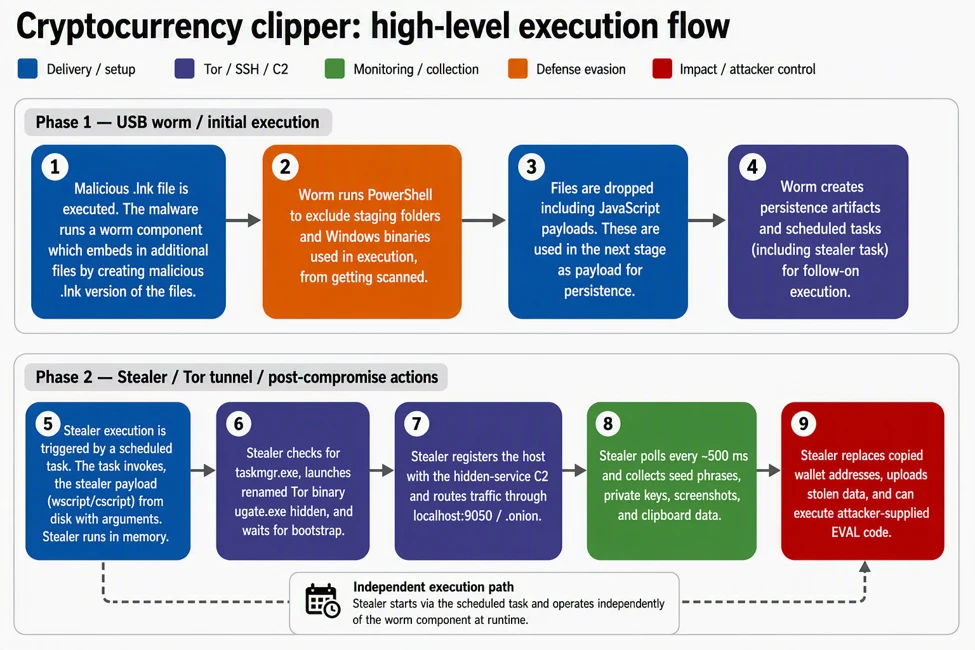
Attack flow (Source: Microsoft)

How it Avoids Detection

The clipper shuts itself down if Task Manager (taskmgr.exe) is running to evade detection. It bundles a built-in Tor privacy tool (ugate.exe) for network communication and a local IP address (127.0.0.1) on port 9050 for routing traffic. This mechanism helps it hide its final destination. A tool called curl is used to send data to a .onion website.

“The bundled Tor client is central to the operation. By routing communication over localhost:9050 and resolving “.onion” destination domains inside Tor, the malware reduces DNS visibility, obscures the final C2 destination, and complicates destination-based blocking. This design gives the operator anonymity benefits while keeping the malware compact and self-contained,” researchers explained in the blog post.

It is also worth noting that the data is sent via three specific endpoints: /route.php to get commands, /recvf.php to upload screenshots, and /stub.php to download files. An EVAL command from the server runs new code hidden in a local file named cfile, granting attackers permanent remote control.

To protect systems, Microsoft advises disabling AutoPlay for removable media, blocking .lnk execution from USBs, and double-checking wallet addresses before transactions.