


SpaceX is preparing for an IPO that, if priced as reported, would be the largest public debut in history. The company is targeting a valuation of about $1.75 trillion and aims to raise $75 billion after reporting $18.67 billion in 2025 revenue.
For decades, allocations in offerings of this scale have remained walled off from everyday market participants. While institutional funds secure early positions, retail investors are typically forced to wait until shares trade publicly. Crypto exchanges are offering a workaround through synthetic exposure to private-company valuations, though these products do not provide equity ownership or shareholder rights.
Historically, gaining exposure to late-stage private companies required navigating a complex and exclusive system. Secondary market shares are notoriously illiquid and plagued by legal friction. They often demand participation through Special Purpose Vehicles that require capital minimums extending well into the six figures. These structures routinely carry hefty management fees and strict lock-up periods.
Pre-IPO perpetual contracts offer a crypto-native alternative that bypasses these legacy hurdles. As Shunyet Jan, Head of Spot and Derivatives Business at Binance, notes, “The momentum we saw in the first days of this category launch is a strong signal that users are looking for new ways to access major market narratives through crypto-native products.”
By replacing private-share ownership with exchange-traded derivatives, platforms reduce some traditional access barriers, though availability still depends on jurisdiction, eligibility, and platform rules.
Jan adds that reaching more than $280 million in cumulative trading volume within five days of their first listing gives the exchange “confidence in both the appeal of Pre-IPO perpetuals and our broader strategy to evolve Binance into a financial super app. As we democratize access to a wider range of financial opportunities, that vision is clearly resonating with users.”
Cryptocurrency exchanges are deploying perpetual futures to synthetically track these private valuations. Products such as the SPCXUSDT contract on Binance, along with similar offerings on OKX, Crypto.com, and decentralized venues like Hyperliquid, allow traders to speculate on the company’s anticipated market capitalization.
Early trading data suggests strong demand for the category, although volume alone does not prove durable product-market fit. Within days of its launch, SpaceX dominated the pre-IPO perpetuals category, accounting for 79% of all trading volume across the sector.
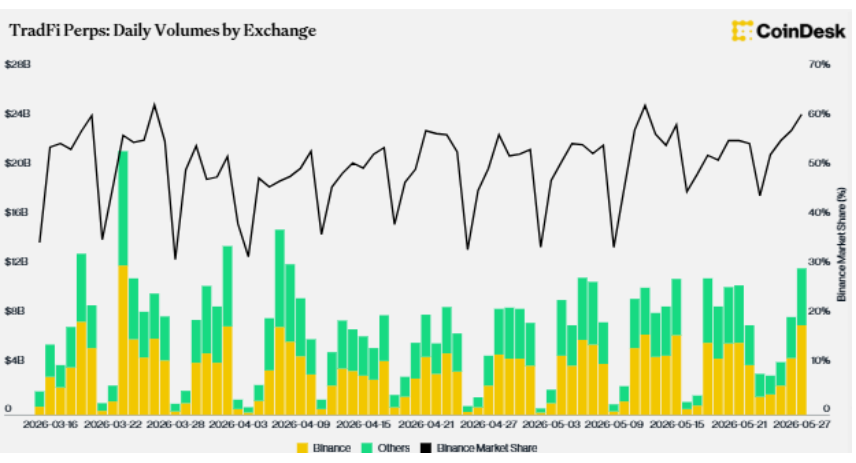
These contracts operate on the same margin infrastructure familiar to digital asset traders. Compared with private-market vehicles, these contracts allow smaller position sizes, but leverage can magnify losses and trigger liquidations.
The contracts are margined and settled in USDT, enabling continuous trading regardless of traditional market hours. This setup allows 24/7 trading and avoids traditional private-market lock-ups, but liquidity can thin during volatility or contract adjustments. It creates a functional bridge between the $13 trillion private-market pricing and standard digital-asset trading rails.
The lifecycle generally has a pre-listing phase and a post-listing adjustment phase, but the exact mechanics vary by exchange. Before listing, pricing is informed by exchange index methodology, secondary-market signals, public disclosures, and IPO filings once available. The contract references a valuation-based index, allowing continuous price discovery well before the stock exchange opens.
The transition mechanism requires careful engineering. Around the transition from pre-IPO pricing to public-market trading, exchanges may adjust contract parameters so the index can move from valuation-based pricing toward share-based pricing. This adjustment can convert the valuation-based index into a share-based perpetual that tracks live market data.
Market participants must navigate substantial gap risk, as the initial public trading price can diverge sharply from pre-IPO estimates. High volatility is expected on opening day, and traders utilizing leverage may face sudden margin requirements if the public market prices the asset differently than the synthetic derivative.
The scale of the SpaceX listing presents unique challenges for the traditional market structure. Recent index-rule changes could create significant passive-fund demand for SpaceX shares after listing, especially from Nasdaq-100-linked products if the company qualifies for fast-track inclusion.
S&P 500 inclusion is less immediate, as existing profitability and eligibility requirements may prevent near-term entry. Any resulting index-linked buying could affect early price action and concentrate liquidity demand around rebalance dates.
Crypto exchanges may provide an additional venue for continuous price discovery before the IPO, though prices can diverge from the eventual public-market price. By allowing traders to express directional views before the listing, these synthetic markets may distribute some pricing expectations ahead of public trading, but they cannot eliminate opening-day volatility or index-flow pressure.
Crypto infrastructure is creating a new form of synthetic access to private-company pricing, but it does not replace direct ownership or regulated IPO allocation. By listing derivatives linked to private-company valuations rather than the shares themselves, digital asset platforms can offer exposure without transferring ownership of the underlying equity.
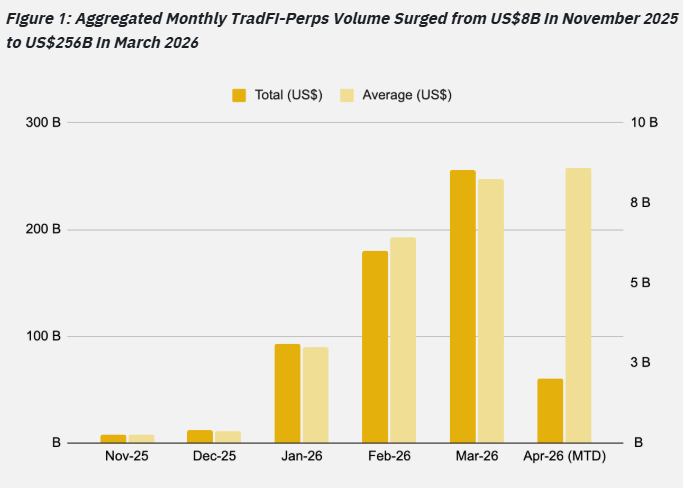
The early demand for SpaceX-linked pre-IPO contracts, alongside surging volumes in traditional-finance perpetuals that reached $8.6 billion in daily volume in March, suggests that retail participants want a larger role in early price discovery.
As these synthetic instruments mature, they may become an important venue for trading expectations around major IPO candidates before public-market trading begins.
(Photo by Anirudh on Unsplash)
此内容由惯性聚合(RSS阅读器)自动聚合整理,仅供阅读参考。 原文来自 — 版权归原作者所有。