


惯性聚合 高效追踪和阅读你感兴趣的博客、新闻、科技资讯
阅读原文 在惯性聚合中打开

推荐订阅源

Hacker News - Newest:
Hacker News - Newest: "LLM"
Webroot Blog
Webroot Blog
S
Security @ Cisco Blogs
H
Heimdal Security Blog
cs.CV updates on arXiv.org
www.infosecurity-magazine.com
N
News and Events Feed by Topic
H
Hacker News: Front Page
K
KPMG report finds enterprise disconnect between AI and its ROI | CIO
cs.AI updates on arXiv.org
Application and Cybersecurity Blog
SecWiki News
SecWiki News
N
News | PayPal Newsroom
T
Tor Project blog
W
WeLiveSecurity
A
Arctic Wolf
Security Archives - TechRepublic
S
Secure Thoughts
月光博客
月光博客
AWS News Blog
AWS News Blog
D
Docker
C
CERT Recently Published Vulnerability Notes
MyScale Blog
MyScale Blog
Google Online Security Blog
大猫的无限游戏
大猫的无限游戏
T
The Blog of Author Tim Ferriss
I
InfoQ
人人都是产品经理
人人都是产品经理
Recent Announcements
Google DeepMind News
Hacker News: Ask HN
Hacker News: Ask HN
Blog — PlanetScale
Blog — PlanetScale
博客园 - 【当耐特】
Engineering at Meta
Engineering at Meta
Stack Overflow Blog
Stack Overflow Blog
Recorded Future
Recorded Future
罗磊的独立博客
Exploit-DB.com RSS Feed
T
The Exploit Database - CXSecurity.com
D
DataBreaches.Net
S
Security Affairs
WordPress大学
WordPress大学
T
Threatpost
Microsoft Security Blog
V
Vulnerabilities – Threatpost
The Hacker News
The Hacker News
S
SegmentFault 最新的问题
B
Blog RSS Feed
Project Zero
Project Zero
P
Proofpoint News Feed

Google Developers Blog

LiteRT.js, Google's high performance Web AI Inference- Google Developers Blog Bridging the Domain Gap: AI Race Coach built with Antigravity and Gemini- Google Developers Blog We terminated a TPU mid-training and it recovered in seconds: Introduction to elastic training with MaxText- Google Developers Blog ML Development in VS Code with Google Cloud Power: Workbench Extension Now Available- Google Developers Blog Why we built ADK 2.0- Google Developers Blog Build agentic full-stack apps with Genkit- Google Developers Blog Driving the Agent Quality Flywheel from Your Coding Agent- Google Developers Blog Build reliable multi-agent applications with ADK Go 2.0. Discover our new graph-based workflow engine, built-in human-in-the-loop, and dynamic orchestration- Google Developers Blog Measuring What Matters with Jules- Google Developers Blog Build Cross-Language Multi-Agent Team with Google’s Agent Development Kit and A2A- Google Developers Blog How A2A is Building a World of Collaborative Agents- Google Developers Blog A2UI + MCP Apps: Combining the best of declarative and custom agentic UIs- Google Developers Blog Announcing the Agentic Resource Discovery specification- Google Developers Blog Enhance Security and Trust: New Session Metadata in Sign in with Google- Google Developers Blog Unlocking the Power of the TPU Stack: Introducing our new Developer Hub- Google Developers Blog DiffusionGemma: The Developer Guide Introducing the Google Colab CLI Bringing Gemma 4 12B to your Laptop: Unlocking Local, Agentic Workflows with Google AI Edge Supercharge your integration workflow with the Google Pay & Wallet Developer MCP server How the community trained Gemma to "Think" with Tunix and TPUs
Gemma 4 12B: The Developer Guide
André Susano Pinto, Andreas Steiner, Karolis Misiunas, Karsten R · 2026-06-03 · via Google Developers Blog

Following the announcement in our launch blog, we are releasing Gemma 4 12B, a dense multimodal model with a unified, encoder-free architecture.

Gemma 4 12B introduces several milestones for local AI:

  1. A multimodal encoder-free architecture: Bypassing heavy multi-stage vision and audio encoders entirely, multimodal data is fed straight into the LLM backbone, reducing multimodal latency.
  2. Our first medium-sized model with audio input: In the Gemma family, audio inputs were restricted to small, lightweight edge architectures (e.g. E4B). Gemma 4 12B is the first medium-sized model capable of natively ingesting audio.
  3. Developer-friendly size: Small enough to run locally on dedicated GPU laptops with 16GB VRAM or unified memory. To maximize local inference speeds, we are additionally releasing a dedicated multi-token prediction (MTP) model.
  4. New MacOS desktop experience: For the first time, we are releasing downloadable macOS desktop applications, letting developers experience fully local spoken and visual interaction directly on consumer-grade devices.

The Architecture

Traditional multimodal models rely on frozen, separate vision encoders (e.g., Gemma 4 uses a 150M parameter vision model for edge sizes and 550M for medium-sized models) and audio encoders (300M parameters for Gemma 4 E2B and E4B). Processing multimodal inputs with multiple separate encoders before feeding them to the LLM leads to increased latency and fragmented memory footprints.

Gemma 4 12B solves these issues by utilizing a single decoder-only transformer containing the same advanced decoder structure as the Gemma 4 31B Dense model.
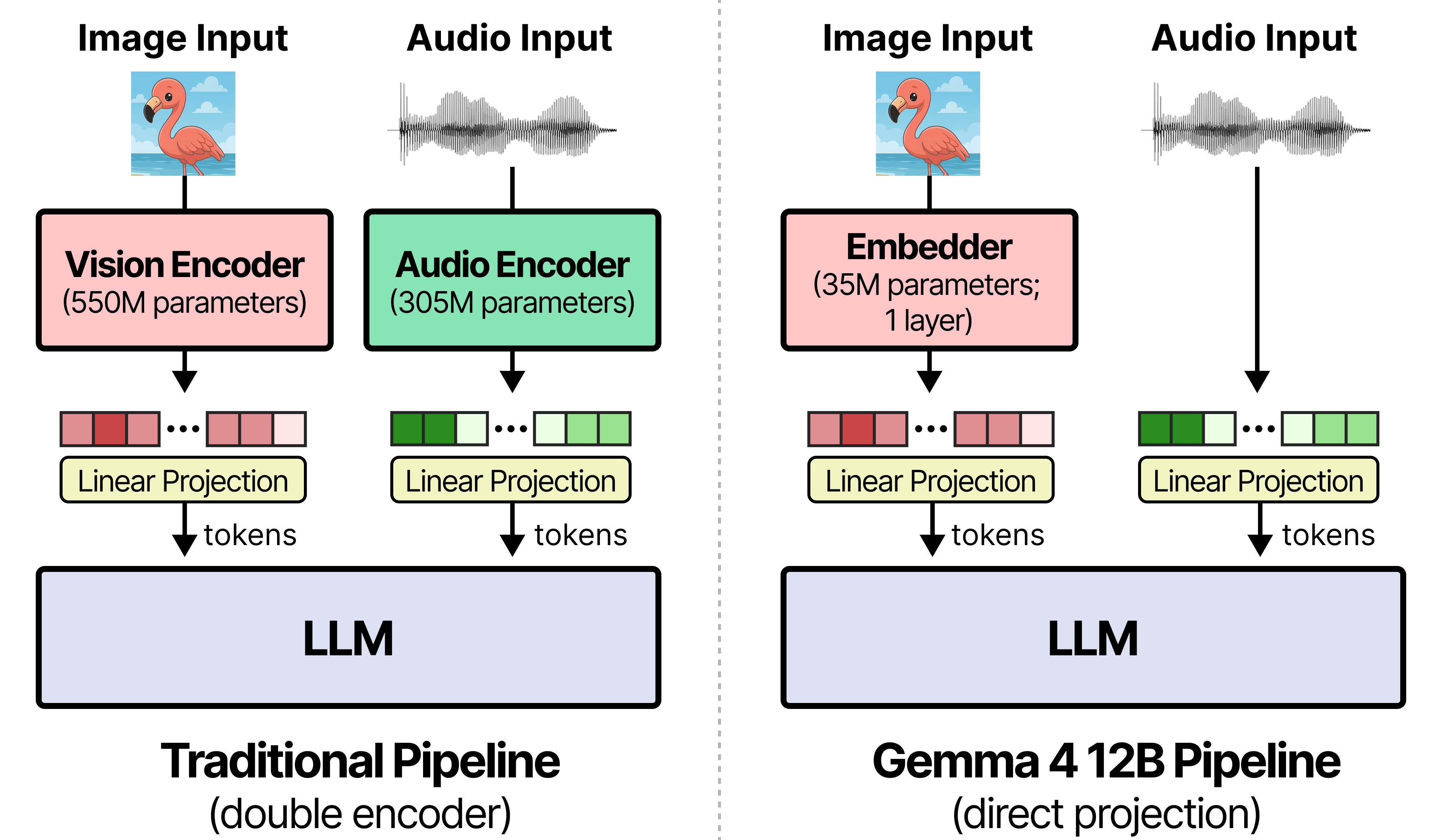
overview

  • Vision embedder (35M parameters): Replaces the 27 vision transformer layers of the other medium-sized Gemma 4 models. Raw 48x48 pixel patches are projected to the LLM hidden dimension with a single matmul. A factorized coordinate lookup (X and Y matrices) attaches spatial location information directly to the input.
  • Audio wave projection: Eliminates the separate audio encoder (skipping the 12 conformer layers used in Gemma 4 E2B and E4B). Raw 16 kHz audio signals are sliced into 40ms frames (640 floats each) and projected linearly to the LLM input space.
  • Unified fine-tuning advantage: Because vision, audio, and text inputs share the exact same weights, you no longer have to co-tune separate frozen encoders. Downstream adapter (e.g. LoRA) or full tuning naturally update the entire multimodal token loop in a single pass (via Hugging Face or Unsloth).

For a more in-depth overview of how this encoder-free architecture works, check out A Visual Guide to Gemma 4 12B.

Capabilities

Gemma 4 12B achieves outstanding performance, with capabilities such as automatic speech recognition, agentic reasoning, diarization, video understanding, coding, and more.

See below examples for a demonstration of the model's agentic and multimodal capabilities:

Example 1: Gemma 4 12B creates a local image processing app that uses Gemma 4 12B

Thanks to its agentic and multimodal understanding capabilities, Gemma 4 12B can be easily used with existing agent harnesses like OpenCode. In this example, we served it locally using llama.cpp using the gemma-skills to code a Gradio app that helped the user process images. This app was powered by the same Gemma 4 12B model that built it!

Example 2: Processing 5 minutes of Video at 1 FPS with audio

We used Gemma 4 12B to analyse a part from the Google IO Keynote moment from May 19, specifically the 5 minutes between 00:15:32 and 00:20:45. To do that, we extracted all the frames of that segment (at 1 FPS), plus the prompt and the audio from the video:

Prompt:

  1. 313 frames (at 1FPS, images resized to visual token budget 70)
  2. "what happens when the man takes a selfie?"
  3. the Video's audio + the prompt below
When the man takes a "selfie" or is shown holding a smartphone in front of his face in these demonstration videos, it is a clever way to visually represent how the AI models can take existing media—like a personal photo or a video clip—and "reimagine" it. In these specific clips, the model is taking a selfie and using it as a base to generate various scenarios (like a person in a space station, or walking through a forest).

Essentially, the man is not actually taking a selfie; rather, he is **acting out a visual metaphor for the AI's capability to take one specific input (a "selfie") and generate a whole world of new content based on it.** This is part of the "Swap" and "Build worlds" demonstrations of the Gemini Omni model, showing its ability to perform complex, multi-modal reasoning and creative generation.

On-Device & Desktop Serving: Powered by LiteRT-LM

In tandem with the Gemma 4 12B launch, we are officially introducing powerful on-device developer integrations powered by LiteRT-LM, bringing zero-latency local AI execution natively to standard desktop environments:

1.Native MacOS Apps: The mobile Google AI Edge Gallery is officially expanding to desktop platforms, running Gemma 4 12B offline, natively on Apple Silicon GPUs. It comes with a secure sandboxed Python execution loop to write, execute, and plot scientific charts inside the chat bubble. In parallel, the Google AI Edge Eloquent app on Mac launches support for Gemma 12B to power Voice Edit conversational inputs.

2. Drop-in Local API Servers (litert-lm serve): Run Gemma 4 12B as a local, OpenAI-compatible API server using the new litert-lm serve CLI command. Seamlessly connect standard integrations (e.g., Continue, Aider, OpenClaw, Hermes or OpenCode), leveraging stateless prefix caching in memory to match context history and instantly bypass prefill latency.

litert-lm import --from-huggingface-repo=litert-community/gemma-4-12B-it-litert-lm  gemma-4-12B-it.litertlm gemma4-12b

# Start the OpenAI-compatible server
litert-lm serve

Shell

Copied

Find a deep dive about it on the Google AI Edge Gallery blog.

Getting Started Today

Ready to build local multimodal agents with the first encoder-free architecture of the Gemma family? Here is how you can jump in today