


惯性聚合 高效追踪和阅读你感兴趣的博客、新闻、科技资讯
阅读原文 在惯性聚合中打开

推荐订阅源

U
Unit 42
P
Proofpoint News Feed
The Last Watchdog
The Last Watchdog
S
Secure Thoughts
cs.AI updates on arXiv.org
N
News | PayPal Newsroom
Application and Cybersecurity Blog
O
OpenAI News
S
Security @ Cisco Blogs
宝玉的分享
宝玉的分享
Hacker News: Ask HN
Hacker News: Ask HN
T
Troy Hunt's Blog
Google Online Security Blog
WordPress大学
WordPress大学
有赞技术团队
有赞技术团队
TaoSecurity Blog
TaoSecurity Blog
Help Net Security
Help Net Security
Latest news
Latest news
NISL@THU
NISL@THU
S
Security Affairs
博客园_首页
C
CXSECURITY Database RSS Feed - CXSecurity.com
博客园 - 聂微东
AI
AI
www.infosecurity-magazine.com
Recent Announcements
P
Privacy & Cybersecurity Law Blog
小众软件
小众软件
cs.CV updates on arXiv.org
Hugging Face - Blog
Hugging Face - Blog
博客园 - 司徒正美
AWS News Blog
AWS News Blog
W
WeLiveSecurity
Google DeepMind News
I
InfoQ
Schneier on Security
Recent Commits to openclaw:main
T
The Exploit Database - CXSecurity.com
IT之家
IT之家
T
Threatpost
Scott Helme
Scott Helme
L
LINUX DO - 热门话题
腾讯CDC
CTFtime.org: upcoming CTF events
N
News and Events Feed by Topic
L
LINUX DO - 最新话题
F
Full Disclosure
大猫的无限游戏
大猫的无限游戏
H
Heimdal Security Blog
S
SegmentFault 最新的问题

Google Developers Blog

LiteRT.js, Google's high performance Web AI Inference- Google Developers Blog We terminated a TPU mid-training and it recovered in seconds: Introduction to elastic training with MaxText- Google Developers Blog ML Development in VS Code with Google Cloud Power: Workbench Extension Now Available- Google Developers Blog Why we built ADK 2.0- Google Developers Blog Build agentic full-stack apps with Genkit- Google Developers Blog Driving the Agent Quality Flywheel from Your Coding Agent- Google Developers Blog Build reliable multi-agent applications with ADK Go 2.0. Discover our new graph-based workflow engine, built-in human-in-the-loop, and dynamic orchestration- Google Developers Blog Measuring What Matters with Jules- Google Developers Blog Build Cross-Language Multi-Agent Team with Google’s Agent Development Kit and A2A- Google Developers Blog How A2A is Building a World of Collaborative Agents- Google Developers Blog A2UI + MCP Apps: Combining the best of declarative and custom agentic UIs- Google Developers Blog Announcing the Agentic Resource Discovery specification- Google Developers Blog Enhance Security and Trust: New Session Metadata in Sign in with Google- Google Developers Blog Unlocking the Power of the TPU Stack: Introducing our new Developer Hub- Google Developers Blog DiffusionGemma: The Developer Guide Introducing the Google Colab CLI Gemma 4 12B: The Developer Guide Bringing Gemma 4 12B to your Laptop: Unlocking Local, Agentic Workflows with Google AI Edge Supercharge your integration workflow with the Google Pay & Wallet Developer MCP server How the community trained Gemma to "Think" with Tunix and TPUs
Bridging the Domain Gap: AI Race Coach built with Antigravity and Gemini- Google Developers Blog
David Mclaughlin, Ajeet Mirwani · 2026-07-08 · via Google Developers Blog

Ajeet Mirwani Americas Program Lead, Google Developer Experts

On May 23, 2026, fresh off the stage at Google I/O, our Google Developer Experts (GDEs) converged on Sonoma Raceway to get inspired and build a real-time, AI-powered race coach. While our pilot proved we could process basic telemetry, Sonoma was about taking the next step: using Antigravity and Gemini to create an AI tool that gives drivers split-second, actionable advice to improve their lap times on the track.

We are closing the AI trust gap by grounding our architecture in physics and real-time verification so people feel confident handing over high-stakes decisions to generative models. For instance, rather than offering theoretical advice, the system pinpointed a new throttle application zone mid-corner in Turn 2, securing a 0.1-second advantage where failure is not an option.

Bridging the domain gap with Google Antigravity

One of the most powerful revelations from Sonoma was how Antigravity served as a domain-bridging engine to build an AI Race Coach that grounded our Trustable AI architecture. Our GDEs, who are expert software engineers, used Antigravity to handle stateful orchestration and telemetry ingestion from the race cars. This allowed builders to focus on high-level system behavior and coaching methods provided by racing experts, demonstrating how AI can empower teams to build real-world applications in unfamiliar domains. The Antigravity product teams were on-site filming this exact transition, capturing how developers move from vibe coding to production-grade deployment at the edge.

Gemini_Generated_Image_8nq8lw8nq8lw8nq8

From prototype to production-grade Edge AI

At Sonoma, the GDEs operated in a specialized matrix, similar to enterprise adoption tiers to prove Trustable AI scales to meet organizational challenges.

  • The Entry-Level Tier (Beginner Pod): This team mirrored the initial adoption phase of enterprise AI, focusing on accessibility and intuitive coaching pedagogy.
  • The Optimization Tier (Intermediate Pod): Representing growth-phase integration, they used advanced data logging systems to maximize platform capabilities through precise threshold management.
  • The Mission-Critical Tier (Pro-Tier Pod): This team tackled extreme domain gaps in racing, processing massive real-time telemetry and collaborating with pro-level drivers to identify performance gains beyond human perception.

The stack behind the speed

The success at Sonoma Raceway was underpinned by a sophisticated technology stack designed for high-velocity inference. While Antigravity acted as the critical orchestration "glue," the framework leveraged the power of Google Cloud Platform (GCP) and Agent Development Kit (ADK) to facilitate deep, online analysis of telemetry data. This combination allowed the GDEs to bridge the gap between raw data ingestion and actionable strategic insights.

105011094-GBMG2991 (1)

Core product stack:

  • Antigravity for real-time code iteration and domain expertise bridging.
  • Python for backend telemetry ingestion and data parsing.
  • Agent Development Kit (ADK) managing a collection of agents orchestrating key functions.
  • Jetpack Compose powering the high-refresh Android cockpit dashboard without dropping frames under heavy telemetry loads.
  • Gemini API managing complex post-session driver modeling and cloud reasoning.
  • Gemma 4 running locally as an edge-intelligence layer for zero-latency, offline audio coaching alerts.
  • Text-to-Speech (TTS) integration for real-time auditory delivery.

Gemini_Generated_Image_nk5kb8nk5kb8nk5k

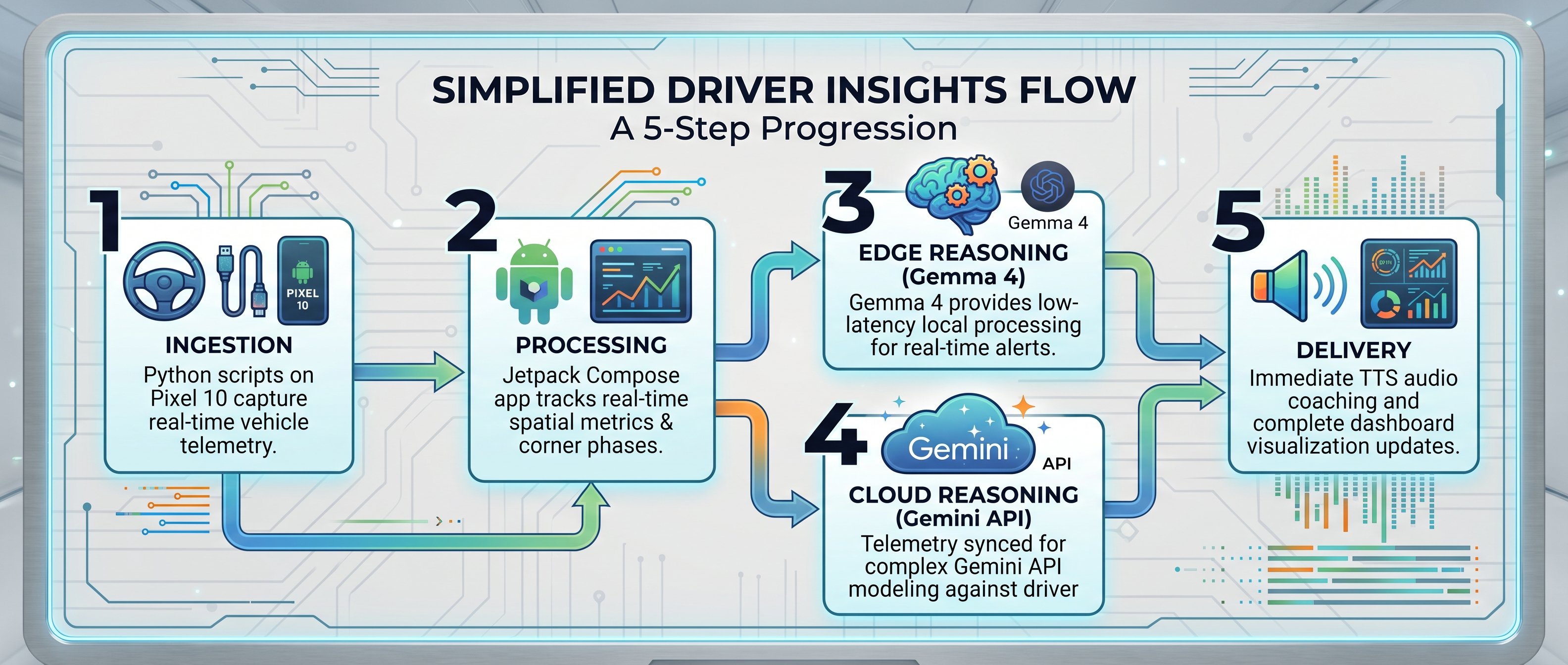
Architecture flow:

The architecture flow details a high-velocity data pipeline that translates raw racing telemetry into real-time driver coaching across five key stages. It demonstrates how data moves from edge ingestion and real-time processing to hybrid edge-cloud reasoning, culminating in immediate auditory and visual insights.
Gemini_Generated_Image_cbbrhccbbrhccbbr

  1. Ingestion: Python scripts running on Pixel 10 interface with the vehicle to capture real time telemetry directly at the mobile edge.
  2. Processing: The Android app built using Jetpack Compose to fluidly track spatial metrics and display corner phases in real-time.
  3. Edge Reasoning: Gemma 4 processes the localized stream with low-latency, acting as a fail-safe for real-time alerts when cellular connectivity drops.
  4. Cloud Reasoning: Telemetry is synced to the cloud where the Gemini API evaluates performance against our established driver models.
  5. Delivery: Immediate insights trigger TTS audio coaching, while complex visualizations update the Compose dashboard.

Our edge architecture required a resilient data pipeline to actually work in the hostile environment of a race car at 100 mph. We are incredibly grateful to community member Brian Luc for solving the hardware gap. He engineered a custom USB interface that wired the Pixel 10 directly into the vehicle telemetry network. This allowed the phone to bypass standard wireless latency and pull a 10 Hz data stream straight from the car’s hundreds of sensors, giving the AI the exact physical inputs needed to execute coaching decisions in real time.

The breakthrough of the Sonoma test was the technical activation of the Pixel 10 TPU. By collaborating with Android engineers to activate the on-device TPU, performance surged to 40 tokens per second. This jump provided the real-time reliability required to deliver coaching exactly when the driver needed it.

This architecture translates directly to mission-critical enterprise domains. Startup founders like Vijay Vivekanand (COI Energy) and Jorge Mendieta (Bloom Energy) joined the cohort to explore how agentic orchestration can secure energy pipelines and manage agriculture respectively. By proving the framework at 100 mph, we are paving the way for trustable AI in industries where failure is not an option.

The global sprint: Destination interlagos

The Sonoma evolution is just the beginning. To maintain our momentum, the initiative heads next to Interlagos, Brazil. There, we will further harden the architecture in a new climate and complex track configuration, continuing our mission to bridge the AI Trust Gap across the world.

IMG_20260528_113543 (5)

Members of the July cohort of the "AI Field Test"

Ready to build?

Get hands-on with the same tech we used on the track. If you are ready to move beyond vibe coding and start building on the pro-tier of Vertex AI, get started with our ADK Crash Course. Then, take it to the next level by building your own AI Race Coach with the Trustable AI Codelab.

Deep Dives from our GDEs