





You know, sometimes it’s kind of hard to explain the “circular” part of circular financing to people, in the sense that some of the agreements are kind of clunky. NVIDIA funds OpenAI, who then spends that money to rent back NVIDIA GPUs from Microsoft, Google, Amazon, or CoreWeave, and then that money is used…to buy servers from Taiwanese ODMs (original design manufacturers) that build their servers, who then buy GPUs from NVIDIA to put in them.
The reason it’s clunky is that people will, even if it’s not true, claim that there’s some indeterminately-large “other” subset of customers that are also buying compute or NVIDIA GPUs, and that we should as a result ignore our lying eyes and, if anything, celebrate how well this is all working. While there’s a ‘circle’ of ‘finance,’ it’s not a problem because somewhere in the mess of money exists a few real dollars, and because we can’t precisely measure them, there’s nothing to be concerned about!
Fear not, dear reader, because we finally have a pure, unfiltered circular financing operation to obsess over — SoftBank subsidiary SB Energy just filed its S-1, and it’s so incredibly circular that I’m genuinely surprised that they bothered to list.
That’s a good question, and not as obvious an answer as you’d think.
So, SB Energy is/was a renewable energy business, one that was technically founded in 2019, but sold most of its shares (along with most of its wind and solar power) to Toyota in April 2023, which then became a company called “Terras Energy,” leaving SoftBank with 15% of the remaining shares. While it’s unclear what exactly was left behind, a company called SB Energy raised $2.4 billion from a consortium of banks in November 2023, then re-emerged in 2024 as a data center power company for Google in Milam County (called Orion), raising $500 million from SoftBank and asset manager Ares, and in early 2025 was mentioned in the initial announcement of the non-existent Stargate data center project in relation to an OpenAI-focused data center in Milam County Texas, which suggests the Google deal is done and OpenAI will take over.
All remained fairly quiet for SB Energy until January 2026, when OpenAI and SoftBank invested $500 million each, and a few months later in March, a consortium of Japanese and US companies announced their intention to build a data center on a Department of Energy site in Piketon, Ohio. In August 2026, SB Energy and OpenAI announced a deal where it would lease 10GW of capacity, at some point in the future, with NVIDIA backstopping $105 billion of the deal, though it turned out that the actual terms were that if it gets built, NVIDIA will cover the difference if nobody else will lease it and if selling off the pieces doesn’t amount to $105 billion. The critical words there are if it gets built, because NVIDIA does not have to pay a dime if it isn’t.
NVIDIA has also agreed to invest $3 billion, with $1.5 billion up front, with another $1.5 billion, per the Journal, as a “prepaid forward contract,” meaning it’ll get paid the shares on the close of the offering. SB Energy also provided 4 million share warrants to OpenAI, along with a board designation right as long as it owns 5% of shares, per the Journal, at a value of approximately $5.5 billion.
SB Energy made about $138 million in the first half of 2026, predominantly from selling power. Its data center division made a whopping $653,000.
Not to worry though, SB Energy has tons of capacity under construction…
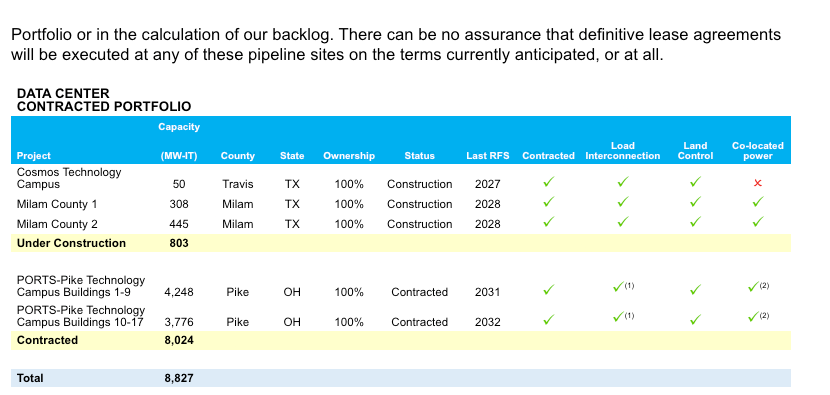
…except 99.4% of that capacity is earmarked for OpenAI, and based on that “RFS” (ready for service) date, it looks like none of it will come online before 2028. In fact, virtually the entirety of SB Energy’s revenue is contingent on A) finishing these data centers and B) OpenAI being able to pay for them.
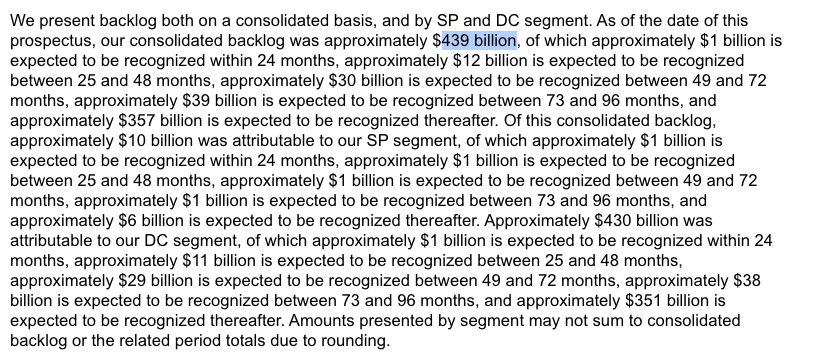
Well, let’s not get too worried. Perhaps SB Energy has other data center capacity somewhere? No, no, that’d show up there. Maybe it will…make…money elsewhere? Somehow? I hear it has a $439 billion backlog, it’s gotta make that money at some point, right?
Jesus fucking christ!
I realize that’s a big pile of numbers and words, but of that $439 billion, SB Energy estimates that it will make $1 billion of it within the next two years, $12 billion of it within the next four years, $30 billion of it within the next six years, $39 billion within the next eight years, and $357 billion at some point after that. 97% of SB Energy’s revenue backlog will arrive more than four years in the future, and will be contingent on SB Energy being able to spend $178 billion in capital expenditures.
OpenAI’s leases are split across 17 different SPVs, all of which I assume will try to raise debt at some point.
To summarize, SoftBank portfolio company SB Energy has signed $439 billion in business with SoftBank portfolio company OpenAI, which is also an investor in SB Energy, as well as its largest (and only real) client. Its ability to make any of this money relies upon it completing two different and incredibly ambitious infrastructure projects — a 1GW data center in Milam County Texas, and a 10GW buildout in Ohio, the latter of which is only half backstopped by NVIDIA if it actually gets built.
Let’s be frank: this IPO is only made possible by circular financing, with the vast majority of its valuation coming from entirely-theoretical deals with a company that cannot afford to pay it for data center capacity it cannot afford to build.
This is about as blatant an “emperor has no clothes” situation as you could ask for. 99.4% of SB Energy’s future revenue is contingent upon building data center capacity, which will take years, using funds that have not been raised, all for a customer that will need to make more than ten times its current revenue to pay it.
Anyone writing about this IPO should be directly informing investors that they are, for the most part, investing in a few signatures and strips of land owned by a company that has, to this point, not actually built an AI data center.
Instead, most blandly repeat that SB Energy “has a huge contract with OpenAI” and "hundreds of billions of dollars in its revenue backlog.”
While last week’s premium focused heavily on NVIDIA, today I’m digging into the rest of the AI bubble’s circular suspects, as well as the history of circular financing itself, as a means of explaining exactly how brittle and dangerous this all is.
此内容由惯性聚合(RSS阅读器)自动聚合整理,仅供阅读参考。 原文来自 — 版权归原作者所有。