



惯性聚合 高效追踪和阅读你感兴趣的博客、新闻、科技资讯
阅读原文 在惯性聚合中打开

推荐订阅源

爱范儿
爱范儿
Y
Y Combinator Blog
博客园 - Franky
D
Docker
B
Blog RSS Feed
M
MIT News - Artificial intelligence
雷峰网
雷峰网
博客园 - 司徒正美
人人都是产品经理
人人都是产品经理
宝玉的分享
宝玉的分享
S
SegmentFault 最新的问题
GbyAI
GbyAI
Recent Announcements
Martin Fowler
Martin Fowler
H
Hackread – Cybersecurity News, Data Breaches, AI and More
MyScale Blog
MyScale Blog
B
Blog
H
Help Net Security
Microsoft Security Blog
WordPress大学
WordPress大学
Vercel News
Vercel News
The Cloudflare Blog
OSCHINA 社区最新新闻
OSCHINA 社区最新新闻
Google DeepMind News

NVIDIA Blog

Cute Critters Come to the Cloud: ‘Aniimo’ Launches on GeForce NOW NVIDIA Vera Rubin NVL72 Delivers Leading Performance in MLPerf Inference v6.1 Debut Emerald AI, Google and NVIDIA Launch Alliance to Advance Flexible AI Data Centers University of Manchester Uses NVIDIA Earth-2 to Forecast Air Pollution Across the UK ‘Now We Can Know Everything and Do Anything,' Jensen Huang Says at Dreamforce From Megawatts to Tokens: How NVIDIA Maximizes AI Factory Production AI Infra Summit: NVIDIA Vera Rubin and DSX Platform Advancements Showcase Energy Efficiencies of Optimizing Tokens Per Watt for AI Factories Heart of the Matter: How a Major Children’s Hospital Uses Open Source NVIDIA AI for Cardiac Care Perplexity Portable Computer Is Now Available on Windows, Powered by NVIDIA RTX Skild AI Taps NVIDIA Physical AI to Teach Robots New Tasks From a Single Video d-Matrix Adopts NVIDIA NVLink Fusion for Rack-Scale XPU Deployment Boots on the Ground: ‘WARDOGS’ Goes All Out on GeForce NOW at Early-Access Launch NVIDIA Brings Real-Time AI to Broadcast, Sports and Global Streaming at IBC Sparks Fly: NVIDIA Accelerates Local AI at IFA 2026 ‘NBA 2K27’ With NVIDIA DLSS 5 Leads 26 New Games Coming to GeForce NOW NVIDIA to Acquire Hugging Face NVIDIA and CrowdStrike Strengthen Agentic Cybersecurity Frontier GeForce NOW Gives Gamers More Ways to Play at Gamescom 2026 NVIDIA NVLink Fusion Expands With NVHBM Custom High-Bandwidth Memory Leading Publishers Bring Blockbuster PC Games and Technology to NVIDIA RTX Spark How XPUs Meet a World-Class AI Factory With Groq 3 LPX in Full Production, NVIDIA Extends Vera Rubin Inference for Agents Up to 30x More Work Per Watt: NVIDIA Vera Rubin NVL72 Sets a New Efficiency Standard for AI Agents Bring the Fire: Play Games on GeForce NOW With New Firefox Browser Support Securing the Infrastructure of Intelligence Universitas Gadjah Mada, Indosat and NVIDIA Open Indonesia’s First University AI Center to Develop Local AI Talent Class Is in Session: GeForce NOW Levels Up Linux, Chromebooks and More NVIDIA CEO Tops Glassdoor’s 2026 List of Best CEOs NVIDIA AI Factory Compute Is Becoming an Investable Asset Class Why Scaling AI Compute Performance Requires a New Power Architecture
Physical AI Takes the Wheel: How the World’s Robotaxi Lea...
Ali Kani · 2026-09-11 · via NVIDIA Blog

The global robotaxi market — physical AI’s first commercial breakthrough — is projected to reach $400 billion by 2035, with over 6 million commercial vehicles in operation as driverless fleets are already moving people through some of the world’s busiest and most complex streets.

Deploying a driverless vehicle is one challenge. Scaling a fleet is a next-level computing challenge; it means delivering the same safe, reliable performance across thousands of vehicles. 

Meeting those demands requires enormous amounts of compute across the robotaxi development lifecycle, from preparing and training AI models to simulating and validating driving behavior, as well as real-time processing in the vehicle. 

NVIDIA provides an open platform for AI training, simulation and safety validation, with libraries, software development kits, workflows and models that developers can use alongside their own technology stacks.

Every major robotaxi program operating at commercial scale today is running on NVIDIA’s modular stack, spanning AI training, simulation, in-vehicle computing — or a combination of the three — to develop and deploy fleets at scale. 

What Is a Robotaxi Technology Stack?

A robotaxi technology stack is the end-to-end set of technologies used to develop, validate and deploy autonomous vehicles (AVs) — from data and AI model training to simulation, safety validation and real-time in-vehicle computing. 

NVIDIA’s robotaxi and AV platform brings these capabilities together in a three-computer solution: the model training computer, simulation and validation computer, and in-vehicle computer.

1. Training Computer: NVIDIA DGX

Robotaxi intelligence advances as programs turn growing volumes of fleet data into increasingly capable models. Driving models can be trained on NVIDIA DGX systems. 

The NVIDIA Alpamayo portfolio of open reasoning vision language action (VLA) models, simulation frameworks and physical AI datasets gives developers building blocks they can adapt to their own data, requirements and technology stacks. Its reasoning models help address long-tail AV challenges by breaking complex driving situations into smaller steps, reasoning through each one and selecting the safest trajectory. 

NVIDIA also provides physical AI datasets, reinforcement learning blueprints and recipes for post-training and distillation, helping developers optimize models for their target vehicles.
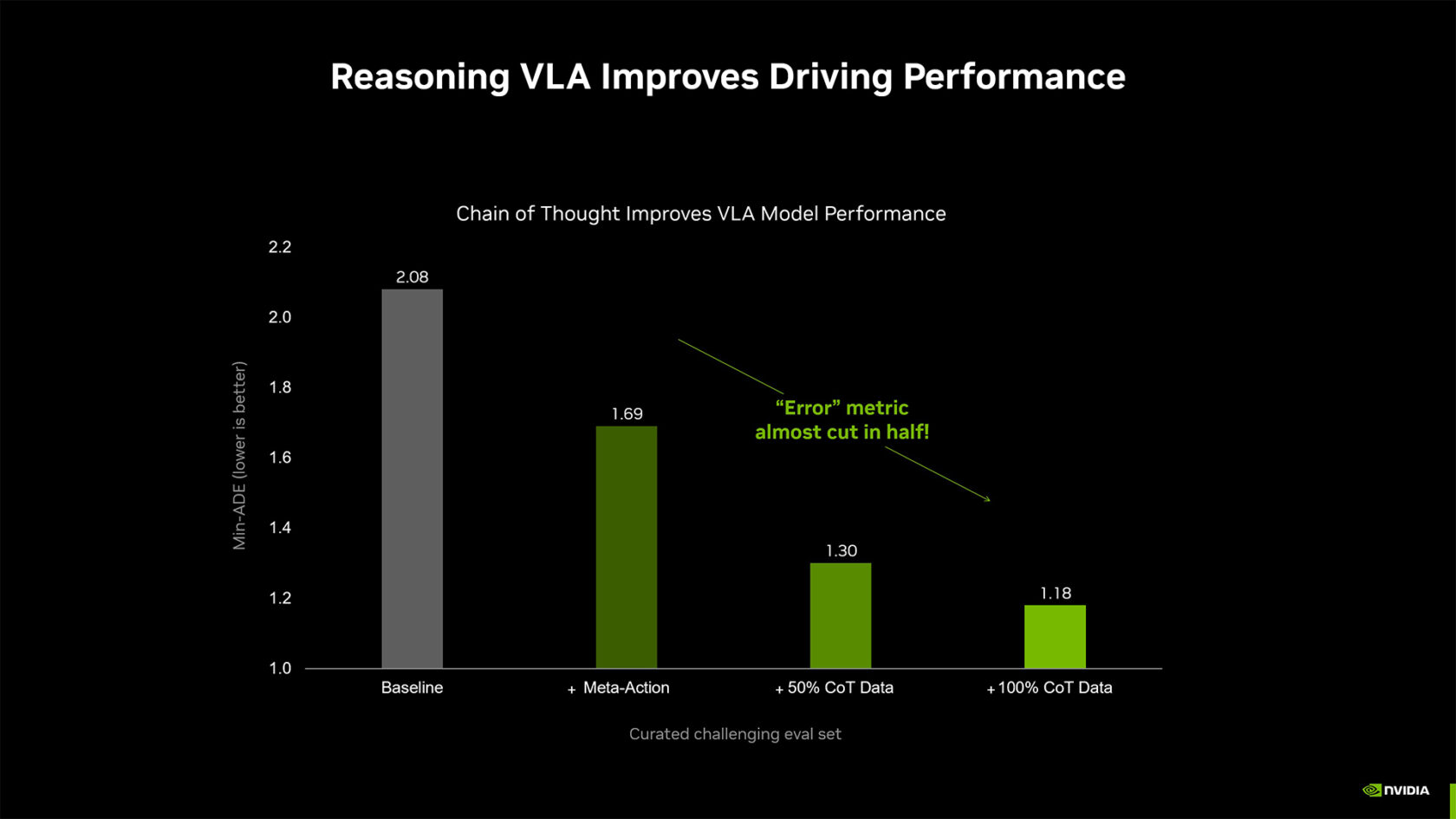
On a challenging autonomous driving evaluation, adding meta-action and chain-of-thought reasoning data improved a VLA model’s trajectory prediction accuracy, reducing minimum average displacement error — the predicted path’s average deviation from the reference route — by 43%, from 2.08 to 1.18.

2. Simulation and Validation Computer: NVIDIA Omniverse and Cosmos on NVIDIA RTX PRO 

Robotaxi programs can’t rely on physical miles alone to capture rare, long-tail driving scenarios. NVIDIA Omniverse NuRec models reconstruct real-world driving scenarios from sensor data, while NVIDIA Cosmos world foundation models generate physically based variations of them, enabling developers to turn thousands of real-world corner cases into millions of combinations of driving behavior, traffic, weather, lighting and sensor conditions.
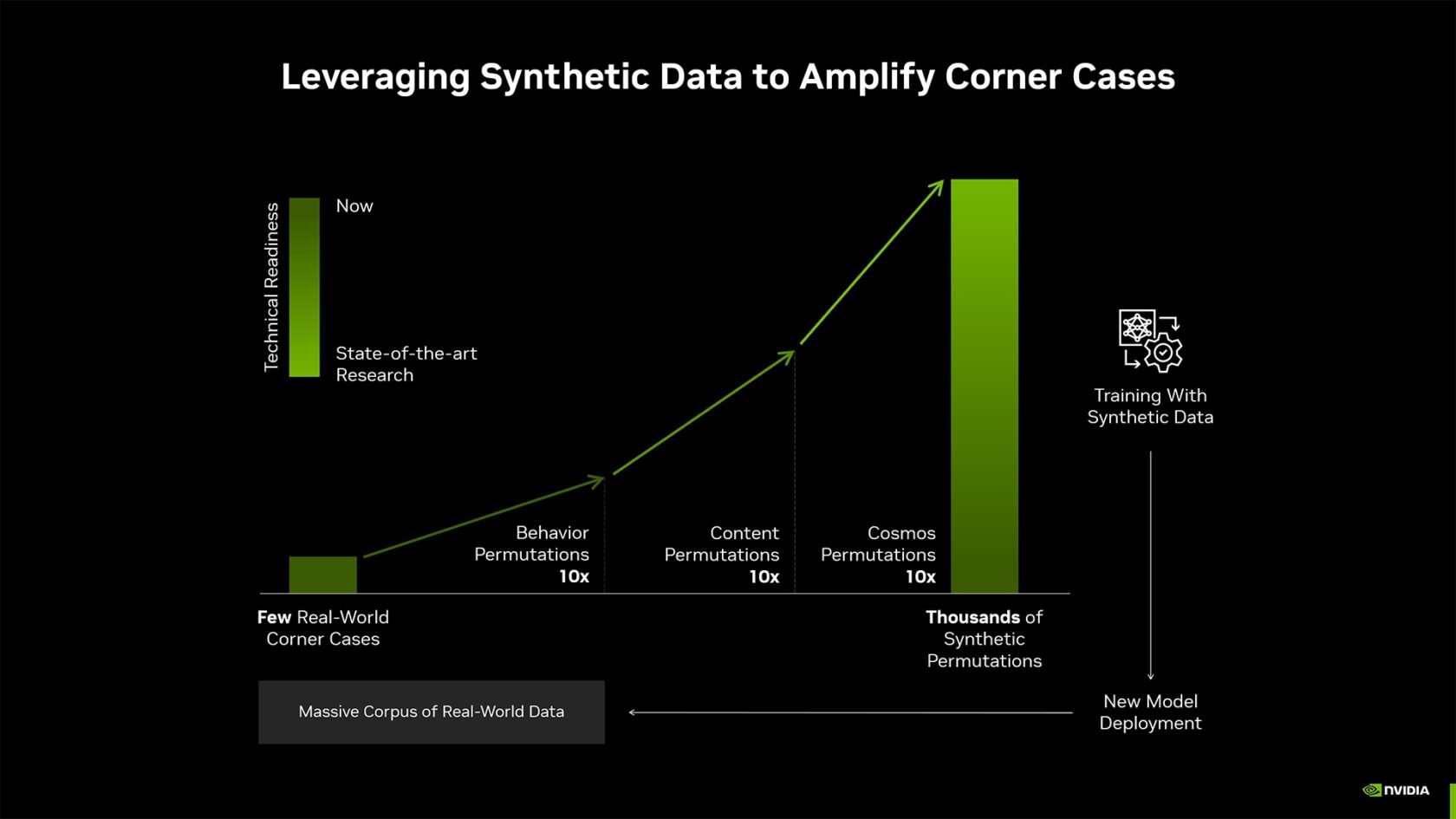
From real-world corner cases to thousands of synthetic permutations spanning behavior and content, NVIDIA Cosmos variations expand AV training data and accelerate model deployment.

Running on NVIDIA RTX PRO Servers, NVIDIA Omniverse and Cosmos support closed-loop simulation and validation. The NVIDIA AlpaSim simulation framework extends the workflow for training and evaluating reasoning-based autonomous-driving models, helping developers identify weaknesses before deployment.

3. In-Vehicle Computer and Sensor Architecture: NVIDIA DRIVE Hyperion With DRIVE AGX

NVIDIA DRIVE Hyperion is NVIDIA’s modular in-vehicle compute and sensor reference architecture for level-4-ready robotaxis. DRIVE Hyperion 10 pairs dual NVIDIA DRIVE AGX Thor systems-on-a-chip, built on the NVIDIA Blackwell platform, with 14 high-definition cameras, nine radars, three lidars and 12 ultrasonics for real-time, 360-degree sensor fusion. Its redundant compute and sensing design supports fail-operational driving if a sensor or compute component fails.

The dual DRIVE AGX Thor is designed to run modern AI workloads — including VLA models — for perception, reasoning, path planning and driving actions.
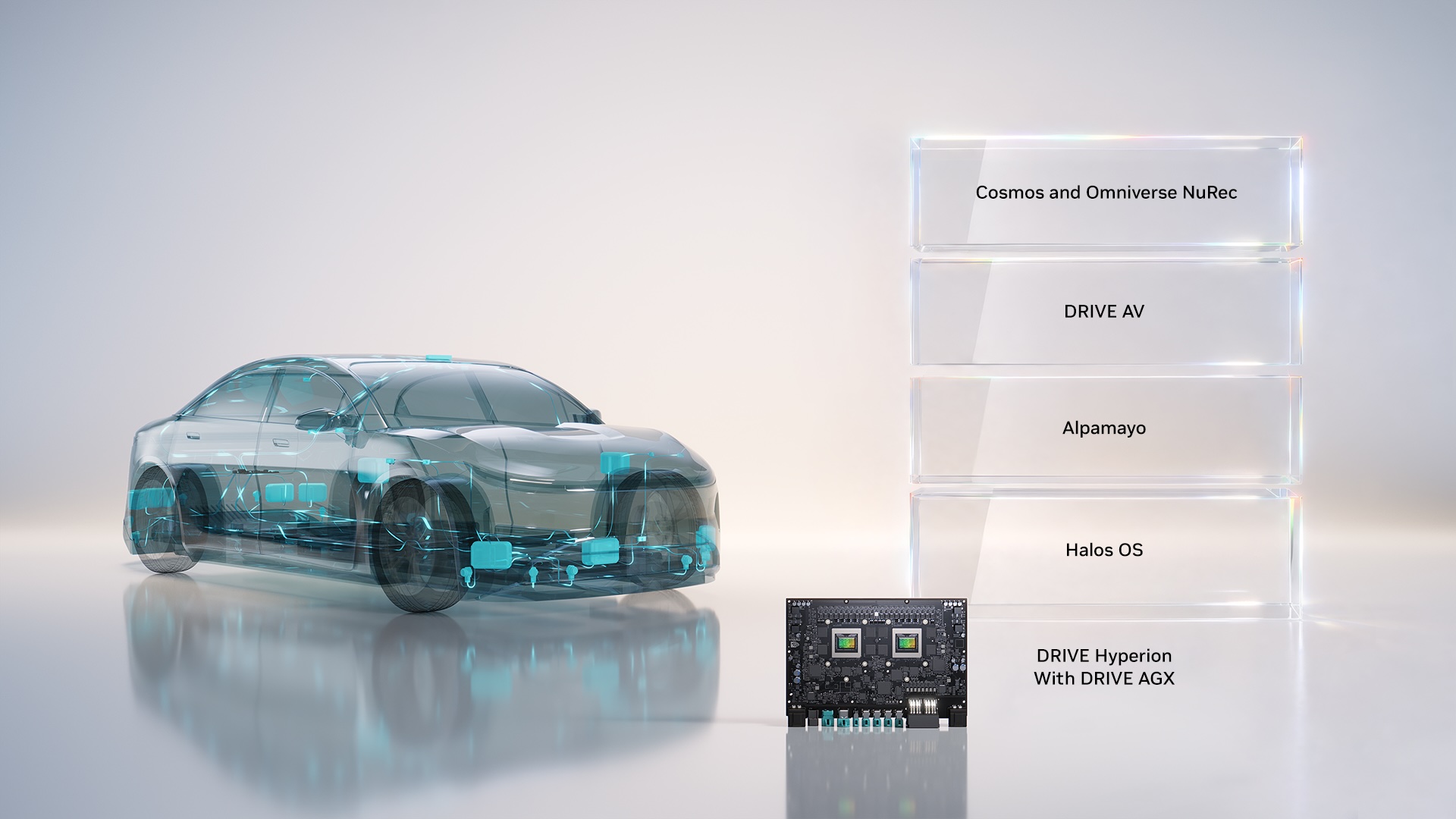
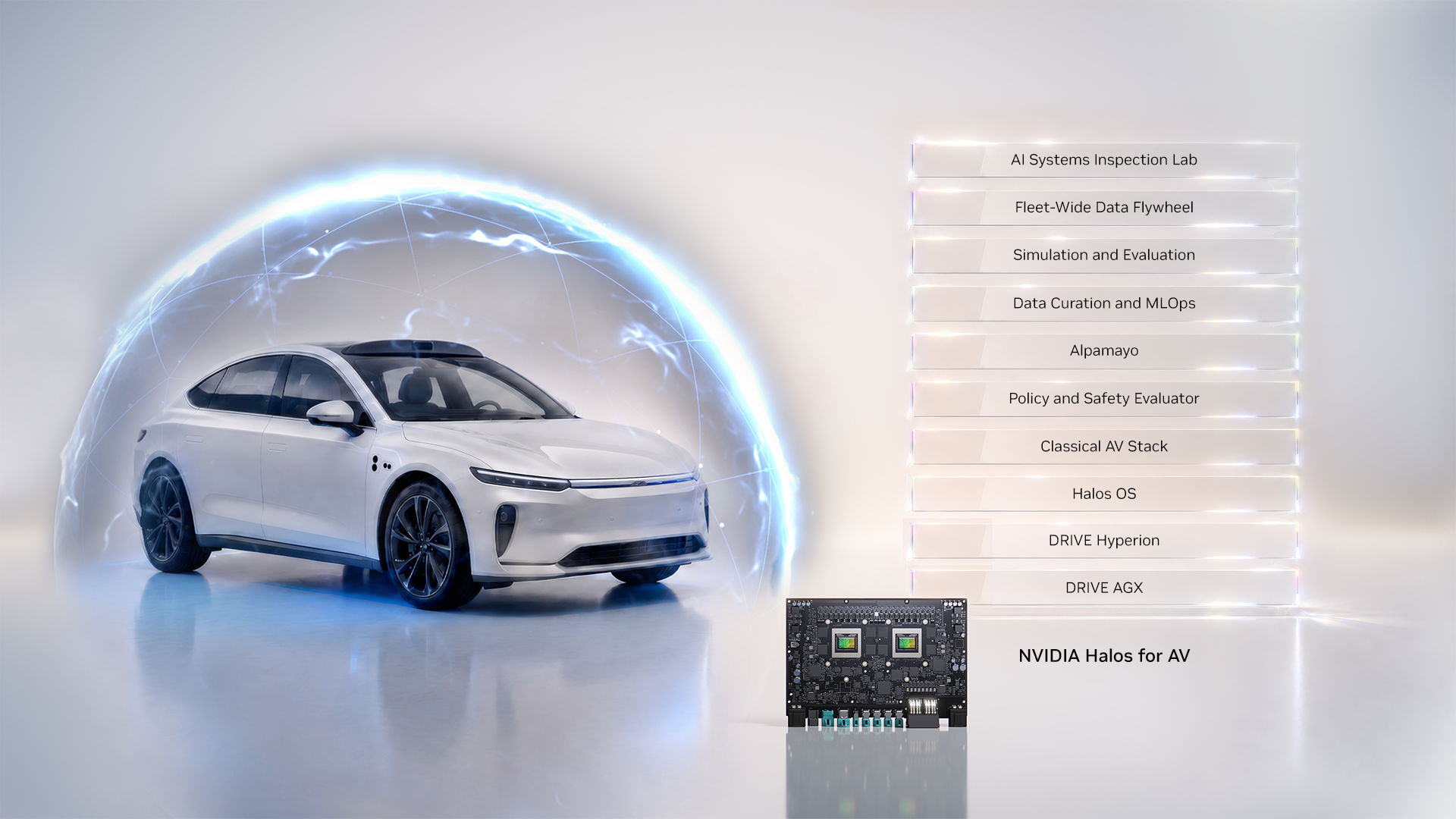
NVIDIA Halos provides a production-ready safety foundation through Halos OS, and a broader validation and certification framework spanning independent inspection, system validation, large-scale simulation and continuous testing from cloud to car.
Robotaxi Leaders Adopting NVIDIA’s Robotaxi Technology Stack

NVIDIA’s robotaxi ecosystem spans every region where commercial robotaxi services are emerging today: Asia, Europe, the Middle East and North America. Across these markets, mobility providers, AV developers and automakers are adopting NVIDIA’s three-computer architecture to train AI models, simulate and validate driving behavior, and deploy autonomous vehicles at scale.

Scaling Robotaxi Services Globally

  • Uber is scaling its fleet of NVIDIA DRIVE Hyperion, with plans to reach 28 cities by 2028. Uber and NVIDIA are also building a robotaxi AI data factory on NVIDIA Cosmos to curate fleet driving data for rare scenarios. Together, Uber and NVIDIA are collaborating with Autobrains, Avride, Lucid, May Mobility, Mercedes-Benz, Momenta, Nissan, Nuro, Pony.ai, Stellantis, Waabi, Wayve, WeRide and Zoox to bring NVIDIA-powered robotaxi services to the Uber platform.
  • May Mobility is planning to operate autonomous ride-hailing services through Uber’s network, while developing its software stack on the NVIDIA DRIVE platform.
  • Bolt uses NVIDIA technologies to develop and scale AVs across Europe.
  • Lyft plans to use NVIDIA DRIVE Hyperion as a reference architecture for future autonomous fleets. May Mobility vehicles are also currently operating on Lyft’s network in Atlanta, powered by NVIDIA DRIVE.
  • Through its partnership with Grab, WeRide plans to bring its DRIVE Hyperion- and DRIVE AGX Thor-based GXR to key markets across Southeast Asia.
  • Waymo partners with NVIDIA to help build its autonomous computing system.

Building Robotaxi Intelligence 

Behind these services, AV developers are using NVIDIA accelerated computing, simulation and in-vehicle platforms to build the intelligence that operators and automakers deploy.

  • Wayve, Nissan and Uber are developing a global robotaxi program using a prototype vehicle that combines Nissan’s vehicle engineering, Wayve’s embodied AI and the NVIDIA DRIVE Hyperion platform.
  • Autobrains is developing robotaxi programs with Uber in Munich and VinFast in Southeast Asia, built on NVIDIA DRIVE Hyperion and enabled by Autobrains’ Agentic AI technology.
  • Zoox uses NVIDIA DRIVE for in-vehicle computing and cloud-based training and simulation. 
  • Momenta is developing its software stack based on NVIDIA DRIVE AGX running on DriveOS. 
  • Pony.ai developed its new-generation autonomous-driving domain controller with NVIDIA DRIVE Hyperion and DRIVE AGX Thor. 
  • Tensor is developing its level 4 Robocar with eight NVIDIA DRIVE AGX Thor systems-on-a-chip in its in-vehicle supercomputer. 
  • Waabi expands into the robotaxi market through a deployment collaboration with Uber; its Waabi Driver platform is built on NVIDIA DRIVE AGX Thor.
  • TIER IV and Isuzu are deploying level 4 autonomous buses built on NVIDIA DRIVE Hyperion and DRIVE AGX Thor.
  • Lenovo is supplying its NVIDIA DRIVE AGX Thor-based AD1 level 4 domain controller for a next-generation robotaxi program with SWM.
  • DeepRoute.ai is developing a new generation of robotaxis built on the NVIDIA DRIVE Hyperion platform with DRIVE AGX Thor.

Bringing Robotaxis Into Production

As these systems move from development into production, automakers are integrating NVIDIA technology into autonomous and robotaxi-ready vehicle programs.

  • Tesla trains its autonomous-driving neural networks on NVIDIA supercomputers. 
  • Mercedes-Benz and NVIDIA are collaborating with Uber to develop a robotaxi ecosystem based on the new S-Class, built on the NVIDIA DRIVE Hyperion architecture, full-stack NVIDIA DRIVE AV L4 software, and NVIDIA Alpamayo open AI models, simulation tools and datasets to support reasoning-based, safety-first autonomy.
  • Stellantis, Wayve and Uber are collaborating to develop and deploy L4 driverless mobility services, leveraging NVIDIA DRIVE Hyperion and AI computing technologies.
  • Lucid, Nuro and Uber are developing a global robotaxi service using NVIDIA DRIVE AGX Thor, part of the DRIVE Hyperion platform.
  • Hyundai Motor and Kia are expanding their collaboration with NVIDIA to develop data-driven autonomous-driving systems built on NVIDIA DRIVE Hyperion. NVIDIA will also explore expanded collaboration with Hyundai Motor Group’s joint venture, Motional, to advance level 4 robotaxi services.
  • Geely, alongside its ecosystem partners, plans to develop and commercialize robotaxis using DRIVE Hyperion.
  • Zeekr, a Geely Auto Group brand, has adopted DRIVE AGX Thor for a centralized domain controller.

From cloud to car, nearly every layer of the robotaxi platform is being developed on NVIDIA accelerated computing. 

Explore NVIDIA’s complete platform for robotaxi development.