




Digital sovereignty is no longer a theoretical debate or a narrow compliance exercise. For leaders across governments, regulated industries, and critical infrastructure sectors, it has become a practical leadership discipline grounded in risk management, continuity planning, and long-term accountability.
Over the past several years, we have seen customer concerns evolve materially. Early conversations focused primarily on privacy and lawful data handling. Today, those concerns have expanded. Leaders are now asking how they maintain operational continuity during disruption, how they adopt AI responsibly without losing control, and how they protect national, organizational, and customer interests in an increasingly volatile global environment.
These questions are not abstract. They surface in boardrooms, procurement decisions, architecture reviews, and crisis simulations. They reflect a broader shift in how trust is evaluated in digital systems. Today in Brussels we brought together attendees from around the world—policy makers, IT leaders, and enterprises—to approach these questions from the multiplicity of perspectives to move the conversation from headlines to action.
Privacy remains foundational. But it is no longer the sole lens through which sovereignty is assessed.
Customers are increasingly concerned about business continuity in the face of cyber incidents, geopolitical tension, supply chain disruption, and network instability. They want to understand how critical workloads operate if connectivity is constrained, if dependencies fail, or if policy conditions change with little warning.
At the same time, innovation pressures have intensified. AI is becoming central to public service delivery, national competitiveness, and economic growth. Organizations cannot afford to pause progress while sovereignty questions are debated in isolation. They need approaches that allow them to move forward responsibly, balancing opportunity with control.
What we hear consistently is this: sovereignty concerns will continue to evolve. Any approach that treats them as static is already behind.
For four decades, Microsoft has operated under some of the world’s most demanding data protection, competition, and digital governance frameworks. Working closely with European institutions, regulators, and customers has shaped how we think about sovereignty—not as a regional exception, but as a discipline that must function at scale, under scrutiny, and over time. That experience matters because many of the sovereignty questions now emerging globally were first tested in Europe, long before they became mainstream elsewhere.
This is why we believe digital sovereignty must be approached as consultative risk management, not a checkbox or a predefined deployment model.
Every organization faces a unique mix of regulatory obligations, cyber risk, operational exposure, and innovation goals. Even within a single institution, sovereignty requirements differ by workload. Some demand strict isolation and local control. Others require global scale, advanced security capabilities, and rapid innovation.
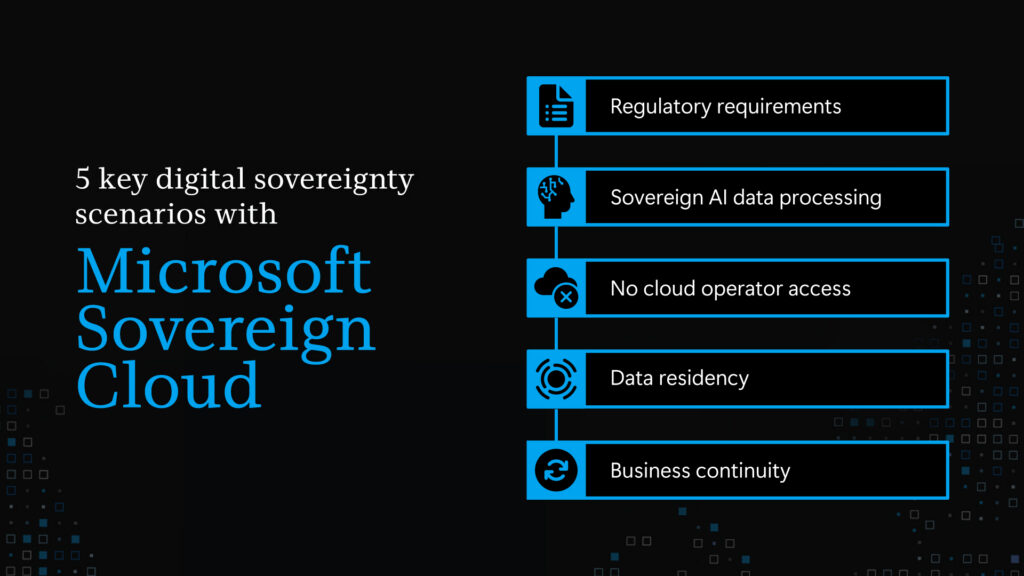
Our role is to help customers navigate these tradeoffs deliberately. That means working with them to assess risk, align architecture to policy realities, and design environments that reflect both today’s constraints and tomorrow’s unknowns.
This work sits at the intersection of cybersecurity, compliance, resilience, and frontier transformation. It requires ongoing engagement, transparency, and the willingness to adapt as conditions change.
A digital sovereignty posture that is flexible recognizes that no single approach can address every requirement. Instead, it focuses on giving organizations options, visibility, and control across a continuum of environments.
Customers operating in public cloud environments expect clear data residency options, strong encryption and access controls, and visible operational discipline. Just as important, they look for transparency into how cloud systems are governed and how exceptional situations are managed, particularly as regulatory scrutiny increases.
Those expectations do not disappear when workloads move closer to the edge. In fact, they intensify. For workloads that require greater isolation, local processing, or operation in constrained environments, hybrid and disconnected solutions become essential. In February, Microsoft announced the expansion of disconnected operations, enabling customers to run critical workloads in air-gapped environments while retaining consistent governance and operational control. This capability extends cloud-based practices into disconnected settings, supporting operational continuity without abandoning security and innovation.
That commitment shows up in concrete safeguards that customers can independently evaluate and apply. The EU Data Boundary is one example, supporting data storage and processing within the EU and European Free Trade Association (EFTA) regions for cloud services, alongside longstanding investments in encryption, access controls, auditability, and operational transparency. These measures provide practical mechanisms for aligning cloud operations with regulatory and risk requirements, rather than relying on abstract assurances.
At the same time, we are expanding options across hybrid and private cloud environments to support continuity, resilience, and local control where required. These investments reflect a simple reality: customer needs are not converging toward one model. They are diversifying.
Underpinning all of this are Microsoft’s digital commitments, which frame how we approach privacy, security, transparency, and responsible AI. These commitments are not marketing statements. They guide how systems are built, operated, and governed, and they provide a foundation for long-term accountability.
As digital sovereignty becomes embedded in policy and procurement decisions, leaders benefit from a practical lens. Based on what we hear from customers and stakeholders, there are a few consistent themes shaping successful approaches:
Addressing these realities requires partners who understand the full scope of the challenge and are willing to engage over the long term. It requires platforms and collaboration designed with sovereignty in mind from the start.
Digital sovereignty is not a destination. It is an ongoing discipline shaped by changing technology, regulation, and global conditions.
At Microsoft, we approach this work with humility and responsibility. We recognize that customer concerns will continue to evolve, and that our own platforms and practices must evolve with them. We remain committed to expanding our sovereign cloud continuum, strengthening our cloud capabilities, and delivering solutions that balance innovation with control.
Most importantly, we remain focused on delivery. Because in moments of uncertainty, what matters most is not what technology promises, but what it allows organizations to do with confidence.
The future of digital sovereignty will be defined by implementation, not rhetoric. Success will depend on collaboration between governments, industry, and civil society, as well as a shared commitment to transparency and continuous improvement.
As we look ahead, our focus remains on helping organizations turn sovereignty principles into durable, scalable outcomes. That means continuing to invest in capabilities that support trust, engaging constructively with policymakers, and listening closely to the evolving needs of our customers.
Digital trust is built over time, through consistent action and openness, and that trust is one of the most important foundations we can help create.
此内容由惯性聚合(RSS阅读器)自动聚合整理,仅供阅读参考。 原文来自 — 版权归原作者所有。