







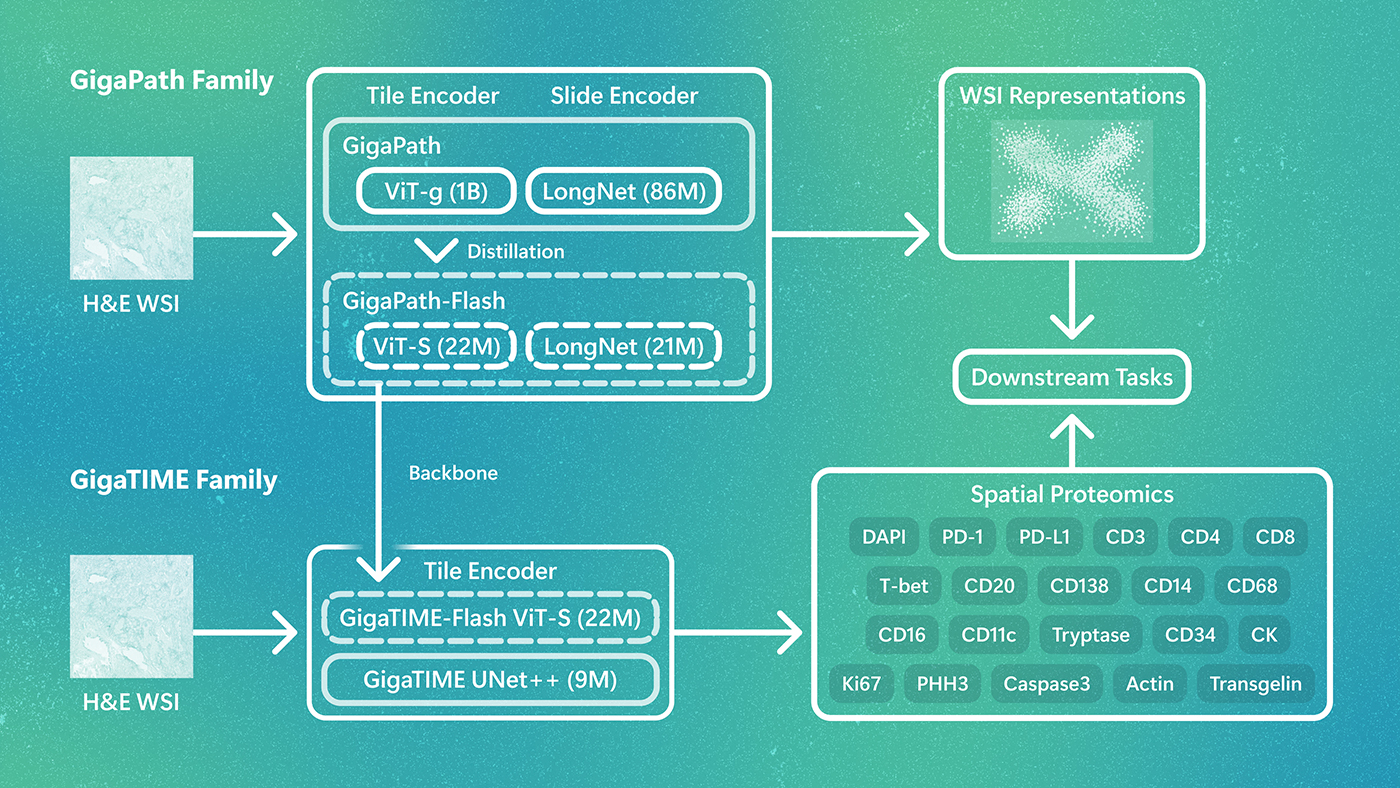
GigaPath (opens in new tab) and GigaTIME (opens in new tab) demonstrated how foundation models can support whole-slide analysis and tumor microenvironment modeling from routinely collected pathology data. GigaPath-Flash and GigaTIME-Flash make these capabilities substantially more efficient, enabling researchers to analyze larger cohorts, run more experiments, and move toward population-scale discovery. GigaPath-Flash and GigaTIME-Flash are research models. They are not intended or validated for clinical use, including diagnosis, prognosis, treatment selection, or other patient-care decisions. Performance may vary across datasets, scanners, institutions, populations, and use cases.
Histopathology is among the richest and most widely available sources of information in cancer research. Every tissue biopsy produces a whole-slide image that captures cellular morphology at subcellular resolution — and hospitals generate millions of these slides each year. This data contains information relevant to diagnosis, prognosis, treatment selection, and the biology of the tumor microenvironment.
Foundation models have begun to unlock this information at scale. But whole-slide images are large — often exceeding a gigapixel — and applying a foundation model to even a single slide requires processing thousands of image tiles. When a research question involves tens of thousands of patients, the computational cost grows quickly. And population-scale discovery is not a single model run: it requires repeated cycles of feature extraction, statistical analysis, hypothesis testing, and validation across patient subgroups, biomarkers, and clinical endpoints.
Computational cost limits the number of patients, datasets, tasks, and hypotheses that researchers can study. To realize the full potential of pathology foundation models, we need models that can be applied repeatedly and affordably across large patient populations.
GigaPath (Nature, 2024) (opens in new tab) is a whole-slide foundation model pretrained on large-scale real-world histopathology data from Providence. Unlike models that operate only at the tile level, GigaPath learns contextualized representations of entire slides, capturing both local cellular patterns and global tissue architecture.
GigaTIME (Cell, 2026) (opens in new tab) extends this line of work to tumor microenvironments. Trained on 40 million cells with paired H&E and multiplex immunofluorescence (mIF) data, GigaTIME translates routine H&E images into virtual spatial proteomics maps across 21 protein channels. Applied to over 14,000 cancer patients, it generated a virtual population that uncovered more than 1,200 statistically significant associations between immune cell states and clinical biomarkers.
GigaPath and GigaTIME addressed the scale of pathology data and biological discovery. And now, the Flash family of models addresses scale of experimentation.
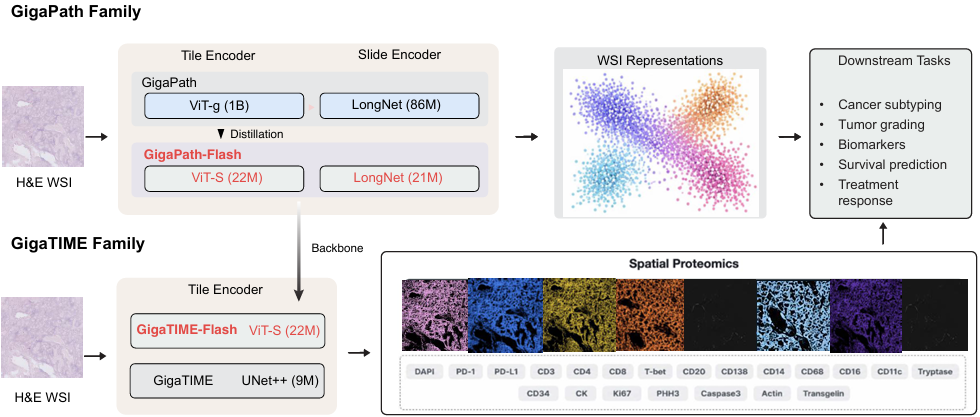
The Flash family shares a core design goal: preserving useful pathology representations while substantially reducing the computational resources required to generate and use them. Both models are built on a common efficient backbone — a compact ViT-S tile encoder distilled from the original billion-parameter GigaPath encoder — and both are released under the Apache 2.0 license.
GigaPath-Flash is an efficient foundation model for whole-slide representation learning. It combines a 22M-parameter ViT-S tile encoder with a 21M-parameter LongNet slide encoder. The tile encoder is distilled from the original GigaPath ViT-g teacher, transferring the representational capacity of a billion-parameter model into a backbone that is an order of magnitude smaller. The slide encoder contextualizes all tile embeddings via dilated attention, scaling linearly with the number of tiles.
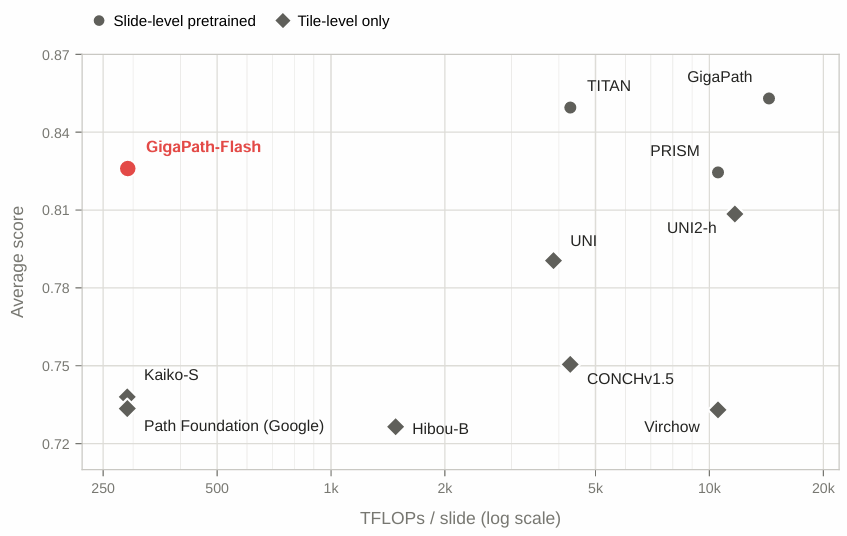
On slide-level classification benchmarks (PANDA prostate grading and EBRAINS brain tumor subtyping), GigaPath-Flash achieves the lowest inference cost among whole-slide pretrained models while retaining competitive performance — scoring within 3% of the original GigaPath at roughly 50 times less compute.
GigaTIME-Flash replaces the CNN backbone of the original GigaTIME with the GigaPath-Flash ViT-S encoder, paired with a lightweight convolutional decoder for H&E-to-mIF translation. The model is fine-tuned using LoRA adapters, keeping the pretrained encoder weights largely frozen.
On both in-distribution and out-of-distribution cohorts spanning brain, breast, colon, and lung cancers, GigaTIME-Flash matches or improves upon the original GigaTIME in spatial protein prediction quality. The gains are particularly notable on out-of-distribution data, suggesting that the foundation model backbone improves generalization to previously unseen tissue types.

The efficiency gains of the Flash models are substantial:
| Model | Type | Efficiency gain |
|---|---|---|
| GigaPath-Flash | Whole-slide Foundation Model | ~50× less compute, 97% of predictive performance compared to GigaPath |
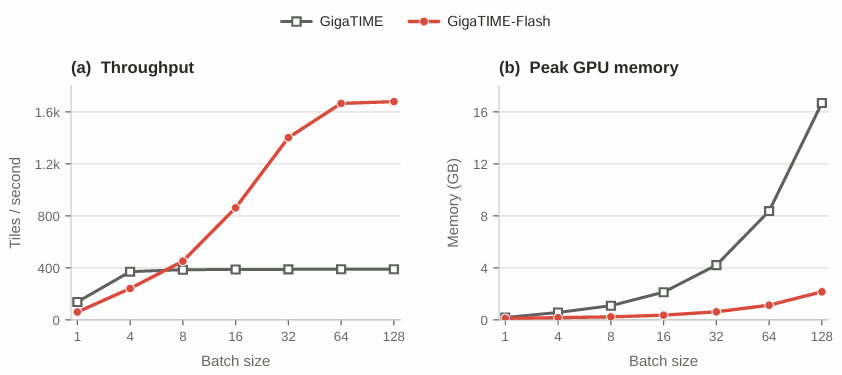
| GigaTIME-Flash | Spatial Proteomics | ~6× faster, ~8× less memory, better predictive performance compared to GigaTIME |
For a single slide, these differences reduce runtime and hardware requirements. Across tens of thousands of slides, they can determine whether an experiment is practical at all. To illustrate, we estimate the wall-clock time for generating virtual mIF across cohorts of different sizes on a single A100 GPU, assuming approximately 10,000 tiles per slide:
| Model | 1,000 slides | 100K slides | 1M slides |
|---|---|---|---|
| GigaTIME-Flash | ~2 GPU-hours | ~7 GPU-days | ~70 GPU-days |
| GigaTIME | ~7 GPU-hours | ~30 GPU-days | ~300 GPU-days |
Both GigaPath-Flash and GigaTIME-Flash are released as open-weight models under the Apache 2.0 license. Model weights and code are available on HuggingFace:
This is an early research release. Our current evaluations cover a limited set of benchmarks and cohorts, and broader validation across tasks, scanners, and patient populations is still needed. We expect the most valuable applications of these models to include scientific questions, cohorts, and use cases beyond those in our initial experiments. We welcome community evaluation, and we are equally interested in reports of where these models work well and where they fall short.
Downstream clinical applications will require additional multi-institutional and prospective validation.
Spotlight: AI-POWERED EXPERIENCE

Discover more about research at Microsoft through our AI-powered experience
GigaPath and GigaTIME demonstrated what pathology foundation models can learn from whole slides and tumor tissue. GigaPath-Flash and GigaTIME-Flash are a step toward making those capabilities usable across larger populations, more experiments, and a broader research community.
By making pathology foundation models more efficient, we hope to expand the scale of the scientific questions researchers can ask.
GigaPath-Flash and GigaTIME-Flash are joint work across Microsoft Research, the University of Washington, and Providence. For technical details, see the paper.
Paper co-authors: Naoto Usuyama, Jeya Maria Jose Valanarasu, Sicong Yao, Hanwen Xu, Jaspreet Bagga, Guanghui Qin, Robert E. Kramer, Cliff Wong, Soohee Lee, Hao Qiu, Theodore Zhengde Zhao, Racheli Ben Shimol, Angela Crabtree, Kevin Matlock, Eduardo Alejandro Lozano Garcia, Naiteek Sangani, Alberto Santamaria-Pang, Maximilian Rokuss, Yashna Hasija, Naisargi Manishkumar Patel, Jason Entenmann, Alexandra Q. Bartlett, Bill J. Wright, Bernard A. Fox, Brian Piening, Sheng Zhang, Sheng Wang, Tristan Naumann, Carlo Bifulco, Hoifung Poon
此内容由惯性聚合(RSS阅读器)自动聚合整理,仅供阅读参考。 原文来自 — 版权归原作者所有。