

惯性聚合 高效追踪和阅读你感兴趣的博客、新闻、科技资讯
阅读原文 在惯性聚合中打开

推荐订阅源

爱范儿
爱范儿
大猫的无限游戏
大猫的无限游戏
WordPress大学
WordPress大学
C
Cyber Attacks, Cyber Crime and Cyber Security
D
DataBreaches.Net
G
Google Developers Blog
博客园 - Franky
V
V2EX
博客园 - 叶小钗
D
Docker
The GitHub Blog
The GitHub Blog
Microsoft Security Blog
博客园 - 【当耐特】
H
Hackread – Cybersecurity News, Data Breaches, AI and More
B
Blog RSS Feed
月光博客
月光博客
M
MIT News - Artificial intelligence
F
Fortinet All Blogs
Microsoft Azure Blog
人人都是产品经理
人人都是产品经理
IT之家
IT之家
Google DeepMind News
Apple Machine Learning Research
V
Visual Studio Blog
博客园 - 司徒正美
Stack Overflow Blog
Stack Overflow Blog
罗磊的独立博客
J
Java Code Geeks
U
Unit 42
freeCodeCamp Programming Tutorials: Python, JavaScript, Git & More
博客园 - 聂微东
T
Tailwind CSS Blog
T
The Blog of Author Tim Ferriss
奇客Solidot–传递最新科技情报
奇客Solidot–传递最新科技情报
Blog — PlanetScale
Blog — PlanetScale
Jina AI
Jina AI
C
Check Point Blog
Y
Y Combinator Blog
MyScale Blog
MyScale Blog
OSCHINA 社区最新新闻
OSCHINA 社区最新新闻
阮一峰的网络日志
阮一峰的网络日志
宝玉的分享
宝玉的分享
B
Blog
小众软件
小众软件
云风的 BLOG
云风的 BLOG
I
InfoQ
Recorded Future
Recorded Future
酷 壳 – CoolShell
酷 壳 – CoolShell
钛媒体:引领未来商业与生活新知
钛媒体:引领未来商业与生活新知
美团技术团队

Microsoft Research Blog - Microsoft Research

Scaling cryptographic verification to boost computer security Aurora 1.5: Extending open foundation models for weather and Earth-system applications - Microsoft Research AI can generate Charts. Flint helps generate better ones. SkillOpt turns AI agent skills into trainable assets Memora scales agent memory to boost long-horizon productivity Turning brain prediction models into testable explanations Talos brings continuous genomic reanalysis to nearly 5,000 unsolved cases Ire identifies another LOTUSLITE specimen Data Formulator 0.7: AI-powered data analytics for enterprise data Extending Human Intelligence Through AI Vega: Zero-knowledge proofs for digital identity in the age of AI Further Notes on Our Recent Research on AI Delegation and Long-Horizon Reliability mimalloc: A new, high-performance, scalable memory allocator for the modern era GridSFM: A new, small foundation model for the electric grid Advancing AI for materials with MatterSim: experimental synthesis, faster simulation, and multi-task models SocialReasoning-Bench: Measuring whether AI agents act in users’ best interests Building realistic electric transmission grid dataset at scale: a pipeline from open dataset - Microsoft Research Microsoft at NSDI 2026: Advances in large-scale networked systems Red-teaming a network of agents: Understanding what breaks when AI agents interact at scale AutoAdapt: Automated domain adaptation for large language models New Future of Work: AI is driving rapid change, uneven benefits ADeLe: Predicting and explaining AI performance across tasks AsgardBench: A benchmark for visually grounded interactive planning GroundedPlanBench: Spatially grounded long-horizon task planning for robot manipulation Systematic debugging for AI agents: Introducing the AgentRx framework PlugMem: Transforming raw agent interactions into reusable knowledge Phi-4-reasoning-vision and the lessons of training a multimodal reasoning model CORPGEN advances AI agents for real work Media Authenticity Methods in Practice: Capabilities, Limitations, and Directions Project Silica’s advances in glass storage technology
MagenticLite, MagenticBrain, Fara1.5: An agentic experience optimized for small models
Brenda Potts · 2026-05-22 · via Microsoft Research Blog - Microsoft Research
MagenticLite

At a glance

  • MagenticLite is an agentic application that works across both the browser and local file system in a single workflow. Built as the next generation of Magentic-UI, it combines a redesigned app with a harness optimized for small models.
  • MagenticBrain and Fara1.5 are small models designed for orchestration and computer-use tasks, respectively. Fara1.5 is the next iteration of Fara and delivers measurable gains on real-world browser tasks.
  • Together, these releases explore how far agentic performance can be pushed with smaller models, codesigned tools, and an optimized execution harness.

Today, Microsoft Research AI Frontiers releases MagenticLite (opens in new tab), an experimental agentic application designed for small models. As the next generation of Magentic-UI, it works across the browser and local file system in a single workflow.

MagenticLite is powered by two purpose-built models: MagenticBrain, for reasoning, delegation, and terminal use, and Fara1.5, a computer-use model family for browser-based tasks. The three components were designed to work together as a single system. The result is an agent that runs efficiently, keeps data on the user’s machine, and supports a broad range of agentic tasks. It also points toward a broader goal: capable agents that can run directly on users’ hardware.

The project is built around a key research bet: that agentic capability depends on tool orchestration and action rather than knowledge alone. That insight makes it possible to use smaller models while still enabling a broad range of agentic tasks at a fraction of the cost.

MagenticLite also reflects how we approach agentic AI end-to-end—from training data and model design to orchestration, interaction design, and human oversight throughout the experience.

Figure 1 – One experience, three components.png | A diagram titled
Figure 1. One experience, three components: MagenticLite, MagenticBrain, and Fara1.5.

Included in this release

MagenticLite (opens in new tab)

The next generation of Magentic-UI, our experimental agentic experience, is powered by an agent harness rebuilt for small models, with an updated user interface informed by community feedback. It works across users’ browsers and local file systems in a single workflow.

MagenticBrain (opens in new tab)

MagenticBrain is MagenticLite’s planner, coder, and delegator in one. It turns vague requests into concrete plans, selects the right tool or subagent for each step, writes code when needed, and recovers should something break mid-task. 

Fara1.5

The next generation of our computer-use model family, Fara1.5 comes  in three sizes, with a flagship 9-billion-parameter model for most use cases. Fara1.5 sets new state-of-the-art (SOTA) results among small computer-use models and nearly doubles Fara-7B’s performance on web navigation, with sharper handling of forms, credentialed sites, and long-running tasks.

Each component is useful on its own, but they work best together. Codesigning the app, models, and the harness enables capable and reliable agentic performance at this scale.

Our research approach: Doing more with less

We started with a simple question: what does it take to make a small model genuinely good at agentic tasks? The answer spanned the full lifecycle—data generation, training objectives, model design, and orchestration had to be redesigned together rather than in isolation.

We identified requirements from real-world use cases like filling out forms, conducting browser research, and managing files locally, and built an evaluation dataset around them. Standard benchmarks capture part of the picture, but they are not always a direct measure of real-world usefulness. Scenario-based evaluations complemented those benchmarks and became a key signal for iterative improvement across both the models and the harness, as shown in Figure 2.

Figure 2 – Eval flywheel.png | A flowchart titled
Figure 2. An iterative process for building agentic systems involves defining success criteria, evaluating performance, and refining the models or system design (or both). Then repeat.

For the user experience, we retained key elements from Magentic-UI, including visibility into the agent’s reasoning and actions, the ability for users to take direct control, and explicit approval at critical points. Based on recent user studies, we also made MagenticLite easier to learn and collaborate with through updated browser and chat views, designed to make it easier for users to understand the agent’s actions and intervene when needed. This is illustrated in Figure 3.

Figure 3 – MAGUI new interface.png | A screenshot of the MagenticLite 2.0.063 application interface. The left sidebar shows a session history with task names and statuses, including one active task highlighted in pink. The central panel displays an ongoing agent session with a sequential log of actions—including
Figure 3. MagenticLite’s interface includes updated browser and chat views designed to make it easier to understand agent actions and intervene when needed.

PODCAST SERIES

Illustrated headshots of Daniel Carpenter, Timo Minssen, Chad Atalla, and Kathleen Sullivan for the Microsoft Research Podcast

AI Testing and Evaluation: Learnings from Science and Industry

Discover how Microsoft is learning from other domains to advance evaluation and testing as a pillar of AI governance.

System components

Fara1.5: A computer-use model that outperforms its weight class

Fara1.5 is the next generation of our computer-use model family, which is available in three sizes, with a flagship 9B model recommended for most use cases. Fara1.5 achieves new SOTA performance among small computer-use models and nearly doubles Fara-7B’s performance on web navigation, with better handling of forms, credentialed sites, and long-running tasks.

Last November, we released Fara-7B, a small agentic model built for completing tasks in a web browser. It was trained using a novel synthetic data generation engine that enabled best-in-class performance. Fara1.5 is the next step in that bet: a family of three models (4B, 9B, 27B) based on Qwen 3.5, designed to close the gaps we saw in the prior release.

What’s new

State-of-the-art results. On the popular Online-Mind2Web benchmark, which contains 300 tasks across widely used web domains, Fara1.5 sets new SOTA results for models in its size class. Fara1.5 outperforms all similarly sized models and nearly doubles the performance of Fara-7B. The larger Fara1.5-27B variant achieves more than 90% performance on the same benchmark.

Figure 4 – Fara-1.5 latest results.png | A bar chart titled
Figure 4. On the OnlineMind2Web benchmark, Fara‑1.5-9B achieves state-of-the-art performance among models in its size class and substantially outperforms prior models. 

Improved user experience. In addition to improvements on benchmarks, we improved the user experience of Fara1.5. Users should observe stronger performance on everyday tasks like filling out forms, handling logins for credentialed sites, and booking appointments. These improvements are driven by the next evolution of our FaraGen data generation pipeline. Alongside training on live websites, we also trained the model on highly realistic synthetic environments designed to simulate scenarios like logins and irreversible actions.

A native action space tuned for long-running tasks. Beyond clicks and keyboard actions, Fara1.5 has built-in tools to store key information in its context across hundreds of steps and ask the user for permission or preferences when needed, helping it stay coherent on tasks that span many minutes of real work.

Recalibrated critical points. Fara-7B was trained to detect critical points for activities like transactions, login flows, or irreversible submissions and flag them. In Fara1.5, we refined our design around critical points based on our learnings from real use, so safety triggers still occur when they should but do not block useful tasks, such as form-filling.

Figure 5 – Critical point.png | A screenshot of Fara1.5's browser interface showing a live view of the LinkedIn sign-up and sign-in page, with fields for email and password visible. Below the browser panel, a section titled
Figure 5. Fara1.5 pauses and requests user intervention when it detects a critical point, in this case during a sign-in to a LinkedIn account using email credentials. 

MagenticBrain: The orchestrator model

MagenticBrain is a 14B-parameter orchestration model—planner, coder, and delegator in one. Fine-tuned from Qwen 3 14B, MagenticBrain was trained end-to-end within the MagenticLite harness with the same tool schemas and execution environment it will encounter at inference time. As a result, there is no gap between how it learned to orchestrate and how it runs.

In many agentic systems, orchestration (planning and coordination) is the most reasoning-intensive component, so teams have historically relied on their most capable models for this role. Our bet is that small models can handle this role without sacrificing capability. Two design choices make that possible.

The first involves combining multistep tool-calling trajectories—where the model learns to pick the right tool and call it correctly—with coding and terminal trajectories—where the right answer is sometimes five lines of Python, not a tool call. This is paired with tight coupling between the tool format used during training and inference.

The second is computer-use agent (CUA) delegation. A key part of the orchestrator’s job is knowing when not to act itself and instead handing off a task to Fara1.5. Our data pipeline includes explicit delegation trajectories: sequences where the orchestrator recognizes a browser or user interface (UI) task, issues a structured handoff to the CUA model, waits for the result, and resumes the task. The result is an orchestrator model that reasons, codes, calls tools, and delegates fluidly within a single 14B footprint. We are releasing MagenticBrain which is designed for use with MagenticLite. 
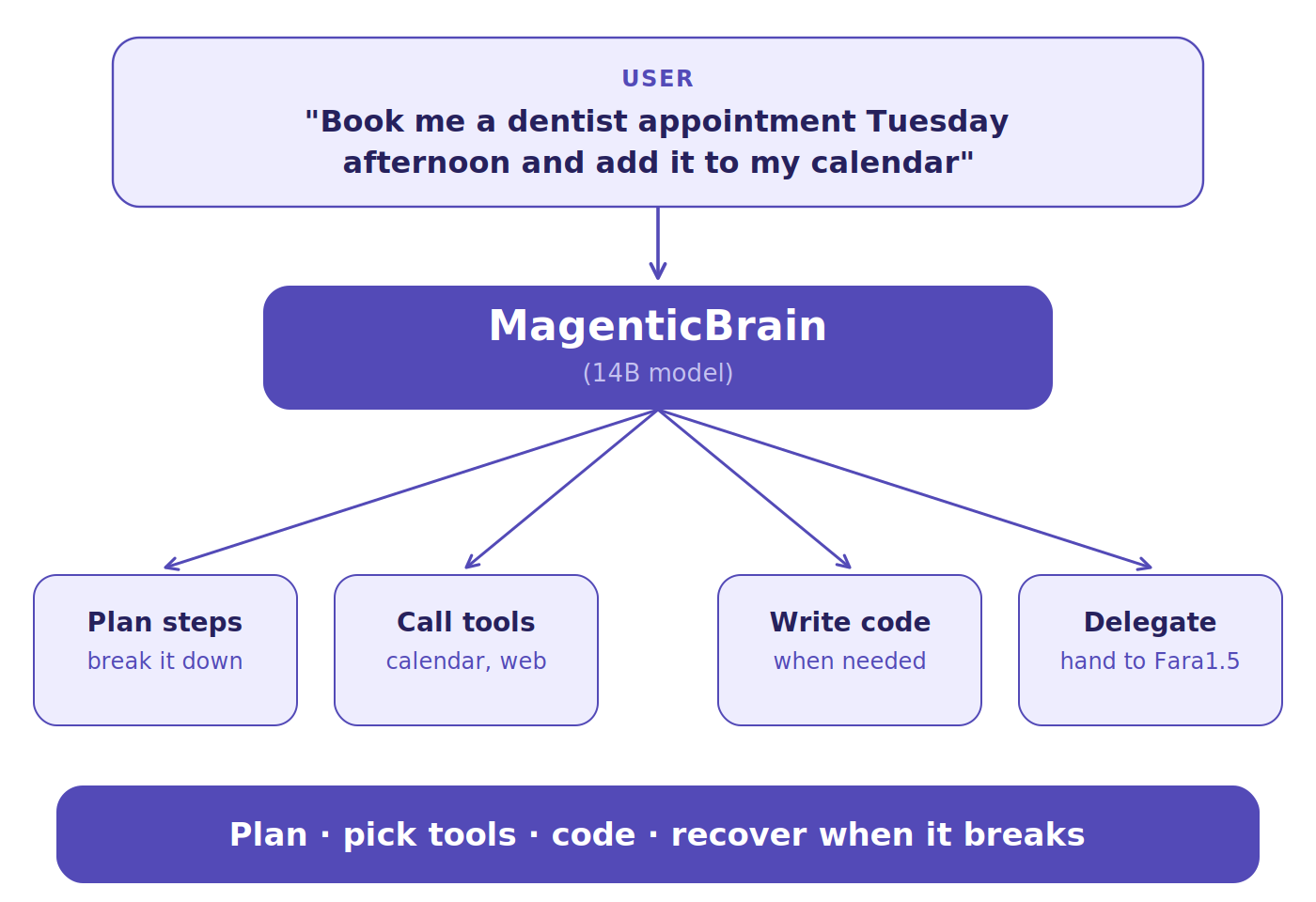
Figure 6 – MagenticBrain.png | A flow diagram illustrating MagenticBrain's role as an orchestration model. At the top, a box represents the user's natural-language request:
Figure 6. MagenticBrain is a small orchestration model that can break down a natural-language request into smaller steps, select the right tools, write code when needed, and delegate browser tasks to Fara1.5.

The Harness: Built for small models

The harness combines the orchestrator and browser-use models into a single workflow. Three design choices matter most:

  • Step-by-step planning. The harness plans incrementally, keeping the system flexible and enabling smoother course correction and recovery throughout long-running tasks.
  • Active context management. Small models have smaller effective context windows and degrade faster as context grows. The harness actively curates what each model receives at each step, keeping prompts focused, surfacing only the necessary information, condensing earlier interactions into concise summaries, and offloading the rest, so the orchestrator and Fara1.5 remain effective across long tasks.
  • Delegation through subagents. Rather than relying on a single small model for every task, the orchestrator acts as the main agent and delegates specialized work to subagents. This means handing off browser tasks to Fara1.5. This pattern plays to the strengths of small language models by allowing each model to handle a narrower, more specialized part of the problem. It also lays the foundation for future expansion: later versions could introduce additional subagents and run them in parallel for richer, more efficient workflows.

The harness preserves the human-in-the-loop guarantees from Magentic-UI 1.0. Critical points across both browser and code actions still pause for explicit user approval, and the entire system runs inside Quicksand (opens in new tab), an open-source wrapper created for a QEMU-based sandbox, which isolates browser sessions and code execution from the host system.

Figure 7 – MagenticLite architecture diagram | A layered system architecture diagram for MagenticLite, organized top to bottom across four labeled sections. The topmost layer, User Interface, contains the Frontend (React SPA) with four components: Chat (conversational task input), Live Browser (noVNC stream of agent session), Approvals (human-in-the-loop gates), and Files (inputs and generated outputs). Below it, connected via WebSocket and REST, is the Orchestration layer containing the Agentic Harness (FastAPI + WebSocket). It includes four components: Orchestration (run lifecycle, streaming), Context Compaction (summarize and prune long contexts), Pause/Resume (user-in-the-loop control), and Critical Points (detection of critical code actions), which is visually highlighted in yellow to signal its importance. The next layer is reached via a Dispatch connector and contains two parallel model components. On the left, MagenticBrain (14B model, purple) handles reasoning, coding, and delegation, with two sub-components: Reasoning Loop (think → tool → result) and Tool Dispatch (bash, edit, search, open). On the right, Fara 1.5 (9B model, teal) handles web navigation and browser use, with three sub-components: Screenshot → Action (vision-driven loop), Browser Actions (navigate, click, type, scroll), and Critical Points (forms, payments, logins). An arrow labeled
Figure 7. Overview of the MagenticLite architecture. The system uses a layered architecture spanning the front end, harness, models, and sandboxed execution environment.

See it in action

MagenticLite can perform a wide range of tasks across the browser and local file system, such as filling out forms, making appointments, organizing local files, and searching for and analyzing information.

MagenticLite | Fill expense forms demo

MagenticLite | Find and book a restaurant demo

MagenticLite | Find prices for recipe ingredients demo

MagenticLite | Organize local files demo

Try it, and build with us

MagenticLite, MagenticBrain, and Fara1.5 are research releases intended to support continued exploration and development. We are releasing them to encourage experimentation, evaluation, and feedback from the broader community.

Contributors