




惯性聚合 高效追踪和阅读你感兴趣的博客、新闻、科技资讯
阅读原文 在惯性聚合中打开

推荐订阅源

Google DeepMind News
爱范儿
爱范儿
J
Java Code Geeks
L
LangChain Blog
V
V2EX
大猫的无限游戏
大猫的无限游戏
S
SegmentFault 最新的问题
博客园 - Franky
Microsoft Azure Blog
Jina AI
Jina AI
Blog — PlanetScale
Blog — PlanetScale
奇客Solidot–传递最新科技情报
奇客Solidot–传递最新科技情报
The Cloudflare Blog
博客园 - 司徒正美
B
Blog
G
Google Developers Blog
Stack Overflow Blog
Stack Overflow Blog
罗磊的独立博客
OSCHINA 社区最新新闻
OSCHINA 社区最新新闻
Apple Machine Learning Research
Engineering at Meta
Engineering at Meta
MyScale Blog
MyScale Blog
有赞技术团队
有赞技术团队
Hugging Face - Blog
Hugging Face - Blog

DEV Community

Authentication Security Deep Dive: From Brute Force to Salted Hashing (With Java Examples) Why AI Systems Don’t Fail — They Drift Spilling beans for how i learn for exam😁"Reinforcement Learning Cheat Sheet" I Replaced Chrome with Safari for AI Browser Automation. Here's What Broke (and What Finally Worked) How Python Borrows Other People's Work The $40 Architecture: Processing 1 Billion API Requests with 99.99% Uptime Vibe Coding: A Workflow Guide (From Zero to SaaS) Most webhook security guides protect the wrong side. The scary part is delivery. Headless CMS for TanStack Start: Build a Blog with Cosmic EU Age Verification App "Hacked in 2 Minutes" — What Actually Happened Comfy Cloud’s delete function does not actually remove files Running AI Models on GPU Cloud Servers: A Beginner Guide Event-driven media intelligence with AWS Step Functions and Bedrock I scored 500 AI prompts across 8 quality dimensions — here's what broke How to Call Google Gemini API from Next.js (Free Tier, No Backend Needed) The Portal Protocol: Reclaiming Human Connection in the Age of AI How to Fix Your Team's Scattered Knowledge Problem With a Self-Hosted Forum Intro to tc Cloud Functors: A Graph-First Mental Model for the Modern Cloud Designing Multi-Tenant Backends With Both Ownership and Team Access I Built a Neumorphic CSS Library with 77+ Components — Here's What I Learned PostgreSQL Performance Optimization: Why Connection Pooling Is Critical at Scale Cómo construí un SaaS multi-rubro para gestionar expensas en Argentina con FastAPI + Vue 3 🚀 I Built an Ethical Hacking Scanner Tool – Open Source Project I Replaced /usage and /context in Claude Code With a Single Statusline A Pythonic Way to Handle Emails (IMAP/SMTP) with Auto-Discovery and AI-Ready Design I Collected 8.9 Million Polymarket Price Points — Here's What I Found About How Markets Really Move EcoTrack AI — Carbon Footprint Tracker & Dashboard Everyone's Using AI. No One Agrees How. 5 self-hosted ebook managers worth trying in 2026 Building Your First AI Agent with LangChain: From Chatbot to Autonomous Assistant
💻 Learning Cybersecurity by Building- A Hacker Terminal G...
Eidolmor · 2026-04-24 · via DEV Community

🚀 Introduction (The "Why")
As I started learning cybersecurity, I realized that just reading concepts or watching tutorials wasn't enough. Topics like password security, encryption, and system monitoring only truly make sense when you apply them.
So instead of building a typical beginner project, I decided to create something that would both-
-Reinforce what I've learned
-Help other beginners understand these concepts in a simple, interactive way

👉 The result is a terminal-based Hacker Simulation Game built in Python.
It's designed to be-
-Beginner-friendly
-Interactive
-Based on real cybersecurity ideas

🎮 What the Program Does
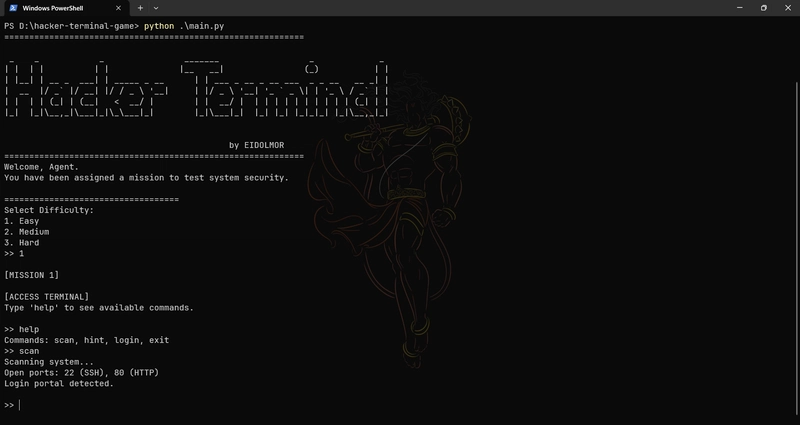
The game puts the player in the role of an ethical hacker completing missions-
-🔐 Password Cracking
Simulates login systems with limited attempts and hint-based discovery.
-🔑 Cipher Decryption
Introduces encryption concepts using a Caesar cipher challenge.
-📜 Log Analysis
Teaches how to identify suspicious activity in system logs.

Each mission includes-
-Difficulty levels
-Randomized challenges
-Controlled hint systems
-Score tracking

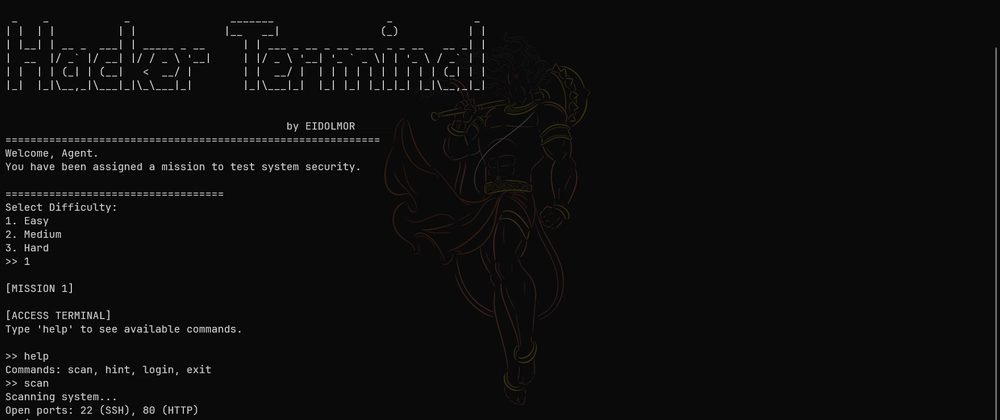
🖥️** Terminal Gameplay**
🧠 How the Code Works
The project is structured into three main components:
-main.py
Controls the game flow using a Game class, managing score and progression.
-challenges.py
Contains all mission logic (password cracking, cipher decoding, log analysis).
-utils.py
Handles helper functions like terminal UI, difficulty selection, and formatted output.

Concepts used-
-Functions and loops
-Conditional logic
-Randomization for replayability
-Object-Oriented Programming (Game class)

The goal was to keep the code simple, modular, and easy to understand, especially for beginners.

🔗 GitHub Repository

Check out the full code here:
👉 Hacker Terminal Game

🔮 Future Improvements & Vision
This project is just the beginning. As I continue learning cybersecurity and development, I plan to expand this game with more advanced and realistic missions.
-Add a logging system to track player actions
-Introduce more cybersecurity challenges (e.g., brute force, network scanning, vulnerabilities)
-Expand the game progressively to multiple levels

👉 My roadmap-
-Build up to 10 levels in the terminal version
-Then transition to a web-based version of the game
-Long-term goal: reach Level 86 by the end of the year, turning this into a complete cybersecurity learning simulation

🏁 Conclusion
This project is a small step in my cybersecurity learning journey, but it helped me bridge the gap between theory and practical implementation.
By building this game, I was able to:
-Apply core cybersecurity concepts
-Improve my Python programming skills
-Create something useful for other beginners

If you're learning cybersecurity, try building something similar - it's one of the best ways to truly understand the concepts.