


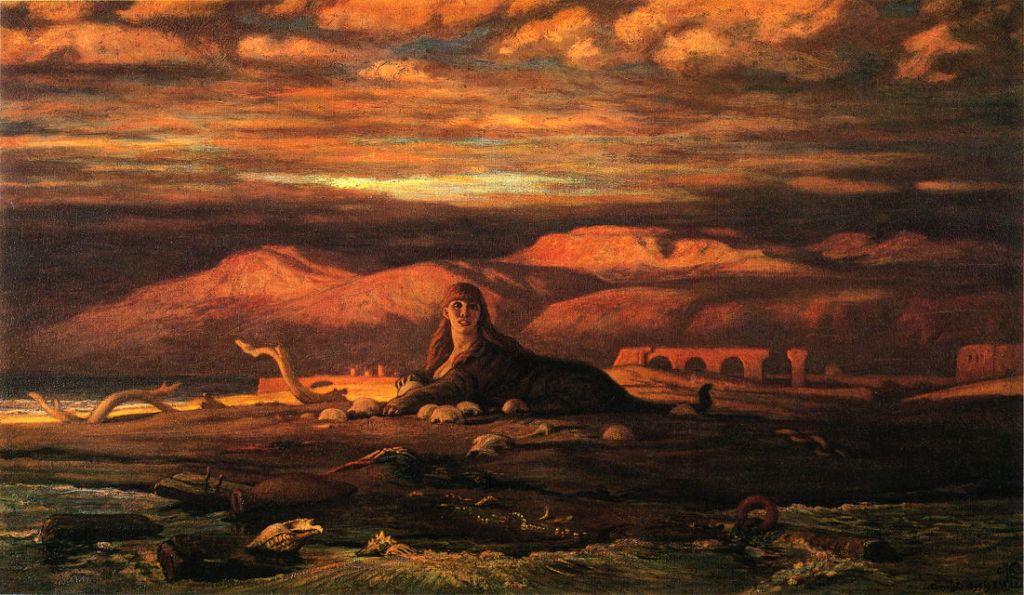
 Elihu Vedder (1836–1923), The Sphinx of the Seashore (1879), oil on canvas, 40.6 x 71.1 cm, Fine Arts Museums of San Francisco, de Young, San Francisco, CA. The Athenaeum.
Among the many murals and mosaics decorating the Library of Congress in Washington, DC, are several by the American Symbolist Elihu Vedder (1836–1923), who also contributed the fine illustrations for Edward FitzGerald’s translation of The Rubaiyat of Omar Khayyam. This weekend I show a selection of his more narrative paintings.
Vedder was the son of a dentist in New York City, where he was born in 1836. He decided to be an artist while he was at boarding school, and started his training in New York City before moving to Paris, where he studied under François-Édouard Picot. He then moved to Italy in 1858, where he was influenced by the masters of the Renaissance and contemporary Macchiaioli painters. Among the latter was Giovanni Costa, with whom Vedder formed a deep friendship, and the pair travelled through the countryside painting landscapes side by side until 1860, when Vedder’s father stopped his financial support, forcing him to return to the USA.
Unfortunately, he returned to a country in the midst of the Civil War, and turned to making illustrations. He became friends with Walt Whitman, Herman Melville and William Morris Hunt, a famous painter of the day.
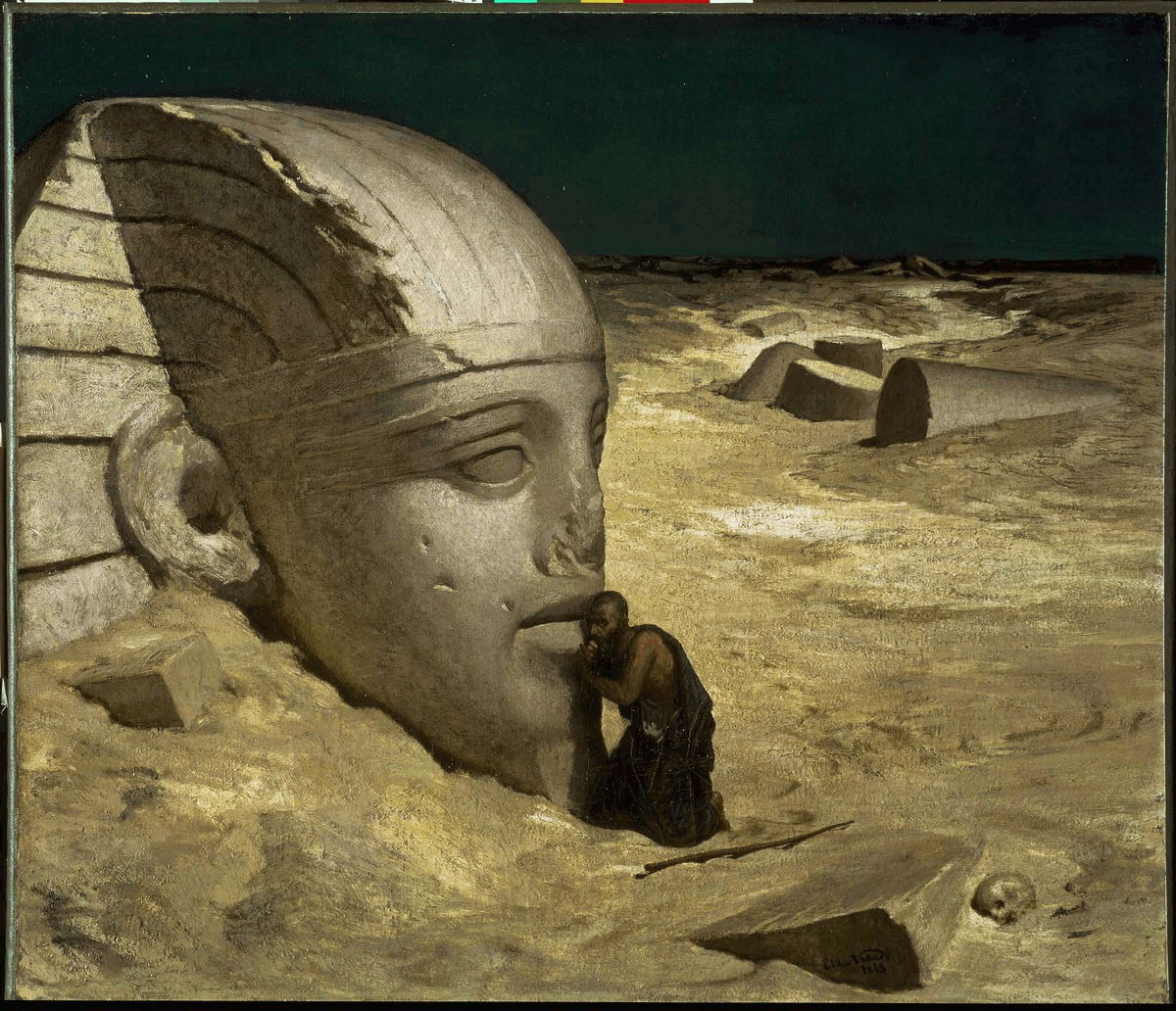
At some stage, he appears to have visited Egypt, where he made drawings of some of its remains, which he then turned into this unusual narrative landscape of The Questioner of the Sphinx from 1863. This was turned into a successful print.
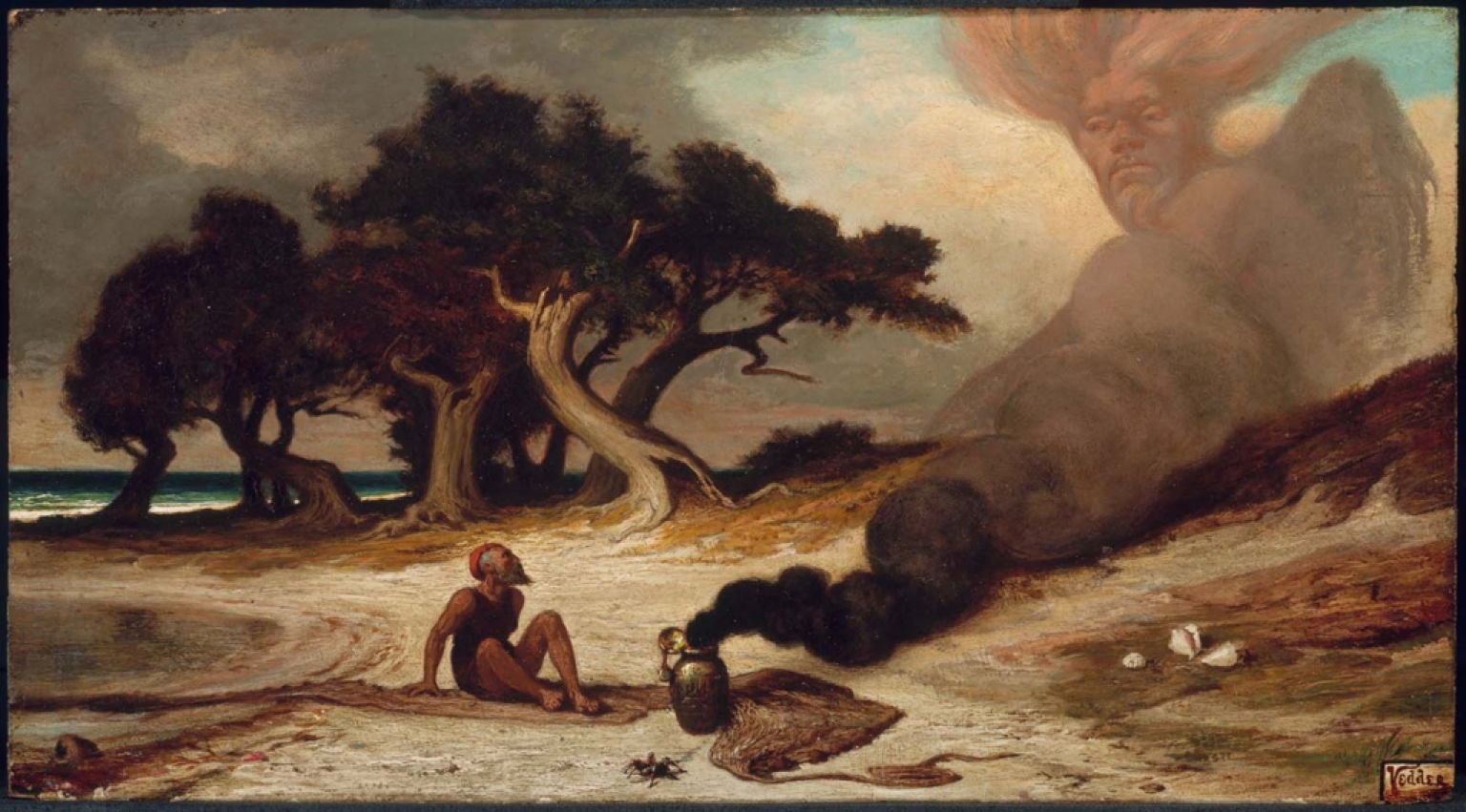
Fisherman and the Genie from about 1863 shows a scene from the second top-level story told by Sheherazade in the One Thousand and One Nights.
A poor old fisherman cast his net unsuccessfully three times, but on the fourth cast he caught a large copper jar bearing the seal of Solomon. Curious as to what was inside it, he opened it and a plume of smoke emerged and formed into a malevolent genie (or Ifrit). The genie then offered the fisherman his choice of the manner of his death. The fisherman tricked the genie into putting himself back into the bottle. This leads to a succession of other stories before the fisherman is appointed treasurer to the Sultan and lives happily ever after.
After the end of the Civil War in 1865, Vedder returned to Italy, and seems to have maintained a home in Rome from then onwards.
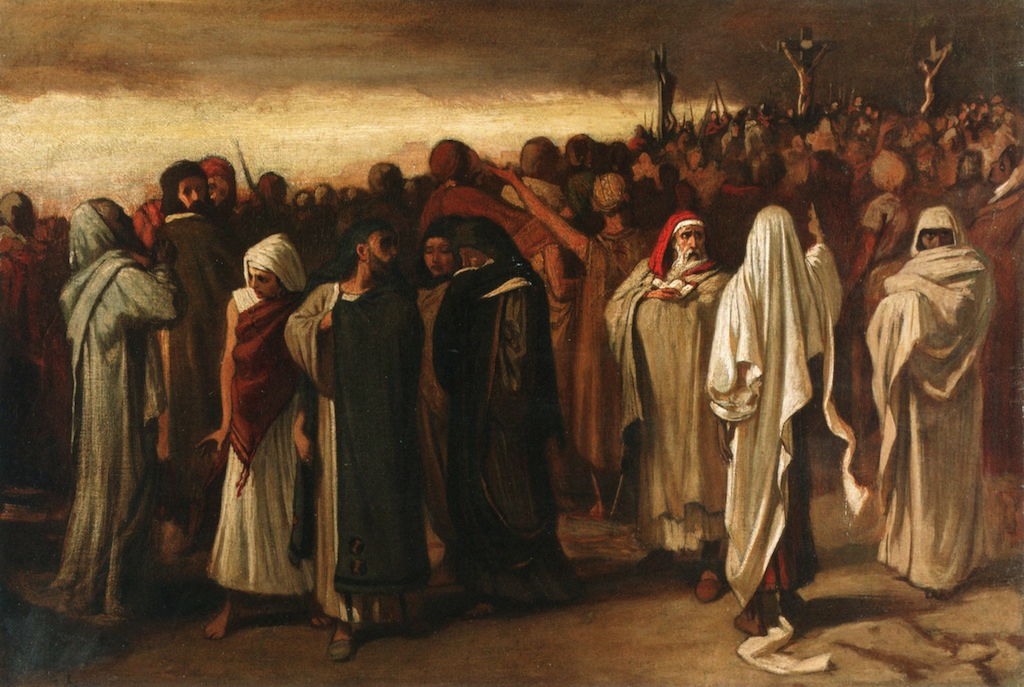
Return from Calvary (c 1867) shows an unusual view of Christ’s Crucifixion, with the crosses in the background behind a large crowd presumably dispersing back into Jerusalem. Although it’s tempting to presume that the figures in the foreground are the Marys and Joseph of Arimathea, as they were present at the deposition of Christ’s body from the cross, and its removal for burial, that couldn’t be the case.
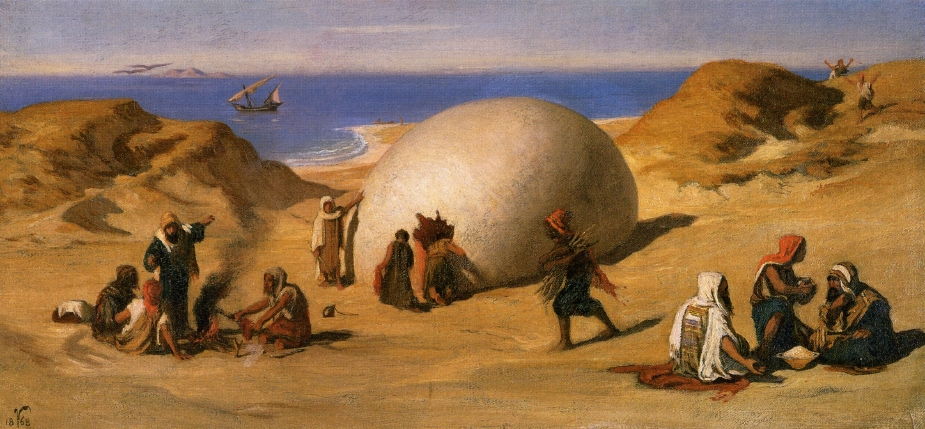
The Roc’s Egg (1868) is a scene from the legend of Sinbad the sailor, a story-cycle probably of Middle Eastern origin. These tales were a late addition to the compilation of the One Thousand and One Nights, but seemed to have existed independently before being incorporated there.
In the second voyage of Sinbad, he is accidentally abandoned on an island on which there are roc eggs. Rocs are legendary enormous birds that appear in a number of sources. Here the sailors remove the contents of one of the roc’s giant eggs, which they cook on an open fire. Later in that adventure Sinbad uses a roc to obtain diamonds, before returning home to Baghdad.

The Dead Alchemist (c 1868) shows a lone figure, slumped and apparently dead against a carved chest. Scattered around him is the equipment that might have been used by an alchemist. During the Age of Enlightenment, alchemy was progressively unmasked as bogus, and at best misguided. Although its replacement by scientific chemistry was a slow process, by the late nineteenth century alchemy was scorned and ridiculed. Vedder may have used this image to illustrate poetry.
By 1869, when he married, he had returned to New York City. At some stage, he also visited Britain, where he admired the work of the Pre-Raphaelites, and became friends with Simeon Solomon.

This remarkable painting of Memory (1870) is one of the earliest symbolist images made by an American artist. Its origins are probably in sketches Vedder made in 1866 and 1867, according to Regina Soria. The earlier of those was a response to Tennyson’s poem Break, Break, Break (1842), in which he ponders the memory of loved ones when contemplating the sea, as Vedder shows here. The crisp realism of the waves and beach contrast with the soft vagueness of the face in the clouds.
In the middle of the 1870s, Vedder seems to have been back in Italy where he returned to landscape painting, working both outdoors and in the studio.
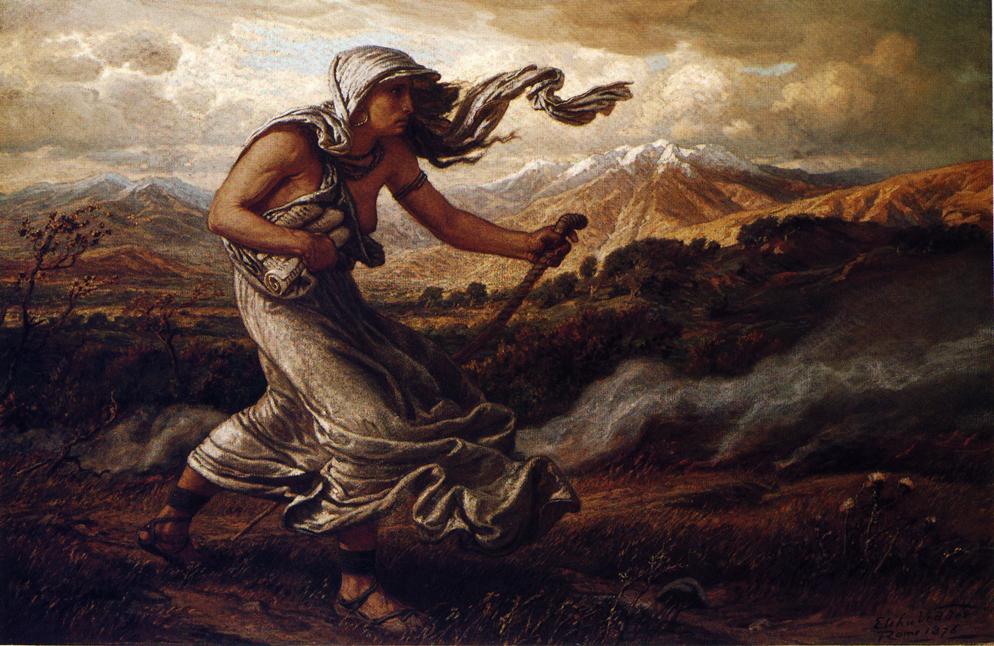
In 1876, Vedder painted this portrait of The Cumean Sibyl, the prophetess who played a major role in the foundation and success of Rome and its empire. The first key role that she had was of selling the Sibylline books to the last king of Rome, and the second was in prophesying to Aeneas (hero of Virgil’s Aeneid) about his future in Italy, which drove him to travel there.
Vedder here focusses on the first role, in that he shows the sibyl striding out, clutching several scrolls under her right arm, presumably the Sibylline books that were to guide the future of Rome.
In Greek mythology, Marsyas was a satyr (top half human, bottom half goat) who one day found a double-piped reed instrument known as a double flute (although it is not a flute) or aulos. This had been tossed aside by Athena, who had invented it, when the other gods made fun of the way she puffed her cheeks out when playing it. Marsyas became an expert aulos player, but later lost a musical contest with Apollo, as judged by the Muses, and was flayed alive in a grisly scene once popular in paintings.
Late in 1877, Carrie Vedder, the artist’s wife, recorded in a letter that her husband had been thinking about Marsyas, and considered the satyr must have proved his skill with the aulos before his contest with Apollo. He therefore came up with the idea this must have at least been charming hares with the instrument.
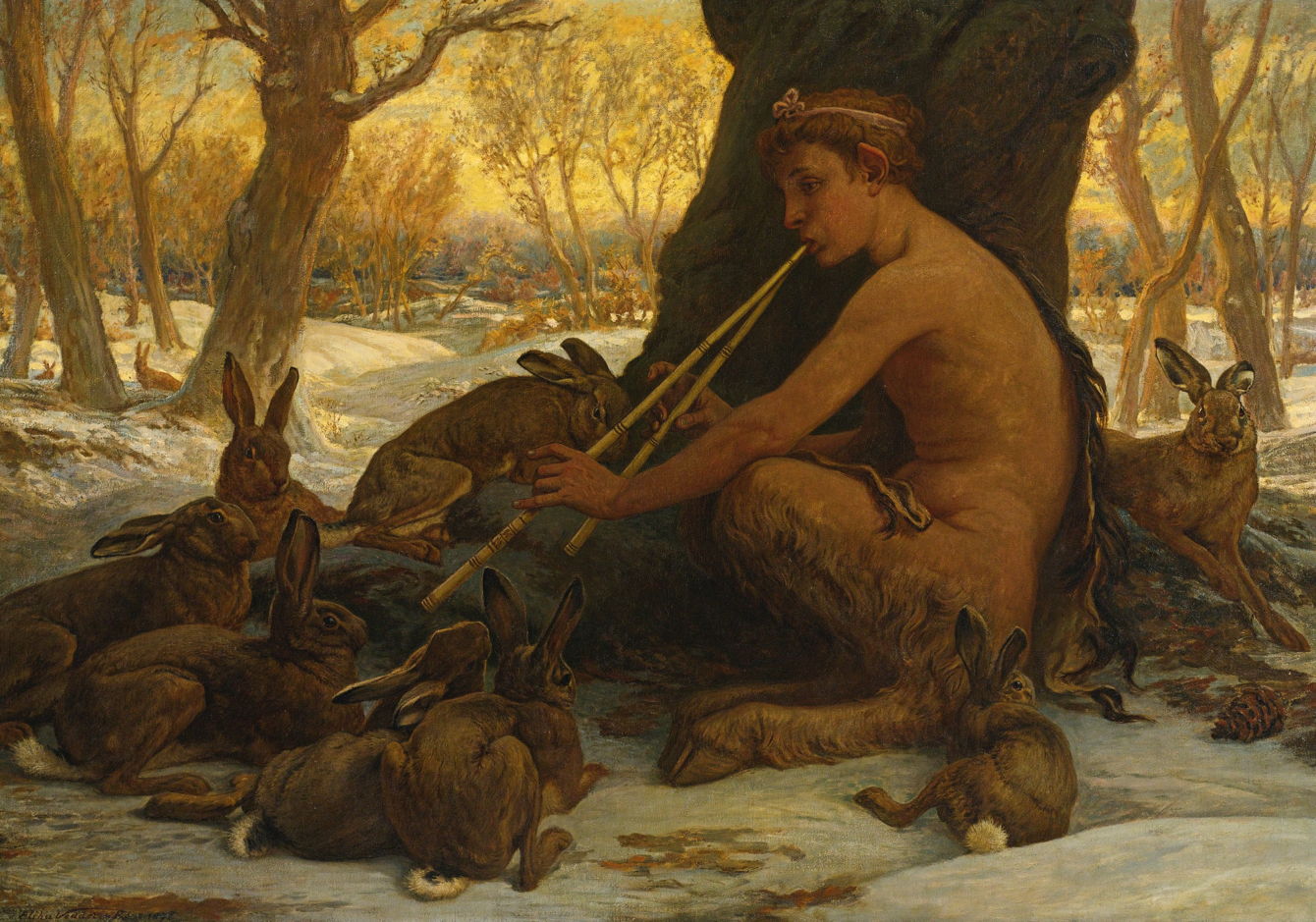
He started this painting of Young Marsyas or Marsyas Enchanting the Hares early in 1878, setting it in the New England winter. This and The Cumean Sibyl were shipped to Paris for display at the Exposition Universelle later that year, but Vedder was disappointed that they did not do well there.
The sphinx was a mythical creature with the head of a human, the haunches of a lion, and sometimes a bird’s wings. Two varieties are described in the classical literature: the Greek sphinx, based on a woman and typically shown with human breasts, and the Egyptian, based on a man’s upper body. The only example of the Greek sphinx guarded the entrance to the city of Thebes, whose deadly riddle was solved by Oedipus.

In The Sphinx of the Seashore (1879), Vedder shows a distinctly Greek sphinx in a coastal desert that could readily be close to the city of Thebes, in the rich red light of sunset. Around it are the skulls and other remains of those who didn’t solve its riddle correctly, but there’s no sign of Oedipus.
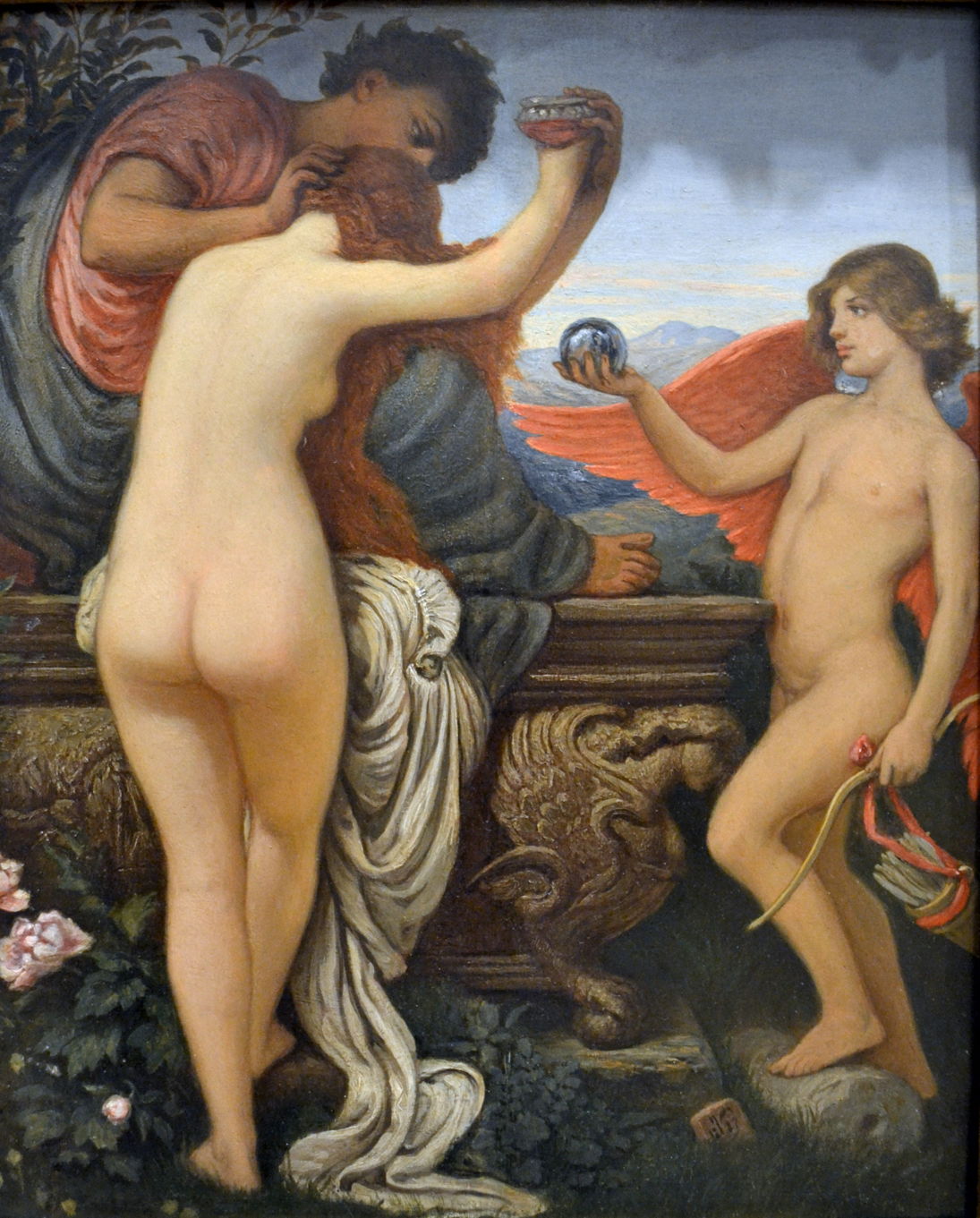
A deluxe edition of Edward FitzGerald’s translation of The Rubáiyát of Omar Khayyám was published in 1884 containing fifty-five of Vedder’s illustrations. The Cup of Love from about the same year is based on one of those. The sarcophagus is here buried in the past, as a young woman brings a cup of love to the swarthy man sitting on it. At the right is Cupid, giving his blessing to the relationship, in a very European treatment of this Persian literature.
Reference
此内容由惯性聚合(RSS阅读器)自动聚合整理,仅供阅读参考。 原文来自 — 版权归原作者所有。