


惯性聚合 高效追踪和阅读你感兴趣的博客、新闻、科技资讯
阅读原文 在惯性聚合中打开

推荐订阅源

C
Check Point Blog
O
OpenAI News
WordPress大学
WordPress大学
Jina AI
Jina AI
freeCodeCamp Programming Tutorials: Python, JavaScript, Git & More
酷 壳 – CoolShell
酷 壳 – CoolShell
月光博客
月光博客
阮一峰的网络日志
阮一峰的网络日志
量子位
OSCHINA 社区最新新闻
OSCHINA 社区最新新闻
钛媒体:引领未来商业与生活新知
钛媒体:引领未来商业与生活新知
博客园_首页
IT之家
IT之家
Last Week in AI
Last Week in AI
Vercel News
Vercel News
让小产品的独立变现更简单 - ezindie.com
B
Blog
MongoDB | Blog
MongoDB | Blog
小众软件
小众软件
P
Proofpoint News Feed
Application and Cybersecurity Blog
MyScale Blog
MyScale Blog
Schneier on Security
CTFtime.org: upcoming CTF events
N
News and Events Feed by Topic
Google Online Security Blog
N
News | PayPal Newsroom
Hacker News - Newest:
Hacker News - Newest: "LLM"
Google DeepMind News
aimingoo的专栏
aimingoo的专栏
Apple Machine Learning Research
宝玉的分享
宝玉的分享
The GitHub Blog
The GitHub Blog
Exploit-DB.com RSS Feed
Recent Announcements
L
LINUX DO - 最新话题
TaoSecurity Blog
TaoSecurity Blog
cs.CV updates on arXiv.org
F
Fortinet All Blogs
罗磊的独立博客
Forbes - Security
Forbes - Security
人人都是产品经理
人人都是产品经理
J
Java Code Geeks
H
Heimdal Security Blog
Help Net Security
Help Net Security
V
V2EX
Security Latest
Security Latest
W
WeLiveSecurity
Attack and Defense Labs
H
Help Net Security

The Eclectic Light Company

Apple has released an update to XProtect for all macOS Hero or hooligan: Theseus’ later years BSD flags are incompatible with iCloud Drive Apple has released macOS Tahoe 26.5.1 In memoriam Mary Cassatt: 1, 1868-1880 Solutions to Saturday Mac riddles 362 What Location Services do in macOS Eclectic paintings of Joseph Stella: 2 European myths Last Week on My Mac: Razzle and dazzle Eclectic paintings of Joseph Stella: 1 American landscapes Saturday Mac riddles 362 Protect files with the Locked or Immutable flag Reading Visual Art: 252 Dragonfly What happens in the log when an app crashes as it starts up? Portraits of trees: Introduction On Reflection: Conclusions and contents Which tasks require mains power? Medium and message: Vast canvases Online reference to external displays for Apple silicon Macs What’s in that phishing email? Hero or hooligan: Theseus and Ariadne Solutions to Saturday Mac riddles 361 How to search document versions Rubens’ Consequences of War Rubens’ Peace and War Saturday Mac riddles 361 How to search Time Machine backups? Naturalists: Contents and artists Tackle QuickLook problems Medium and message: Pottery Hero or hooligan: Theseus and the sandals How QuickLook provides thumbnails and previews Last Week on My Mac: Syncing metadata in iCloud Drive Paintings of visits to India 1778-1877 Saturday Mac riddles 360 Naturalists: Sorolla and Zorn On Reflection: Pierre Bonnard 1909-1946 SpotTest 1.2 can display Spotlight metadata directly On Reflection: Pierre Bonnard 1899-1908 How to preserve versions, and how to create versioned PDFs Medium and message: Sculpture What gets synced in iCloud Drive? Hero or hooligan: Perseus 2 Solutions to Saturday Mac riddles 359 Last Week on My Mac: snapshots, the elephant in APFS Paintings of Beatrice Portinari: to 1862 Saturday Mac riddles 359 Naturalists: Into the 20th century How to check whether Spotlight is getting the right metadata On Reflection: Mirror play Hero or hooligan: Perseus 1 The bicentenary of Frederic Edwin Church: 1857-77 Solutions to Saturday Mac riddles 358 macOS virtual machines and audio-video syncing A walk in the parks of Rome, Vienna, Manhattan and Brooklyn Saturday Mac riddles 358 Naturalists: Photography Use Finder tags for categories Control what gets written to the log Medium and message: Tapestry Virtualisation on Apple silicon Macs is different Jerusalem Delivered: Overview and contents The bicentenary of Frederic Edwin Church: 1849-57 Solutions to Saturday Mac riddles 357 Painting Pandora and her box: 1883-1919 Painting Pandora and her box: 1550-1882 Saturday Mac riddles 357 Reading Visual Art: 250 Winged sandals The secret life of the xattr The macOS Natural Language framework and Nalaprop Medium and Message: Stained glass The MACL extended attribute Jerusalem Delivered: 13 Leading characters Solutions to Saturday Mac riddles 356 Privacy: How locations are protected Painting Spring blossom 2 Last Week on My Mac: Don’t be a victim of fraud Painting Spring blossom 1 Saturday Mac riddles 356 Explainer: Recovery Reading Visual Art: 249 Mask Naturalists: Urban poverty On Reflection: Cézanne Privacy: Which folders are protected in Tahoe? Medium and Message: Mosaic Jerusalem Delivered: 12 Delivery Solutions to Saturday Mac riddles 355 Centaurs 2: Revenge Centaurs 1: Fights Saturday Mac riddles 355 Explainer: sandboxes Naturalists: The modern meal Why you can’t trust Privacy & Security Apple has just released an update to macOS Tahoe, to version 26.4.1 On Reflection: Divisionism Please help update CPU frequencies for Apple silicon Macs Commemorating the centenary of the death of John Ferguson Weir Privacy: Files & Folders or Full Disk Access? Jerusalem Delivered: 11 Into Jerusalem Privacy: protected folders
On Reflection: Extending the image
hoakley · 2026-05-20 · via The Eclectic Light Company

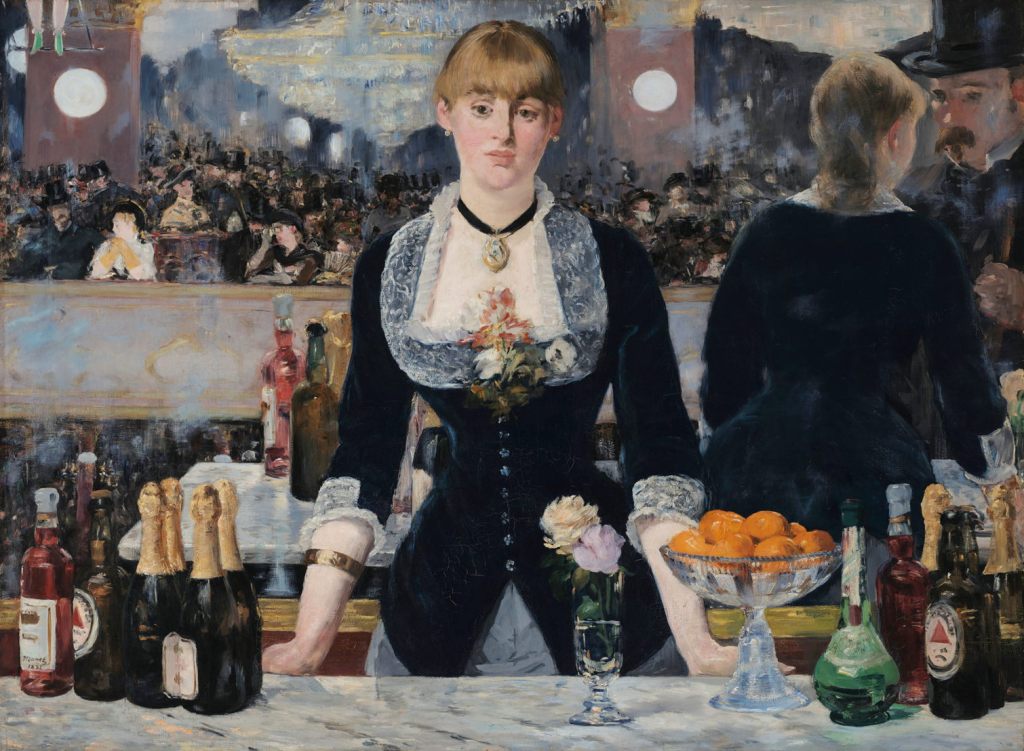
Édouard Manet (1832–1883), A Bar at the Folies-Bergère (1882), oil on canvas, 96 x 130 cm, The Courtauld Gallery, London. Wikimedia Commons.

Jan van Eyck’s famous double-portrait of the Arnolfini Wedding (1434) introduced mirror-play, but didn’t quite demonstrate its use to extend the scene depicted because of the small size of its reflected image. Surprisingly it appears that four centuries were to pass before reflections became more widely adopted for this purpose, although I’m sure they had already been used for it in interior decoration.

One of the earliest of my examples refers back to the Arnolfini Wedding in its use of a circular and non-planar mirror.

'Take your Son, Sir' ?1851-92 by Ford Madox Brown 1821-1893
Ford Madox Brown (1821–1893), Take your Son, Sir! (1851-52), oil on canvas, 70.5 x 38.1 cm, The Tate Gallery (Presented by Miss Emily Sargent and Mrs Ormond in memory of their brother, John S. Sargent), London. © The Tate Gallery and Photographic Rights © Tate (2016), CC-BY-NC-ND 3.0 (Unported), https://www.tate.org.uk/art/artworks/brown-take-your-son-sir-n04429

The dates and background to Ford Madox Brown’s unfinished painting Take your Son, Sir! remain unclear. It’s thought that Brown started work on this in 1851, although it shows his second wife Emma with their newborn son. Their first son, Oliver, wasn’t born until 1855, and their second, Arthur, in September 1856, suggesting that he didn’t start this until at least 1855. It’s generally held that this shows not Oliver, who lived until 1874, but Arthur, who died aged ten months in July 1857, at which time Brown abandoned the painting. The detail seen reflected in the mirror is of a contemporary living room and a man, presumably a self-portrait.

The Awakening Conscience 1853 by William Holman Hunt 1827-1910
William Holman Hunt (1827-1910), The Awakening Conscience (1851-53), oil on canvas, 76.2 x 55.9 cm, The Tate Gallery (Presented by Sir Colin and Lady Anderson through the Friends of the Tate Gallery 1976), London. © The Tate Gallery and Photographic Rights © Tate (2016), CC-BY-NC-ND 3.0 (Unported), https://www.tate.org.uk/art/artworks/hunt-the-awakening-conscience-t02075

A few years before that, William Holman Hunt’s The Awakening Conscience, painted over the period 1851-53, employs the reflection seen in a much larger mirror to add substantial detail to its unresolved narrative. This places the scene in a small if not cramped house in the leafy suburbs of London, in reality Saint John’s Wood, where this couple are clearly in an extra-marital relationship.
Solomon, Rebecca, 1832-1886; The Appointment
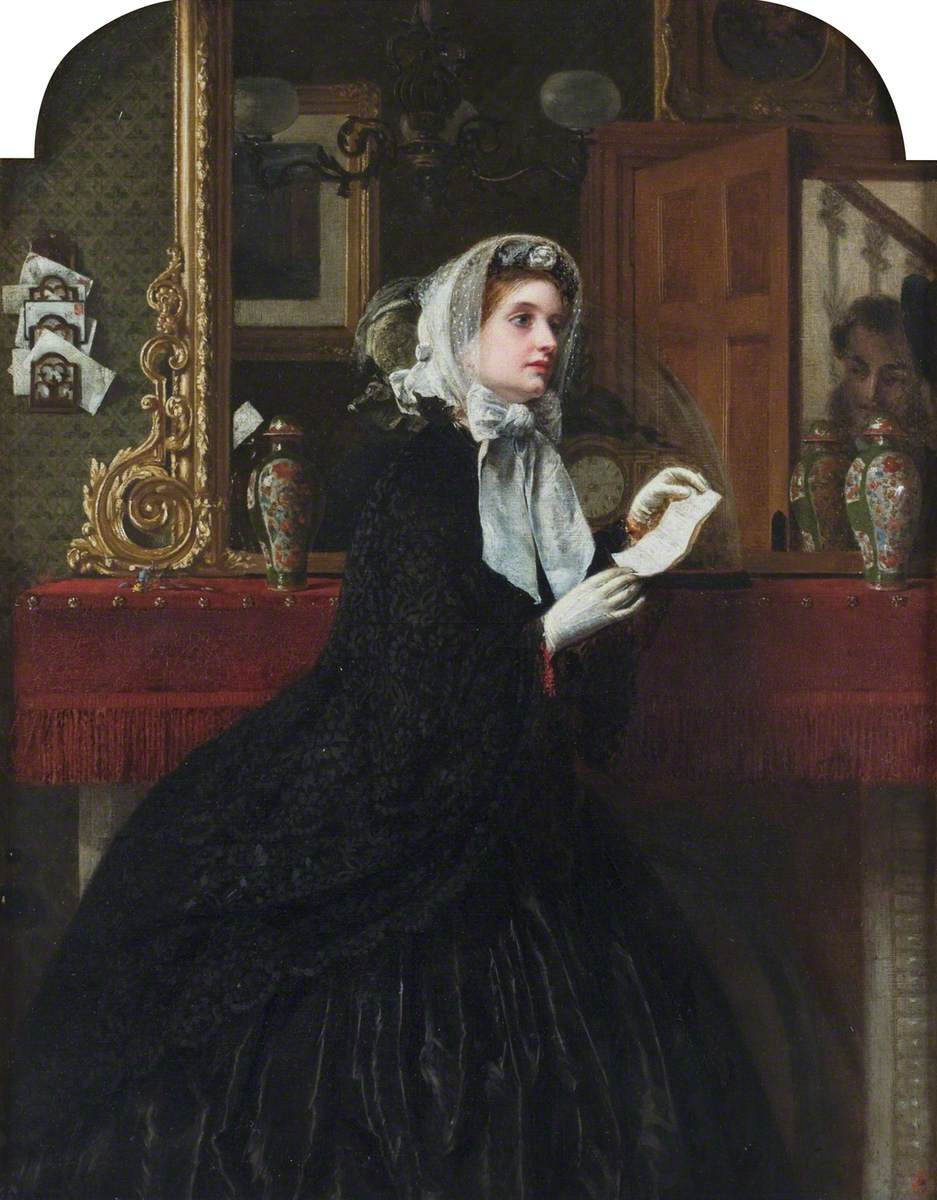
Rebecca Solomon (1832-1886), The Appointment (1861), media and dimensions not known, The Geffrye, Museum of the Home. Wikimedia Commons.

Rebecca Solomon’s Appointment (1861) is another early problem picture, with a deliberately open-ended narrative set in an interior. A beautiful woman stands in front of a mirror, and looks intently at a man, who is only seen in his reflection in the mirror, and stands in a doorway behind the viewer’s right shoulder. The woman is dressed to go out, and is holding a letter in her gloved hands.

stevensjapaneseparisian
Alfred Stevens (1823–1906), The Japanese Parisian (1872), oil on canvas, 105 × 150 cm, Musée d’art moderne et d’art contemporain, Liège. Wikimedia Commons.

In 1872 Alfred Stevens’ The Japanese Parisian filled its canvas with the reflection of the face of his model framed by floating flowers, which must be behind the viewer.
huntdolcefarniente
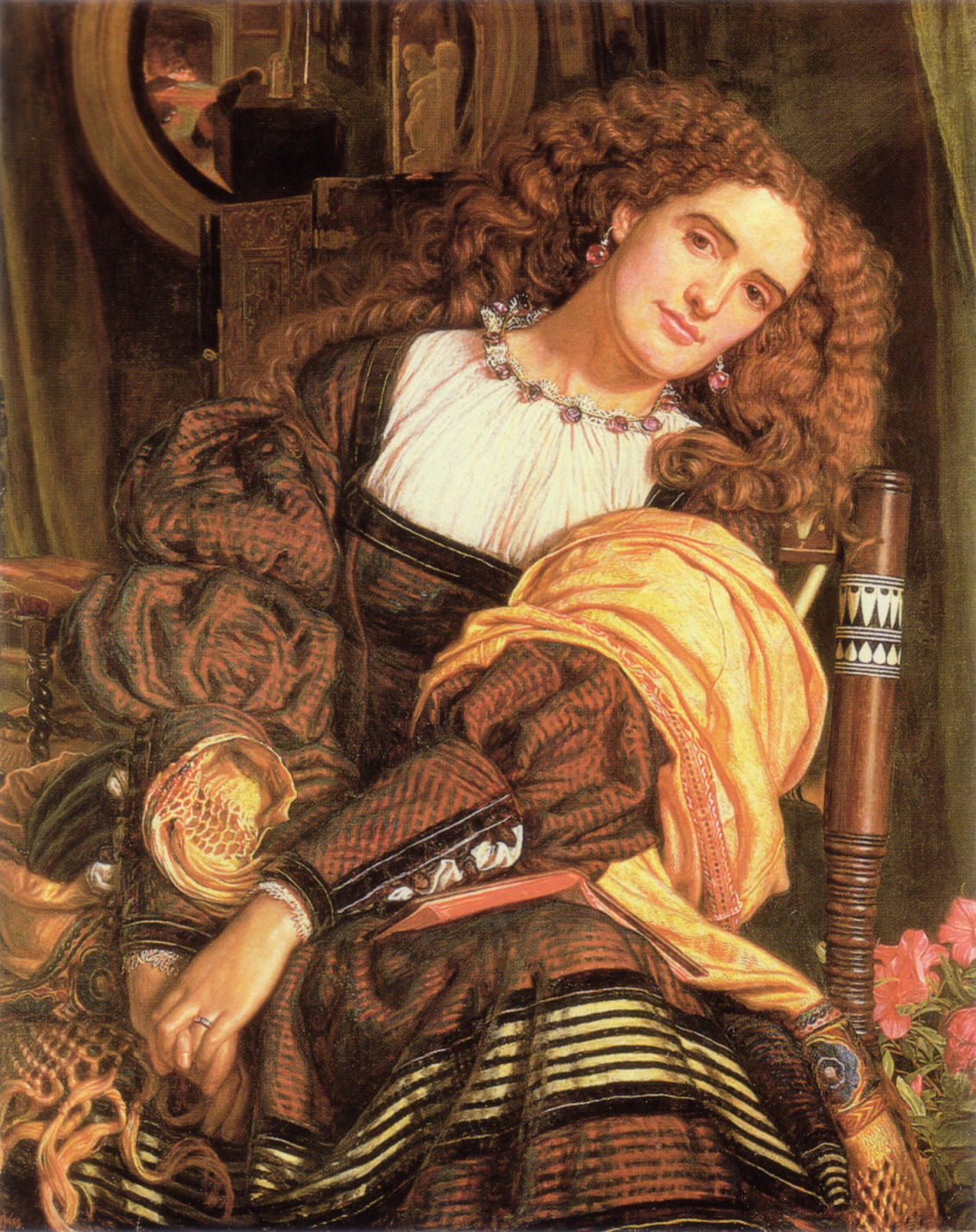
William Holman Hunt (1827–1910), Dolce Far Niente (1865-75), oil on canvas, 99 × 82.5 cm, Private collection. Wikimedia Commons.

Soon after William Holman Hunt had completed his Awakening Conscience above, he started work on another painting using a smaller circular mirror to extend the scene and its reading, Dolce Far Niente, which may have been started as early as 1859 but wasn’t completed until 1875. The reflection in the mirror above the woman’s head shows this to be a domestic scene, with another figure leaning over a large wooden bureau or a dressing-table, perhaps.

So far, these examples have all appeared to conform to optical principles. It was Édouard Manet who challenged those.

Édouard Manet (1832–1883), A Bar at the Folies-Bergère (1882), oil on canvas, 96 x 130 cm, The Courtauld Gallery, London. Wikimedia Commons.

His Bar at the Folies-Bergère from 1882 poses the problem of resolving the optically impossible, no matter how you try to read it. This forlorn young woman is serving at the bar in front of her, with what is presumed to be a large mirror behind showing a reflection that doesn’t match its original. Arranged on the bar are assorted bottles of beers and spirits, that on the far left bearing the artist’s signature. According to the reflection, the audience at the Folies-Bergère are watching the show under the light of a huge chandelier.

IF
John William Waterhouse (1849–1917), Circe Offering the Cup to Odysseus (1891), oil on canvas, 149 x 92 cm, Gallery Oldham, Manchester, England. Wikimedia Commons.

John William Waterhouse’s Circe Offering the Cup to Odysseus from 1891 develops the circular mirror of the Arnolfini Wedding into a key narrative device. Circe sits on her throne, holding up a krater for Ulysses to drink, with her wand in the other hand. The viewer is Ulysses, seen preparing to draw his sword in the large mirror behind the sorceress. On the left side of the mirror is his ship.

In the closing years of his career, Waterhouse returned with an even larger mirror at the centre of his story.

waterhousehalfsickshadows
John William Waterhouse (1849–1917), “I am Half Sick of Shadows” said the Lady of Shalott (1915), oil on canvas, 100 x 74 cm, Art Gallery of Ontario, Toronto, Canada. Wikimedia Commons.

His “I am Half Sick of Shadows” said the Lady of Shalott (1915) is the third and last of his paintings based on the poem The Lady of Shalott by Alfred Lord Tennyson (1809–1892), published in 1833 and 1842. This recounts part of the Arthurian legends, the tragedy of Elaine of Astolat, as retold in an Italian novella from the 1200s from which it draws its title.

The Lady of Shalott lives in a castle connected to Camelot by a river. She’s subject to a mysterious curse confining her to weaving images on her loom, and mustn’t look directly at the outside world, although she can view it using a mirror. Tennyson calls these reflected images ‘shadows of the world’, and this painting depicts the stanza from the poem:

But in her web she still delights
To weave the mirror’s magic sights,
For often thro’ the silent nights
A funeral, with plumes and lights,
And music, went to Camelot:
Or when the moon was overhead,
Came two young lovers lately wed;
‘I am half sick of shadows,’ said
The Lady of Shalott.

The circular image behind her isn’t a window, but a mirror revealing Camelot with its winding river. Although this includes her loom, the castle can’t be real, but one of “the mirror’s magic sights”.

My last example, painted just before the Second World War by Paul Nash, extends this deeper into the unconscious.
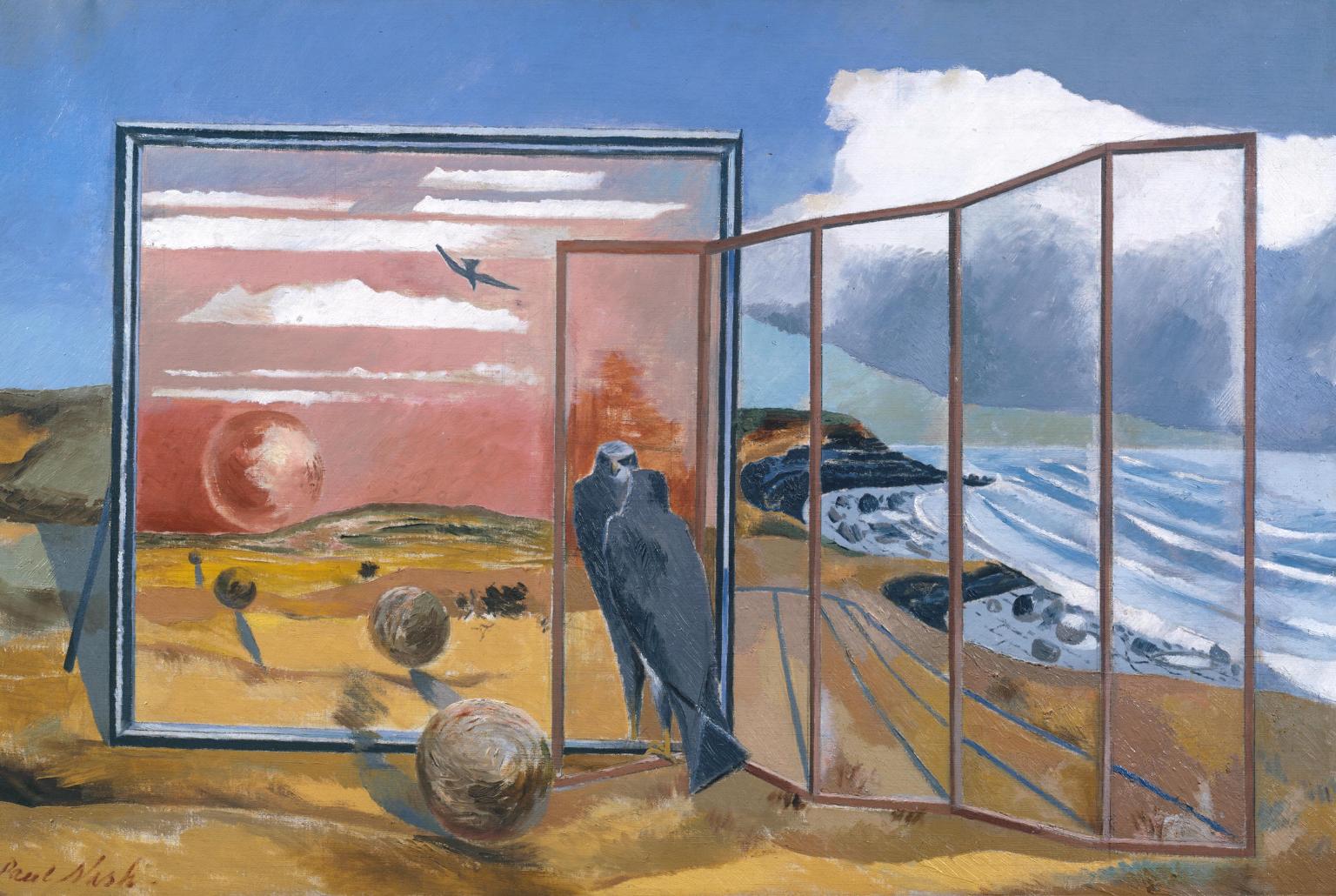
Landscape from a Dream 1936-8 by Paul Nash 1889-1946
Paul Nash (1892–1946), Landscape from a Dream (1936-38), oil on canvas, 67.9 x 101.6 cm, The Tate Gallery (Presented by the Contemporary Art Society 1946), London. © The Tate Gallery and Photographic Rights © Tate (2016), CC-BY-NC-ND 3.0 (Unported), http://www.tate.org.uk/art/artworks/nash-landscape-from-a-dream-n05667

Landscape from a Dream (1936-38) was inspired by Freud’s theories of the significance of dreams as reflections of the unconscious. Nash locates this collection of incongruous objects on the Dorset coast, a landscape he associated with the praeternatural. Dominating the scene is a large framed planar mirror, almost parallel with the picture plane.

Stood at the right end of the mirror is a hawk staring at its own reflection, which Nash explained is a symbol of the material world. To the left, the mirror reflects several floating spheres, referring to the soul. The reflection shows that behind the viewer is a red sun setting in a red sky, with another hawk flying high, away from the scene. To the right of the hawk is a five-panelled screen made of glass, through which the coastal landscape can be seen: it’s a screen which doesn’t screen.