



惯性聚合 高效追踪和阅读你感兴趣的博客、新闻、科技资讯
阅读原文 在惯性聚合中打开

推荐订阅源

S
SegmentFault 最新的问题
The Last Watchdog
The Last Watchdog
P
Proofpoint News Feed
C
Cybersecurity and Infrastructure Security Agency CISA
L
LINUX DO - 热门话题
Cyberwarzone
Cyberwarzone
S
Schneier on Security
C
CERT Recently Published Vulnerability Notes
Latest news
Latest news
I
Intezer
A
Arctic Wolf
IT之家
IT之家
cs.CL updates on arXiv.org
C
Cisco Blogs
AWS News Blog
AWS News Blog
博客园 - 三生石上(FineUI控件)
C
CXSECURITY Database RSS Feed - CXSecurity.com
F
Fortinet All Blogs
Microsoft Azure Blog
Cyber Security Advisories - MS-ISAC
T
The Exploit Database - CXSecurity.com
Google DeepMind News
M
MIT News - Artificial intelligence
D
Docker
cs.AI updates on arXiv.org
C
Cyber Attacks, Cyber Crime and Cyber Security
MongoDB | Blog
MongoDB | Blog
B
Blog
博客园 - 叶小钗
V2EX - 技术
V2EX - 技术
Simon Willison's Weblog
MyScale Blog
MyScale Blog
Hugging Face - Blog
Hugging Face - Blog
Engineering at Meta
Engineering at Meta
NISL@THU
NISL@THU
WordPress大学
WordPress大学
人人都是产品经理
人人都是产品经理
Stack Overflow Blog
Stack Overflow Blog
N
Netflix TechBlog - Medium
The GitHub Blog
The GitHub Blog
V
V2EX
PCI Perspectives
PCI Perspectives
N
News | PayPal Newsroom
V
Visual Studio Blog
Vercel News
Vercel News
P
Proofpoint News Feed
Exploit-DB.com RSS Feed
J
Java Code Geeks
O
OpenAI News
爱范儿
爱范儿

The Eclectic Light Company

Apple has released an update to XProtect for all macOS Hero or hooligan: Theseus’ later years BSD flags are incompatible with iCloud Drive Apple has released macOS Tahoe 26.5.1 In memoriam Mary Cassatt: 1, 1868-1880 Solutions to Saturday Mac riddles 362 What Location Services do in macOS Eclectic paintings of Joseph Stella: 2 European myths Last Week on My Mac: Razzle and dazzle Eclectic paintings of Joseph Stella: 1 American landscapes Saturday Mac riddles 362 Protect files with the Locked or Immutable flag Reading Visual Art: 252 Dragonfly What happens in the log when an app crashes as it starts up? Portraits of trees: Introduction On Reflection: Conclusions and contents Which tasks require mains power? Medium and message: Vast canvases Online reference to external displays for Apple silicon Macs What’s in that phishing email? Hero or hooligan: Theseus and Ariadne Solutions to Saturday Mac riddles 361 How to search document versions Rubens’ Consequences of War Rubens’ Peace and War Saturday Mac riddles 361 How to search Time Machine backups? Naturalists: Contents and artists On Reflection: Extending the image Tackle QuickLook problems Medium and message: Pottery Hero or hooligan: Theseus and the sandals How QuickLook provides thumbnails and previews Last Week on My Mac: Syncing metadata in iCloud Drive Paintings of visits to India 1778-1877 Saturday Mac riddles 360 Naturalists: Sorolla and Zorn On Reflection: Pierre Bonnard 1909-1946 SpotTest 1.2 can display Spotlight metadata directly On Reflection: Pierre Bonnard 1899-1908 How to preserve versions, and how to create versioned PDFs Medium and message: Sculpture What gets synced in iCloud Drive? Hero or hooligan: Perseus 2 Solutions to Saturday Mac riddles 359 Last Week on My Mac: snapshots, the elephant in APFS Paintings of Beatrice Portinari: to 1862 Saturday Mac riddles 359 Naturalists: Into the 20th century How to check whether Spotlight is getting the right metadata On Reflection: Mirror play Hero or hooligan: Perseus 1 The bicentenary of Frederic Edwin Church: 1857-77 Solutions to Saturday Mac riddles 358 macOS virtual machines and audio-video syncing A walk in the parks of Rome, Vienna, Manhattan and Brooklyn Saturday Mac riddles 358 Naturalists: Photography Use Finder tags for categories Control what gets written to the log Medium and message: Tapestry Virtualisation on Apple silicon Macs is different Jerusalem Delivered: Overview and contents The bicentenary of Frederic Edwin Church: 1849-57 Solutions to Saturday Mac riddles 357 Painting Pandora and her box: 1550-1882 Saturday Mac riddles 357 Reading Visual Art: 250 Winged sandals The secret life of the xattr The macOS Natural Language framework and Nalaprop Medium and Message: Stained glass The MACL extended attribute Jerusalem Delivered: 13 Leading characters Solutions to Saturday Mac riddles 356 Privacy: How locations are protected Painting Spring blossom 2 Last Week on My Mac: Don’t be a victim of fraud Painting Spring blossom 1 Saturday Mac riddles 356 Explainer: Recovery Reading Visual Art: 249 Mask Naturalists: Urban poverty On Reflection: Cézanne Privacy: Which folders are protected in Tahoe? Medium and Message: Mosaic Jerusalem Delivered: 12 Delivery Solutions to Saturday Mac riddles 355 Centaurs 2: Revenge Centaurs 1: Fights Saturday Mac riddles 355 Explainer: sandboxes Naturalists: The modern meal Why you can’t trust Privacy & Security Apple has just released an update to macOS Tahoe, to version 26.4.1 On Reflection: Divisionism Please help update CPU frequencies for Apple silicon Macs Commemorating the centenary of the death of John Ferguson Weir Privacy: Files & Folders or Full Disk Access? Jerusalem Delivered: 11 Into Jerusalem Privacy: protected folders
Painting Pandora and her box: 1883-1919
hoakley · 2026-04-26 · via The Eclectic Light Company

Ernest Normand (1857-1923), Pandora (1899), further details not known. The Athenaeum.

The ancient Greek myth of Pandora had been almost unknown in paintings until the nineteenth century. During the 1870s it suddenly became a popular theme for European paintings, but its narrative had altered from the original in showing the first woman in Greek mythology with a box containing the ills of the world, rather than a large earthenware storage pot, and only one artist had depicted its crux.
churchopenedpandorasbox
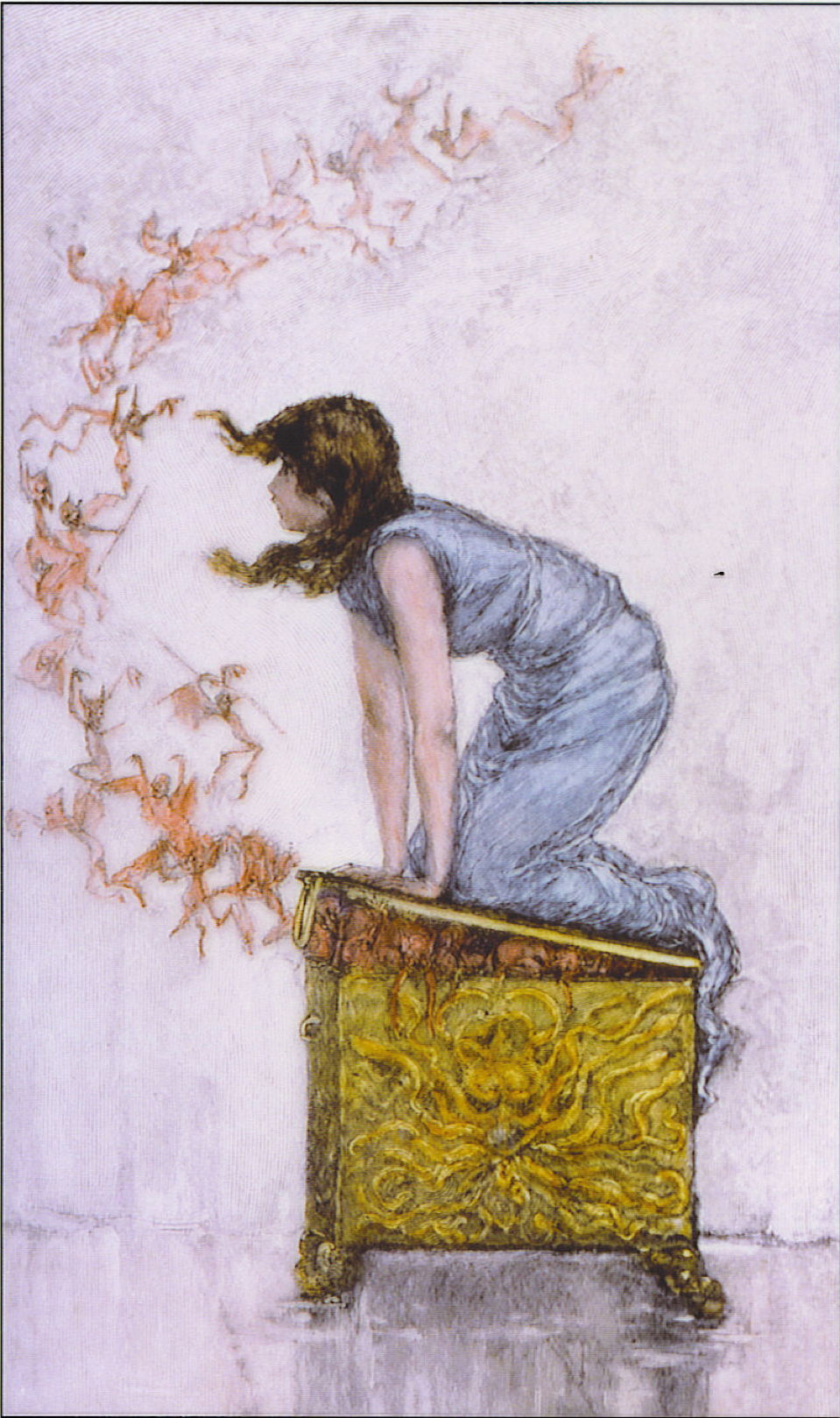
Frederick Stuart Church (1842–1924), Pandora (1883), pencil and ink wash on paper, 30.2 x 45.7 cm, Private collection. Wikimedia Commons.

The story broke out of Europe by 1883, when the American painter and illustrator Frederick Stuart Church painted his more illustrative Pandora. Dressed more modestly (presumably for a wider audience), she is shown as an innocent young woman kneeling on a large golden chest as she tries to close its lid and stop the emerging stream of red demons. I suspect this was intended as an illustration for a printed collection of classical myths.

Walter Crane (1845–1915), Pandora (1885), watercolour on paper, 53.3 x 73.6 cm, location not known. Wikimedia Commons.

The following year Walter Crane, a British painter and illustrator, painted Pandora in an unusual interpretation that’s only loosely connected with the original myth. She is here draped in grief over a substantial casket, and on its side panel are the figures of the three Fates. At the corners of the casket are guardian winged sphinxes, each clasping a sphere.

bouguereaupandora
William-Adolphe Bouguereau (1825–1905), Pandora (1890), oil on canvas, 92.5 × 64.5 cm, location not known. Wikimedia Commons.

In his later years, William-Adolphe Bouguereau chose an oddly androgynous model for his depiction of Pandora in 1890, but has rather lost the narrative. Her neutral expression, body language, and the closed box tell little of what is imminent.
waterhousepandora
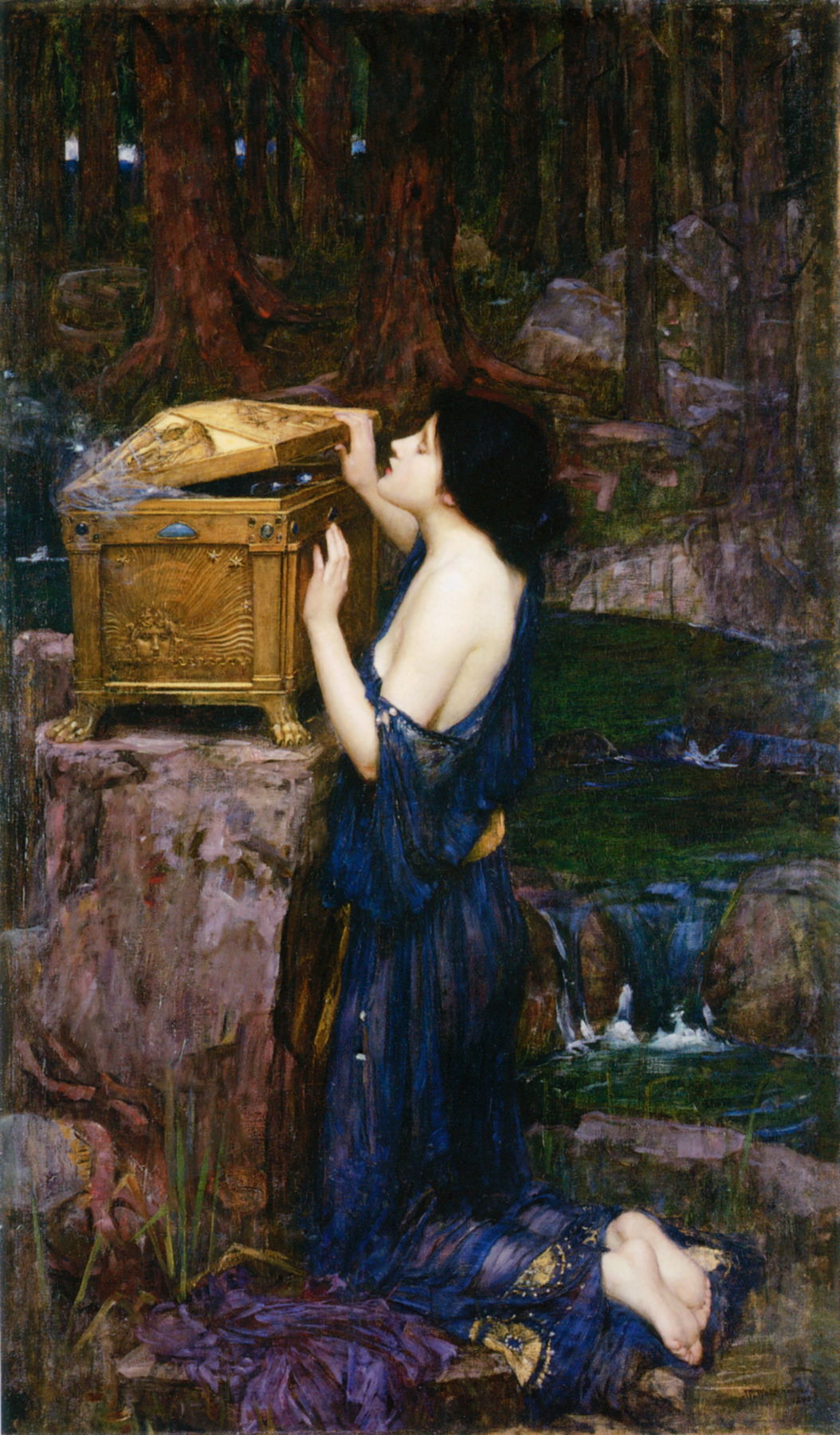
John William Waterhouse (1849–1917), Pandora (1896), oil on canvas, 152 × 91 cm, Private collection. Wikimedia Commons.

One of his lesser-known paintings, John William Waterhouse’s Pandora from 1896 is a major depiction of this myth, and one of the most complete. Set by a small brook in a dark, primeval forest, her box has become a large gold chest encrusted with precious stones and decorated with mythological motifs. Pandora kneels by its side, peeking inside as she carefully raises its lid, but even this tentative glimpse is sufficient to release its stream of ills, of which she appears unaware.
normandpandora
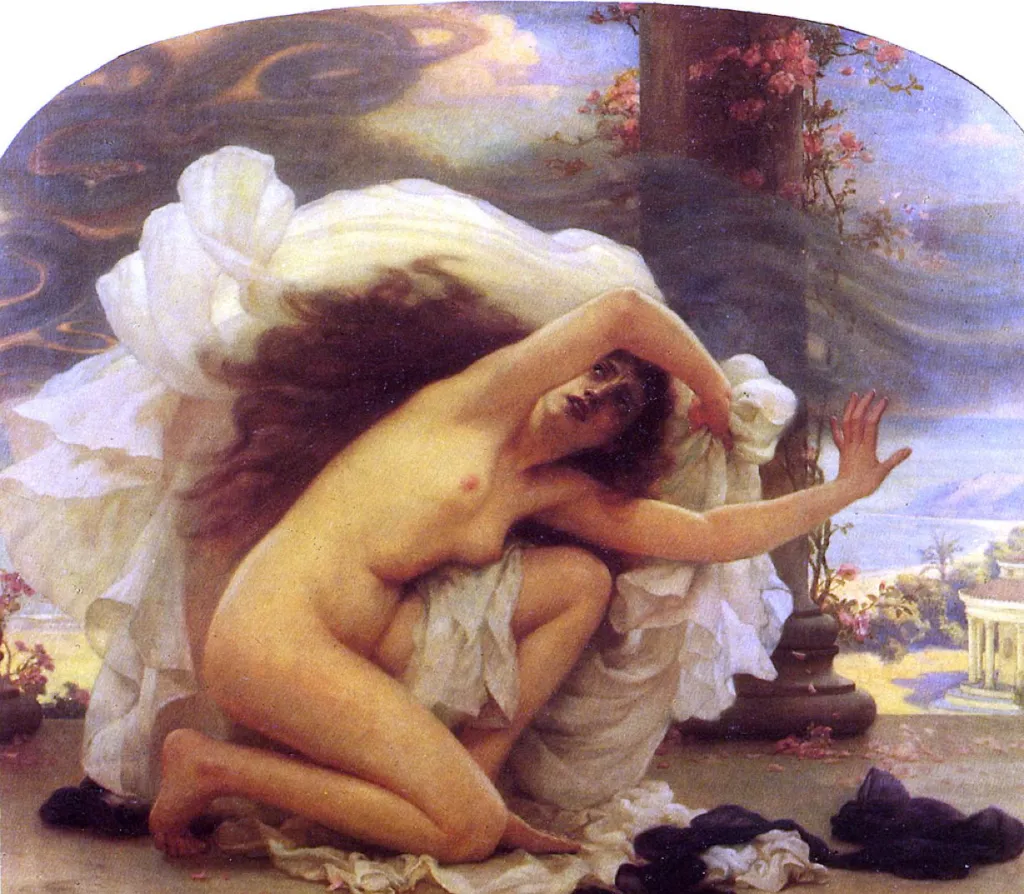
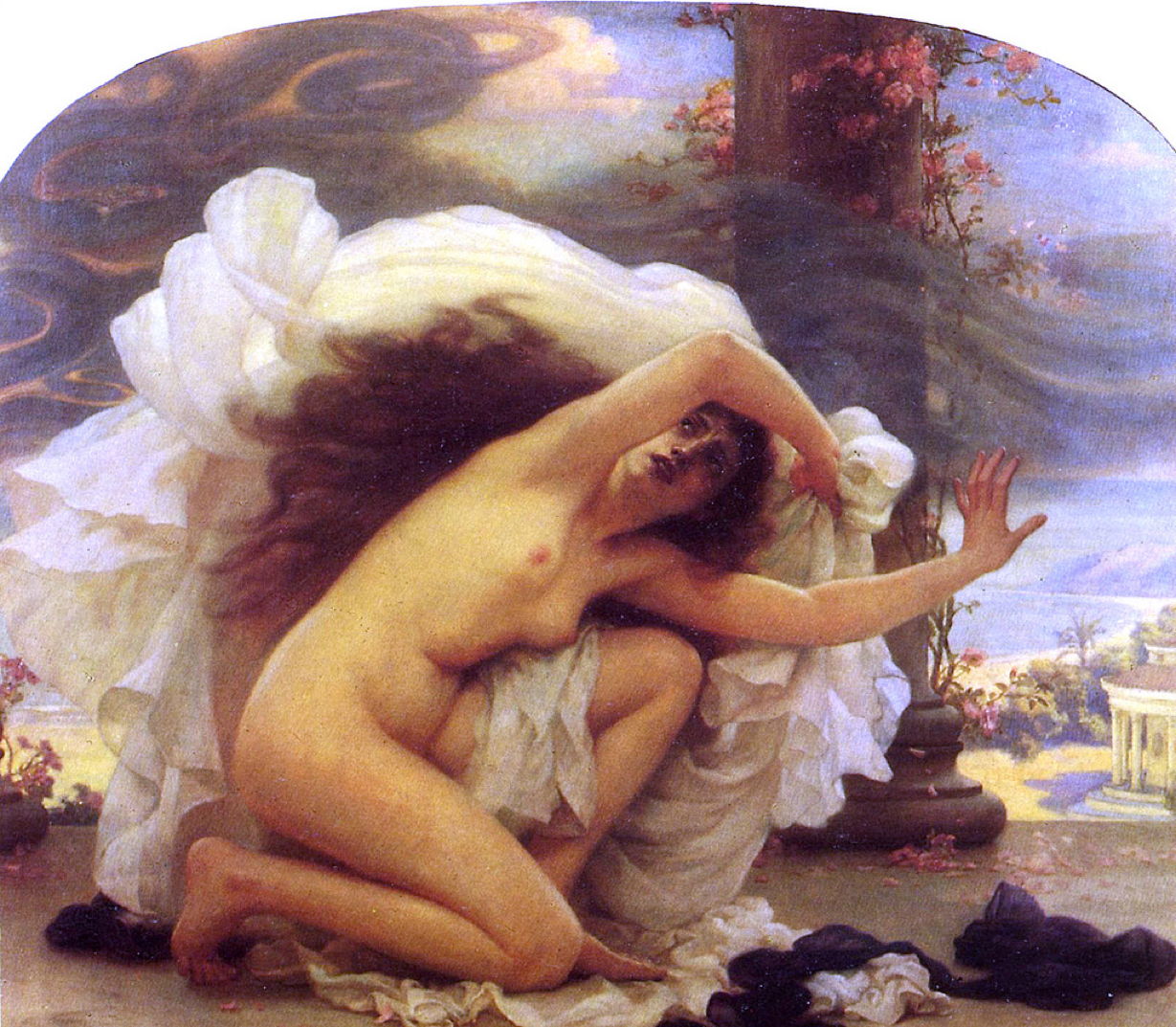
Ernest Normand (1857-1923), Pandora (1899), further details not known. The Athenaeum.

Ernest Normand is one of few painters to show a later moment, in which Pandora (1899) bends low to duck beneath the swirling grey clouds of evils as they spread out into the idyllic world beyond, causing blossom to fall as petals to the ground. Her jar is only hinted at, behind her billowing white robes, almost depriving the viewer of this vital clue to the original story.
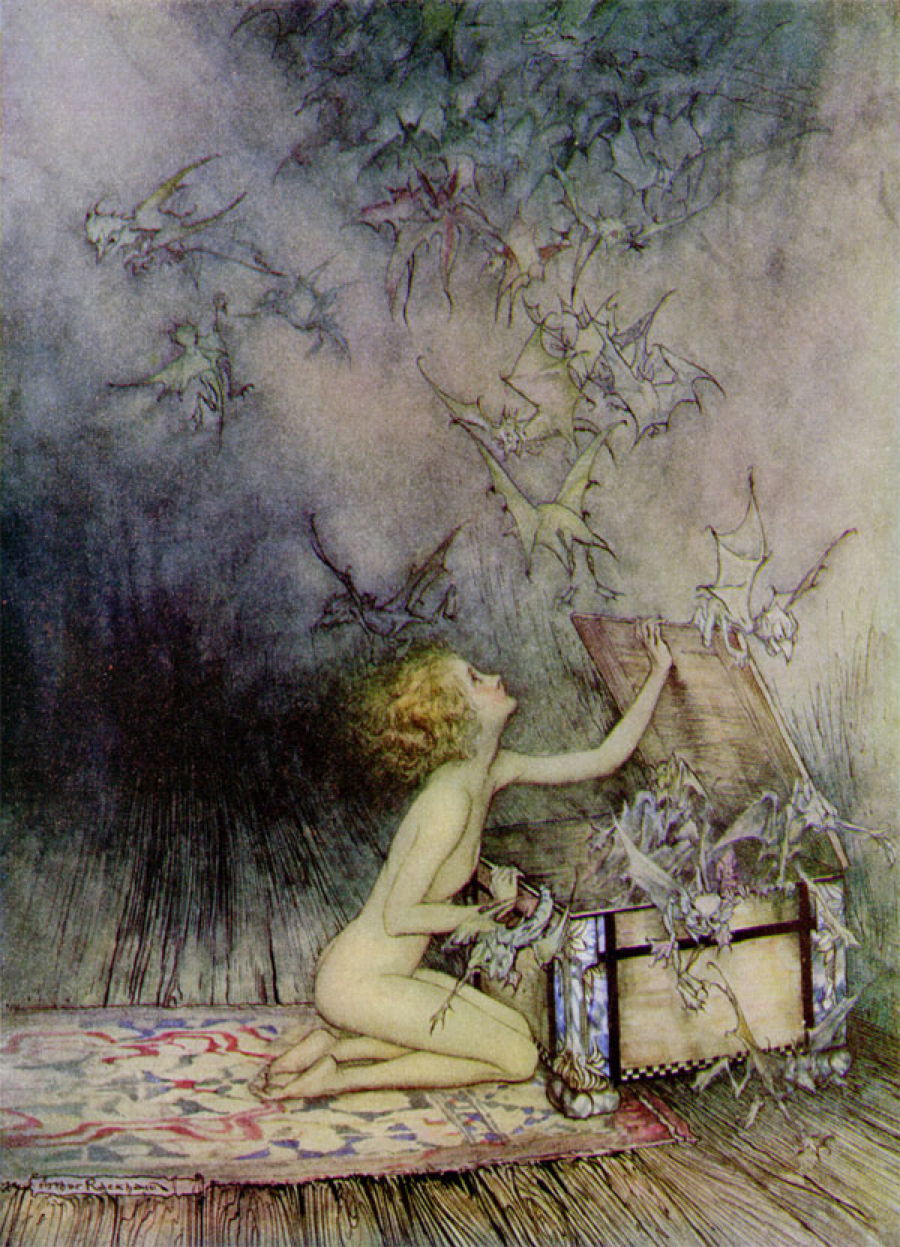
rackhampandora
Arthur Rackham (1867–1939), Pandora (date not known), further details not known. Wikimedia Commons.

I have been unable to find a date for this presumed illustration by the great Arthur Rackham of Pandora, but suspect it was made around the turn of the twentieth century, and intended to accompany a British English retelling of this myth. As with Church before, Pandora is young and innocent in her nakedness. She gazes up in awe at the batlike demons as they escape from the open lid of her large wooden chest, seemingly unaware of what she is unleashing in her curiosity.
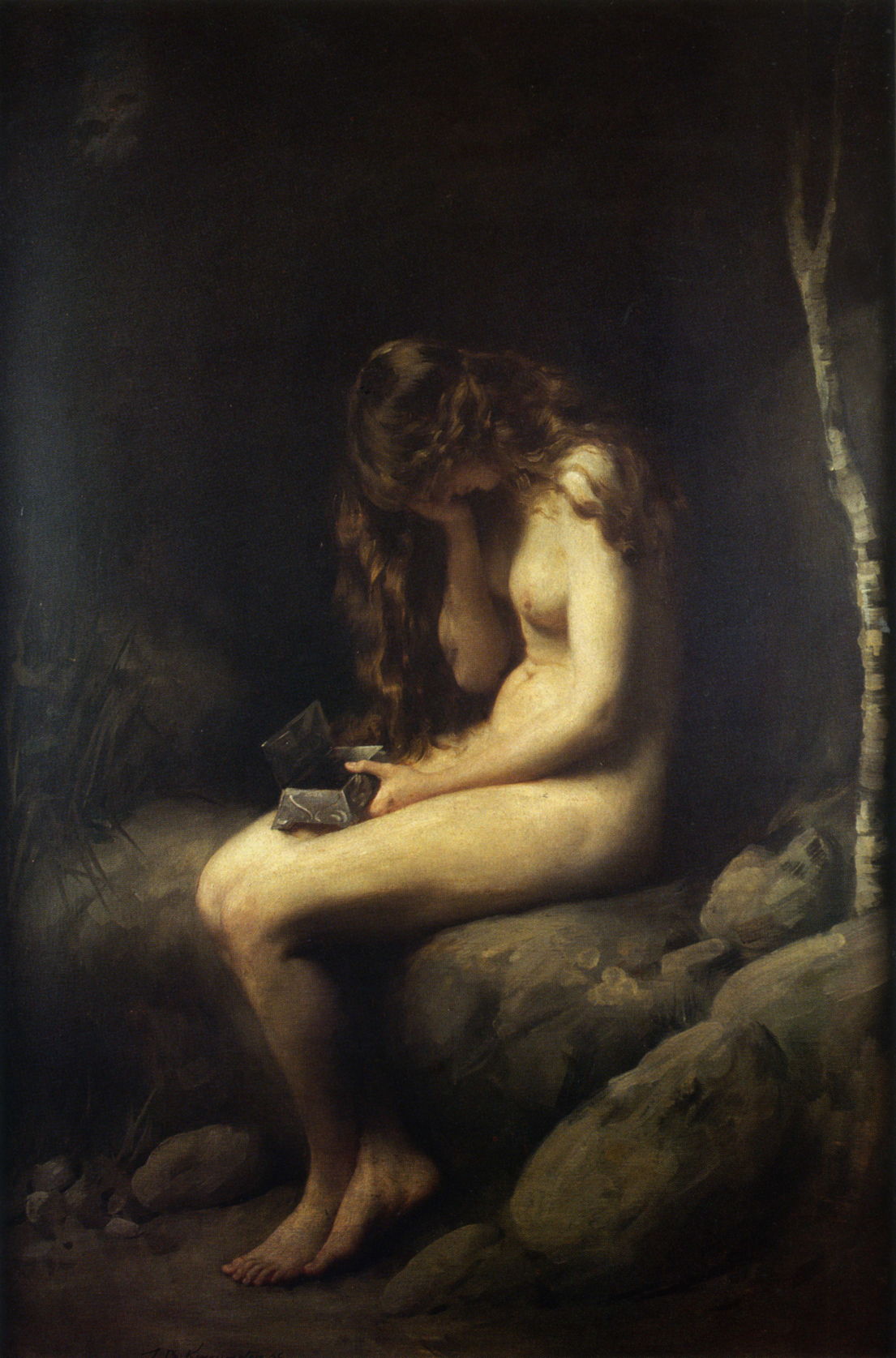
kenningtonpandora
Thomas Benjamin Kennington (1856–1916), Pandora (1908), oil on canvas, 166.3 × 113 cm, Private collection. Wikimedia Commons.

Thomas Benjamin Kennington shows Pandora (1908) in the final phase of regret and sorrow, after the evils have all been released. Her box, now empty, with no sign of the remaining Hope, rests on her thigh. She hangs her head in shame, resting it on her right hand as she weeps at what she has done. Unfortunately, the released demons shown at the left edge are so dark that they are hard to see.

Over this period, other artists had also been painting the story of the creation of Pandora, a theme I have avoided so far. I will, though, show one of its more unusual depictions, a painting lost for forty years.

battenpandora
John Dixon Batten (1860-1932), The Creation of Pandora (1913), tempera on fresco, 128 x 168 cm, Reading University, Reading, England. Wikimedia Commons.

John Dixon Batten’s The Creation of Pandora was painted anachronistically in egg tempera on a fresco ground by 1913. Batten was one of the late adherents of the Pre-Raphaelite movement, and now almost forgotten. It had been exhibited in a commercial gallery, and was acquired by the University of Reading, England, shortly before the First World War. Deemed unfashionable in 1949, it was put into storage and quietly forgotten until its rediscovery in 1990.

Pandora is at the centre, having just been fashioned out of earth by Hephaestus, who stands at the left, his foot on his anvil. Behind them, other blacksmiths work metal in his forge. At the right, Athena is about to place her gift of a robe about Pandora’s figure, and other gods queue behind her to offer their contributions.

Just before the start of the First World War, Odilon Redon made a series of studies leading to a radically different presentation of Pandora’s story.
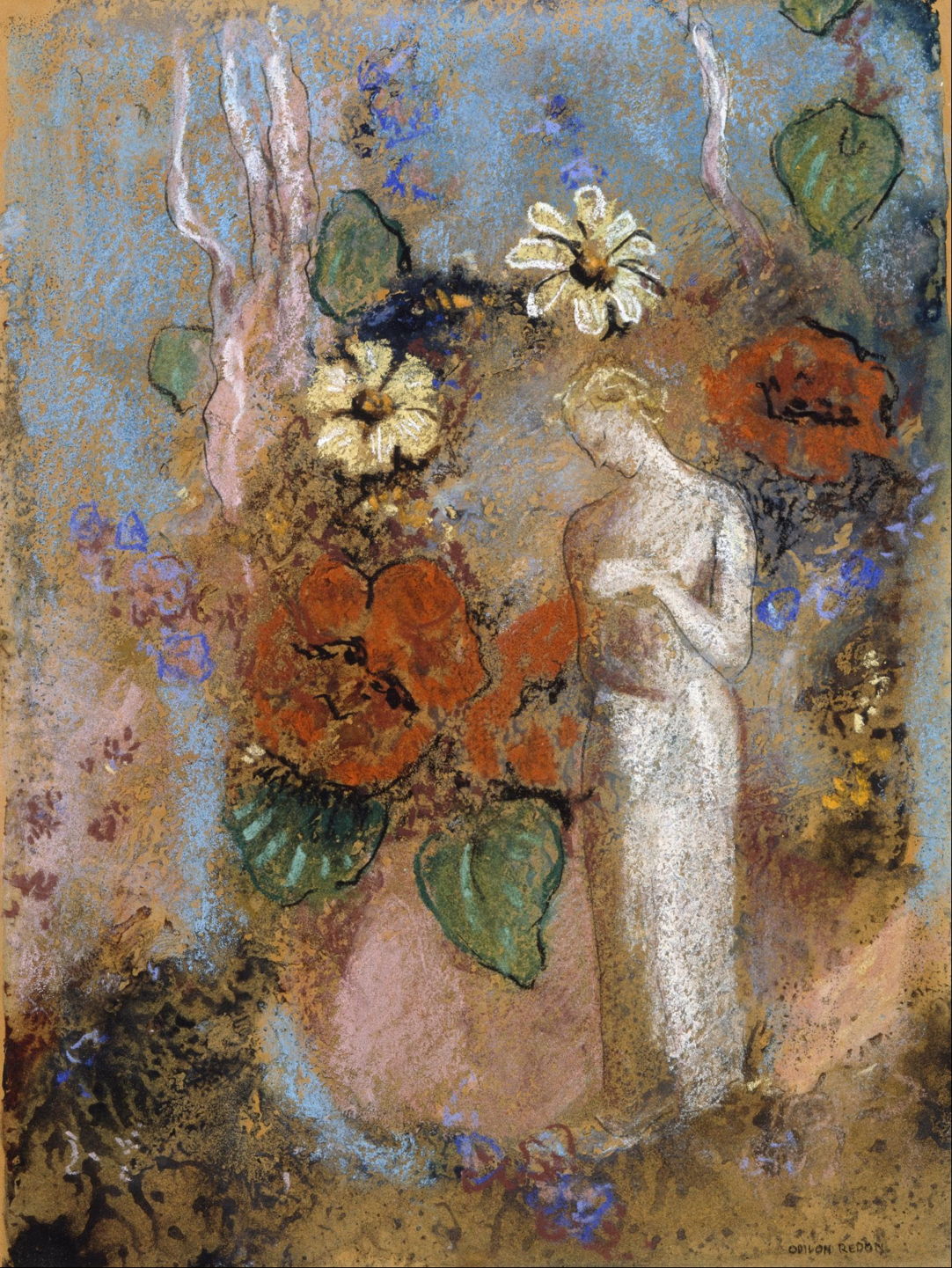
redonpandorahouston
Odilon Redon (1840–1916), Pandora (date not known), pastel and charcoal on board, 22.1 x 29.1 cm, Museum of Fine Arts, Houston, TX. Wikimedia Commons.

Redon’s undated pastel study of Pandora shows her clasping her box close in the midst of huge floral images.
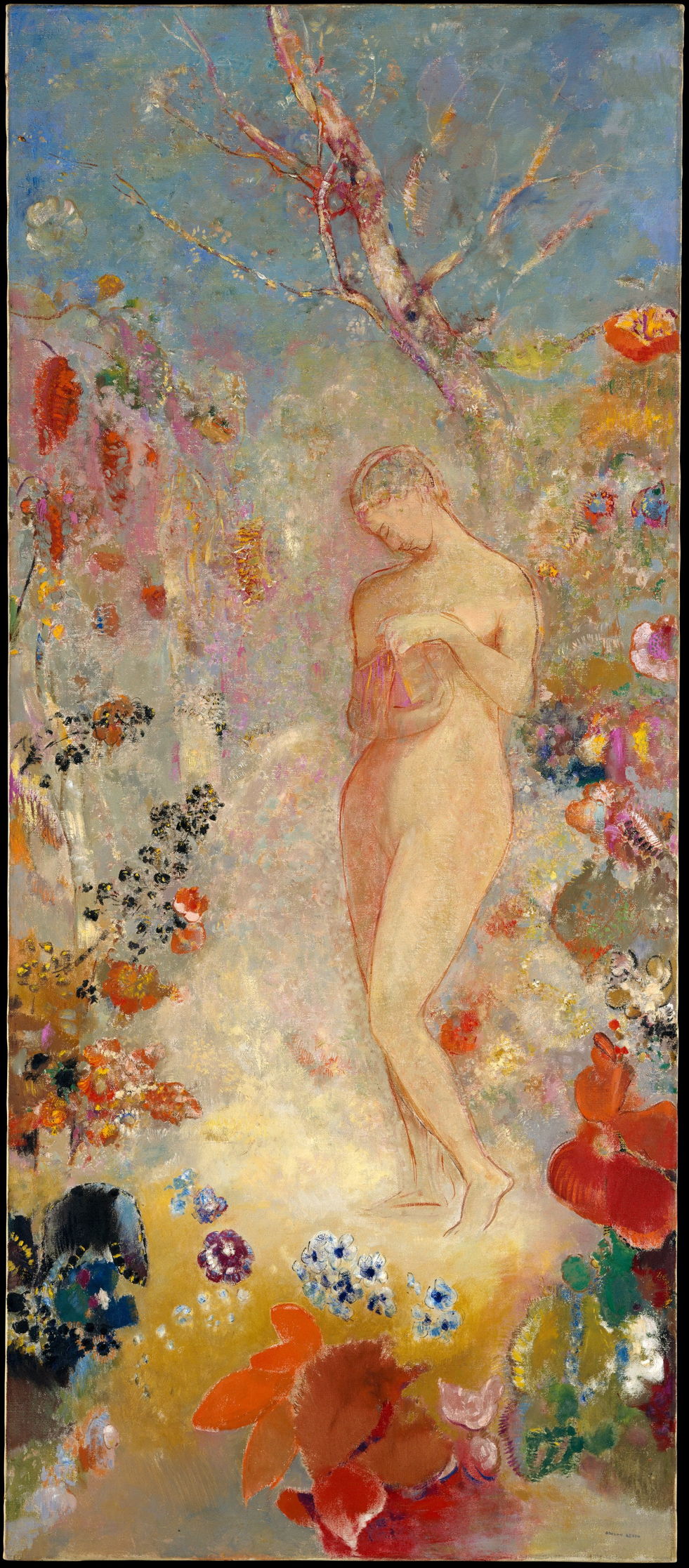
redonpandoramet
Odilon Redon (1840–1916), Pandora (c 1914), oil on canvas, 143.5 x 62.2 cm, The Metropolitan Museum of Art (Bequest of Alexander M. Bing, 1959), New York, NY. Courtesy of The Metropolitan Museum of Art.

Redon’s finished oil painting of Pandora from about 1914 shows her more clearly, surrounded by a garden of exquisite and exotic blooms, referring to Eve’s Paradise before the Fall. She holds her box to her bosom, as she succumbs to the temptation to open it, but Redon stops just short of showing its evils pouring out.

gregorypandora
Yvonne Gregory (Park) (1889-1970), Pandora (1919), photograph, published in ‘Photograms of the Year’, 1919, further details not known. Wikimedia Commons.

My final representation of the myth of Pandora is a photograph from 1919 by the society portrait photographer Yvonne Gregory (who also worked under her married surname of Park): Pandora. The box lies wide open by her knees, as Pandora is bent double in distress over it, her left arm over her head to shelter her from the demons that have been released, and in grief at what she has done.

Given the disasters that had struck the world in the years immediately preceding this photograph – the mass carnage of the war, and the influenza pandemic which followed it – it must have had great impact when it was published in 1919. Much as these images have today. For despite the story’s underlying misogyny, I can’t help thinking that Pandora’s box has been opened yet again.

Reference

Wikipedia on the myth of Pandora.