



惯性聚合 高效追踪和阅读你感兴趣的博客、新闻、科技资讯
阅读原文 在惯性聚合中打开

推荐订阅源

The Cloudflare Blog
U
Unit 42
OSCHINA 社区最新新闻
OSCHINA 社区最新新闻
腾讯CDC
罗磊的独立博客
博客园 - 聂微东
博客园_首页
雷峰网
雷峰网
云风的 BLOG
云风的 BLOG
Jina AI
Jina AI
奇客Solidot–传递最新科技情报
奇客Solidot–传递最新科技情报
D
DataBreaches.Net
The GitHub Blog
The GitHub Blog
人人都是产品经理
人人都是产品经理
Y
Y Combinator Blog
量子位
Microsoft Azure Blog
阮一峰的网络日志
阮一峰的网络日志
小众软件
小众软件
月光博客
月光博客
T
The Exploit Database - CXSecurity.com
Google DeepMind News
H
Help Net Security
O
OpenAI News
Blog — PlanetScale
Blog — PlanetScale
S
Security Affairs
S
Security @ Cisco Blogs
Microsoft Security Blog
T
The Blog of Author Tim Ferriss
AI
AI
MongoDB | Blog
MongoDB | Blog
G
Google Developers Blog
MyScale Blog
MyScale Blog
Cyber Security Advisories - MS-ISAC
D
Docker
Hugging Face - Blog
Hugging Face - Blog
D
Darknet – Hacking Tools, Hacker News & Cyber Security
S
Schneier on Security
Cloudbric
Cloudbric
H
Heimdal Security Blog
J
Java Code Geeks
N
News and Events Feed by Topic
Hacker News - Newest:
Hacker News - Newest: "LLM"
宝玉的分享
宝玉的分享
有赞技术团队
有赞技术团队
S
SegmentFault 最新的问题
让小产品的独立变现更简单 - ezindie.com
爱范儿
爱范儿
I
Intezer
GbyAI
GbyAI

The Eclectic Light Company

Apple has released an update to XProtect for all macOS Hero or hooligan: Theseus’ later years BSD flags are incompatible with iCloud Drive Apple has released macOS Tahoe 26.5.1 In memoriam Mary Cassatt: 1, 1868-1880 Solutions to Saturday Mac riddles 362 What Location Services do in macOS Eclectic paintings of Joseph Stella: 2 European myths Last Week on My Mac: Razzle and dazzle Eclectic paintings of Joseph Stella: 1 American landscapes Saturday Mac riddles 362 Protect files with the Locked or Immutable flag Reading Visual Art: 252 Dragonfly What happens in the log when an app crashes as it starts up? Portraits of trees: Introduction On Reflection: Conclusions and contents Which tasks require mains power? Medium and message: Vast canvases Online reference to external displays for Apple silicon Macs What’s in that phishing email? Hero or hooligan: Theseus and Ariadne Solutions to Saturday Mac riddles 361 How to search document versions Rubens’ Consequences of War Rubens’ Peace and War Saturday Mac riddles 361 How to search Time Machine backups? Naturalists: Contents and artists On Reflection: Extending the image Tackle QuickLook problems Medium and message: Pottery Hero or hooligan: Theseus and the sandals How QuickLook provides thumbnails and previews Last Week on My Mac: Syncing metadata in iCloud Drive Paintings of visits to India 1778-1877 Saturday Mac riddles 360 Naturalists: Sorolla and Zorn On Reflection: Pierre Bonnard 1909-1946 SpotTest 1.2 can display Spotlight metadata directly On Reflection: Pierre Bonnard 1899-1908 How to preserve versions, and how to create versioned PDFs Medium and message: Sculpture What gets synced in iCloud Drive? Hero or hooligan: Perseus 2 Solutions to Saturday Mac riddles 359 Last Week on My Mac: snapshots, the elephant in APFS Paintings of Beatrice Portinari: to 1862 Saturday Mac riddles 359 Naturalists: Into the 20th century How to check whether Spotlight is getting the right metadata On Reflection: Mirror play Hero or hooligan: Perseus 1 The bicentenary of Frederic Edwin Church: 1857-77 Solutions to Saturday Mac riddles 358 macOS virtual machines and audio-video syncing A walk in the parks of Rome, Vienna, Manhattan and Brooklyn Saturday Mac riddles 358 Naturalists: Photography Use Finder tags for categories Control what gets written to the log Medium and message: Tapestry Virtualisation on Apple silicon Macs is different Jerusalem Delivered: Overview and contents The bicentenary of Frederic Edwin Church: 1849-57 Solutions to Saturday Mac riddles 357 Painting Pandora and her box: 1883-1919 Painting Pandora and her box: 1550-1882 Saturday Mac riddles 357 Reading Visual Art: 250 Winged sandals The secret life of the xattr The macOS Natural Language framework and Nalaprop Medium and Message: Stained glass The MACL extended attribute Jerusalem Delivered: 13 Leading characters Solutions to Saturday Mac riddles 356 Privacy: How locations are protected Painting Spring blossom 2 Last Week on My Mac: Don’t be a victim of fraud Painting Spring blossom 1 Saturday Mac riddles 356 Explainer: Recovery Reading Visual Art: 249 Mask On Reflection: Cézanne Privacy: Which folders are protected in Tahoe? Medium and Message: Mosaic Jerusalem Delivered: 12 Delivery Solutions to Saturday Mac riddles 355 Centaurs 2: Revenge Centaurs 1: Fights Saturday Mac riddles 355 Explainer: sandboxes Naturalists: The modern meal Why you can’t trust Privacy & Security Apple has just released an update to macOS Tahoe, to version 26.4.1 On Reflection: Divisionism Please help update CPU frequencies for Apple silicon Macs Commemorating the centenary of the death of John Ferguson Weir Privacy: Files & Folders or Full Disk Access? Jerusalem Delivered: 11 Into Jerusalem Privacy: protected folders
Naturalists: Urban poverty
hoakley · 2026-04-16 · via The Eclectic Light Company

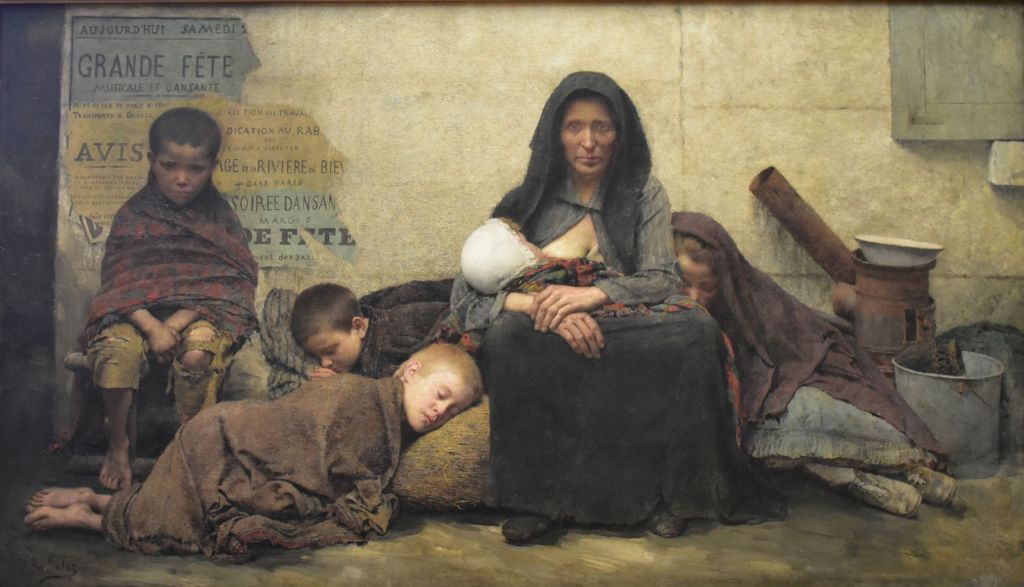
Fernand Pelez (1848-1913), Homeless (1883), oil on canvas, 77.5 x 136 cm, location not known. Image by Bastenbas, via Wikimedia Commons.

During the nineteenth century social realism depicted poverty in the countryside, but that of the growing cities was seldom depicted until it was tackled by the Naturalists later in the century.

Some earlier attempts were based on deception.
rejlanderpoorjo
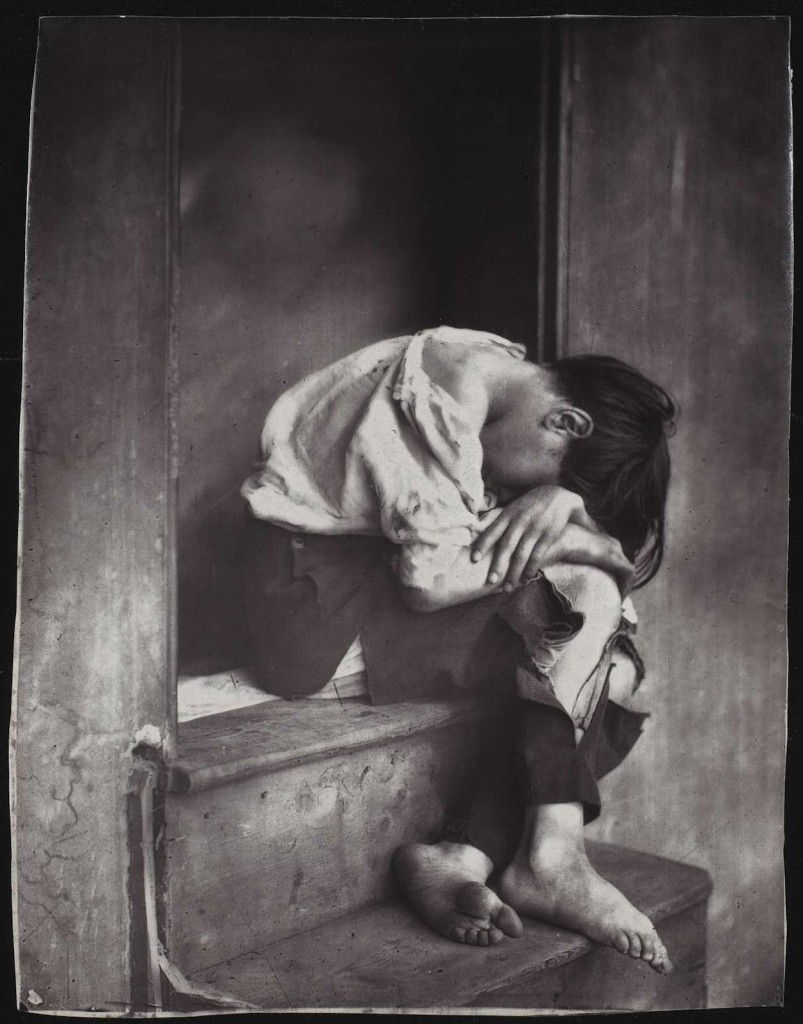
Oscar Gustave Rejlander (1813–1875), Poor Jo (1864), photograph, further details not known. Image by Roger Cicala, via Wikimedia Commons.

Oscar Gustave Rejlander’s photo of Poor Jo from 1864 shows a young streetboy, in a pioneering collection of images of homeless children in England. Being an early photo, it cannot of course lie, but it does. This photo, as with all Rejlander’s other images of poor and vagrant children, was a fiction created in his studio, using props and models, and heavily retouched. We tend to think of such trickery as a modern phenomenon enabled by the likes of Photoshop; although the techniques were different, visual deception is far older.

mulreadyuncaredfor
Augustus Edwin Mulready (1844–1905), Uncared For (1871), oil on canvas, 101 × 76 cm, location not known. Wikimedia Commons.

It was an English writer, Charles Dickens, who was probably the greatest literary influence over Augustus Edwin Mulready, whose reputation was built on paintings of street sellers and vagrants in London, such as his Uncared For from 1871. Mulready’s approach was very different from either Dickens or Millet, in being laden with sentimentalism. Here a young girl with exceptionally large brown eyes stares straight at the viewer as she proffers a tiny bunch of violets.

Both the girl and her brother are sparklingly clean, their hair well cared-for, and their clothes relatively smart. There is nothing to suggest that Mulready used real vagrants as his models.

More convincing, though, are the remains of posters on the brick wall behind them: at the top, The Triumph of Christianity is attributed to the French artist and illustrator Gustave Doré, who illustrated an edition of the Bible in 1866, visited London on several occasions afterwards, and in 1871 produced illustrations for London: A Pilgrimage, published the following year, showing London’s down and outs.

dorecoupletwochildren
Gustave Doré (1832–1883), A Couple and Two Children Sleeping on a London Bridge (1871), print, 19 × 24.7 cm, Denver Art Museum, Denver, CO. Wikimedia Commons.

When Doré visited London, he was shocked by its large population of vagrants and homeless. His print of A Couple and Two Children Sleeping on a London Bridge (1871) is one of several objective records he made at the time. A selection was included in his illustrated book on London published the following year.

bulandalmsbeggar
Jean-Eugène Buland (1852–1926), Alms of a Beggar (1880), oil on canvas, 117 × 89 cm, location not known. Wikimedia Commons.

Change continued in this challenging painting by the Naturalist Jean-Eugène Buland, Alms of a Beggar from 1880. A young woman dressed immaculately in white is sat outside a church seeking charity. Approaching her, a coin in his right hand, is a man who can only be a beggar himself. His clothes are patched on patches, faded and filthy, and he wears battered old wooden shoes. Yet he is about to give the young woman what is probably his last coin.

In the early 1880s Fernand Pelez started to paint some of the most moving portraits of the poor, comparable to those of Jules Bastien-Lepage and Marie Bashkirtseff.

pelezsleepinglaundress
Fernand Pelez (1848-1913), Sleeping Laundress (c 1880), media and dimensions not known, Private collection. Wikimedia Commons.

This early portrait of a Sleeping Laundress (c 1880) is one of a group of works showing poor women reclining. Another showed a young woman dead from asphyxiation. For all her obvious poverty, there is a faint smile on her face, as she enjoys a brief rest from her long hours of washing.
gandolfoevicted
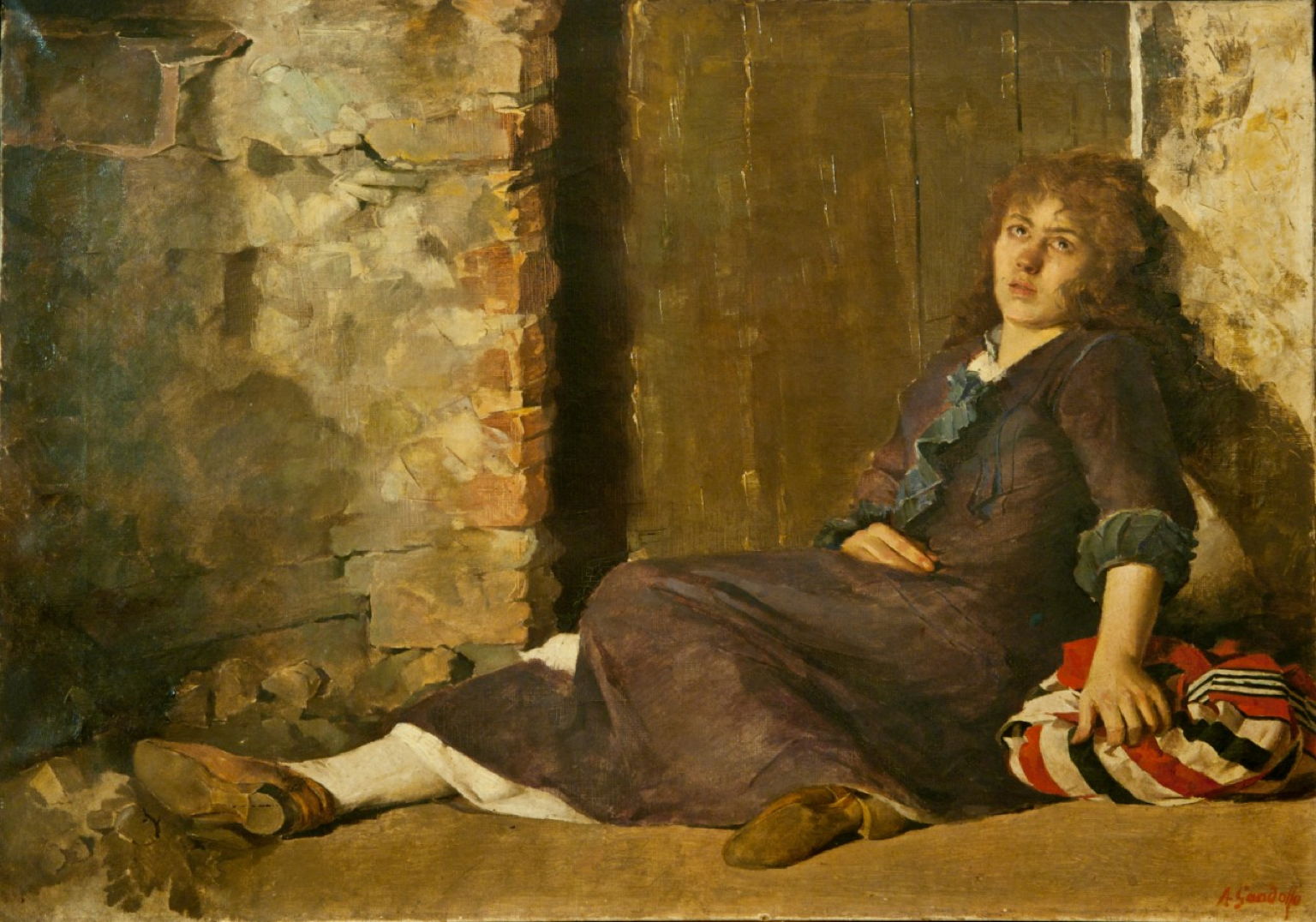
Antonino Gandolfo (1841–1910), Evicted (Let he who is without sin cast the first stone) (1880), oil on canvas, 88 x 63 cm, location not known. Image by Luigi Gandolfo, via Wikimedia Commons.

In Italy it was Antonino Gandolfo who took up the theme in his depictions of urban poverty in the city of Catania on Sicily, just as Naturalism was breaking out in France, between 1880-85. Evicted, which bears the Biblical sub-title of Let he who is without sin cast the first stone, dates from 1880, and shows a woman cast out into the street, her only possessions in the bag under her left hand.

pelezhomeless
Fernand Pelez (1848-1913), Homeless (1883), oil on canvas, 77.5 x 136 cm, location not known. Image by Bastenbas, via Wikimedia Commons.

Most of Pelez’s paintings of the poor are unsettling if not frankly depressing. His Homeless from 1883 shows a worn and weary mother and her five children living on the street. She stares from sunken eyes straight at the viewer, as her children huddle in filthy blankets and sacking around her. Only the mother and her oldest daughter, who is presumably already at work, wear any shoes.

pelezmartyrvioletvendor
Fernand Pelez (1848-1913), A Martyr – The Violet Vendor (1885), media and dimensions not known, Petit Palais, Paris. Wikimedia Commons.

A Martyr – The Violet Vendor (1885) shows another child of the street, although here Pelez leaves doubt as to whether we are looking at the boy asleep, or dead. One of the small bunches of violets has fallen from his tray. His eyes are closed, and his mouth agape.

michelenacharity
Arturo Michelena (1863–1898), Charity (1888), oil on canvas, 288.8 x 231.7 cm, Galería de Arte Nacional, Caracas, Venezuela. Wikimedia Commons.

Arturo Michelena’s Charity from 1888 shows a pair of charitable bourgeois ladies arriving at the hovel that is home to a young mother and her small child. Beside the woman, on a table under the window, are a couple of bottles of her favourite ‘poison’, most probably absinthe.
pelezsaltimbanquessmall
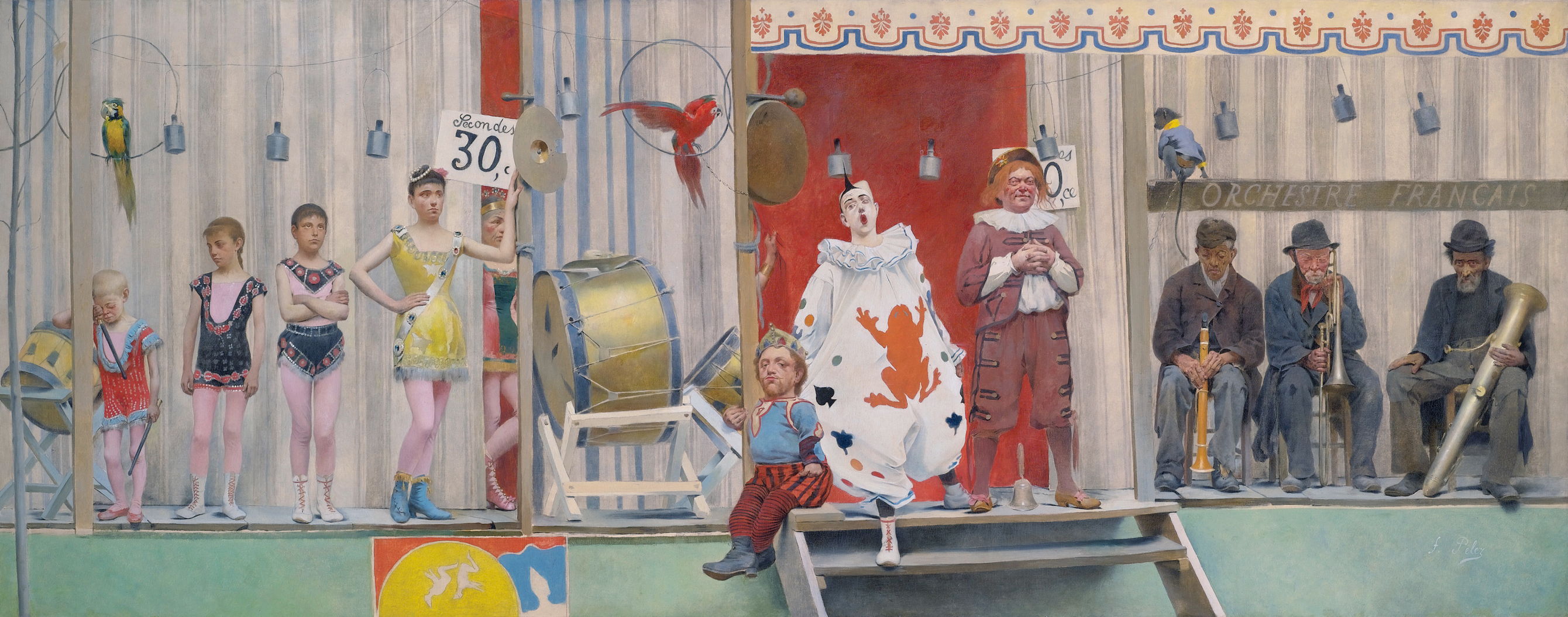
Fernand Pelez (1848-1913), Grimaces et misères: les Saltimbanques (Grimaces and Miseries: the Acrobats) (smaller version) (1888), oil on canvas, 114.6 x 292.7 cm, Private collection. Wikimedia Commons.

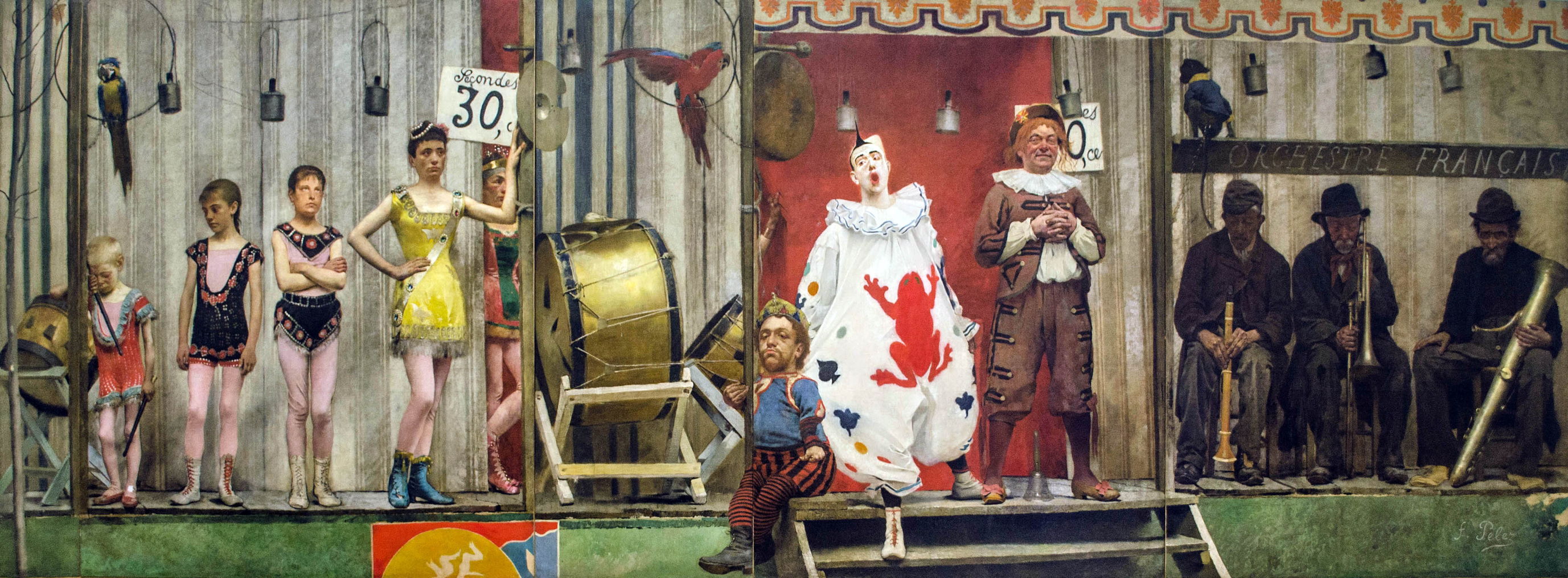
In 1888 Pelez progressed to Grimaces and Miseries: the Acrobats, or Les Saltimbanques, shown above in its smaller version, and below in the larger version exhibited to acclaim at the Salon. This follows the pattern of a traditional ‘ages of man’ image, in which the figures increase in stature from the start at the left edge, to the centre, then diminish again with advancing years, to the right.

Les Saltimbanques had been a successful show in the theatre fifty years earlier, and had lived on in entertainments staged in fairs around France. Contemporary performers attested to the faithfulness and accuracy of Pelez’s painting. This was featured and illustrated in the French weekly magazine l’Illustration, which also identified many of the models, who were performers in fairs and circuses.
pelezsaltimbanqueslarge
Fernand Pelez (1848-1913), Grimaces et misères: les Saltimbanques (Grimaces and Miseries: the Acrobats) (larger version) (1888), oil on canvas, 222 x 625 cm, Musée du Petit Palais, Paris. Image by Morburre, via Wikimedia Commons.

Pelez never repeated the success of Les Saltimbanques, and in subsequent Salons faded from public view.

krohgstruggleforsurvival
Christian Krohg (1852–1925), The Struggle for Existence (1889), oil on canvas, 300 x 225 cm, Nasjonalgalleriet, Oslo, Norway. Wikimedia Commons.

In the late 1880s the Norwegian artist Christian Krohg had been working on his next major painting, The Struggle for Existence (also translated as The Struggle for Survival) (1889). It shows Karl Johan Street in Oslo in the depths of winter, almost deserted except for a tight-packed crowd of poor women and children queuing for free bread.

geoffroynighthostel
Henri Jules Jean Geoffroy (1853–1924), The Night Hostel (or, The Soup Kitchen) (1891), further details not known. Wikimedia Commons.

Better known for his many paintings of schools and children, Henri Jules Jean Geoffroy’s painting of The Night Hostel or The Soup Kitchen (1891) shows homeless women and children being fed in what appears to be almost a prison.
pelezlittlelemonvendor
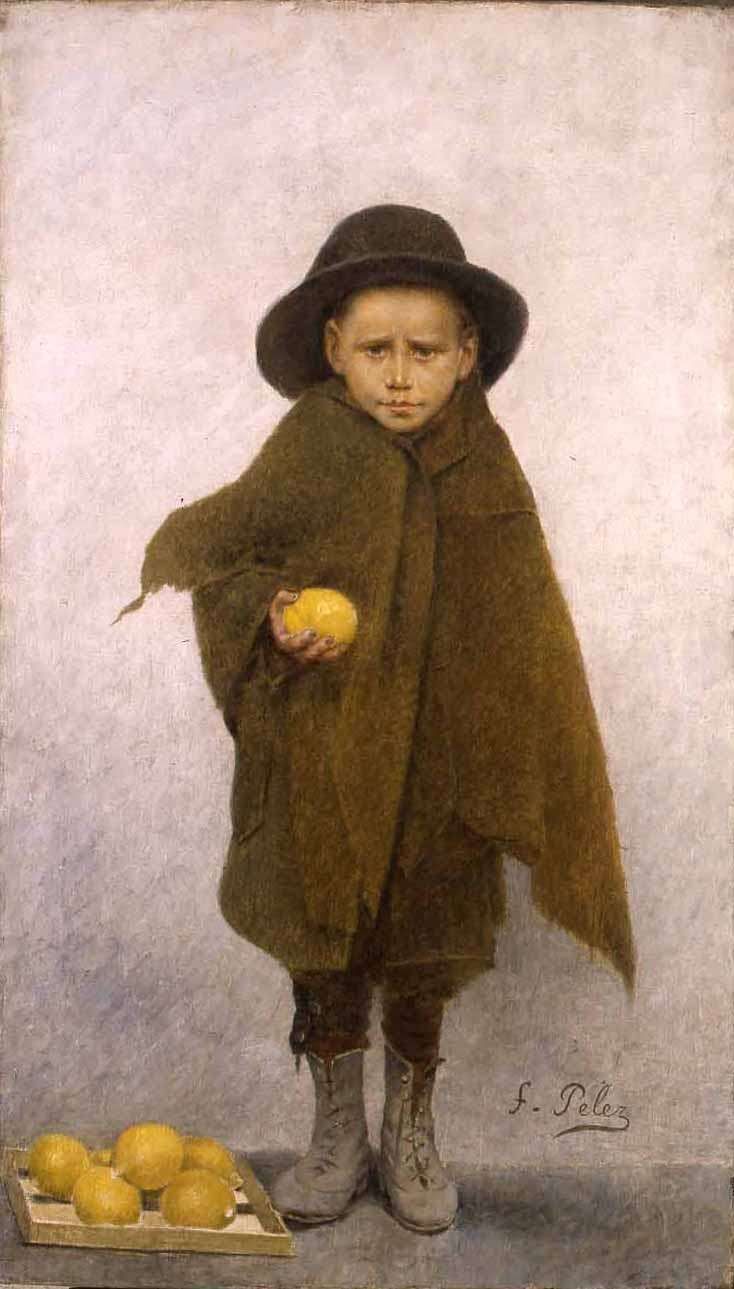
Fernand Pelez (1848-1913), The Little Lemon Vendor (c 1895-97), media and dimensions not known, Musée des Beaux-Arts, Chambéry, France. Wikimedia Commons.

Pelez painted six different versions of The Little Lemon Vendor (c 1895-97), of which this is thought to have been the last. It was never shown in a Salon, despite its compelling imagery.

pelezvachalcade
Fernand Pelez (1848-1913), La Vachalcade (The Cow-valcade) (1896), media and dimensions not known, Musée du Petit Palais, Paris. Wikimedia Commons.

La Vachalcade (The Cow-valcade) (1896) is a reversal of a portrait of an affluent family by way of parody. Thirteen young revellers are taking part in a carnival procession, perhaps one of the Vachalcades that took place in Montmartre at the time. Some wear masks, others have the close-shorn hair characteristic of the poor, a measure against endemic parasites.

At the centre is a boy very similar to The Little Lemon Vendor, wearing an adult’s jacket and a huge hat. Behind him is a Pierrot character, and in the background a banner bearing the word Misère, misery. Dangling on that is a dead rat, a reference to a well-known café on the Place Pigalle. The ‘vache’ (cow) in the title refers to the French phrase manger de la vache enragée, meaning to live in poverty.