

惯性聚合 高效追踪和阅读你感兴趣的博客、新闻、科技资讯
阅读原文 在惯性聚合中打开

推荐订阅源

TaoSecurity Blog
TaoSecurity Blog
博客园 - 司徒正美
奇客Solidot–传递最新科技情报
奇客Solidot–传递最新科技情报
博客园 - 【当耐特】
M
MIT News - Artificial intelligence
罗磊的独立博客
让小产品的独立变现更简单 - ezindie.com
Stack Overflow Blog
Stack Overflow Blog
The GitHub Blog
The GitHub Blog
Google DeepMind News
Security Archives - TechRepublic
宝玉的分享
宝玉的分享
N
News and Events Feed by Topic
The Hacker News
The Hacker News
Google DeepMind News
C
CERT Recently Published Vulnerability Notes
F
Full Disclosure
Threat Intelligence Blog | Flashpoint
S
Security @ Cisco Blogs
H
Hacker News: Front Page
L
LangChain Blog
Microsoft Security Blog
Y
Y Combinator Blog
B
Blog RSS Feed
H
Heimdal Security Blog
Google Online Security Blog
Apple Machine Learning Research
博客园 - 三生石上(FineUI控件)
V2EX - 技术
V2EX - 技术
V
Vulnerabilities – Threatpost
Help Net Security
Help Net Security
Hacker News - Newest:
Hacker News - Newest: "LLM"
T
Tailwind CSS Blog
W
WeLiveSecurity
T
Tenable Blog
D
DataBreaches.Net
Martin Fowler
Martin Fowler
Cyberwarzone
Cyberwarzone
Cisco Talos Blog
Cisco Talos Blog
S
Secure Thoughts
O
OpenAI News
L
LINUX DO - 热门话题
Vercel News
Vercel News
阮一峰的网络日志
阮一峰的网络日志
Jina AI
Jina AI
J
Java Code Geeks
Know Your Adversary
Know Your Adversary
IT之家
IT之家
Latest news
Latest news
Cloudbric
Cloudbric

The Eclectic Light Company

Apple has released an update to XProtect for all macOS Hero or hooligan: Theseus’ later years BSD flags are incompatible with iCloud Drive Apple has released macOS Tahoe 26.5.1 In memoriam Mary Cassatt: 1, 1868-1880 Solutions to Saturday Mac riddles 362 What Location Services do in macOS Eclectic paintings of Joseph Stella: 2 European myths Last Week on My Mac: Razzle and dazzle Eclectic paintings of Joseph Stella: 1 American landscapes Saturday Mac riddles 362 Protect files with the Locked or Immutable flag Reading Visual Art: 252 Dragonfly What happens in the log when an app crashes as it starts up? Portraits of trees: Introduction On Reflection: Conclusions and contents Which tasks require mains power? Medium and message: Vast canvases Online reference to external displays for Apple silicon Macs What’s in that phishing email? Hero or hooligan: Theseus and Ariadne Solutions to Saturday Mac riddles 361 How to search document versions Rubens’ Consequences of War Rubens’ Peace and War Saturday Mac riddles 361 How to search Time Machine backups? Naturalists: Contents and artists On Reflection: Extending the image Tackle QuickLook problems Medium and message: Pottery Hero or hooligan: Theseus and the sandals How QuickLook provides thumbnails and previews Last Week on My Mac: Syncing metadata in iCloud Drive Paintings of visits to India 1778-1877 Saturday Mac riddles 360 Naturalists: Sorolla and Zorn On Reflection: Pierre Bonnard 1909-1946 SpotTest 1.2 can display Spotlight metadata directly On Reflection: Pierre Bonnard 1899-1908 How to preserve versions, and how to create versioned PDFs Medium and message: Sculpture What gets synced in iCloud Drive? Hero or hooligan: Perseus 2 Solutions to Saturday Mac riddles 359 Last Week on My Mac: snapshots, the elephant in APFS Paintings of Beatrice Portinari: to 1862 Saturday Mac riddles 359 Naturalists: Into the 20th century How to check whether Spotlight is getting the right metadata On Reflection: Mirror play Hero or hooligan: Perseus 1 The bicentenary of Frederic Edwin Church: 1857-77 Solutions to Saturday Mac riddles 358 macOS virtual machines and audio-video syncing A walk in the parks of Rome, Vienna, Manhattan and Brooklyn Saturday Mac riddles 358 Naturalists: Photography Use Finder tags for categories Control what gets written to the log Medium and message: Tapestry Virtualisation on Apple silicon Macs is different Jerusalem Delivered: Overview and contents The bicentenary of Frederic Edwin Church: 1849-57 Solutions to Saturday Mac riddles 357 Painting Pandora and her box: 1883-1919 Painting Pandora and her box: 1550-1882 Saturday Mac riddles 357 Reading Visual Art: 250 Winged sandals The secret life of the xattr The macOS Natural Language framework and Nalaprop Medium and Message: Stained glass The MACL extended attribute Jerusalem Delivered: 13 Leading characters Solutions to Saturday Mac riddles 356 Privacy: How locations are protected Painting Spring blossom 2 Last Week on My Mac: Don’t be a victim of fraud Painting Spring blossom 1 Saturday Mac riddles 356 Explainer: Recovery Reading Visual Art: 249 Mask Naturalists: Urban poverty On Reflection: Cézanne Privacy: Which folders are protected in Tahoe? Medium and Message: Mosaic Jerusalem Delivered: 12 Delivery Solutions to Saturday Mac riddles 355 Centaurs 2: Revenge Saturday Mac riddles 355 Explainer: sandboxes Naturalists: The modern meal Why you can’t trust Privacy & Security Apple has just released an update to macOS Tahoe, to version 26.4.1 On Reflection: Divisionism Please help update CPU frequencies for Apple silicon Macs Commemorating the centenary of the death of John Ferguson Weir Privacy: Files & Folders or Full Disk Access? Jerusalem Delivered: 11 Into Jerusalem Privacy: protected folders
Centaurs 1: Fights
2026-04-11 · via The Eclectic Light Company

Eugène Delacroix (1798–1863), The Education of Achilles (c 1862), pastel on paper, 30.6 x 41.9 cm, Getty Center, Los Angeles, CA. Wikimedia Commons.

In Greek and Roman mythology centaurs were creatures with the upper body of a human, down to the waist, fused onto the body of a horse, with all its four legs. Although some tales about centaurs suggest otherwise, in general they represented the lower appetites and behaviours of humans, and were more like wild horses than people. They were known for their fights with Lapiths, an Aeolian tribe, against whom they wielded rocks and limbs of trees. Centaurs persisted in legends and stories well into the Middle Ages, and are the subject of this weekend’s two articles about paintings.
dicosimotritonsnereids
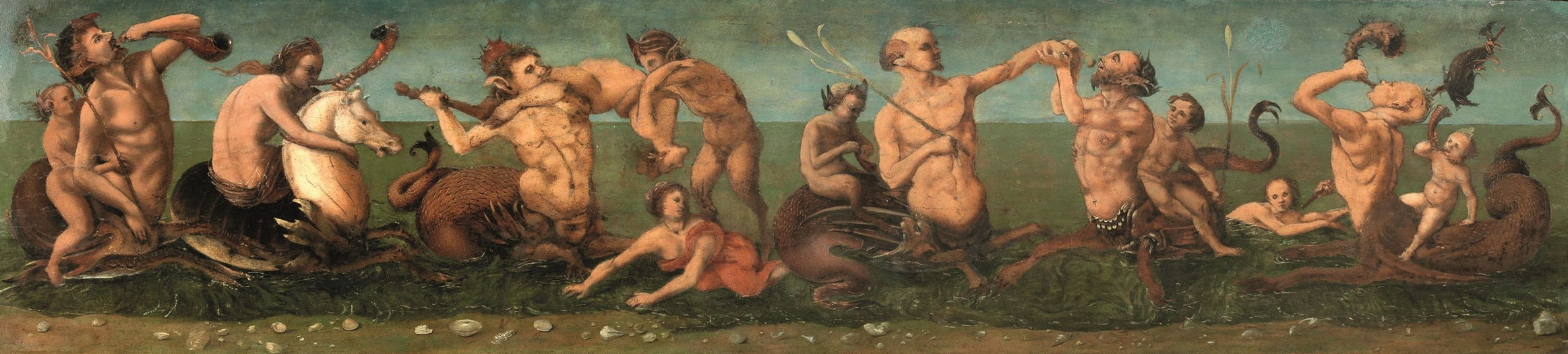
Piero di Cosimo (1462–1522), Tritons and Nereids, with Satyrs and Centaurs (c 1500-05), oil on panel, 37 x 158 cm, Private collection. Wikimedia Commons.

Piero di Cosimo’s assembly of Tritons and Nereids, with Satyrs and Centaurs painted in about 1500-05 shows an odd range of centaur-like creatures, and is believed to have been commissioned for the Palazzo Vespucci.
boecklinfightcentaurs
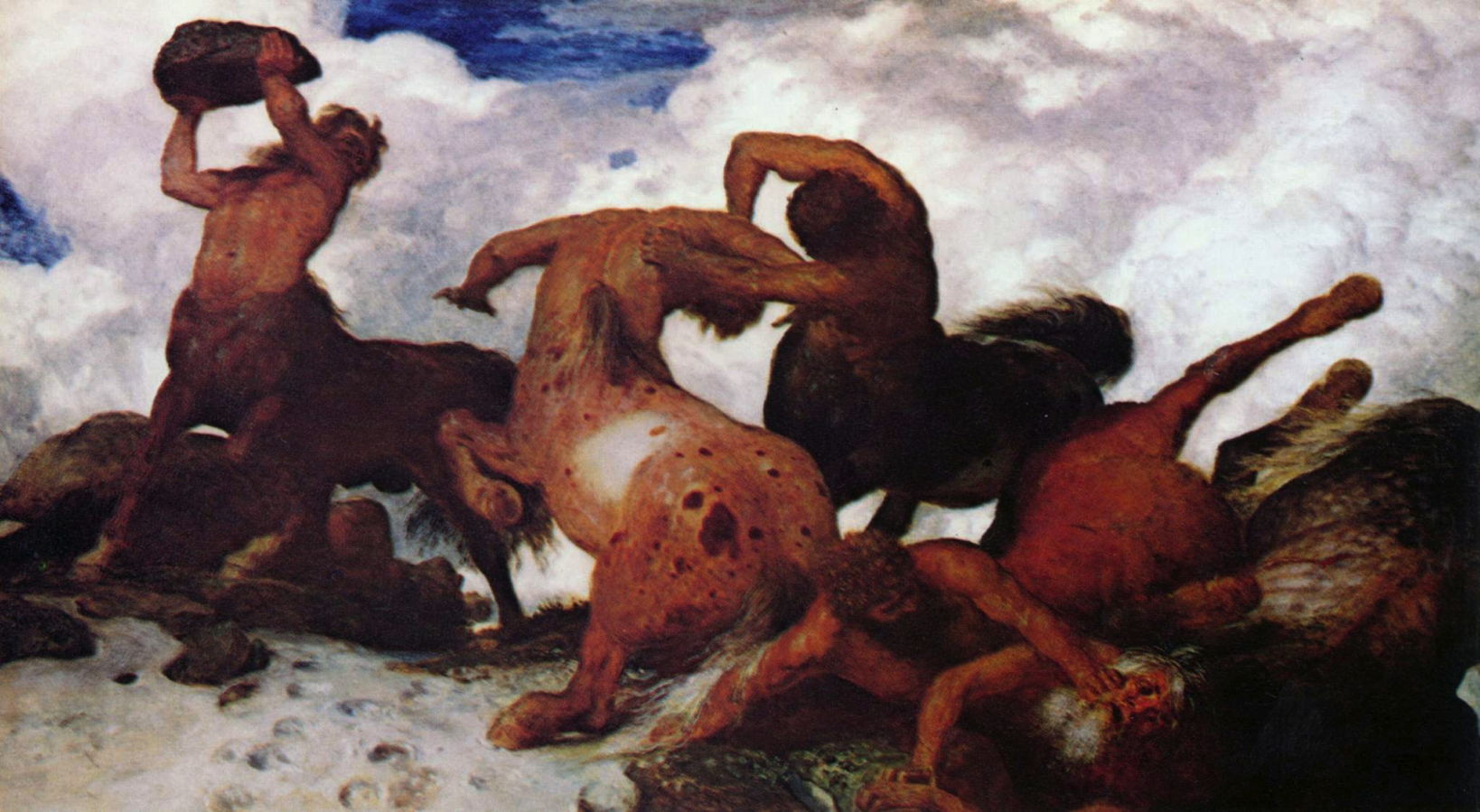
Arnold Böcklin (1827–1901), Fight of the Centaurs (1873), oil on canvas, 105 × 195 cm, Kunstmuseum Basel, Switzerland. Wikimedia Commons.

Those in Böcklin’s Fight of the Centaurs (1873) are behaving more in character, in hand-to-hand combat, and by wielding rocks.

But Eugène Delacroix had better to report.

delacroixachilles
Eugène Delacroix (1798–1863), Poetry: The Education of Achilles (1838-1847), oil on canvas, 221 x 292 cm, Bibliothèque de l’Assemblée nationale, Palais Bourbon, Paris. Wikimedia Commons.

In the Poetry cupola of the Library of the National Assembly in Paris, Delacroix painted The Education of Achilles. This shows the myth of the young Achilles with a bow and arrow, riding on the back of his tutor Chiron the centaur, on the steep slopes of Mount Pelion. This was to become one of Delacroix’s favourite motifs.

delacroixeducationachilles
Eugène Delacroix (1798–1863), The Education of Achilles (c 1862), pastel on paper, 30.6 x 41.9 cm, Getty Center, Los Angeles, CA. Wikimedia Commons.

His last known pastel painting, and one of his finest, is The Education of Achilles, painted in about 1862, showing the same scene of the ‘wisest and justest of all the centaurs’ Chiron teaching Achilles to hunt. The artist gave this to his longstanding friend Aurore Dudevant, better known under her pen name of George Sand.
michallontheseus
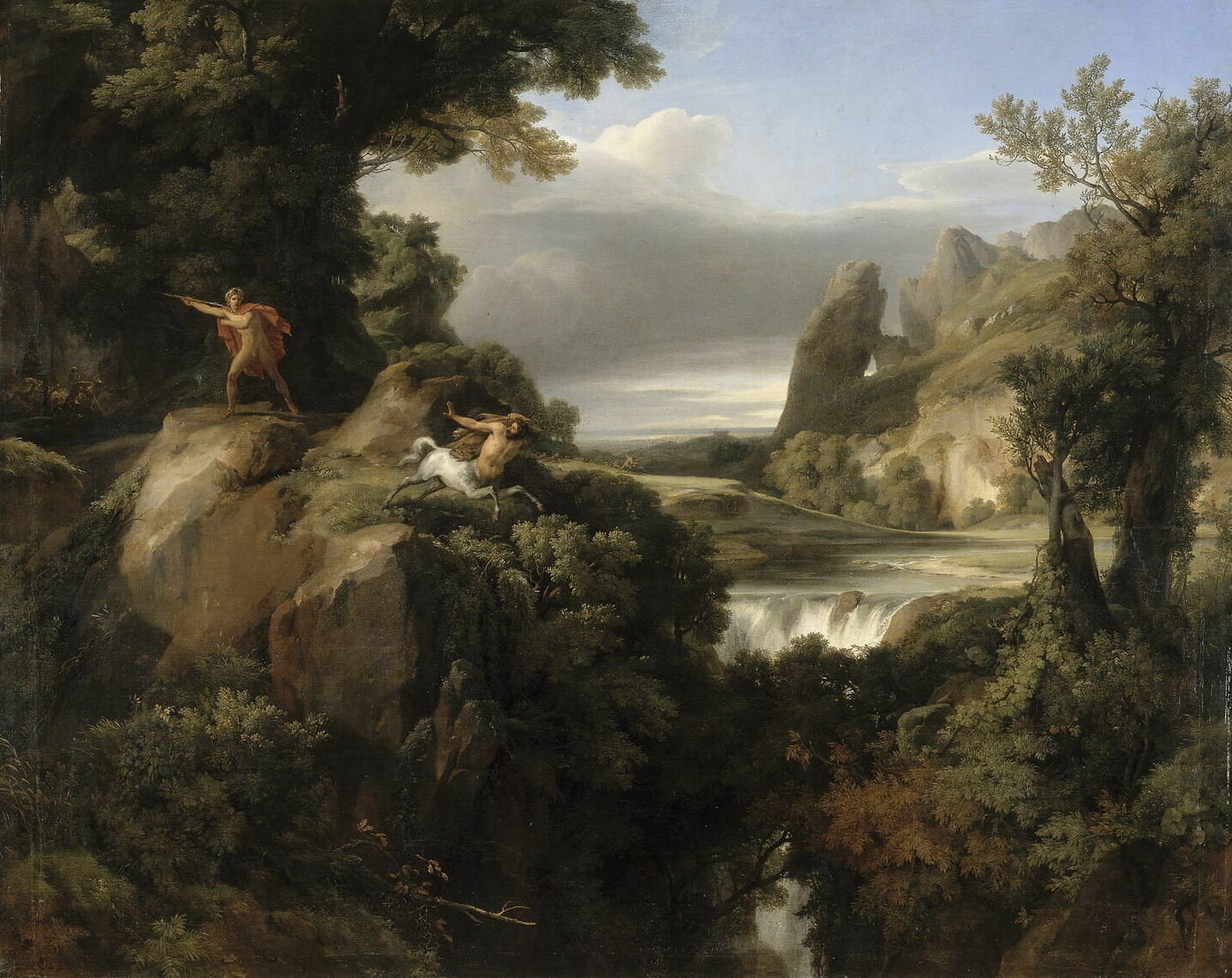
Achille Etna Michallon (1796–1822), Landscape: Theseus Pursuing the Centaurs (1821), oil on canvas, 218 x 273 cm, Musée du Louvre, Paris. Wikimedia Commons.

Following the tradition of Nicolas Poussin, Achille Etna Michallon (a namesake of Achilles) set mythological figures in some of his finished landscape paintings. His Landscape: Theseus Pursuing the Centaurs from 1821 shows the Greek hero about to throw his spear at a galloping centaur.
stuckfantastichunt
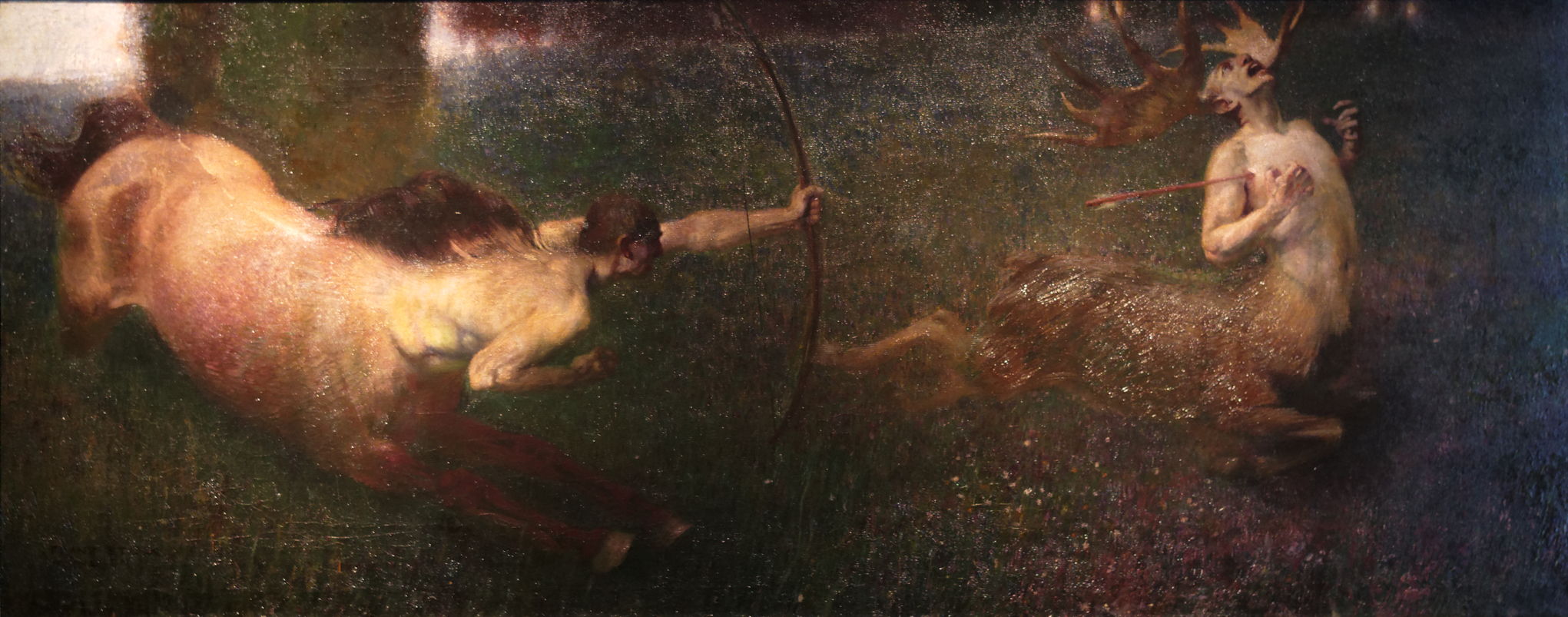
Franz von Stuck (1863–1928), Fantastic Hunt (1890), oil on canvas, dimensions not known, Museum Villa Stuck, Munich, Germany. Image by Yelkrokoyade, via Wikimedia Commons.

Franz von Stuck added centaurs to his repertoire of mythical beasts in his Fantastic Hunt (1890). Here an archer centaur has buried his arrow into the right axilla of a deer-like variant, perhaps resembling Actaeon after Diana’s vicious metamorphosis. The deer-centaur’s legs have already buckled under him, and his hands claw at the air in his agony.

There are two major myths involving centaurs that have been painted extensively, both picturing them at their worst, at a wedding feast that turned into a pitched battle, and the attempted abduction of the wife of Hercules.

The account of the former is given by Nestor in Ovid’s Metamorphoses, and is one of a pair of primaeval battles said to have established world order: that between the Titans and the Gods ended the heavenly Titanomachy, and that between the Lapiths and Centaurs ended the earthly Centauromachy.

When Pirithous married Hippodame, the couple invited centaurs to the feast. Unfortunately, passions of the centaur Eurytus became inflamed by drink and lust for the bride, and he carried Hippodame off by her hair. The other centaurs followed suit by each seizing a woman of their choice, turning the wedding feast into utter chaos, more like a city being sacked.

Theseus castigated Eurytus and rescued the bride, so the centaur attacked him. Theseus responded by throwing a huge wine krater at Eurytus, killing him. The centaurs then started throwing goblets and crockery, and the battle escalated from there. Nestor details a succession of grisly accounts of Lapiths and Centaurs killed. Gryneus the centaur ripped up the altar and crushed two Lapiths with its weight, only to have his eyeballs gouged out by a Lapith using the prongs of some antlers. Not content with using the objects around them as weapons, they started using their own lances and swords.

When the centaur Petraeus was trying to uproot a whole oak tree, the groom Pirithous pinned the centaur to the tree-trunk with his lance. Nestor also tells of the success of Caeneus, formerly Caenis, in killing five centaurs. The centaur Latreus taunted Caeneus, so the latter wounded the centaur with his spear. Latreus thrust his lance in Caeneus’ face, but was unable to hurt him, so he tried with his sword, which broke against the invulnerable Caeneus, leaving him to finish the centaur off with thrusts of his own sword.

The centaurs then united to try to overwhelm Caeneus by crushing him under their combined weight. Just as they thought they had succeeded, Caeneus was transformed into a bird and flew out from underneath them. With that the survivors dispersed, the Lapiths having won the day.

dicosimolapithscentaurs
Piero di Cosimo (1462–1522), The Fight between Lapiths and Centaurs (1500-15), oil on wood, 71 x 260 cm, The National Gallery, London. Wikimedia Commons.

Piero di Cosimo’s The Fight between Lapiths and Centaurs (1500-15) is my favourite among the earlier paintings, and remains one of its best-structured and complete accounts. In the centre foreground, Hylonome embraces and kisses the dying Cyllarus, a huge arrow-like spear resting underneath them. Immediately behind them, on large carpets laid out for the wedding feast, centaurs are still abducting women. All around are scenes of pitched and bloody battles, with eyes being gouged out, Lapiths and Centaurs wielding clubs and other weapons at one another.

rubensrapehippodamesketch
Peter Paul Rubens (1577–1640), The Rape of Hippodame (sketch) (c 1637-38), oil on panel, 26 × 40 cm, Koninklijke Musea voor Schone Kunsten van België / Musées Royaux des Beaux Arts de Belgique, Brussels, Belgium. Wikimedia Commons.

Towards the end of his life, Peter Paul Rubens painted this brilliant oil sketch of The Rape of Hippodame (c 1637-38). At the right, Eurytus is trying to carry off the bride, with Theseus just about to rescue her from the centaur’s back. At the left, Lapiths are attacking with their weapons, and behind them another centaur is trying to abduct a woman.

rubensrapehippodame
Peter Paul Rubens (1577–1640), The Rape of Hippodame (Lapiths and Centaurs) (1636-38), oil on canvas, 182 × 290 cm, Museo Nacional del Prado, Madrid, Spain. Wikimedia Commons.

That became the finished painting, The Rape of Hippodame (Lapiths and Centaurs) (1636-38), which remains faithful to Rubens’ sketch and its composition. Facial expressions, particularly that of the Lapith at the left bearing a sword, are particularly powerful.

giordanolapithscentaurs
Luca Giordano (1632–1705), Battle of Lapiths and Centaurs (1688), oil on canvas, 255 x 390 cm, State Hermitage Museum, Saint Petersburg, Russia. Image by Wayne77, via Wikimedia Commons.

Luca Giordano’s later painting of the Battle of Lapiths and Centaurs from 1688 lacks the narrative structure of Piero di Cosimo’s, and covers later action than Rubens’. As a result, its story has become a little lost in the mêlée of battle.

riccilapithscentaurs
Sebastiano Ricci (1659–1734), The Battle of the Lapiths and Centaurs (c 1705), oil on canvas, 138.4 × 176.8 cm, The High Museum of Art, Atlanta, GA. Wikimedia Commons.

Sebastiano Ricci’s The Battle of the Lapiths and Centaurs from about 1705 has similar problems, although it does use multiplex narrative to help. In the left background, Hippodame is seen being carried away by Eurytus, and to the right there are further scenes of abduction.

solimenalapithscentaurs
Francesco Solimena (1657–1747), Battle between Lapiths and Centaurs (1735-40), oil on canvas, 104 x 130 cm, Private collection. Wikimedia Commons.

Francesco Solimena’s Battle between Lapiths and Centaurs (1735-40) puts multiple abductions in the foreground, with pitched battles taking place behind.

Tomorrow I’ll look at paintings of the fight between Nessus and Hercules, and how Nessus got his revenge.