








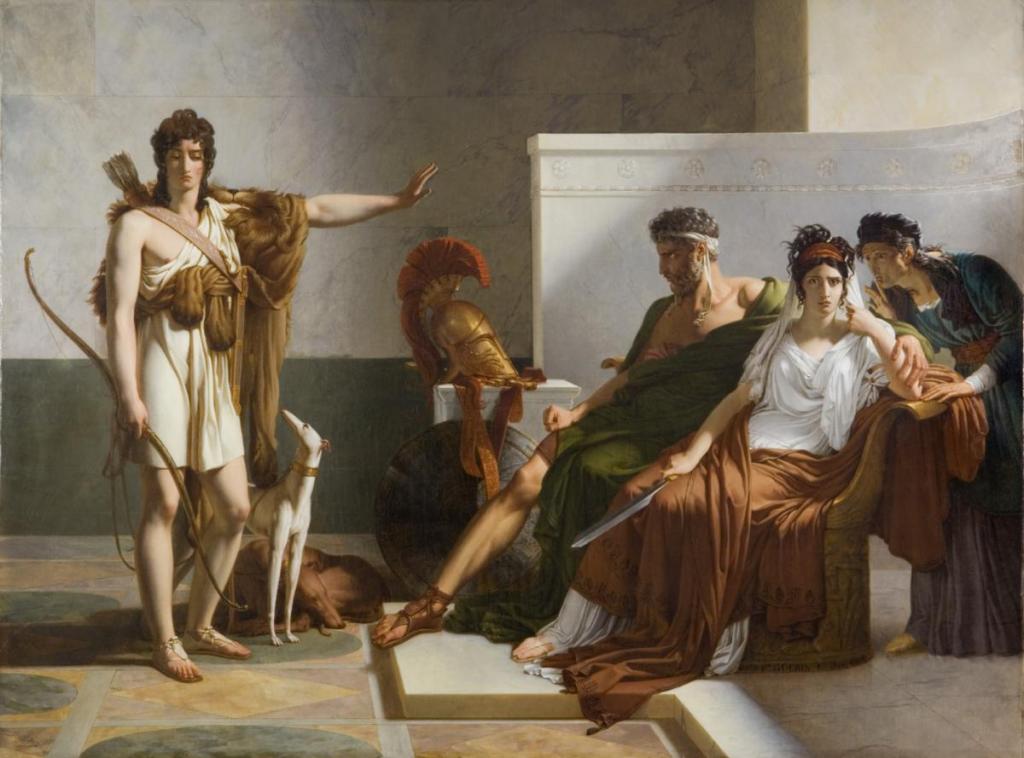
 Pierre-Narcisse Guérin (1774–1833), Phaedra and Hippolytus (1815), oil on canvas, dimensions not known, Musée des Beaux-Arts, Bordeaux, France. The Athenaeum.
The classical Greek hero Theseus had narrowly escaped death by Medea’s poison, then travelled to the island of Crete where he killed the Minotaur with the help of Ariadne, whom he had agreed to marry. He abandoned her on the island of Naxos, and returned to Athens a hero, despite causing his father’s death by suicide.
Theseus became a close friend of Pirithoüs when the latter drove Theseus’ cattle away from Marathon; although the two looked as if they would come to blows, they ended up admiring one another’s boldness and swearing to friendship. They went together on the Calydonian boar hunt, and during Theseus’ journey home afterwards he banqueted with a river god. It had been raining in torrents and the rivers were swollen when Theseus reached the River Achelous, whose river god invited Theseus to pause in his home until his waters had fallen.
Theseus accepted this invitation, and was taken to a hut made of pumice and volcanic tufa, with a damp and mossy floor, and a ceiling decorated with conch and murex shells. There Achelous hosted a banquet, his guests being Theseus, Ixion’s son Lelex, and others, who reclined on couches as they feasted.
Theseus looked out and saw an island he didn’t recognise. Achelous informed him that it was actually five islands, the Echinades. They had been five nymphs, who had sacrificed ten bullocks to the gods, but forgot to invite Achelous. The river god raged in anger, and washed them out to sea, where they formed the islands that they could see.
Achelous pointed out one island in the distance which was dear to him, and named Perimele: she had been a nymph beloved by Achelous, but had lost her virginity. Her father Hippodamas was so incensed that he threw her from a cliff. Achelous saved her, and called on Neptune to turn her into an island too.
The feast of Achelous enjoyed a brief period of popularity during the early part of the seventeenth century, then vanished.

Hendrick de Clerck’s The Banquet of Achelous was probably the first of this group, painted in about 1610. The four men are feasting, sat around a table rather than reclining in Roman style. The rock pergola which surrounds them is suitably decorated with shells, and a bevy of bare-breasted young women serves seafood and fruit. In the distance, to the right, nymphs are cavorting in a bay, a delightful reference to Achelous’ story of the creation of the Echinades.

Jan Brueghel the Younger and Hendrick van Balen combined talents to paint The Feast of Achelous slightly later, in about 1610-20. It follows a similar composition to de Clerck’s painting, but reversed, with the distant nymphs on the left.

At about the same time, around 1615, Peter Paul Rubens collaborated with Jan Brueghel the Elder (father of Jan Brueghel the Younger) in The Feast of Achelous. There are now nine men around the table, and the distant nymphs are nowhere to be seen.

At some time during the first half of the seventeenth century, a painter from Rubens’ school made this less convincing and closer composition of The Banquet of Achelous. The stone hut has closed in on the group, and the distant landscape views are gone. The arrangement is reminiscent of the Last Supper or a New Testament wedding feast, with the figure of Theseus presiding, even down to a loaf of bread on the table, and wine being poured.
When Pirithoüs married Deidameia, he invited Theseus to their wedding in the country of the Lapiths. Unfortunately, Pirithoüs also invited some centaurs to the feast, and when they had too much to drink, they started to carry off the Lapith women. The Lapiths killed many of the centaurs on the spot; others died in the subsequent war between the Lapiths and centaurs. Theseus fought alongside the Lapiths both at the wedding and afterwards.

Peter Paul Rubens’ The Rape of Hippodame (Lapiths and Centaurs) (1636-38) shows an early part of the action at the wedding. At the right, Eurytus the centaur is trying to carry off Hippodame (Deidameia), the bride, with Theseus just about to rescue her from the centaur’s back. At the left, Lapiths are attacking with their weapons, and behind them another centaur is trying to abduct a Lapith woman.
Later, Theseus led a campaign into the Euxine Sea, where he took the Amazon leader Antiope captive, leading to the Amazons waging war on Athens. After three months of fighting, the sides agreed a peace treaty through Hippolyta.
Theseus had taken Antiope as his bride, and by her had a son named Hippolytus, or Demophoön. Antiope then died, and Theseus married Phaedra, who fell in love with her stepson Hippolytus, who had sworn to lead a chaste life so rejected his stepmother’s advances.

Alexandre Cabanel exhibited his large canvas of Phaedra (1880), showing a lugubrious young woman spread languidly across a couch. To accompany it, the programme offered the following lines from Euripides’ play Hippolytus:
Consumed with love’s sorrow, Phaedra has locked herself in her palace. A delicate veil covers her head. This is the third day she has gone without food as she is intent on ending her wretched existence.
Phaedra’s story is told by Euripides in that play, from which Racine had written a well-known French play, and which was partially retold by Ovid in the fourth letter in his Heroides. It centres on incest, suicide, and violent death, which might have been controversial themes for the Salon and its critics.
The marriage of Theseus and Phaedra brought together two houses that seemed blighted. Theseus’ father had committed suicide when he mistakenly thought that his son’s mission to kill the Minotaur had failed, throwing himself into the sea which now bears his name, the Aegean. Theseus was an inveterate adulterer whose life strayed from one sexual adventure to the next. Phaedra’s mother Pasiphaë had been impregnated by a bull and then gave birth to the Minotaur, and her father the king of Crete was murdered by being scalded in a bath.
At the time of these events, Theseus, Phaedra and Hippolytus were in voluntary exile at Troezen, a town to the southwest of Athens, on the opposite side of the Saronic Gulf, where Aethra, Theseus’ mother, had conceived him after having sex with both her husband Aegeus and Poseidon on the same night. Theseus had exiled himself after murdering a local king and his sons.
As a result of Aphrodite’s wrath with Hippolytus, Phaedra had fallen in love with her stepson, and at first intended to die with her honour intact. It is this scene which Cabanel chose to paint, and this point at which Ovid’s fictional letter in his Heroides would have been written.
Euripides’ play then tells of a plan by Phaedra’s nurse to save her mistress’s life by telling Hippolytus in secret of his stepmother’s love, and suggesting that they consummate the relationship, which is the proposal argued in Phaedra’s letter in Heroides. This puts to Hippolytus the suggestion that society was becoming more tolerant of such relationships, and that incest wasn’t so immoral after all.
Hippolytus rejected the proposal in a fury, and threatened to tell Theseus of the situation. Phaedra realised that she had no other option, and hung herself. But when her body was discovered, no one could explain to Theseus the reason, as all were sworn to secrecy. Theseus then discovered a letter on Phaedra’s body claiming that Hippolytus had raped her.
Theseus called upon his father Poseidon to avenge Phaedra’s death on Hippolytus; because Hippolytus was still bound by his oath of secrecy, he couldn’t defend himself to his father, and was sent into exile. He then travelled off in his chariot, but his horses were spooked by a bull roaring out from the sea in Poseidon’s response to Theseus. Hippolytus fell from his chariot and was dragged behind it, and lay dying from his wounds.

With Theseus glad that Phaedra has been avenged, Artemis appeared to him and told him the bitter truth, devastating Theseus. In the last moments of the play, Hippolytus forgave his father, they were reconciled, and Hippolytus died.

There were alternative accounts, including one version in which Phaedra and Hippolytus survived to the point where they put their cases to Theseus, as shown in this painting by an unknown artist.

Pierre-Narcisse Guérin’s Phaedra and Hippolytus of 1815 tells this story. An angry Theseus sits beside an alarmed Phaedra, on whose lap is a sword. Whispering secrets into Phaedra’s ear is her old nurse. At the left is Artemis, who holds up her left hand as if to stop Theseus’ thoughts.
Theseus must here be angry because of Phaedra’s lie about her rape by Hippolytus, and Artemis must be trying to tell him of Hippolytus’ chastity. Phaedra and her nurse must be discussing the situation, perhaps that Hippolytus has vowed not to reveal who told him of Phaedra’s love for him; the sword on Phaedra’s lap could perhaps be ready for her intended suicide.
When Theseus was fifty, he became involved in what was perhaps his most disreputable act, the abduction and rape of Helen, the daughter of King Tyndareüs, and later best-known as Helen of Troy. She “was not of marriageable age” at the time.
Perhaps inevitably, Plutarch gives conflicting accounts. The version he considers to be the most credible is that Theseus and Pirithoüs visited the temple of Artemis in Sparta, where they saw the young Helen dancing, abducted her, and fled the city. Once the two friends had left their pursuers behind them, they made a pact that one should have Helen as his wife, and would then help the other to get another wife.
They drew lots, and Theseus won the young Helen. He took her to his mother Aethra, and made a friend guard the two women in secrecy. Theseus then returned to Pirithoüs, to assist him in obtaining Cora, the daughter of the king of the Molossians. That went badly wrong, leaving Theseus the king’s prisoner, and Pirithoüs was killed by the king’s fearsome dog Cerberus.
Meanwhile, back in Athens, Helen’s brothers Castor and Pollux, the Dioscuri or Tyndaridae, were looking for their missing sister. At first, the Athenians rightly denied all knowledge of Helen, but one, Academus, had learned of her captivity, and told the Dioscuri of her whereabouts. Castor and Pollux took a force off to where Helen was being held by Theseus’ friend, killed many of their guards, and took Theseus’ mother and friend captive.

This rescue is shown well in the painting of Helen Delivered by Castor and Pollux that secured Léon Cogniet the Prix de Rome in 1817.
In return for her son’s offence, Aethra, mother of Theseus, was made a slave of Helen, and was not freed until after the fall of Troy many years later. Heracles visited the king of Molossia who was holding Theseus captive, and pleaded successfully for his release. Theseus returned to Athens, where he dedicated much of the city to Heracles in gratitude for his rescue.
Athens had changed a great deal since Theseus had last been there, and he was constantly under fire from dissenters. He therefore sent his children to Euboea, and travelled to the island of Scyros where his ancestors had held estates. Theseus applied to the king there to have those estates restored to him. Instead, that king took him up to a high point of those lands, threw Theseus down a cliff, and killed him.
Later, the high priestess at Delphi told the Athenians to locate Theseus’ remains and give them an honourable burial in Athens. This was done, and Theseus was commemorated on the eighth day of every month, eight being a good number as it is “the first cube of an even number and the double of the first square, fitly represents the steadfast and immovable power of this god, to whom we give the epithets of Securer and Earth-stayer.”
At the start of his biography of Theseus, Plutarch warned that he had raped women and worse. At a conservative estimate, Plutarch’s account credits Theseus with five murders of men and one of the Minotaur, and at least two rapes, and possibly one rape of a minor. He also duped Ariadne into what she thought would be marriage, abducted Antiope and possibly raped her, and seems to have been a serial bigamist with at least three other marriages to his name.
此内容由惯性聚合(RSS阅读器)自动聚合整理,仅供阅读参考。 原文来自 — 版权归原作者所有。