




惯性聚合 高效追踪和阅读你感兴趣的博客、新闻、科技资讯
阅读原文 在惯性聚合中打开

推荐订阅源

Spread Privacy
Spread Privacy
T
Threatpost
L
LINUX DO - 热门话题
Google Online Security Blog
I
InfoQ
大猫的无限游戏
大猫的无限游戏
博客园_首页
爱范儿
爱范儿
有赞技术团队
有赞技术团队
V
Visual Studio Blog
D
Darknet – Hacking Tools, Hacker News & Cyber Security
酷 壳 – CoolShell
酷 壳 – CoolShell
P
Privacy International News Feed
C
Cyber Attacks, Cyber Crime and Cyber Security
Jina AI
Jina AI
博客园 - 聂微东
钛媒体:引领未来商业与生活新知
钛媒体:引领未来商业与生活新知
C
CERT Recently Published Vulnerability Notes
Threat Intelligence Blog | Flashpoint
aimingoo的专栏
aimingoo的专栏
P
Proofpoint News Feed
K
Kaspersky official blog
L
LangChain Blog
G
GRAHAM CLULEY
B
Blog RSS Feed
G
Google Developers Blog
Google DeepMind News
The Cloudflare Blog
OSCHINA 社区最新新闻
OSCHINA 社区最新新闻
A
About on SuperTechFans
阮一峰的网络日志
阮一峰的网络日志
Last Week in AI
Last Week in AI
T
Tailwind CSS Blog
Cyberwarzone
Cyberwarzone
C
Cybersecurity and Infrastructure Security Agency CISA
P
Proofpoint News Feed
Help Net Security
Help Net Security
S
Security @ Cisco Blogs
Cloudbric
Cloudbric
雷峰网
雷峰网
C
Check Point Blog
MongoDB | Blog
MongoDB | Blog
NISL@THU
NISL@THU
L
Lohrmann on Cybersecurity
Vercel News
Vercel News
T
Tor Project blog
T
The Exploit Database - CXSecurity.com
T
Troy Hunt's Blog
W
WeLiveSecurity
T
Threat Research - Cisco Blogs

The Eclectic Light Company

Apple has released an update to XProtect for all macOS Hero or hooligan: Theseus’ later years BSD flags are incompatible with iCloud Drive Apple has released macOS Tahoe 26.5.1 In memoriam Mary Cassatt: 1, 1868-1880 Solutions to Saturday Mac riddles 362 What Location Services do in macOS Eclectic paintings of Joseph Stella: 2 European myths Last Week on My Mac: Razzle and dazzle Eclectic paintings of Joseph Stella: 1 American landscapes Saturday Mac riddles 362 Protect files with the Locked or Immutable flag Reading Visual Art: 252 Dragonfly What happens in the log when an app crashes as it starts up? Portraits of trees: Introduction On Reflection: Conclusions and contents Which tasks require mains power? Medium and message: Vast canvases Online reference to external displays for Apple silicon Macs What’s in that phishing email? Hero or hooligan: Theseus and Ariadne Solutions to Saturday Mac riddles 361 How to search document versions Rubens’ Consequences of War Rubens’ Peace and War Saturday Mac riddles 361 How to search Time Machine backups? Naturalists: Contents and artists On Reflection: Extending the image Tackle QuickLook problems Medium and message: Pottery Hero or hooligan: Theseus and the sandals How QuickLook provides thumbnails and previews Last Week on My Mac: Syncing metadata in iCloud Drive Paintings of visits to India 1778-1877 Saturday Mac riddles 360 Naturalists: Sorolla and Zorn On Reflection: Pierre Bonnard 1909-1946 SpotTest 1.2 can display Spotlight metadata directly On Reflection: Pierre Bonnard 1899-1908 How to preserve versions, and how to create versioned PDFs Medium and message: Sculpture What gets synced in iCloud Drive? Hero or hooligan: Perseus 2 Solutions to Saturday Mac riddles 359 Last Week on My Mac: snapshots, the elephant in APFS Paintings of Beatrice Portinari: to 1862 Saturday Mac riddles 359 Naturalists: Into the 20th century How to check whether Spotlight is getting the right metadata On Reflection: Mirror play Hero or hooligan: Perseus 1 The bicentenary of Frederic Edwin Church: 1857-77 Solutions to Saturday Mac riddles 358 macOS virtual machines and audio-video syncing A walk in the parks of Rome, Vienna, Manhattan and Brooklyn Saturday Mac riddles 358 Naturalists: Photography Use Finder tags for categories Control what gets written to the log Medium and message: Tapestry Virtualisation on Apple silicon Macs is different Jerusalem Delivered: Overview and contents Solutions to Saturday Mac riddles 357 Painting Pandora and her box: 1883-1919 Painting Pandora and her box: 1550-1882 Saturday Mac riddles 357 Reading Visual Art: 250 Winged sandals The secret life of the xattr The macOS Natural Language framework and Nalaprop Medium and Message: Stained glass The MACL extended attribute Jerusalem Delivered: 13 Leading characters Solutions to Saturday Mac riddles 356 Privacy: How locations are protected Painting Spring blossom 2 Last Week on My Mac: Don’t be a victim of fraud Painting Spring blossom 1 Saturday Mac riddles 356 Explainer: Recovery Reading Visual Art: 249 Mask Naturalists: Urban poverty On Reflection: Cézanne Privacy: Which folders are protected in Tahoe? Medium and Message: Mosaic Jerusalem Delivered: 12 Delivery Solutions to Saturday Mac riddles 355 Centaurs 2: Revenge Centaurs 1: Fights Saturday Mac riddles 355 Explainer: sandboxes Naturalists: The modern meal Why you can’t trust Privacy & Security Apple has just released an update to macOS Tahoe, to version 26.4.1 On Reflection: Divisionism Please help update CPU frequencies for Apple silicon Macs Commemorating the centenary of the death of John Ferguson Weir Privacy: Files & Folders or Full Disk Access? Jerusalem Delivered: 11 Into Jerusalem Privacy: protected folders
The bicentenary of Frederic Edwin Church: 1849-57
hoakley · 2026-04-27 · via The Eclectic Light Company

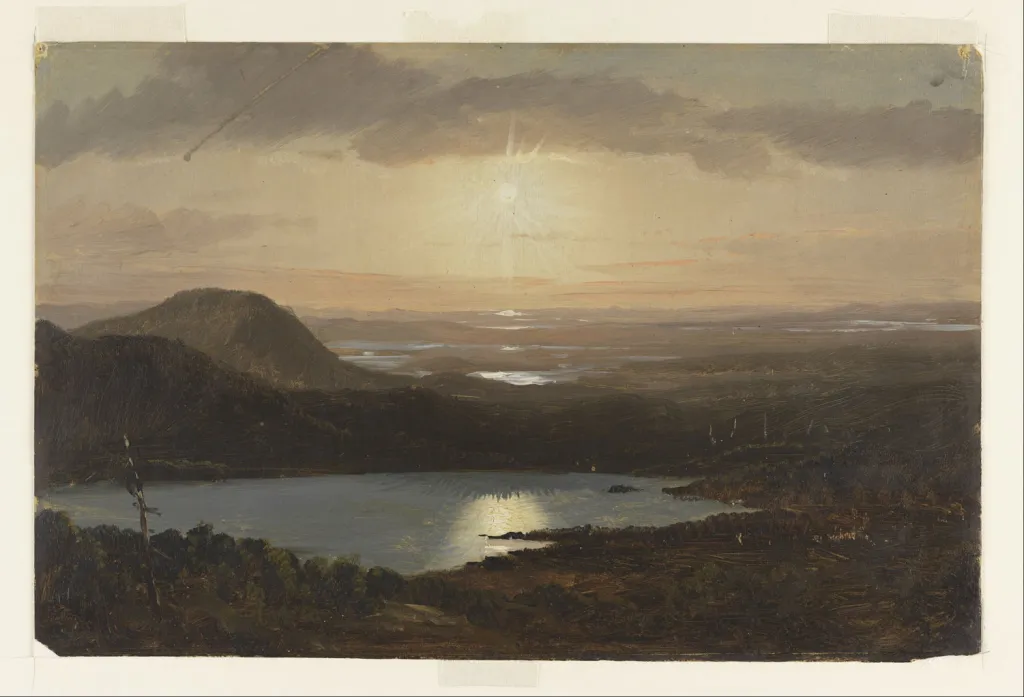
Frederic Edwin Church (1826–1900), Eagle Lake Viewed from Cadillac Mountain, Mount Desert Island, Maine (1850–60), oil and graphite on paperboard, 29.4 x 44.5 cm, Cooper Hewitt, Smithsonian Design Museum, New York, NY. Wikimedia Commons.

Frederic Edwin Church, who was born two centuries ago on 4 May 1826, is one of the founding American masters, and one of the world’s great nineteenth century landscape painters. As the only pupil of Thomas Cole, who founded the Hudson River School, Church has a pivotal place in the history of American painting.

His career started at the time of the Barbizon School, and continued into the height of Impressionism in France, and its arrival in North America. Unlike those, and subsequent US landscape painters, Church was a devout realist who produced huge canvases with meticulous, almost obsessive, detail. He was thus a rival to his contemporary, Albert Bierstadt (1830-1902), who worked largely within his unchallenged territory to the west of the Mississippi.

Church was a precocious artist, and by the time he started his training with Cole in 1844 he seems to have been a fine draftsman and a competent landscape painter. During his two years with Cole, the pair travelled around New England and New York State. Church sold his first painting to his neighbour Daniel Wadsworth, who founded the Wadsworth Athenaeum in Hartford, CT.

From these early days Church’s working methods were traditional, and similar to those of John Constable. He drew in pencil and sketched in oils in front of his motif, then assembled those into highly detailed and finished oil paintings in his studio. Church was an obsessive sketcher in oils, and thousands of his drawings and oil sketches survive in collections such as those of the Cooper Hewitt, Smithsonian Design Museum in New York.
churchwestrocknewhaven
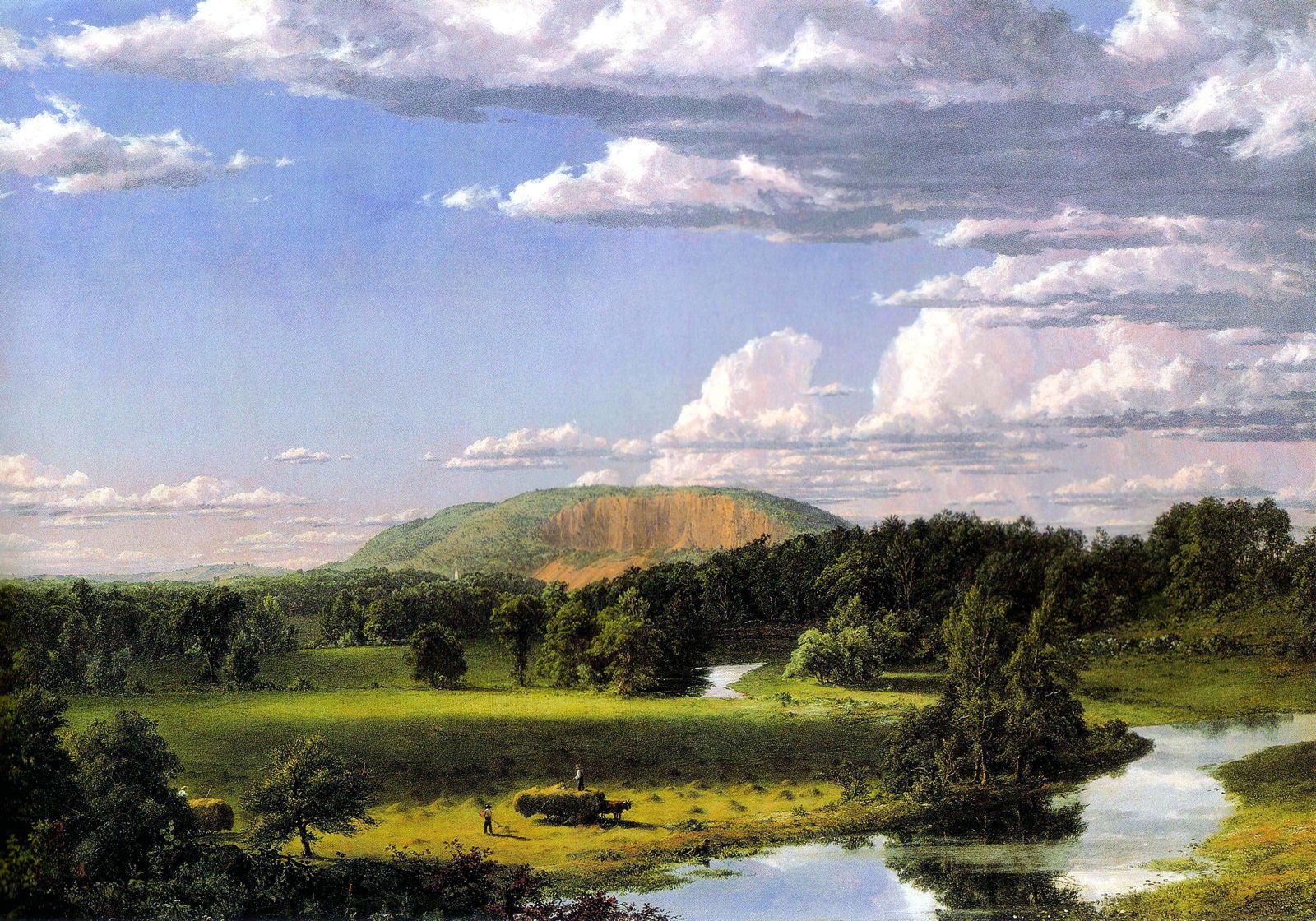
Frederic Edwin Church (1826–1900), West Rock, New Haven (1849), oil on canvas, 68.9 × 101.9 cm, New Britain Museum of American Art, New Britain, CT. Wikimedia Commons.

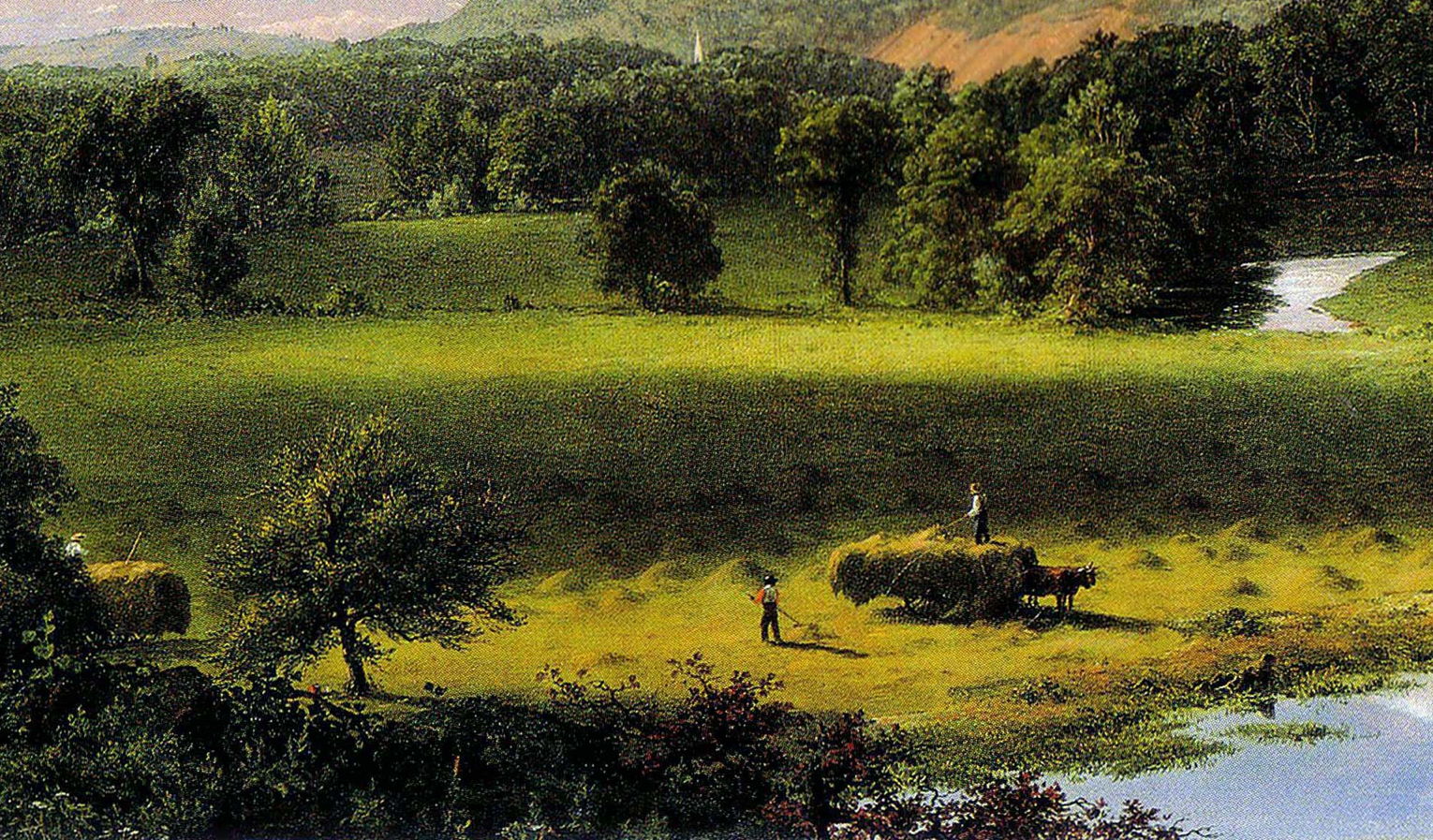
Church’s early landscape painting of West Rock, New Haven (1849) is a good example of his attention to detail in finished paintings. As shown in the detail below, its foreground features three figures making hay, which they’re stacking onto carts drawn by oxen. Down at the river bank, a dog is enjoying a paddle. Just peeking proud of the distant treetops is the white tip of a church spire.
churchwestrocknewhavend1
Frederic Edwin Church (1826–1900), West Rock, New Haven (detail) (1849), oil on canvas, 68.9 × 101.9 cm, New Britain Museum of American Art, New Britain, CT. Wikimedia Commons.
churchmtdesertisland
Frederic Edwin Church (1826–1900), Mt. Desert Island, Maine Coast (1850), oil on cream wove paper, Cooper Hewitt, Smithsonian Design Museum, New York, NY. Wikimedia Commons.

He had settled in New York by 1850, and from then went on trips most summers to the wilds of Maine to paint en plein air in oils. He made this rather sparse view of Mt. Desert Island, Maine Coast in oils on paper in 1850.

churchbeaconmtdesertisland
Frederic Edwin Church (1826–1900), Beacon, off Mount Desert Island (1851), oil on canvas, 116.8 × 78.7 cm, Private collection. Wikimedia Commons.

The following year Church painted this rich twilight seascape of a Beacon, off Mount Desert Island (1851). Judging from its size and canvas support, this was intended as a finished work rather than a study.

churchschoodicpeninsula
Frederic Edwin Church (1826–1900), Schoodic Peninsula from Mount Desert at Sunrise (1850–55), oil on paperboard, 22.9 x 34.9 cm, Cooper Hewitt, Smithsonian Design Museum, New York, NY. Wikimedia Commons.

Schoodic Peninsula from Mount Desert at Sunrise (1850–55) is one of many oil sketches which he made during a summer visit to Maine during this period.

churcheaglelake
Frederic Edwin Church (1826–1900), Eagle Lake Viewed from Cadillac Mountain, Mount Desert Island, Maine (1850–60), oil and graphite on paperboard, 29.4 x 44.5 cm, Cooper Hewitt, Smithsonian Design Museum, New York, NY. Wikimedia Commons.

Eagle Lake Viewed from Cadillac Mountain, Mount Desert Island, Maine (1850–60) is another oil sketch featuring a considerably more complex motif. Cadillac Mountain is relatively low at 466 metres (1,530 feet), but the highest point of Mount Desert Island, so affords such spectacular views.

In 1852, Church read Alexander von Humboldt’s account of his travels in central America, and decided to rise to Humboldt’s challenge to depict the ‘physiognomy’ of the Andes mountains. The following year he travelled to Columbia and Ecuador with the businessman Cyrus West Field, who bankrolled their trip in the hope that he could use Church’s paintings to promote his own local business ventures. They based themselves in Quito, travelling from there to awe-inspiring views of mountains and volcanoes.
churchcayambeotavaloecuador
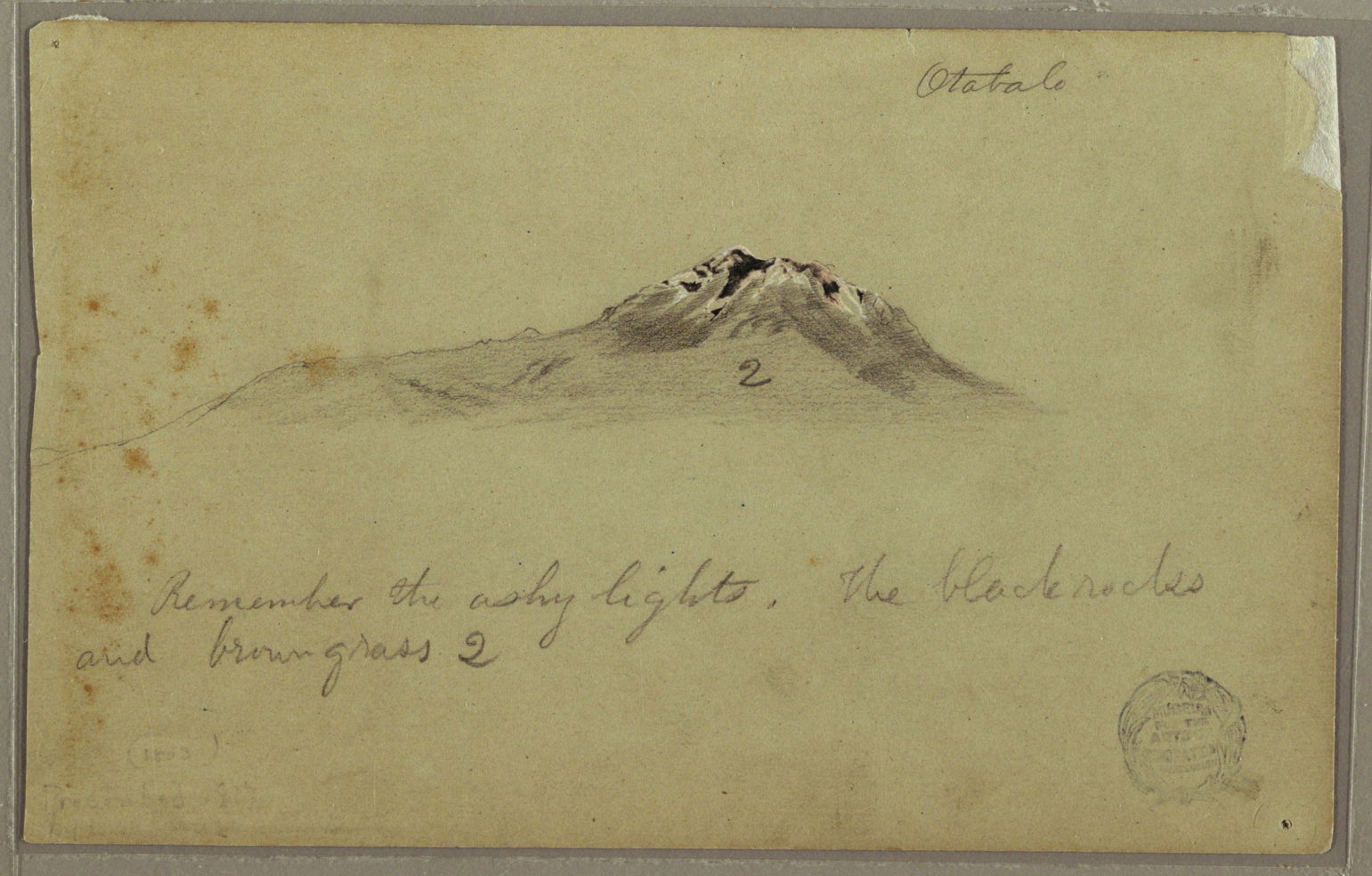
Frederic Edwin Church (1826–1900), Drawing, Andean Mountain Peak (Cayambe ?), Otavalo, Ecuador (August/September 1853), graphite, burch and ozicized white gouache on gray paper, 12.4 x 19.7 cm, Cooper Hewitt, Smithsonian Design Museum, New York, NY. Wikimedia Commons.

Church painted this view of what’s thought to be Cayambe in Ecuador in August or September 1853. This isn’t an oil sketch, though, but was made in pencil and gouache.
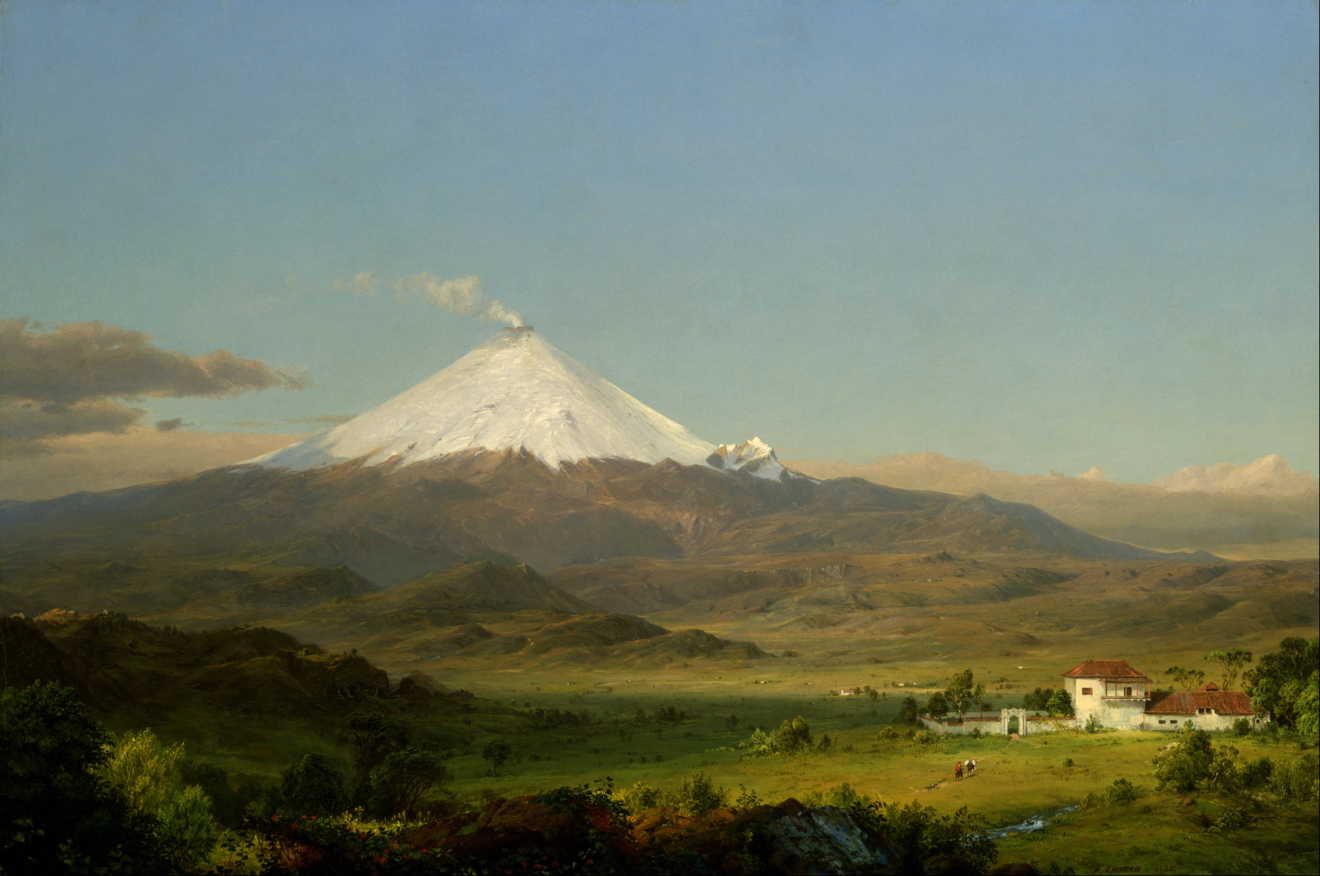
Frederic Edwin Church, Cotopaxi (1855), oil on canvas, 71 x 106.7 cm, Smithsonian American Art Museum, Washington, DC. Wikimedia Commons.

On his return to his studio in New York, Church turned those hundreds of sketches and drawings into larger finished paintings, in this case one of his many views of Cotopaxi (1855) in Ecuador. As was conventional at the time, these are highly finished, with no evidence of brushwork and a smooth paint surface.

His other versions of this motif weren’t as peaceful: that of 1862, commissioned by James Lenox, shows rugged waterfalls in the foreground, a barren rocky plain, and the volcano itself ejecting a high plume of smoke and ash. All this is lit by a blood-red sun, sitting low in the sky. This was to enable Church’s painting to serve as a pendant to one of Lenox’s other paintings, Turner’s dramatic Staffa, Fingal’s Cave (1832).

Frederic Edwin Church (1826-1900), Niagara (1857), oil on canvas, 101.6 x 229.9 cm, National Gallery of Art, Washington, DC. Wikimedia Commons.

Church was among the many landscape painters who visited Niagara (1857). Jennifer Raab has set this painting in its historical context, at a time when secession of Southern states seemed imminent. The Niagara Falls became associated with union and the unity of its details.

He returned to central America in 1857 with the artist Louis Rémy Mignot and added hundreds more drawings and sketches to his collection.

churchcrossinwilderness
Frederic Edwin Church (1826–1900), Cross in the Wilderness (1857), oil on canvas, 41.3 × 61.5 cm, Museo Thyssen-Bornemisza, Madrid. Wikimedia Commons.

Cross in the Wilderness, painted later that year, is one of the earlier works to result from his second visit. This wilderness is unpopulated, devoid of figures or other signs of human presence. It was another two years before Church painted his masterpiece that drew the crowds and established his popularity.

Reference

Raab, Jennifer (2015) Frederic Church, The Art and Science of Detail, Yale UP. ISBN 978 0 300 20837 5.