



惯性聚合 高效追踪和阅读你感兴趣的博客、新闻、科技资讯
阅读原文 在惯性聚合中打开

推荐订阅源

The GitHub Blog
The GitHub Blog
S
SegmentFault 最新的问题
L
LangChain Blog
Simon Willison's Weblog
N
News and Events Feed by Topic
Exploit-DB.com RSS Feed
WordPress大学
WordPress大学
M
MIT News - Artificial intelligence
A
About on SuperTechFans
Microsoft Security Blog
I
Intezer
Know Your Adversary
Know Your Adversary
H
Heimdal Security Blog
博客园 - 叶小钗
B
Blog RSS Feed
F
Fortinet All Blogs
Hacker News: Ask HN
Hacker News: Ask HN
A
Arctic Wolf
小众软件
小众软件
Help Net Security
Help Net Security
MongoDB | Blog
MongoDB | Blog
aimingoo的专栏
aimingoo的专栏
G
Google Developers Blog
Forbes - Security
Forbes - Security
Latest news
Latest news
AI
AI
I
InfoQ
H
Hackread – Cybersecurity News, Data Breaches, AI and More
C
CXSECURITY Database RSS Feed - CXSecurity.com
W
WeLiveSecurity
C
Cybersecurity and Infrastructure Security Agency CISA
人人都是产品经理
人人都是产品经理
Cyberwarzone
Cyberwarzone
奇客Solidot–传递最新科技情报
奇客Solidot–传递最新科技情报
J
Java Code Geeks
Engineering at Meta
Engineering at Meta
C
Cyber Attacks, Cyber Crime and Cyber Security
O
OpenAI News
博客园 - 【当耐特】
T
Threat Research - Cisco Blogs
GbyAI
GbyAI
U
Unit 42
D
Darknet – Hacking Tools, Hacker News & Cyber Security
G
GRAHAM CLULEY
Apple Machine Learning Research
宝玉的分享
宝玉的分享
Google DeepMind News
T
Threatpost
T
The Blog of Author Tim Ferriss
罗磊的独立博客

The Eclectic Light Company

Hero or hooligan: Theseus’ later years BSD flags are incompatible with iCloud Drive Apple has released macOS Tahoe 26.5.1 In memoriam Mary Cassatt: 1, 1868-1880 Solutions to Saturday Mac riddles 362 What Location Services do in macOS Eclectic paintings of Joseph Stella: 2 European myths Last Week on My Mac: Razzle and dazzle Eclectic paintings of Joseph Stella: 1 American landscapes Saturday Mac riddles 362 Protect files with the Locked or Immutable flag Reading Visual Art: 252 Dragonfly What happens in the log when an app crashes as it starts up? Portraits of trees: Introduction On Reflection: Conclusions and contents Which tasks require mains power? Medium and message: Vast canvases Online reference to external displays for Apple silicon Macs What’s in that phishing email? Hero or hooligan: Theseus and Ariadne Solutions to Saturday Mac riddles 361 How to search document versions Rubens’ Consequences of War Rubens’ Peace and War Saturday Mac riddles 361 How to search Time Machine backups? Naturalists: Contents and artists On Reflection: Extending the image Tackle QuickLook problems Medium and message: Pottery Hero or hooligan: Theseus and the sandals How QuickLook provides thumbnails and previews Last Week on My Mac: Syncing metadata in iCloud Drive Paintings of visits to India 1778-1877 Saturday Mac riddles 360 Naturalists: Sorolla and Zorn On Reflection: Pierre Bonnard 1909-1946 SpotTest 1.2 can display Spotlight metadata directly On Reflection: Pierre Bonnard 1899-1908 How to preserve versions, and how to create versioned PDFs Medium and message: Sculpture What gets synced in iCloud Drive? Hero or hooligan: Perseus 2 Solutions to Saturday Mac riddles 359 Last Week on My Mac: snapshots, the elephant in APFS Paintings of Beatrice Portinari: to 1862 Saturday Mac riddles 359 Naturalists: Into the 20th century How to check whether Spotlight is getting the right metadata On Reflection: Mirror play Hero or hooligan: Perseus 1 The bicentenary of Frederic Edwin Church: 1857-77 Solutions to Saturday Mac riddles 358 macOS virtual machines and audio-video syncing A walk in the parks of Rome, Vienna, Manhattan and Brooklyn Saturday Mac riddles 358 Naturalists: Photography Use Finder tags for categories Control what gets written to the log Medium and message: Tapestry Virtualisation on Apple silicon Macs is different Jerusalem Delivered: Overview and contents The bicentenary of Frederic Edwin Church: 1849-57 Solutions to Saturday Mac riddles 357 Painting Pandora and her box: 1883-1919 Painting Pandora and her box: 1550-1882 Saturday Mac riddles 357 Reading Visual Art: 250 Winged sandals The secret life of the xattr The macOS Natural Language framework and Nalaprop Medium and Message: Stained glass The MACL extended attribute Jerusalem Delivered: 13 Leading characters Solutions to Saturday Mac riddles 356 Privacy: How locations are protected Painting Spring blossom 2 Last Week on My Mac: Don’t be a victim of fraud Painting Spring blossom 1 Saturday Mac riddles 356 Explainer: Recovery Reading Visual Art: 249 Mask Naturalists: Urban poverty On Reflection: Cézanne Privacy: Which folders are protected in Tahoe? Medium and Message: Mosaic Jerusalem Delivered: 12 Delivery Solutions to Saturday Mac riddles 355 Centaurs 2: Revenge Centaurs 1: Fights Saturday Mac riddles 355 Explainer: sandboxes Naturalists: The modern meal Why you can’t trust Privacy & Security Apple has just released an update to macOS Tahoe, to version 26.4.1 On Reflection: Divisionism Please help update CPU frequencies for Apple silicon Macs Commemorating the centenary of the death of John Ferguson Weir Privacy: Files & Folders or Full Disk Access? Jerusalem Delivered: 11 Into Jerusalem Privacy: protected folders
Portraits of trees: Nicolas Poussin
hoakley · 2026-06-16 · via The Eclectic Light Company

Nicolas Poussin (1594–1665), Paysage avec deux nymphes et un serpent (Landscape with Two Nymphs and a Snake) (c 1659), oil on canvas, 118 x 179 cm, Musée Condé, Chantilly, Oise, France. Wikimedia Commons.

As one of the founding fathers of the genre, Poussin’s landscapes are among the most influential, and his approach to the depiction of trees set the standard.

Nicolas Poussin (1594-1665) was born near Les Andelys, a village on the River Seine in Normandy, where he was initially apprenticed to Quentin Varin. He ran away to Paris at the age of eighteen, where he continued his apprenticeship under minor masters. Becoming impressed by Italian paintings, he attempted to travel to Rome, but was forced to return to Paris. He eventually moved to Rome in 1624, and remained there painting for much of the rest of his life.

A good friend of the other major French landscape painter of the day, Claude Lorrain, he relied mainly on private patronage and completed many major paintings with religious and historic themes. He returned to France between 1640 and 1642 to work as court painter to Louis XIII, but went back to Rome as a result of intrigues in the French court. His marriage was childless, but he adopted his wife’s brother, Gaspard Dughet, who also painted fine landscapes and assumed the name of Poussin; distinguishing their work remains difficult and controversial.

poussinmandrinking
Nicolas Poussin (1594–1665), Landscape with a Man Drinking, or Landscape with a Man Scooping Water from a Stream (c 1637), oil on canvas, 63 x 77.7 cm, The National Gallery, London. Wikimedia Commons.

In Landscape with a Man Scooping Water from a Stream (c 1637) he comes closest to a view dominated by trees, most probably his lifelong favourite, oaks, in this case the holm oak, Quercus ilex. Each is carefully constructed from the trunk and branch anatomy, and their canopies, although dense, are formed from leaves rather than solid masses. The distant view is that of an idealised Roman campagna.
poussinsacramentordination
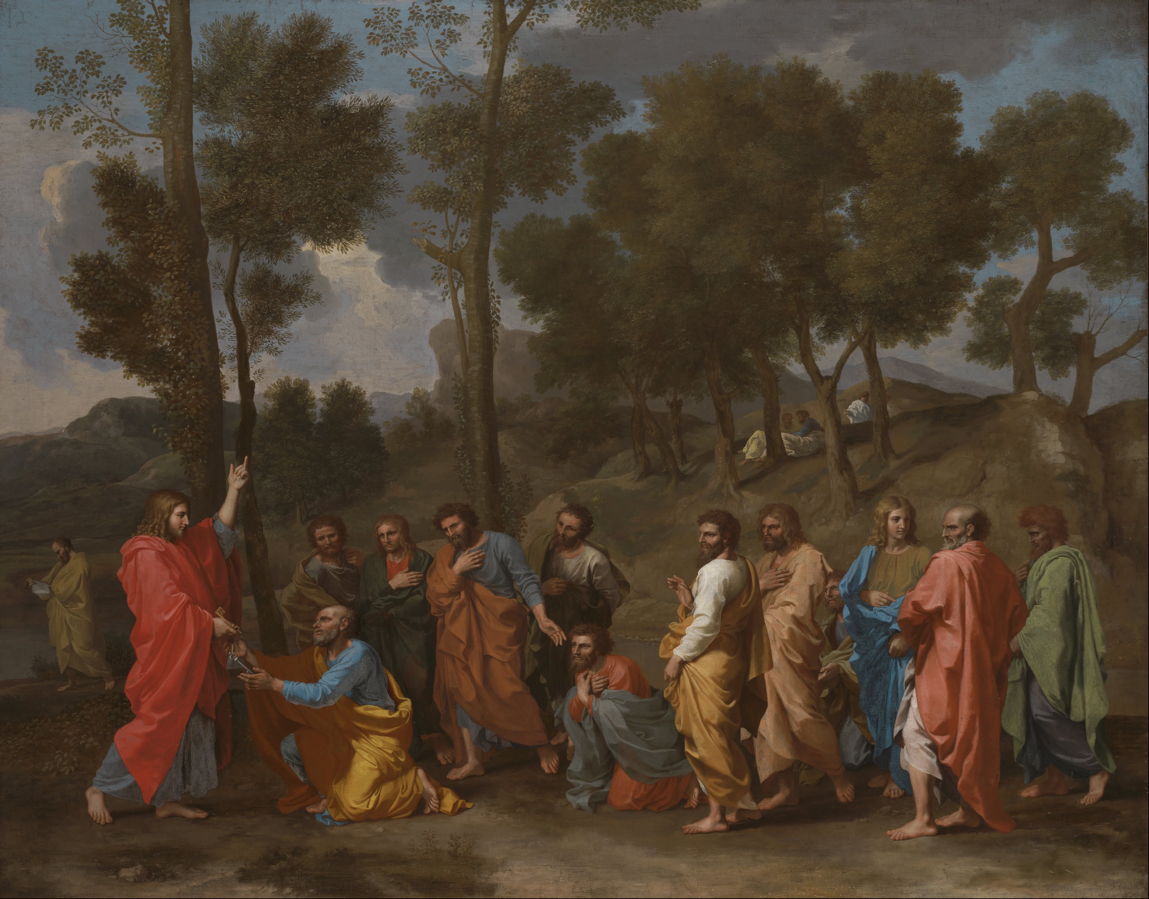
Nicolas Poussin (1594–1665), The Sacrament of Ordination (Christ Presenting the Keys to Saint Peter) (c 1636-40), oil on canvas, 95.9 × 121.6 cm, Kimbell Art Museum, Fort Worth, TX. Wikimedia Commons.

His early works were mostly religious, myth, and history, but he still took the opportunity to enrich landscape backgrounds with carefully painted trees: this, one of his first series of seven paintings showing the sacraments, was completed for Cassiano dal Pozzi, a major patron in Rome. The Sacrament of Ordination (Christ Presenting the Keys to Saint Peter) (c 1636-40) is interesting as its trees, although far less colourful than Christ and his disciples, dominate in size.

poussinsacramentordinationdet
Nicolas Poussin (1594–1665), The Sacrament of Ordination (Christ Presenting the Keys to Saint Peter) (detail) (c 1636-40), oil on canvas, 95.9 × 121.6 cm, Kimbell Art Museum, Fort Worth, TX. Wikimedia Commons.

Seen close up, Poussin has shown closer foliage in crisp detail, and softened that as it goes deeper towards the background: this mimics the effects of optical depth of focus, something he couldn’t have known about. He also modelled variation in colour and texture of the bark, and other subtle details.

poussinsaintjohnpatmos
Nicolas Poussin (1594–1665), Landscape with Saint John on Patmos (1640), oil on canvas, 100.3 x 136.4 cm, Art Institute of Chicago, Chicago, IL. Wikimedia Commons.

Landscape with Saint John on Patmos (1640) shows another idealised landscape, probably based on the western Italian coast, rather than Patmos in the Dodecanese, in the eastern Aegean. Instead of placing trees at the edges, Poussin sets them further back; these again have the look of oaks. There’s a richer variety in the middle distance, breaking the more regular lines of ancient ruins.

poussinsaintjohnpatmosdet
Nicolas Poussin (1594–1665), Landscape with Saint John on Patmos (detail) (1640), oil on canvas, 100.3 x 136.4 cm, Art Institute of Chicago, Chicago, IL. Wikimedia Commons.

A more detailed view of the tree at the left confirms that it has the leaves typical of an oak, and has bark carefully textured and encrusted with lichen. Poussin was no botanist, and understanding of plant and tree species was limited at that time, but his trees reflect careful observation and field drawings.
poussinashesphocion
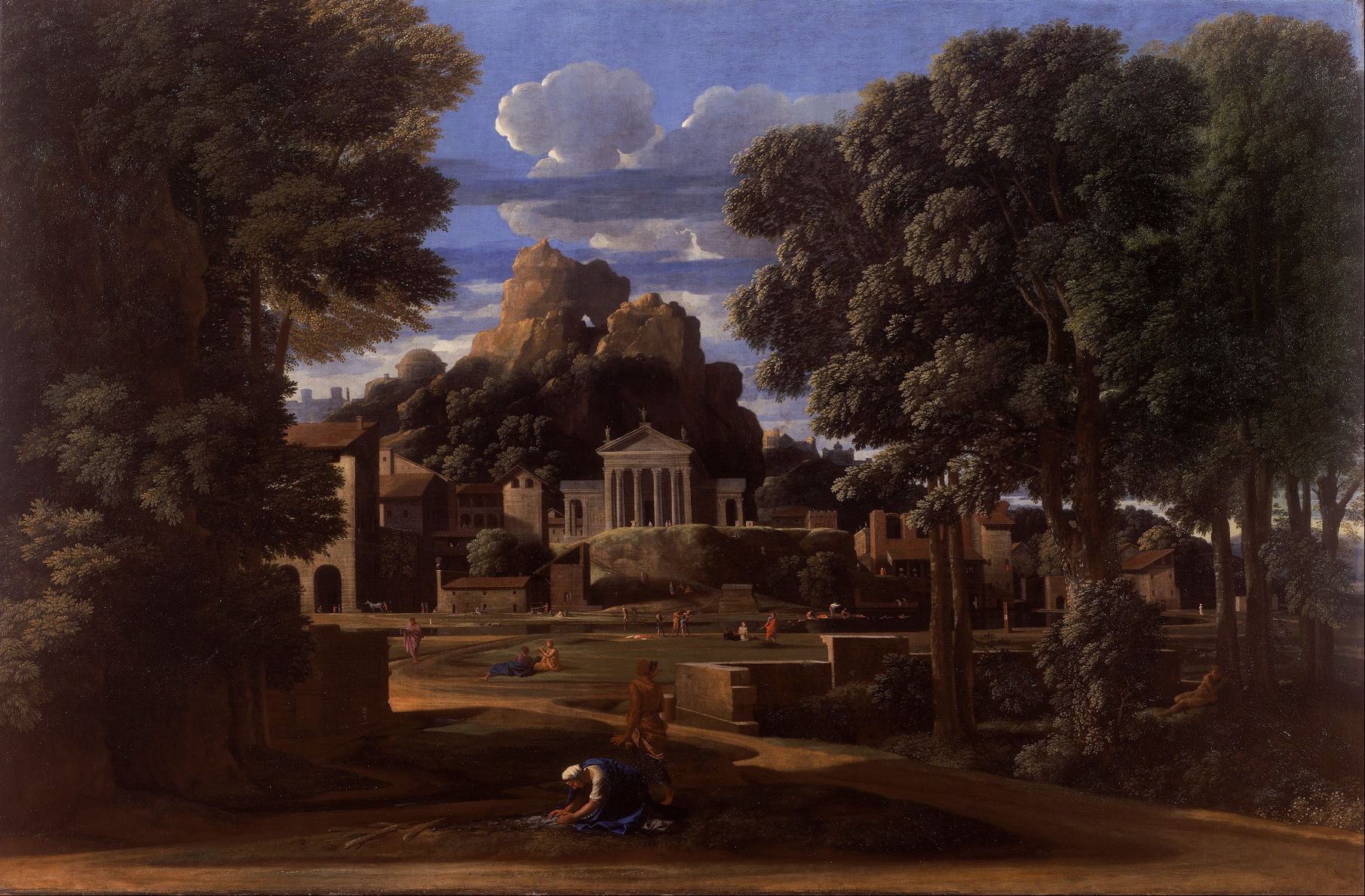
Nicolas Poussin (1594–1665), Landscape with the Ashes of Phocion (1648), oil on canvas, 116.8 x 178.1 cm, Walker Art Gallery, Liverpool. Wikimedia Commons.

Landscape with the Ashes of Phocion (1648) is dominated by the dense canopies of holm oaks, their leaves painted meticulously. At the far right, there appears to be a close group of poplars, perhaps.

poussinashesphociondet
Nicolas Poussin (1594–1665), Landscape with the Ashes of Phocion (detail) (1648), oil on canvas, 116.8 x 178.1 cm, Walker Art Gallery, Liverpool. Wikimedia Commons.

When seen in detail, their anatomical construction is apparent, as are more figures from his staffage, including a person apparently clinging to the base of one of the trunks, at the lower right of this view.

poussinthunderstormpyramusthisbe
Nicolas Poussin (1594–1665), Landscape during a Thunderstorm with Pyramus and Thisbe (1651), oil on canvas, 192.5 × 273.5 cm, Städel, Frankfurt am Main. Wikimedia Commons.

Poussin’s trees were also actors in the narratives in his paintings. Here, in Landscape (during a Thunderstorm) with Pyramus and Thisbe (1651), each canopy is contorted by the wind, and they form the major cue for its strong gusts, the water on the lake remaining unrealistically flat.
poussinthunderstormpyramusthisbedet
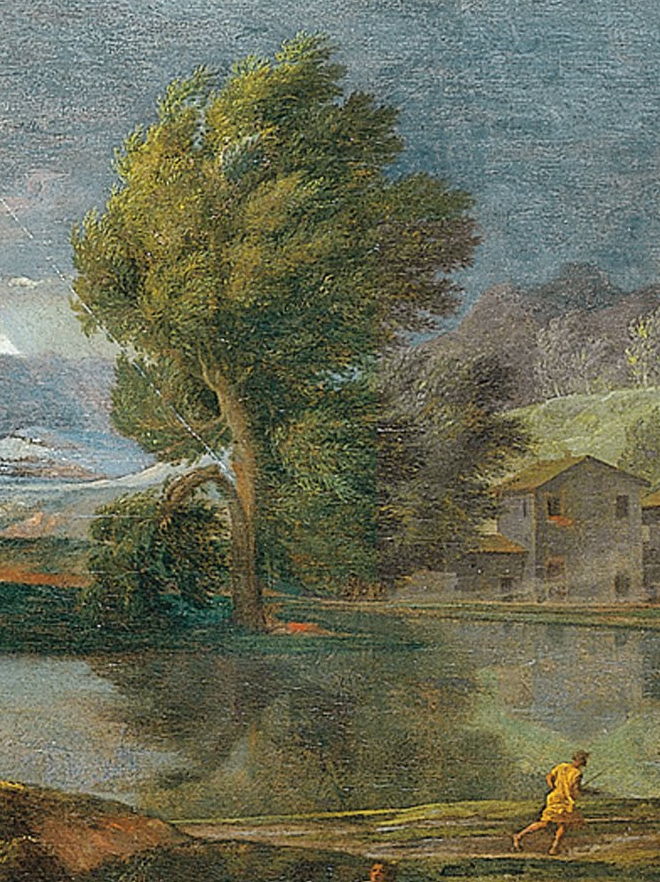
Nicolas Poussin (1594–1665), Landscape during a Thunderstorm with Pyramus and Thisbe (detail) (1651), oil on canvas, 192.5 × 273.5 cm, Städel, Frankfurt am Main. Wikimedia Commons.

This detail shows the leaves and branches of the tree on the lakeside swept back to their limits, and one of the few branches that appears damaged, to reinforce the impression of the strength of the wind.
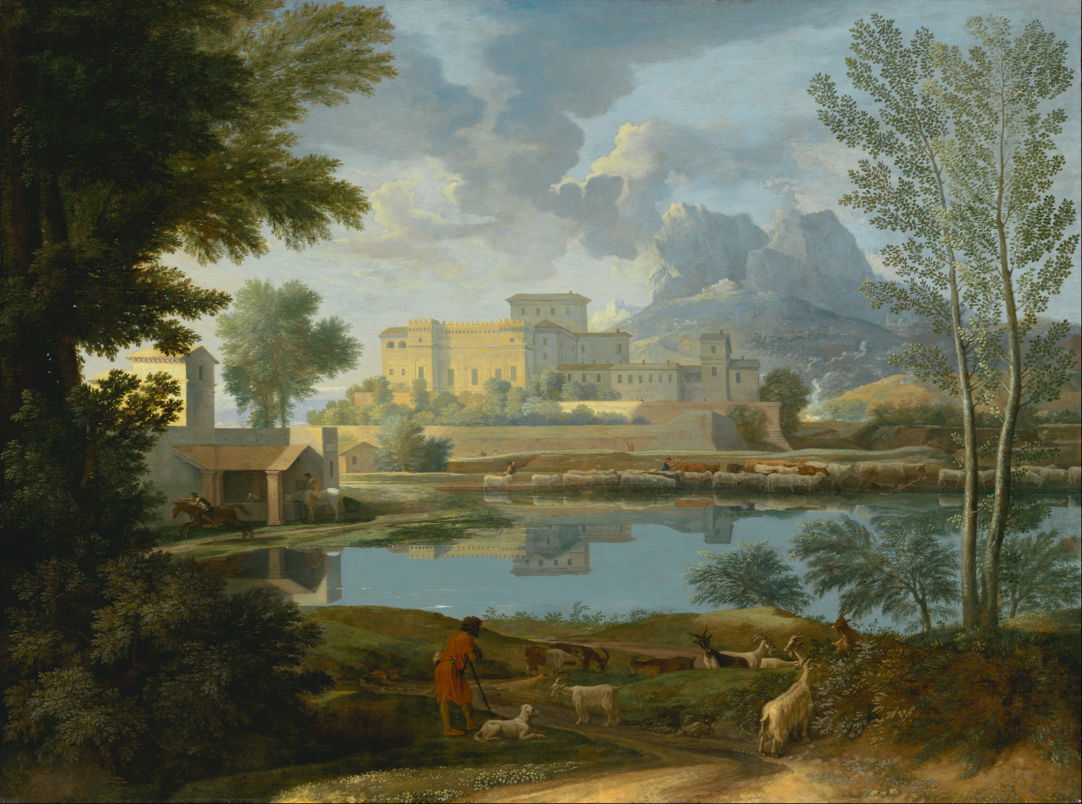
Nicolas Poussin, Landscape with a Calm (c 1651), oil on canvas, 97 x 131 cm, J. Paul Getty Museum, Los Angeles. Digital image courtesy of the Getty's Open Content Program.
Nicolas Poussin, Landscape with a Calm (c 1651), oil on canvas, 97 x 131 cm, J. Paul Getty Museum, Los Angeles. Digital image courtesy of the Getty’s Open Content Program.

The contrast shown in Landscape with a Calm (c 1651) is achieved largely in the appearance of the foliage and canopies. Here the trees are closer to the edges of the canvas, and form a more classical repoussoir.
poussinblindorion
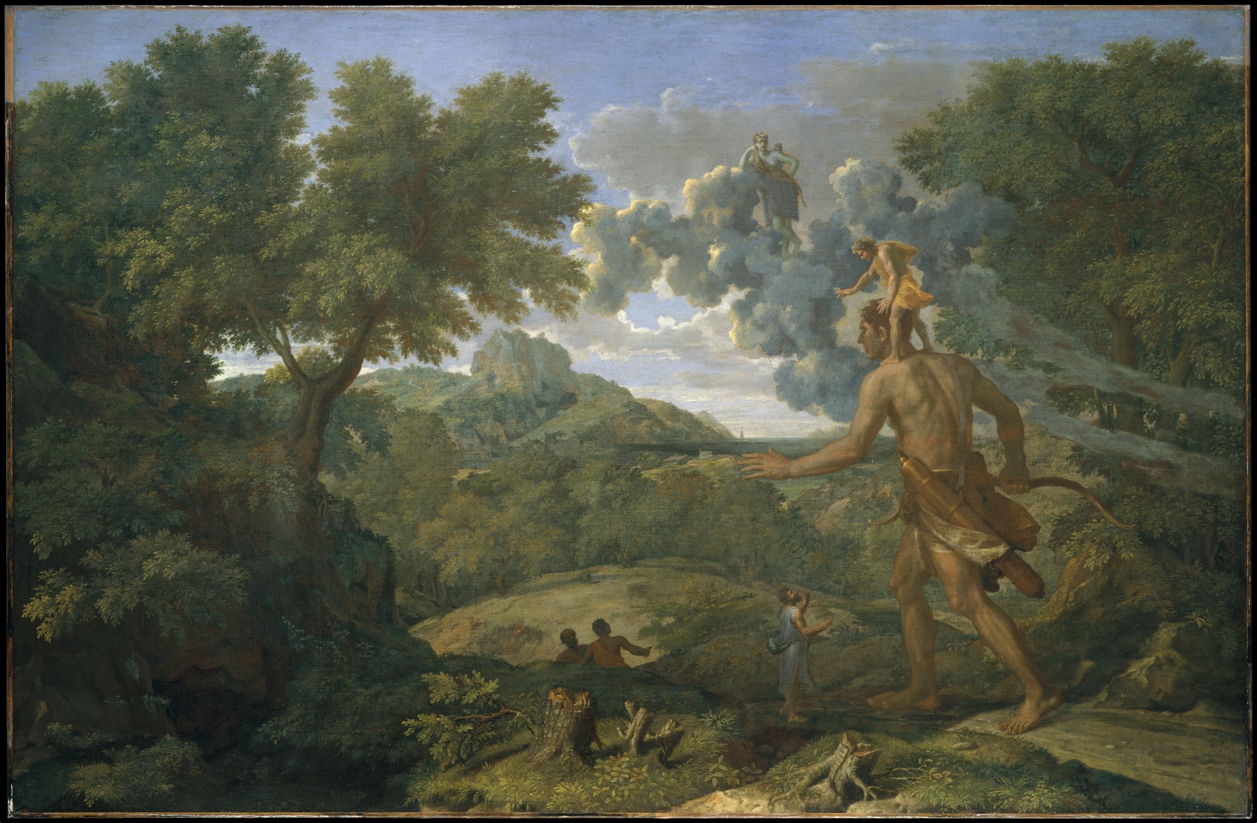
Nicolas Poussin (1594–1665), Landscape with Orion, or Blind Orion Searching for the Rising Sun (1658), oil on canvas, 119.1 × 182.9 cm, Metropolitan Museum of Art, New York, NY. Photo courtesy of the Metropolitan Museum of Art, via Wikimedia Commons.

In Blind Orion Searching for the Rising Sun (1658) Poussin’s oaks not only frame the view, but provide scale for the blind giant Orion.

poussinblindoriondet
Nicolas Poussin (1594–1665), Landscape with Orion, or Blind Orion Searching for the Rising Sun (detail) (1658), oil on canvas, 119.1 × 182.9 cm, Metropolitan Museum of Art, New York, NY. Photo courtesy of the Metropolitan Museum of Art, via Wikimedia Commons.

The fused twin trunk is old, its surface gnarled and uneven, and its base clinging to the edge of a small cliff.
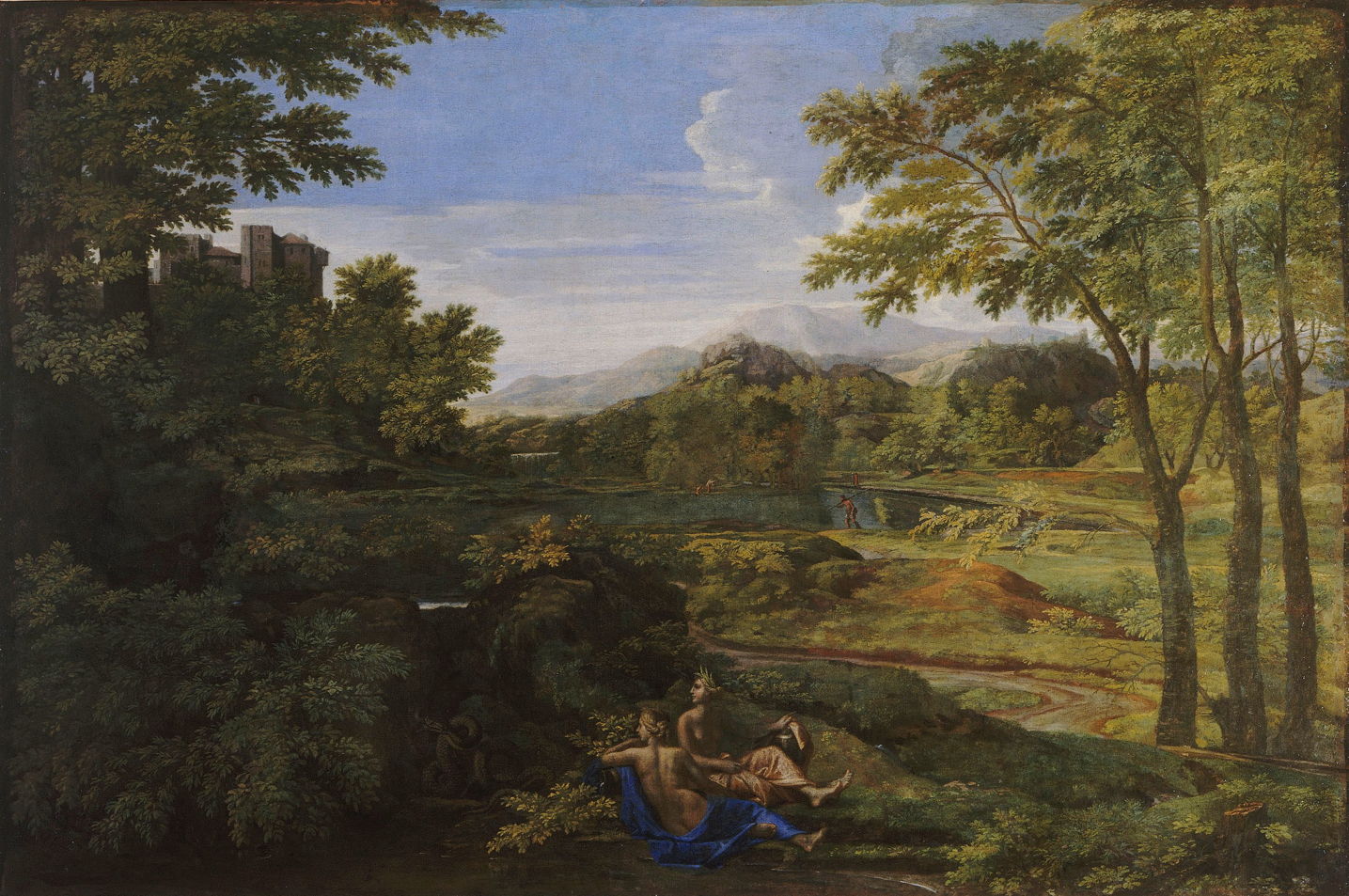
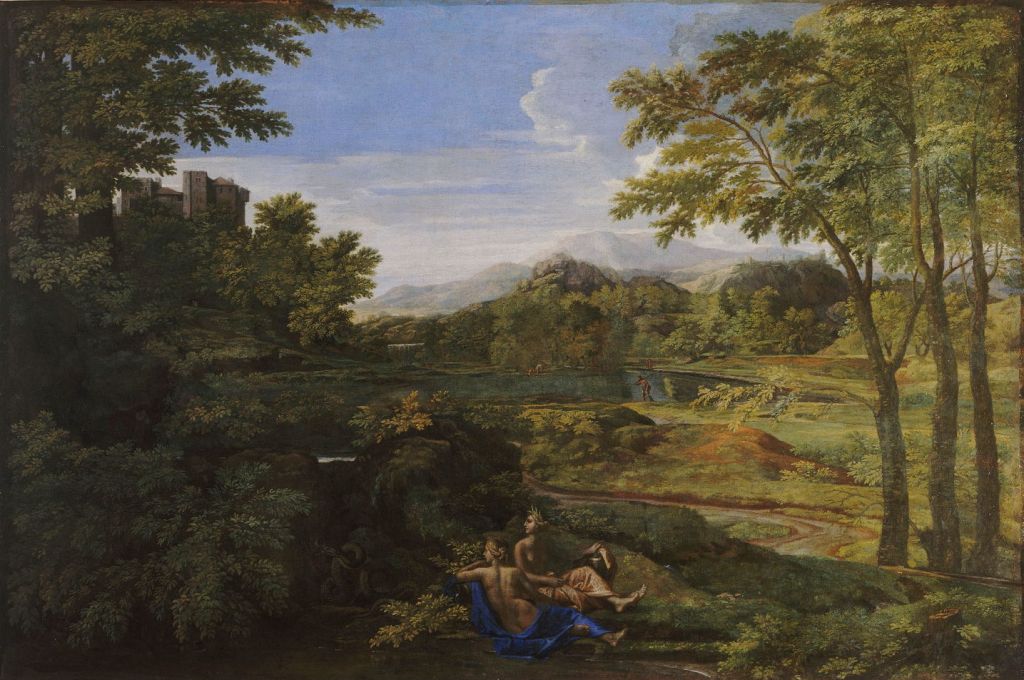
Nicolas Poussin (1594–1665), Paysage avec deux nymphes et un serpent (Landscape with Two Nymphs and a Snake) (c 1659), oil on canvas, 118 x 179 cm, Musée Condé, Chantilly, Oise, France. Wikimedia Commons.

Landscape with Two Nymphs and a Snake (c 1659) uses the trees to the right as more than just a framing device.
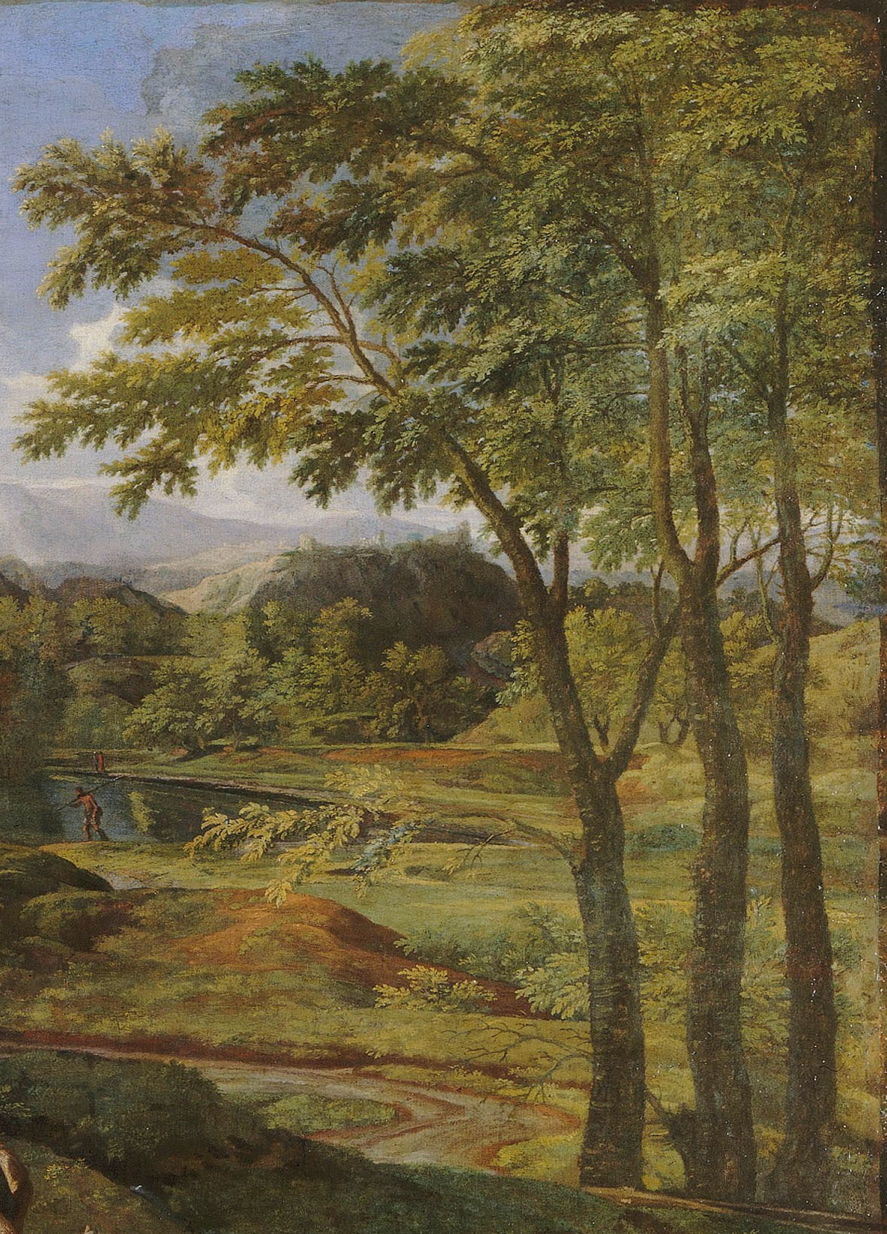
Nicolas Poussin (1594–1665), Paysage avec deux nymphes et un serpent (Landscape with Two Nymphs and a Snake) (detail) (c 1659), oil on canvas, 118 x 179 cm, Musée Condé, Chantilly, Oise, France. Wikimedia Commons.

This detail view suggests the trees at the right are likely to be oaks. He again controls level of detail, size of leaves, and ‘focus’ to enhance the sense of depth.

References

Clark TJ (2006) The Sight of Death, an Experiment in Art Writing, Yale UP. ISBN 0 300 11726 4.
Milovanovic N and Szanto M (eds) (2015) Poussin et Dieu (in French), Hazan. ISBN 978 2 7541 0826 3.
Rosenberg P & Christiansen K (2008) Poussin and Nature. Arcadian Visions, Yale UP. ISBN 978 0 300 13668 5.
Thuillier J (1994) Nicolas Poussin, Flammarion, Paris. ISBN 978 2 08 012440 4.