




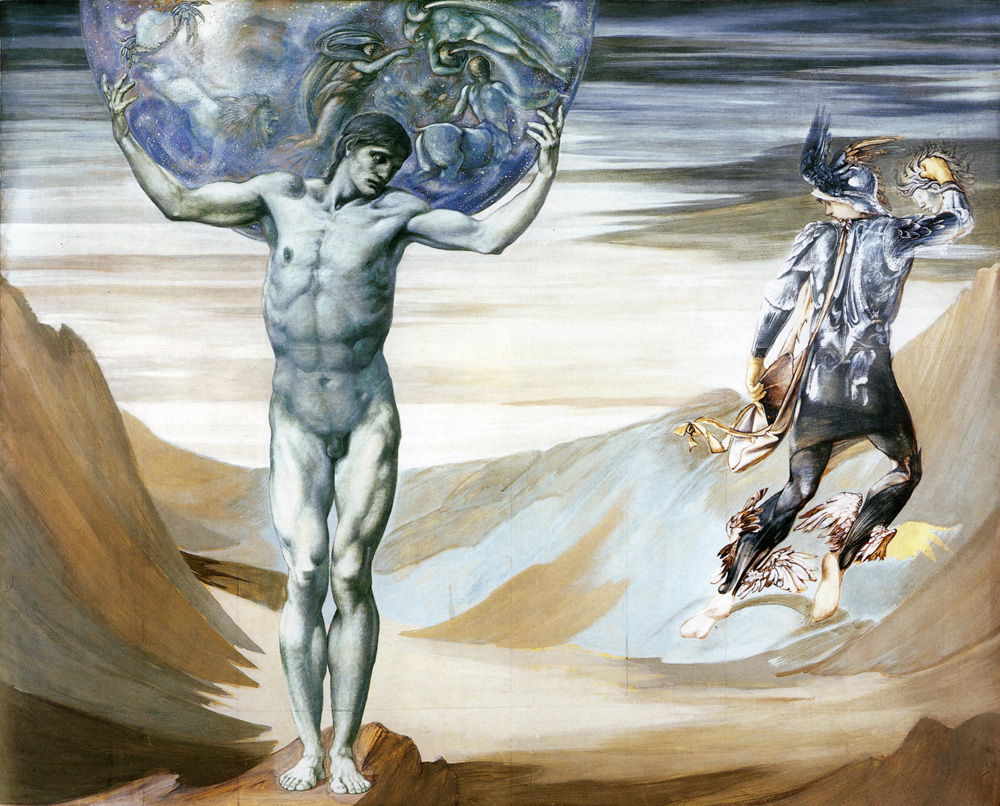
 Edward Burne-Jones (1833–1898), The Perseus Series: Atlas Turned to Stone (1878), bodycolour, 152.5 × 190 cm, Southampton City Art Gallery, Southampton, England. Wikimedia Commons.
Many of the heroes of the classical world were deeply flawed. Theseus, founder of Athens, treated women appallingly, and Jason of the Argonauts was no better. This new series looks at paintings of the legendary lives of those who could have been villains or hooligans rather than the heroes they were held to be.
Perseus, the greatest slayer of monsters among them, seems to have been faithful to Andromeda, the princess he rescued from the jaws of Cetus, the sea monster. He even killed Polydectes, who was chasing his mother. Like several other classical heroes, Perseus was the result of divine union with a mortal, in this case Zeus/Jupiter with Danaë. She had been imprisoned in a bronze chamber to prevent her from becoming pregnant, as her father Acrisius, King of Argos, had been warned by an oracle that he would be killed by his daughter’s son.
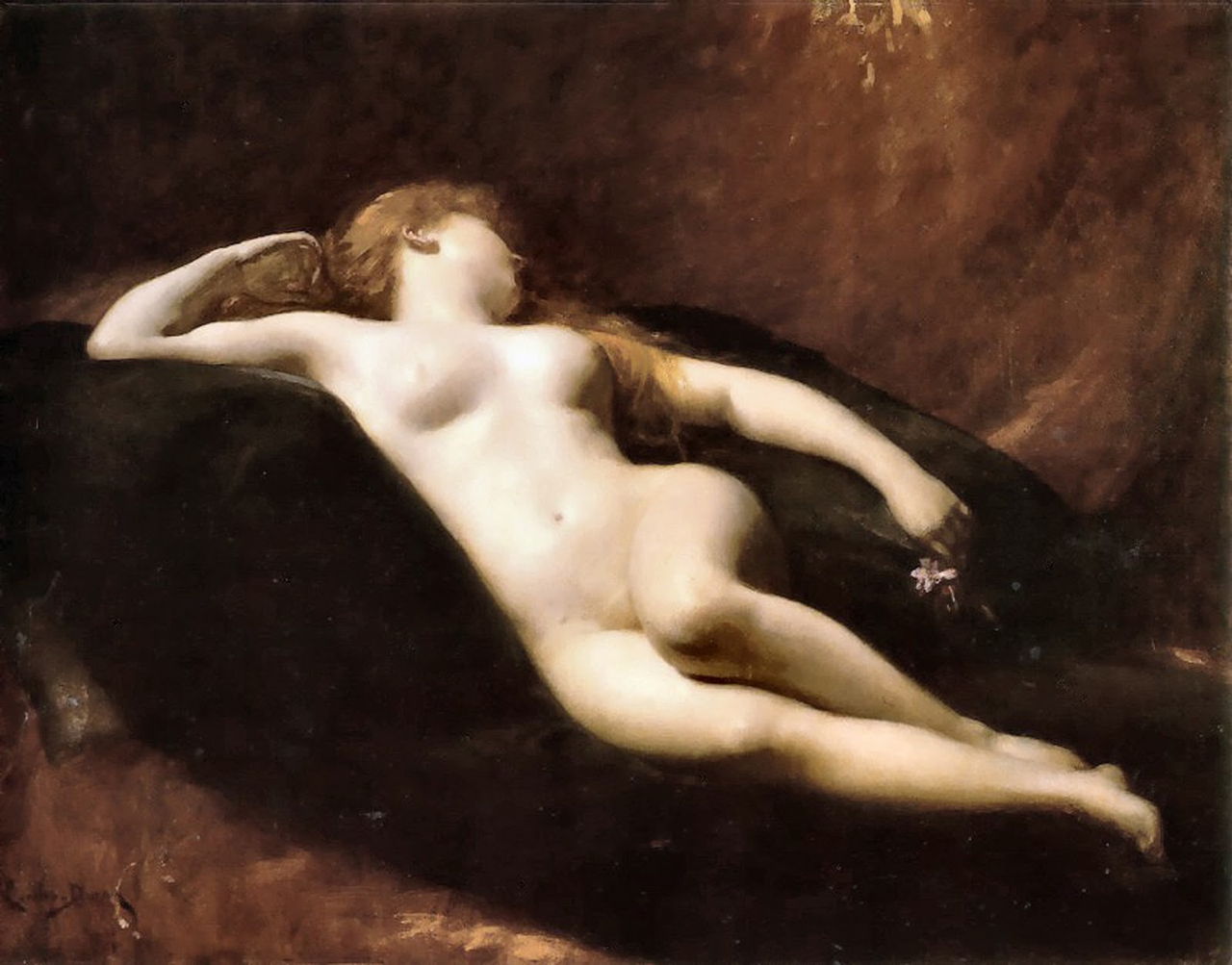
With a skylight as the chamber’s only source of light and air, Zeus descended on her in the form of golden rain. Danae (c 1900) is Carolus-Duran’s beautifully simple painting of this story, showing the shower of gold falling from its upper edge.

Gustav Klimt’s Danaë is curled into a foetal ball, and is usually interpreted as showing arousal. She became pregnant, later giving birth to Perseus. Her father then tried to kill them both by putting them in a wooden chest and casting it into the sea, but they were washed up alive on the island of Seriphos, where Dictys, a fisherman and brother of King Polydectes, raised the boy.
As a young man, Perseus suspected the intentions of Polydectes towards his mother Danaë, and tried to protect her from him. In a bid to get Perseus out of his way, Polydectes called a large banquet for which each guest was expected to bring a gift of a horse. As Perseus had no horse to give, he asked the king to name a substitute, which was the head of the Gorgon Medusa, and the cue for Perseus’ major adventure.
Although the myths of Perseus have long been popular subjects for painters, none has devoted as much attention to them as Edward Burne-Jones, whose uncompleted Perseus series is one of the greatest visual accounts of any classical myth.

This series starts with The Call of Perseus (1877), showing a double image of Perseus with Athena outside the city. At the left, Athena approaches the pensive Perseus, who is pondering how he can obtain the head of Medusa, staring into a stream. At the right, Athena has transformed herself into her regular and recognisable form, and is giving Perseus her advice, and providing him with the mirror with which he can view Medusa in safety. Although other artists have depicted this mirror as an impressive circular shield, throughout this series Burne-Jones shows it as a far smaller circular hand mirror.
The first call in Perseus’ mission were the sisters of the Gorgons, the Graiae (there are various spellings), who would in turn lead him to the Hesperides, who would provide him with a kibisis, a small bag into which he would put Medusa’s head.

Burne-Jones next shows Perseus with the three Graiae. He has just intercepted and seized their single, shared eye, which he is holding in his right hand, and only returns once they have led him to the Hesperides. The words in the inscription provide a potted summary, in translation:
Pallas Athena spurred Perseus to action with her urging, and equipped him with arms. The Graiae revealed to him the remote home of the nymphs. From here he went with wings on his feet and with his head shrouded in darkness, and with his sword he struck the one mortal Gorgon, the others being immortal. Her two sisters arose and pursued him. Next he turned Atlas to stone. The sea serpent was slain and Andromeda rescued, and the comrades of Phineas became lumps of rock. Then Andromeda looked in a mirror with wonder at the dreadful Medusa.
(Modified from Anderson & Cassin.)
Perseus needed four more items for his mission: Zeus gave him an adamantine sword and the helm of darkness from Hades, enabling him to hide invisibly. Hermes lent out his winged sandals so that Perseus could fly like a god, and Athena provided him with a polished shield, so he could avoid looking directly at Medusa’s face, which would have turned him to stone.
Perseus then flew to the cave in which the Gorgons were asleep, and beheaded Medusa. From her severed neck sprung the winged horse Pegasus, and Chrysaor, a sword of gold.
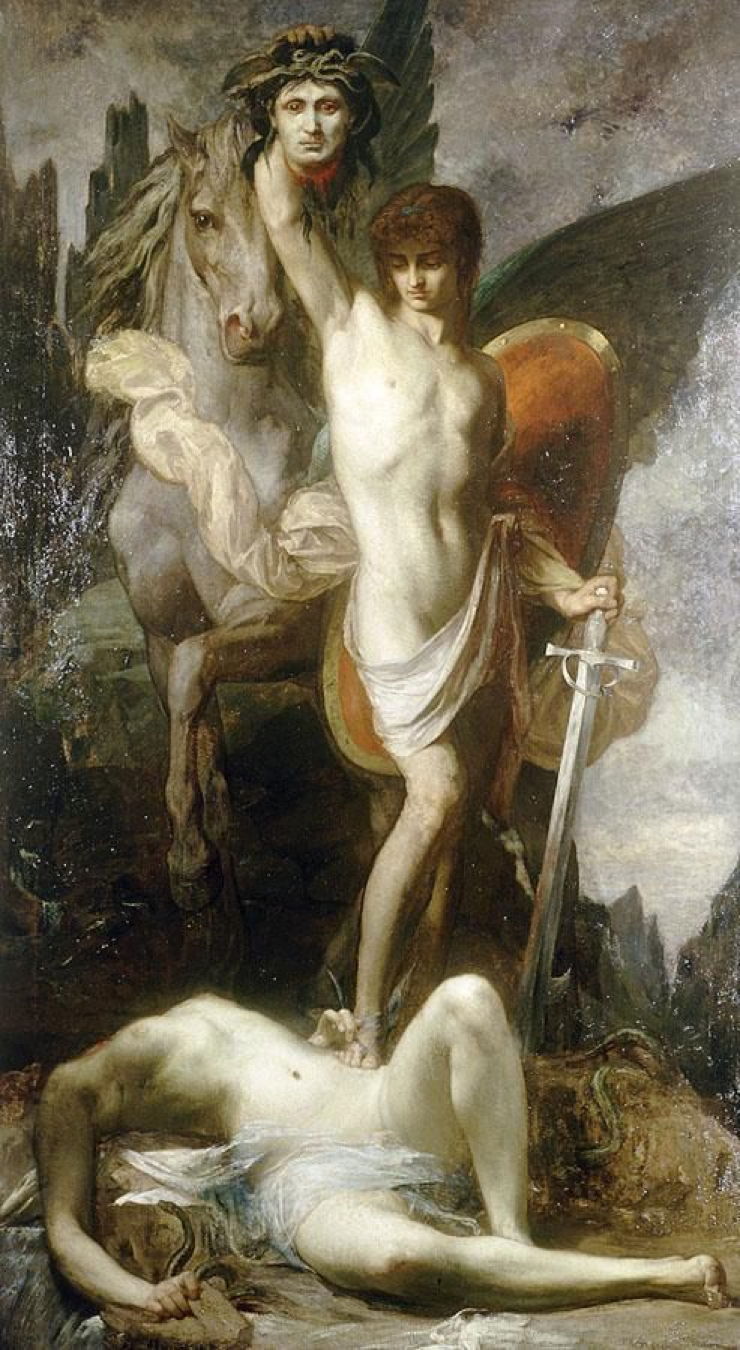
Eugène Romain Thirion’s Perseus Victorious Over Medusa from 1867 respects convention, with the hero triumphantly holding Medusa’s head aloft, facing away from him. He shows Pegasus behind, but not Chrysaor, which is generally omitted from these paintings, and indeed from some verbal accounts.
The two surviving Gorgons tried to pursue Perseus, but he donned the helm of Hades and became invisible to them. He flew over North Africa, and sought rest and accommodation from Atlas there. However, Atlas refused him hospitality, for which Perseus showed him the face of Medusa, turning him to stone.

The seventh painting in Burne-Jones’ Perseus Series, his Atlas Turned to Stone (1878), shows the aftermath of Atlas’ failure to offer hospitality: he has been turned to stone by the residual power of Medusa’s face, and now stands bearing the cosmos on his shoulders as Perseus flies off to Ethiopia to rescue Andromeda.
Perseus stopped in Ethiopia, which was ruled by King Cepheus and Queen Cassiopeia. She had boasted of the beauty of her daughter Andromeda, and so incurred the wrath of Poseidon, bringing floods and a voracious sea monster named Cetus. The local oracle told the king and queen that the only way to save their people from Cetus was to sacrifice their daughter to the monster. Accordingly, and with great grief, they were forced to comply. Andromeda was therefore fastened to a rock at the edge of the sea to await Cetus.
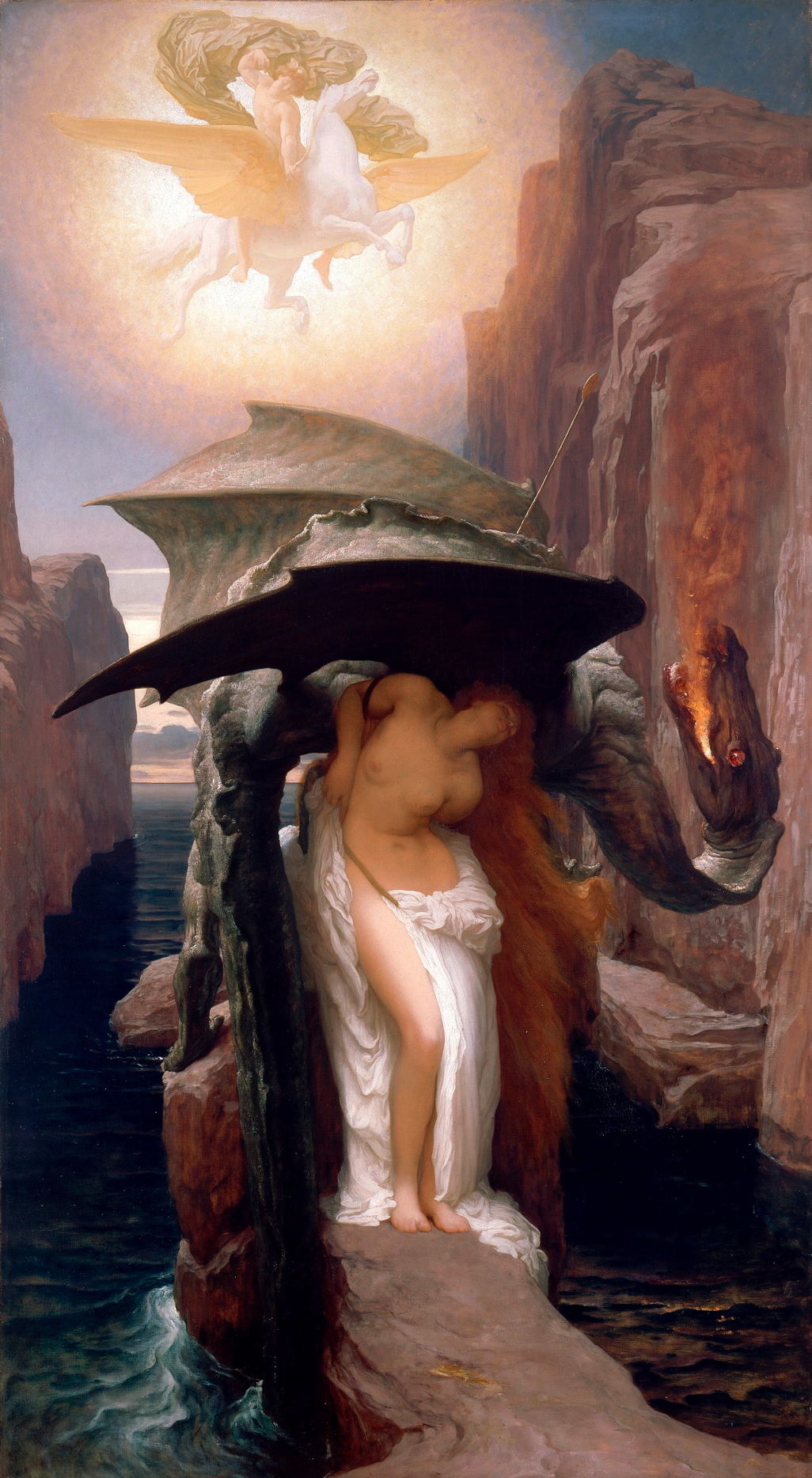
Frederic, Lord Leighton’s Perseus and Andromeda (1891) shows the ‘invisible’ Perseus astride Pegasus shooting arrows into Cetus, while the monster surrounds Andromeda. Cetus is here a conventional fire-breathing dragon, complete with stereotypical wings and a long tail. Andromeda is not naked, as her modesty is preserved by draping a white robe around her waist.

This Roman wall painting from the ruins of Pompeii, dated to about 50-75 CE, adopts the approach typical of many later artists, showing a close-up of the couple. Andromeda is still chained to the rock by her left wrist, and is partially clad, nakedness being reserved for the hero and half-god Perseus. He has Medusa’s head tucked behind him, its face shown for ease of recognition, wears his winged sandals, and carries a straight sword in his left hand. There is still no sign of any sea monster.
此内容由惯性聚合(RSS阅读器)自动聚合整理,仅供阅读参考。 原文来自 — 版权归原作者所有。